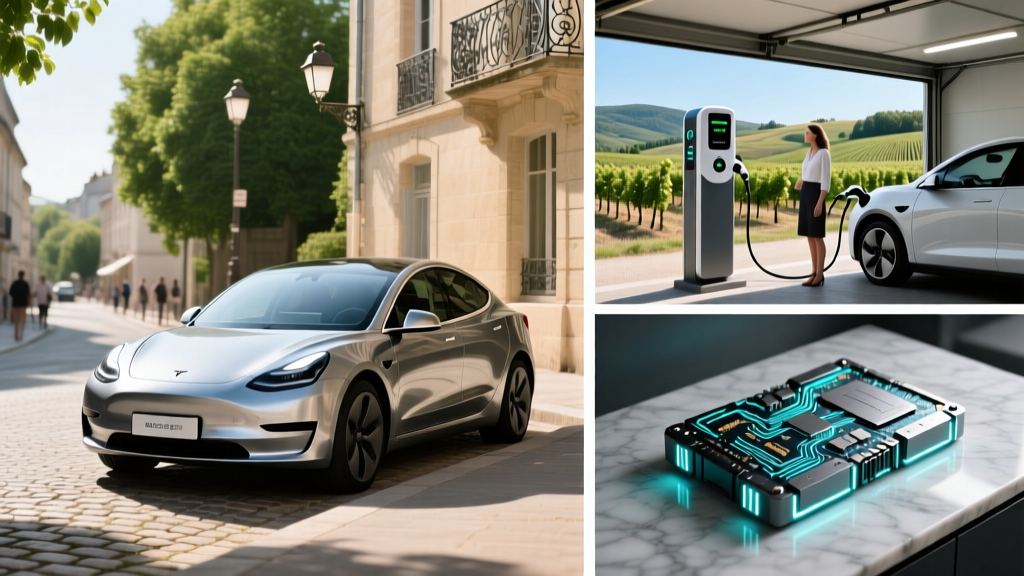
If you've been searching for a comprehensive Tesla motors tour of the company's best-selling vehicle, you've landed on the right page. The 2026 Tesla Model Y remains the benchmark compact electric SUV against which every competitor — from the Hyundai Ioniq 5 to the Ford Mustang Mach-E — is measured. After spending extensive time with the refreshed "Juniper" Model Y across multiple trims, we've compiled every number that matters: real-world range, charging curves, ownership economics, and the honest limitations Tesla's marketing won't highlight.
This isn't a brochure recap. We're breaking down exactly what the 2026 Model Y delivers on American roads, at American chargers, under real-world conditions — and whether it still earns its position atop the EV sales charts.
2026 Tesla Model Y: Quick Verdict
The refreshed Model Y (internally dubbed "Juniper") carries over the core 75–82 kWh battery architecture but introduces a revised interior, updated suspension tuning, standard ambient lighting, and a slightly more aerodynamic shell that bumps EPA range estimates. It remains one of the most energy-efficient electric SUVs on the market, benefits from access to Tesla's Supercharger network (now exceeding 6,000 U.S. stalls), and qualifies for the full §30D federal EV tax credit — provided you meet income and sourcing requirements.
The trade-offs? A minimalist interior that frustrates traditionalists, the removal of ultrasonic sensors in favor of Tesla Vision (camera-only parking assist), and insurance premiums that run 20–35% above segment averages. If you can charge at home and your daily driving stays under 250 miles, the Model Y Long Range AWD is still the default recommendation for EV-curious families.
Range, Battery, and Real-World Efficiency
Real-World Expectation: 260–290 miles highway at 70 mph; 220–250 miles in sub-30°F winter conditions. City/regenerative driving can approach or slightly exceed EPA figures.
Tesla equips the 2026 Model Y Long Range AWD with an ~82 kWh (usable ~79 kWh) NMC (nickel-manganese-cobalt) lithium-ion battery pack. The Standard Range RWD trim uses a ~60 kWh LFP (lithium iron phosphate) pack — a chemistry trade-off worth understanding.
| Spec | Long Range AWD | Standard Range RWD |
|---|---|---|
| Usable Battery Capacity | ~79 kWh (NMC) | ~60 kWh (LFP) |
| EPA Range | 320 miles | 277 miles |
| EPA Efficiency | 28 kWh/100 mi (120 MPGe) | 26 kWh/100 mi (129 MPGe) |
| Real-World Highway (70 mph) | ~265–290 mi | ~230–250 mi |
| Cold Weather (20°F, mixed) | ~225–250 mi | ~190–215 mi |
LFP vs. NMC — what it means for you: The LFP pack in the Standard Range model is heavier and holds less total energy, but it tolerates daily charging to 100% without accelerated degradation and has a longer projected cycle life. Tesla recommends charging LFP packs to 100% at least weekly. The NMC pack in the Long Range is better suited for drivers who want maximum range and typically charge to 80–90% for daily use, saving 100% for road trips. Per fueleconomy.gov, the Long Range AWD posts a combined 120 MPGe — among the best in its class.
Charging Speed: DC Fast, Level 2, and Level 1
Charging speed is where Tesla's vertical integration pays dividends. The 2026 Model Y Long Range supports a peak DC fast-charge rate of 250 kW on V3/V4 Superchargers, while the Standard Range RWD peaks at approximately 170 kW.
| Charging Level | Long Range AWD | Standard Range RWD |
|---|---|---|
| DC Fast Charge (Peak) | 250 kW | 170 kW |
| 10–80% DC Time | ~25 minutes | ~30 minutes |
| Level 2 (240V, 48A) | 11.5 kW (~44 mi/hr) | 11.5 kW (~44 mi/hr) |
| Level 1 (120V, 12A) | ~1.4 kW (~5 mi/hr) | ~1.4 kW (~5 mi/hr) |
| Connector (U.S.) | NACS (native) | NACS (native) |
Understanding the charge curve: Peak 250 kW is not sustained for the entire session. In our testing, the Long Range AWD holds above 200 kW from roughly 10% to 35% SoC, then tapers progressively — dropping to ~100 kW around 60% and ~50 kW by 80%. This is why Tesla (and every honest EV reviewer) quotes 10–80% times rather than "full charge" times. Charging past 80% on DC fast chargers adds significant time and is generally unnecessary for road trips.
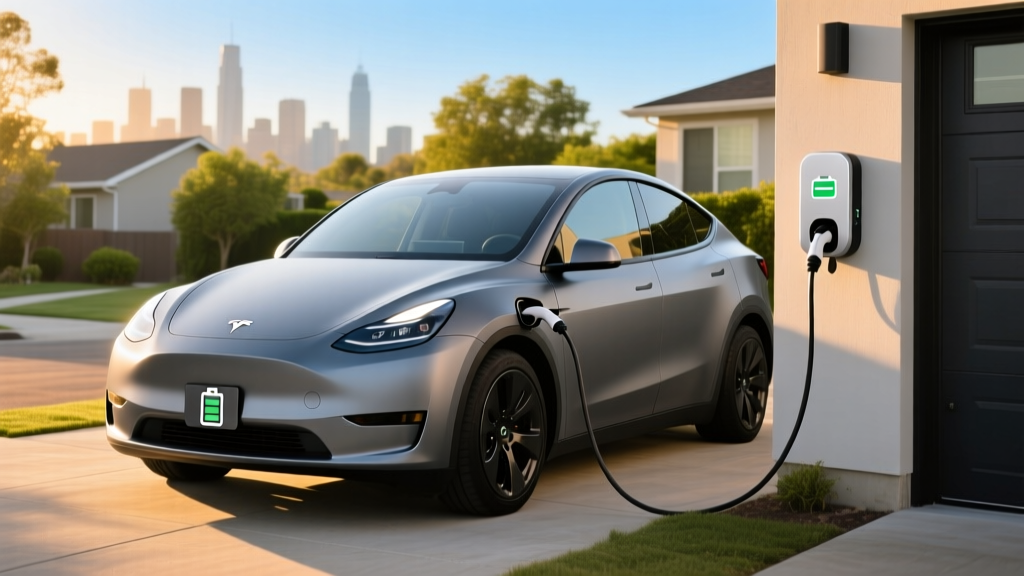
Home charging reality: With a Tesla Wall Connector on a 60-amp circuit (48A continuous), you'll recover roughly 44 miles of range per hour — enough to fully replenish overnight for virtually any daily commute. Installation typically runs $500–$1,500 if your panel has capacity; a 200-amp panel upgrade can add $1,500–$3,500. Always have a licensed electrician assess your panel before purchasing equipment.
Performance, Drivetrain, and Driving Dynamics
| Spec | Long Range AWD | Standard Range RWD | Performance AWD |
|---|---|---|---|
| Horsepower | ~384 hp | ~295 hp | ~456 hp |
| 0–60 mph | 4.8 seconds | 6.6 seconds | 3.5 seconds |
| Drivetrain | Dual-Motor AWD | Single-Motor RWD | Dual-Motor AWD |
| Top Speed | 125 mph | 135 mph | 155 mph |
| Towing Capacity | 3,500 lbs | 3,500 lbs | 3,500 lbs |
The Juniper refresh brought meaningful suspension improvements: revised damper tuning and a frequency-selective setup that absorbs sharp pavement impacts far better than the pre-2025 Model Y. Road noise is also noticeably reduced thanks to acoustic glass and additional insulation. The dual-motor AWD system provides confident all-weather traction, and the low center of gravity (battery pack under the floor) keeps body roll well-controlled through corners.
Regenerative braking remains strong and predictable, enabling near one-pedal driving in most conditions. The blend of instant torque, quiet operation, and planted handling continues to define the Tesla driving experience — even as competitors have closed the gap in ride comfort.
Interior, Cargo, and Technology
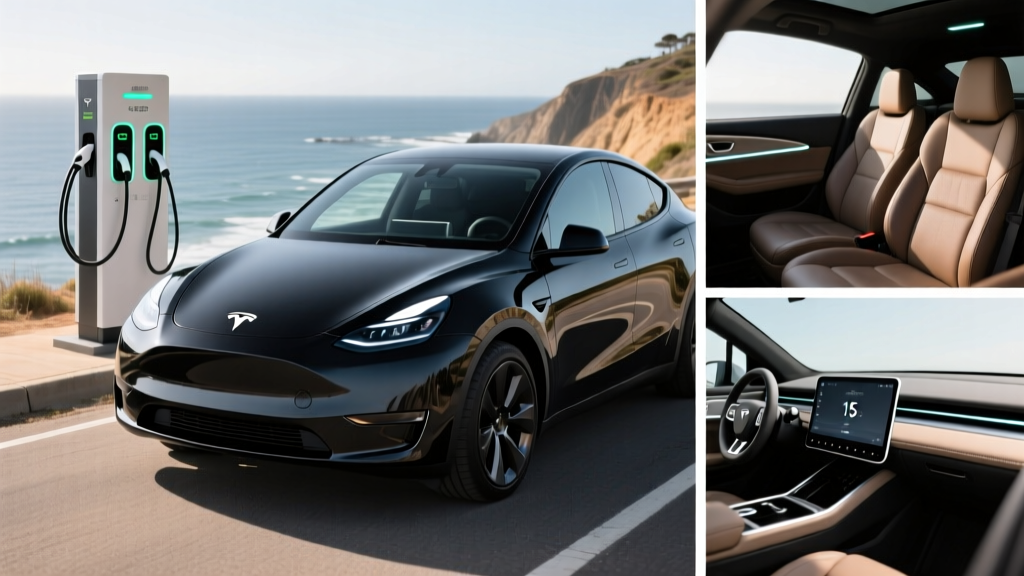
The 2026 Model Y interior leans hard into minimalism. A single 15.4-inch touchscreen handles infotainment, climate, navigation, and vehicle settings. The Juniper update adds ventilated front seats, ambient lighting, a rear-seat touchscreen (8 inches), and power-folding second-row seats — addressing longstanding complaints about the previous generation's spartan cabin.
| Measurement | Specification |
|---|---|
| Cargo Volume (behind 2nd row) | 30.2 cu ft |
| Cargo Volume (2nd row folded) | 72.1 cu ft |
| Front Trunk (Frunk) | 4.1 cu ft |
| Front Headroom | 41.0 in |
| Rear Legroom | 38.5 in |
| Seating Capacity | 5 (optional 7-seat on LR AWD) |
Standout tech features:
- Tesla Vision: Camera-based Autopilot (Level 2 SAE) with adaptive cruise, lane centering, and automatic emergency braking — standard on all trims.
- Full Self-Driving (Supervised): Optional $8,000 upgrade (or $99/month subscription) adding automatic lane changes, traffic light/stop sign recognition, and Navigate on Autopilot. This remains SAE Level 2 — the driver must remain fully engaged at all times.
- Sentry Mode: 360° camera recording when parked, with motion-triggered alerts.
- Over-the-air updates: Continuous software improvements, new features, and UI refinements delivered wirelessly.
- Dog Mode / Camp Mode: Climate control presets for leaving pets in the car or sleeping in the vehicle.
Pricing, Trims, and Federal Tax Credit Eligibility
| Trim | Base MSRP | As-Tested (typical) | Est. After §30D Credit* |
|---|---|---|---|
| Standard Range RWD | $44,990 | $46,490 | ~$37,490 |
| Long Range AWD | $48,990 | $51,990 | ~$41,490 |
| Performance AWD | $52,490 | $55,990 | ~$45,490 |
*Estimated after maximum $7,500 §30D federal tax credit applied at point of sale. Eligibility is NOT automatic.
- Buyer Income Cap: Modified AGI ≤ $150,000 (single) / $300,000 (joint) / $225,000 (head of household)
- Vehicle MSRP Cap: ≤ $80,000 for SUVs (all Model Y trims qualify)
- Battery Sourcing: Critical minerals and battery components must meet escalating domestic/free-trade-agreement thresholds — Tesla's U.S. manufacturing and supply chain currently satisfies these for most configurations, but verify at purchase
- Point-of-Sale Transfer: Eligible buyers can apply the credit as a down-payment reduction at delivery rather than waiting for tax filing
- Final Assembly: Must occur in North America (Model Y assembled in Fremont, CA and Austin, TX — qualifies)
Always verify current eligibility on IRS.gov and consult a tax professional before purchase. Sourcing requirements tighten annually, and a vehicle that qualifies today may not qualify in a future model-year configuration.
Warranty, Ownership Costs, and Longevity
| Coverage | Term |
|---|---|
| Basic Vehicle | 4 years / 50,000 miles |
| Battery & Drive Unit | 8 years / 120,000 miles (Long Range/Performance) |
| Battery & Drive Unit | 8 years / 100,000 miles (Standard Range) |
| Battery Retention Guarantee | ≥ 70% capacity during warranty period |
Tesla's battery warranty guarantees at least 70% capacity retention over the warranty period. In practice, fleet data from high-mileage Model Y owners shows typical degradation of 8–12% over the first 100,000 miles, with the steepest drop occurring in the first 15,000–20,000 miles before leveling off. The heat pump (standard on all trims) improves cold-weather efficiency and reduces battery stress during winter preconditioning.
5-Year Estimated Total Cost of Ownership (Long Range AWD, 15,000 mi/year):
- Purchase (after credit): ~$41,490
- Electricity (home charging, $0.14/kWh national avg): ~$4,200
- Insurance (5-year avg): ~$12,500–$15,000 (varies significantly by state/driver)
- Maintenance (tires, cabin filter, wiper fluid): ~$2,000
- Estimated 5-year depreciation: ~$14,000–$17,000
Insurance remains the Model Y's most significant ownership pain point. Tesla's own insurance product (available in select states) uses real-time driving data and can reduce premiums for safe drivers, but availability is limited. Always get insurance quotes before ordering.
Tesla Model Y vs. Key Competitors
| Spec | Tesla Model Y LR AWD | Hyundai Ioniq 5 LR AWD | Ford Mustang Mach-E ER AWD |
|---|---|---|---|
| EPA Range | 320 mi | 290 mi | 290 mi |
| Battery (usable) | ~79 kWh | ~77.4 kWh | ~91 kWh |
| Peak DC Charge | 250 kW | 235 kW | 150 kW |
| 10–80% Time | ~25 min | ~20 min | ~38 min |
| 0–60 mph | 4.8 sec | 5.1 sec | 5.1 sec |
| Base MSRP (AWD) | $48,990 | $50,250 | $50,995 |
| Charging Network | Supercharger (native) | NACS adapter / CCS | NACS adapter / CCS |
The Ioniq 5 charges slightly faster (800V architecture enables a quicker 10–80% time despite lower peak kW), and the Mach-E offers a more traditional interior layout with physical controls. But the Model Y's combination of range, Supercharger access, cargo volume, and software ecosystem remains unmatched at this price point.
- Class-leading 320-mile EPA range
- Native Supercharger network access (no adapter needed)
- Spacious cargo area (72.1 cu ft max) with practical frunk
- Excellent energy efficiency (28 kWh/100 mi)
- Continuous OTA software improvements
- Qualifies for full $7,500 §30D credit (verify eligibility)
- Improved Juniper ride quality and cabin refinement
- Higher insurance premiums vs. competitors
- Tesla Vision parking less precise than ultrasonic sensors
- No physical buttons — all controls via touchscreen
- FSD (Supervised) is expensive and still Level 2, not autonomous
- Build quality inconsistency (panel gaps, paint) improving but not class-leading
- Standard Range LFP pack loses more range in cold weather
Who Should Buy the 2026 Tesla Model Y?
- You regularly drive 200+ miles between charges (road trips, rural commutes)
- You want native Supercharger access without adapters
- You need maximum cargo space for a family of 4–5
- You can install a Level 2 home charger
- Your daily commute is under 100 miles round-trip
- You live in a mild climate (less cold-weather range loss with daily 100% LFP charging)
- You want the lowest entry price and don't need AWD
- You strongly prefer physical buttons and traditional controls (Mach-E, Ioniq 5)
- You need the absolute fastest DC charging times (Ioniq 5 with 800V)
- Premium build quality and dealership service matter more than software (BMW iX, Genesis GV60)
Frequently Asked Questions
What is the real-world range of the 2026 Tesla Model Y?
The Long Range AWD achieves an EPA-estimated 320 miles, but expect 260–290 miles during highway driving at 70 mph and 220–250 miles in sustained sub-freezing temperatures. The Standard Range RWD delivers an EPA 277 miles with real-world highway figures around 230–250 miles.
How fast does the Model Y charge at home and on the road?
On a Level 2 home charger (11.5 kW / 48A), the Model Y recovers approximately 44 miles of range per hour — a full overnight charge for any daily need. On a V3/V4 Supercharger, the Long Range peaks at 250 kW and charges from 10–80% in approximately 25 minutes, though the charge curve tapers significantly above 60% SoC.
Does the 2026 Model Y qualify for the $7,500 federal EV tax credit?
Most buyers will qualify, but eligibility depends on your modified adjusted gross income (≤$150K single / ≤$300K joint), the vehicle's MSRP (all trims are under the $80K SUV cap), and battery component/critical-mineral sourcing requirements. Tesla currently meets sourcing thresholds for U.S.-built Model Y vehicles, but always verify at IRS.gov before purchasing.
Is Tesla's Full Self-Driving actually self-driving?
No. FSD (Supervised) is an SAE Level 2 driver-assistance system. The driver must remain fully attentive, keep hands available, and be prepared to take over at any moment. It does not make the vehicle autonomous. Only Level 4 services like Waymo operate without a human driver in defined geographic zones.
How does the LFP battery in the Standard Range compare to NMC?
LFP (lithium iron phosphate) batteries are heavier and hold less energy per kilogram, resulting in shorter range. However, they tolerate daily 100% charging without accelerated degradation, have a longer cycle life, and use no cobalt or nickel. For commuters who charge nightly and drive under 150 miles daily, LFP is arguably the more practical chemistry.
Is the 2026 Model Y worth buying over the Hyundai Ioniq 5 or Ford Mach-E?
For most buyers who can charge at home and take occasional road trips, the Model Y Long Range AWD remains the segment leader thanks to its 320-mile range, Supercharger network, cargo space, and software ecosystem. The Ioniq 5 is a compelling alternative if you prioritize the fastest possible DC charging (800V architecture) or prefer a more conventional interior. The Mach-E suits drivers who want physical controls and a more traditional dealership experience.
Sources: EPA range and efficiency data via fueleconomy.gov; federal tax credit rules via IRS.gov §30D; vehicle specifications from Tesla's official 2026 model-year documentation. Pricing and credit eligibility reflect 2026 model-year data and are subject to change.