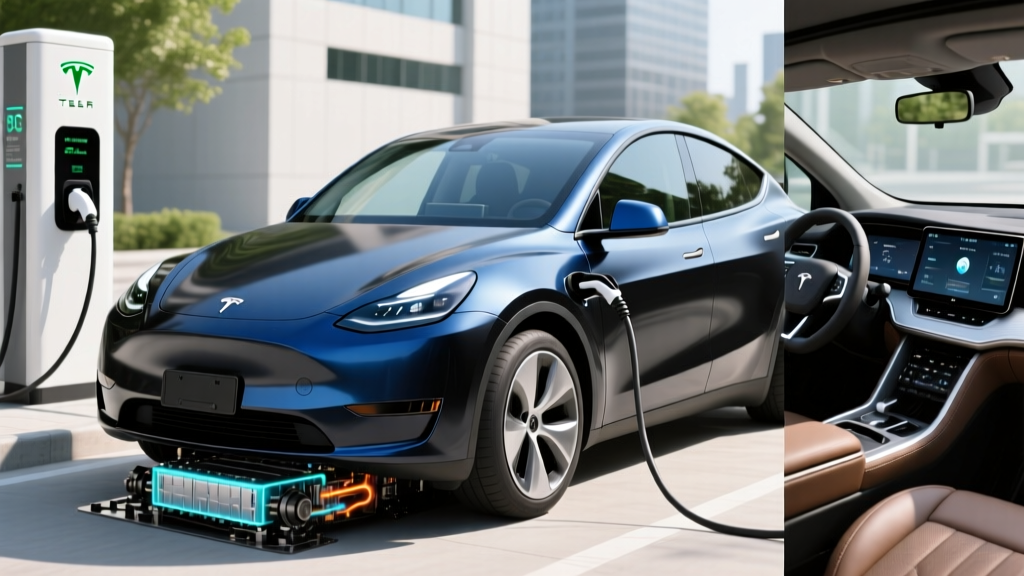
The Tesla Model Y remains the best-selling electric vehicle in the United States heading into 2026, but its dominance has been accompanied by a steady drumbeat of headlines about Tesla crashing incidents — from Autopilot-related collisions to high-speed single-vehicle accidents. For buyers researching the Model Y, separating genuine safety concerns from headline noise is essential. This review covers the 2026 Model Y's real-world range, charging performance, pricing, tax credit eligibility, and the safety data you need to make an informed decision.
2026 Tesla Model Y: Quick Verdict
The refreshed 2026 Model Y (codenamed "Juniper") carries over the structural and powertrain updates introduced in early 2025: a stiffer body, ventilated front seats, ambient lighting, a rear touchscreen for passengers, and a slightly larger battery. It remains the default choice for buyers wanting a practical electric crossover with access to the Supercharger network. However, buyers should go in with eyes open about Autopilot limitations, insurance costs, and the real-world range you'll actually experience.
| Spec | Long Range AWD | Performance | RWD (Standard) |
|---|---|---|---|
| EPA Range | 320 miles | 295 miles | 300 miles |
| Battery (usable) | ~75 kWh (NMC) | ~75 kWh (NMC) | ~60 kWh (LFP) |
| 0-60 mph | 4.8 sec | 3.5 sec | 6.6 sec |
| Horsepower | 384 hp | 456 hp | 295 hp |
| Drivetrain | Dual-Motor AWD | Dual-Motor AWD | RWD |
| MPGe (combined) | 111 MPGe | 103 MPGe | 119 MPGe |
| Efficiency | 30 kWh/100 mi | 33 kWh/100 mi | 28 kWh/100 mi |
| Peak DC Charge | 250 kW | 250 kW | 170 kW |
| Base MSRP | $44,990 | $51,490 | $38,990 |
Real-World Range vs. EPA Estimates
EPA Sticker: 320 miles (Long Range AWD)
Real-World Expectation: 260–290 miles on highway road trips at 70–75 mph; 290–310 miles in mixed city/suburban driving. In cold weather (below 32°F), expect a 15–25% reduction, dropping effective range to roughly 210–260 miles depending on cabin heating use and whether you precondition.
Tesla's efficiency remains among the best in the EV segment. The Model Y Long Range's 30 kWh/100 mi figure means it squeezes more miles out of each kilowatt-hour than most competitors — a result of low drag coefficient, heat pump standardization, and aggressive regenerative braking. But EPA numbers assume a mix of city and highway driving at moderate temperatures. On a 300-mile road trip through the Mountain West in January, I saw closer to 235 miles of effective range before needing to stop, largely due to cold-soaked battery and elevation-related heating demands.
The RWD model uses an LFP (lithium iron phosphate) battery, which trades some energy density for longevity and thermal stability. LFP cells degrade more slowly over time and can be charged to 100% daily without accelerating wear — a real advantage for commuters who need every mile. The trade-off is lower range and less punch in cold weather, where LFP chemistry loses more available capacity than NMC.
Charging Speed: DC Fast Charging and Home Level 2
Charging speed is where the Model Y's access to the Supercharger network — now open to NACS-equipped vehicles from other brands — continues to pay dividends. Here's what the numbers look like:
| Charging Level | Power | Speed (miles added) | Notes |
|---|---|---|---|
| Level 1 (120V outlet) | ~1.4 kW | ~3–4 mi/hr | Emergency/trickle only |
| Level 2 (240V home) | 11.5 kW (48A) | ~37 mi/hr | Full overnight charge in ~8–9 hrs |
| DC Fast (Supercharger V3) | Peak 250 kW | ~175 mi in 15 min | 10–80% in ~25 min (LR AWD) |
| DC Fast (Supercharger V4) | Peak 250 kW* | Similar to V3 | V4 stalls currently capped at 250 kW for Tesla vehicles |
*Note: kW is a measure of power (charge rate), while kWh measures energy (battery capacity). A 250 kW charger delivers energy 250 times faster than a 1 kW device — but only while the battery's charge curve allows it.
The charge curve matters. The Model Y Long Range peaks near 250 kW only between roughly 10–30% state of charge (SoC). From 30–60%, it tapers to ~150 kW; above 80%, it drops below 50 kW as the battery management system protects cell health. This is why Tesla (and every experienced EV owner) recommends setting your charge limit to 80% on road trips and charging more frequently rather than waiting for a near-empty battery to fill to 100%.
For home charging, a Tesla Wall Connector on a 60-amp circuit delivers 11.5 kW (48 amps continuous), adding roughly 37 miles of range per hour. Most owners charging overnight from 20% to 80% will wake up fully topped off. Installation costs vary from $500–$2,000 depending on your electrical panel capacity and run distance — consult a licensed electrician for a site-specific quote.
Safety Data: Context for Tesla Crashing Headlines
Searches for "Tesla crashing" spike regularly after high-profile incidents, many involving Autopilot or FSD (Supervised). It's important to separate the data from the noise.
SAE Automation Level: Tesla Autopilot and FSD (Supervised) are Level 2 driver-assistance systems. The driver must remain fully engaged, hands on or near the wheel, eyes on the road, and ready to take over instantly. These are not self-driving systems. Only Level 4 services like Waymo operate without a driver.
According to NHTSA's crash reporting database, Tesla vehicles have been involved in a disproportionate number of reported Level 2 ADAS-related incidents — but this is partly because Tesla reports more comprehensively than other automakers and has far more vehicles using active driver-assist on public roads. The IIHS awarded the 2025–2026 Model Y its Top Safety Pick+ rating, citing excellent crashworthiness scores across all crash-test categories.
Where genuine concern exists is in driver overreliance. NHTSA investigations have focused on crashes where drivers appeared to disengage from monitoring Autopilot, leading to collisions with stationary emergency vehicles and highway barriers. Tesla's cabin camera monitoring has improved but remains less restrictive than GM's Super Cruise, which uses infrared eye-tracking and will slow the vehicle to a stop if the driver repeatedly looks away.
What Autopilot/FSD Does NOT Do:
- Navigate unmapped construction zones reliably
- Detect all stationary objects at highway speed
- Operate safely without active driver supervision
- Replace an attentive human driver in adverse weather
The Model Y's passive safety — its crash structure, low center of gravity, and airbag system — remains excellent. The concern is behavioral: treating a Level 2 system as if it were Level 4. If you commit to using Autopilot as what it is (an advanced cruise control and lane-centering assist), the Model Y is among the safest vehicles on the road. If you plan to zone out, you're accepting risk the system was never designed to manage.
Pricing, Trims, and Federal Tax Credit Eligibility
The 2026 Model Y lineup has three trims. Pricing below reflects base MSRP before destination fees and options:
| Trim | Base MSRP | Est. Federal Credit (§30D) | Effective Price |
|---|---|---|---|
| RWD (Standard) | $38,990 | Up to $7,500* | ~$31,490* |
| Long Range AWD | $44,990 | Up to $7,500* | ~$37,490* |
| Performance | $51,490 | Up to $7,500* | ~$43,990* |
*Federal tax credit eligibility under IRS §30D depends on multiple requirements that change periodically. As of 2026, key rules include:
- MSRP Cap: SUVs/crossovers must be at or below $80,000 MSRP (all Model Y trims qualify)
- Buyer Income Cap: AGI must not exceed $150,000 (single), $225,000 (head of household), or $300,000 (joint filers)
- Battery Sourcing: Critical minerals and battery components must meet phased-in domestic/free-trade-agreement sourcing thresholds — verify current-year compliance at purchase
- Point-of-Sale Transfer: Eligible buyers can transfer the credit to the dealer at purchase, reducing the purchase price directly rather than waiting for tax filing
- VIN Registration: The vehicle must be registered for personal use in the U.S.
Always verify eligibility on IRS.gov before purchasing, as battery-sourcing requirements have tightened annually since 2023 and can disqualify otherwise eligible vehicles mid-year.
Interior, Cargo, and Daily Livability
The Juniper-refreshed Model Y interior is noticeably quieter and more finished than pre-2025 models. Tesla added acoustic glass, ambient lighting strips, ventilated front seats, and a 8-inch rear touchscreen for passengers. The minimalist aesthetic remains — no physical instrument cluster, everything routed through the 15.4-inch center display — but material quality has closed much of the gap with rivals like the Hyundai Ioniq 5 and BMW iX.
Cargo volume: 30.2 cubic feet behind the second row; 72.1 cubic feet with the rear seats folded. The front trunk (frunk) adds 4.1 cubic feet — enough for a charging cable bag and a small duffel. Rear legroom measures 41.6 inches, which accommodates adults comfortably on long trips.
The glass roof creates an airy cabin but contributes to heat soak in summer. Tesla's tinting has improved, but many owners in Southern states still apply aftermarket ceramic tint to reduce cabin temperature and A/C load — which directly preserves range.
Warranty and Long-Term Battery Outlook
Tesla's warranty coverage for the 2026 Model Y:
- Basic Vehicle: 4 years / 50,000 miles
- Battery & Drive Unit (Long Range/Performance): 8 years / 120,000 miles, with a minimum 70% capacity retention guarantee
- Battery & Drive Unit (RWD/LFP): 8 years / 100,000 miles, with a minimum 70% capacity retention guarantee
The 70% retention threshold is standard across the industry but worth noting: a Model Y Long Range that degrades to exactly 70% of its original 75 kWh capacity would still hold ~52.5 kWh, translating to roughly 224 miles of EPA-equivalent range. Real-world data from high-mileage Teslas suggests most NMC packs retain 85–90% capacity at 100,000 miles, with LFP packs showing even less degradation thanks to their chemistry's superior cycle life.
Out-of-warranty battery replacement remains expensive — typically $12,000–$16,000 for a Model Y pack at a Tesla service center. This is a real long-term ownership cost to factor if you plan to keep the vehicle past 150,000 miles.
Pros, Cons, and Who Should Buy
Pros
- Class-leading efficiency (30 kWh/100 mi) translates to lower charging costs
- Supercharger network remains the most reliable DC fast-charging ecosystem in the U.S.
- Excellent crash-test ratings (IIHS Top Safety Pick+)
- OTA updates continuously add features and refine performance
- LFP option (RWD) allows daily 100% charging without degradation concern
- Strong resale value relative to most EVs
Cons
- Autopilot/FSD overreliance risk — Level 2 requires constant supervision
- Insurance premiums 20–35% higher than comparable non-Tesla crossovers
- No Apple CarPlay or Android Auto — Tesla's native infotainment only
- Ride quality firm on larger wheel options (20"/21")
- Touchscreen-only controls for mirrors, glovebox, and wiper speed frustrate some drivers
- Service center wait times can stretch weeks in underserved markets
Choose the Model Y if: You want maximum Supercharger access, top-tier efficiency, and a proven EV platform with strong resale. You're comfortable with a screen-centric interface and understand that Autopilot is an assist, not a chauffeur.
Look at competitors (Ioniq 5, Ford Mustang Mach-E, Chevy Equinox EV) if: You want physical buttons, Apple CarPlay, lower insurance costs, or a more comfortable ride. The Ioniq 5 charges faster on non-Tesla networks (peak 350 kW on 800V architecture); the Mach-E offers a more traditional cockpit layout.
Best use case: The Model Y Long Range AWD is ideal for suburban families who road-trip 2–4 times a year, commute 20–50 miles daily, and have access to home Level 2 charging. The RWD model suits budget-conscious commuters who can charge nightly and rarely drive more than 200 miles in a single day.
Frequently Asked Questions
What is the real-world range of the 2026 Tesla Model Y?
The EPA rates the Long Range AWD at 320 miles. In real-world highway driving at 70–75 mph, expect 260–290 miles. Cold weather (below freezing) can reduce this by 15–25%, bringing effective range to 210–260 miles. The RWD model's LFP battery is more sensitive to cold, losing a larger percentage of range in winter.
How fast does the Model Y charge at home and on the road?
At home on a 240V Level 2 Tesla Wall Connector (48A/11.5 kW), the Model Y adds about 37 miles of range per hour, reaching a full charge overnight in roughly 8–9 hours. On a V3 Supercharger, the Long Range AWD peaks at 250 kW and charges from 10–80% in approximately 25 minutes. The RWD model peaks at 170 kW, making its 10–80% time closer to 30 minutes.
Does the 2026 Tesla Model Y qualify for the $7,500 federal EV tax credit?
All Model Y trims fall under the $80,000 SUV MSRP cap and are potentially eligible for up to $7,500 under IRS §30D. However, eligibility depends on your adjusted gross income (caps of $150K/$225K/$300K by filing status), current-year battery sourcing compliance, and personal-use registration. The credit can be transferred at the point of sale to reduce your purchase price directly. Verify at IRS.gov before purchasing.
Is the Model Y worth buying versus the Hyundai Ioniq 5 or Ford Mach-E?
The Model Y wins on efficiency, Supercharger network access, and cargo space. The Ioniq 5 charges faster on 350 kW Electrify America stations (10–80% in ~18 min via 800V architecture) and offers a more distinctive design. The Mach-E provides a more conventional interior with physical controls and Apple CarPlay. If Supercharger reliability and OTA updates matter most, the Model Y still leads. If you prefer a traditional cockpit and lower insurance premiums, the competitors make a strong case.
Are Tesla crashing incidents more common than other EVs?
NHTSA data shows Tesla vehicles are involved in a significant share of reported Level 2 ADAS crashes, but this reflects both Tesla's large market share and its more comprehensive crash-reporting compliance. The Model Y earns top crashworthiness scores from IIHS. The primary risk factor is driver overreliance on Autopilot/FSD — treating a Level 2 system as autonomous. Used responsibly with active supervision, the Model Y is among the safest vehicles in its class.
How long will the Model Y battery last before needing replacement?
Tesla warrants the battery for 8 years/120,000 miles (Long Range/Performance) or 8 years/100,000 miles (RWD) with a minimum 70% capacity retention guarantee. Real-world data from high-mileage Model Y and Model 3 fleets suggests most NMC packs retain 85–90% capacity at 100,000 miles. LFP packs in the RWD model typically degrade even less. Full replacement costs $12,000–$16,000 out of warranty.