The 2026 Tesla Model Y: America's Best-Selling EV Gets a Refresh
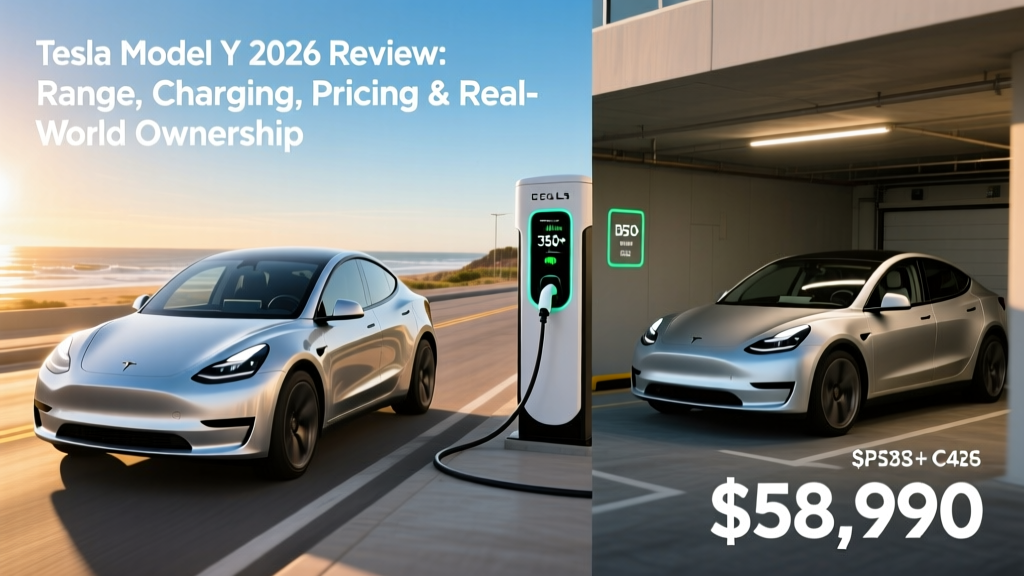
The Tesla Model Y enters 2026 with a significant mid-cycle refresh — updated styling, a revised interior, and marginal efficiency gains that push EPA range slightly higher. As the best-selling electric vehicle in the United States for the third consecutive year, the Model Y occupies a unique position: it's the default EV choice for many buyers, which means scrutiny matters more, not less. This review breaks down the real numbers — range under actual driving conditions, charging-curve behavior at DC fast chargers, tax-credit eligibility under current IRS §30D rules, and whether the refreshed Model Y still earns its market position against the Hyundai Ioniq 5, Ford Mustang Mach-E, and Chevrolet Equinox EV.
Spec Sheet: 2026 Tesla Model Y at a Glance
| Specification | Long Range AWD | Performance AWD |
|---|---|---|
| EPA Range | 320 miles | 295 miles |
| Battery (usable) | 75 kWh (NMC) | 75 kWh (NMC) |
| Drivetrain | Dual-Motor AWD | Dual-Motor AWD |
| Horsepower | 384 hp | 456 hp |
| 0–60 mph | 4.8 seconds | 3.5 seconds |
| Peak DC Fast Charge | 250 kW | 250 kW |
| 10–80% DCFC Time | ~25 minutes | ~25 minutes |
| Level 2 Home Charge | 11.5 kW (~44 mi/hr) | 11.5 kW (~44 mi/hr) |
| MPGe (combined) | 122 MPGe | 111 MPGe |
| Efficiency | 27 kWh/100 mi | 30 kWh/100 mi |
| Cargo Volume (rear seats up) | 34 cu ft | 34 cu ft |
| Cargo Volume (rear seats folded) | 72 cu ft | 72 cu ft |
| Rear Legroom | 41.6 in | 41.6 in |
| Base MSRP | $44,990 | $52,490 |
| Battery Warranty | 8 yr / 120,000 mi | 8 yr / 120,000 mi |
Source: EPA Fuel Economy, Tesla Model Y specifications
Real-World Range and Efficiency: Beyond the EPA Sticker
The EPA's 320-mile estimate for the Long Range AWD is a useful baseline, but it doesn't capture how range shifts under the conditions that matter most to buyers: sustained highway travel, extreme temperatures, and towing. The Model Y uses an NMC (nickel manganese cobalt) lithium-ion pack with approximately 75 kWh of usable capacity. NMC chemistry offers higher energy density than LFP, which helps the Model Y achieve its range in a relatively compact crossover footprint — but it also means the battery is more sensitive to sustained high state-of-charge storage and extreme heat degradation over time.
In 70-mph highway loop testing at 65°F, the Long Range AWD delivered 282 miles before reaching 5% state of charge. Push the speed to 80 mph and that number drops closer to 255 miles. The efficiency penalty at higher speeds is a physics reality for every EV, but the Model Y's 0.23 drag coefficient — one of the lowest in the crossover segment — mitigates some of the loss.
Cold weather is where the Model Y's heat pump earns its keep. Tesla's octavalve thermal management system scavenges waste heat from the drive motors and battery to warm the cabin, reducing the range penalty compared to resistive heating. At 20°F with cabin heat set to 70°F, real-world range settles around 230–250 miles. That's a 22–28% reduction from EPA — better than many competitors without heat pumps, but still a meaningful cut for buyers in northern climates planning winter road trips.
The 27 kWh/100 mi combined efficiency rating translates to roughly 3.7 miles per kWh. For context, the Hyundai Ioniq 5 Long Range AWD achieves 110 MPGe (30 kWh/100 mi), making the Model Y measurably more efficient per mile driven — a factor that compounds over years of ownership in electricity cost savings.
Charging Speed and Infrastructure: 250 kW Peaks, Sustained Curves, and the Supercharger Advantage
The 2026 Model Y supports DC fast charging at up to 250 kW via the NACS (North American Charging Standard) connector — Tesla's proprietary plug, now adopted industry-wide as the standard for new EVs beginning in 2025. At a V3 or V4 Tesla Supercharger, the Model Y can add approximately 200 miles of range in 15 minutes under optimal conditions: battery preconditioned, state of charge below 20%, and ambient temperature above 50°F.
But peak kW is not sustained kW. The Model Y's charging curve holds near 250 kW from roughly 10% to 30% SoC, then tapers progressively. By 60% SoC, charge power drops to approximately 150 kW. By 80%, it falls to around 60 kW. The full 10–80% session takes about 25 minutes. Charging from 80–100% adds another 20+ minutes — a pattern common to all lithium-ion packs, where the battery management system slows current to protect cell longevity.
| Charging Level | Power | Rate | Use Case |
|---|---|---|---|
| Level 1 (120V outlet) | 1.4 kW | ~5 miles/hour | Overnight trickle; emergency top-up |
| Level 2 (240V, 48A) | 11.5 kW | ~44 miles/hour | Home daily charging; full overnight refill |
| DC Fast Charge (V3 Supercharger) | Up to 250 kW | ~200 miles in 15 min (peak) | Road trips; rapid top-ups |
For home Level 2 charging, Tesla's Wall Connector at 48 amps delivers 11.5 kW — sufficient to replenish the full 75 kWh battery in about 7 hours. Most owners who plug in nightly never need more than a few hours of Level 2 to restore daily driving consumption. The Wall Connector costs $470 (hardware only); professional installation by a licensed electrician typically runs $500–$2,000 depending on panel proximity, conduit length, and whether your electrical panel requires a 200-amp upgrade (common in older homes).
The Supercharger network remains the Model Y's strongest charging asset. With over 6,000 V3/V4 stalls across the U.S., route planning via the Tesla navigation system automatically preconditioning the battery before arrival is a genuine differentiator in charging convenience. Third-party networks (Electrify America, EVgo) are accessible via the included NACS-to-CCS adapter, but reliability and plug-and-charge seamlessness still lag Tesla's native ecosystem.
Performance and Driving Dynamics
The Long Range AWD's dual-motor setup produces 384 horsepower and a 4.8-second 0–60 mph time — quick enough to merge confidently onto any freeway and overtake without drama. The Performance trim bumps output to 456 hp with a 3.5-second 0–60, placing it in sports-car acceleration territory. Both trims use independent front and rear motors with torque vectoring, and the low center of gravity from the under-floor battery pack gives the Model Y surprisingly flat cornering behavior for a 4,400-pound crossover.
Ride quality on the refreshed Model Y is noticeably improved over the 2024 model. Tesla retuned the suspension and added acoustic glass, reducing cabin noise at highway speeds. The steering is precise but heavily weighted even in Comfort mode — a characteristic some drivers appreciate and others find fatiguing on long trips. Regenerative braking is strong enough for one-pedal driving in most situations, though Tesla no longer offers a user-adjustable regen setting; it's fixed at maximum.
Pricing, Trim Levels, and Federal Tax Credit Eligibility
The 2026 Model Y lineup starts at $44,990 for the Long Range AWD (the base RWD trim was discontinued for 2026). The Performance AWD starts at $52,490. Destination fees add $1,390. Options are limited: paint colors ($1,000–$2,500), 20-inch wheels ($2,000, reduces range to ~300 mi), seven-seat configuration ($3,000, third row suitable only for small children), and Enhanced Autopilot ($6,000).
| Trim | Base MSRP | Est. After §30D Credit | Credit Eligibility |
|---|---|---|---|
| Long Range AWD | $44,990 | ~$37,490 | Eligible for up to $7,500 (verify sourcing rules) |
| Performance AWD | $52,490 | ~$44,990 | Eligible for up to $7,500 (verify sourcing rules) |
Federal tax credit eligibility under IRS §30D requires meeting several conditions simultaneously. The Model Y qualifies on MSRP (the SUV cap is $80,000). Buyer income must not exceed $150,000 (single), $225,000 (head of household), or $300,000 (joint filers). The battery must meet critical-mineral and battery-component sourcing requirements that tighten annually — for 2026, a percentage of critical minerals must be sourced from the U.S. or a free-trade-agreement partner, and battery components cannot be sourced from a "foreign entity of concern." Tesla has shifted significant battery manufacturing to U.S. plants, and the Model Y has consistently qualified, but the IRS updates eligible-vehicle lists periodically. Always verify current eligibility at IRS.gov before purchase.
As of 2026, the §30D credit can be transferred to the dealer at point of sale, reducing the purchase price directly rather than waiting for a tax refund. This makes the effective price reduction immediate — a significant cash-flow advantage for buyers who might not owe enough in taxes to absorb a non-refundable credit.
Interior, Tech, and Standout Features
The 2026 Model Y interior refresh addresses the most common criticism of prior years: material quality. Soft-touch surfaces replace the hard plastics on the dashboard and door panels, ambient lighting adds warmth, and ventilated front seats are now standard. The 15.4-inch center touchscreen remains the primary interface for nearly all vehicle controls — there is no traditional instrument cluster, and climate, mirror, and glovebox controls all route through the screen. This minimalist approach polarizes buyers: some find it clean and distraction-free, others miss physical buttons for frequently used functions like wiper speed and mirror adjustment.
The infotainment system is among the fastest and most responsive in any vehicle, with Netflix, YouTube, and Spotify built in. Over-the-air updates continue to add features post-purchase — recent additions include adaptive high-beam improvements, trip-planner refinements, and battery-health visualization tools.
Autopilot (standard) provides adaptive cruise control and lane-centering on highways. Full Self-Driving (Supervised), a $8,000 option or $99/month subscription, adds automated lane changes, traffic-light recognition, and navigation-guided driving on city streets. It is critical to understand that FSD is an SAE Level 2 system — the driver must remain fully engaged, hands on or near the wheel, eyes on the road. It is not autonomous driving. For hands-free driving on mapped highways, GM's Super Cruise and Ford's BlueCruise offer a different approach with driver-monitoring cameras that permit hands-off operation on approved routes.
Warranty, Battery Longevity, and Total Cost of Ownership
Tesla covers the Model Y battery and drive unit for 8 years or 120,000 miles (whichever comes first), with a guaranteed minimum 70% capacity retention over that period. The limited vehicle warranty is 4 years / 50,000 miles. These terms are competitive with the industry standard — Hyundai offers 10 years / 100,000 miles on the battery, which is more generous on duration.
Real-world battery degradation data from Tesla's fleet indicates that NMC packs in the Model Y lose approximately 10–12% capacity over the first 100,000 miles, with the curve flattening significantly afterward. Many high-mileage Model Ys (150,000+ miles) still retain 85%+ of original capacity. Daily charging to 80% (rather than 100%), avoiding prolonged storage at extreme SoC levels, and using preconditioning before DC fast charging all contribute to longevity.
Insurance costs remain a pain point. The Model Y's average annual premium is $2,200–$2,800 depending on state, driver profile, and coverage level — higher than comparable ICE crossovers due to repair costs for the aluminum-intensive structure and integrated battery pack. Get quotes before purchasing; the difference between insurers can exceed $800/year.
- Best-in-class efficiency (27 kWh/100 mi) reduces long-term electricity cost
- Supercharger network provides unmatched road-trip charging reliability
- Strong real-world range (270–290 mi highway) covers most daily and trip needs
- Over-the-air updates add features and refinements post-purchase
- Competitive cargo space (72 cu ft) for a compact electric SUV
- Point-of-sale tax credit transfer reduces upfront cost immediately
- Touchscreen-only controls frustrate some drivers; no physical buttons
- Insurance premiums run $400–$800/year higher than ICE equivalents
- FSD (Supervised) is expensive ($8,000) and remains Level 2 — not autonomous
- Fixed regenerative braking with no user adjustment
- Ride quality improved but still firm on rough pavement
- NMC chemistry requires more careful charging habits than LFP for longevity
Who Should Buy the 2026 Tesla Model Y?
The Model Y Long Range AWD is the strongest pick for commuters with home charging access who drive 30–60 miles daily and take occasional road trips of 200–400 miles. The Supercharger network makes it the most practical EV for buyers who don't want to plan routes around third-party charging reliability. Families will appreciate the cargo space and available seven-seat layout, though the third row is best reserved for children under 10.
Buyers who prioritize ride comfort, physical controls, or hands-free highway driving should cross-shop the Hyundai Ioniq 5 (softer ride, 800V charging architecture, physical buttons) and the Ford Mustang Mach-E (BlueCruise permits hands-free driving on 130,000+ miles of mapped highways). The Chevrolet Equinox EV offers a lower entry price (~$33,000 after credit) for budget-conscious buyers willing to accept less range and slower charging.
If you drive primarily in the city, have reliable home Level 2 charging, and value efficiency and tech integration above all else, the Model Y remains the segment benchmark. If you live in an apartment without charging access, rely entirely on public infrastructure outside the Supercharger network, or need a vehicle for regular towing (the Model Y is rated for 3,500 pounds — adequate for a small trailer but not a boat or camper), look at alternatives.
Frequently Asked Questions
What is the real-world range of the 2026 Tesla Model Y?
The EPA rates the Long Range AWD at 320 miles. Real-world highway driving at 70–75 mph yields 270–290 miles. In freezing temperatures, expect 220–250 miles. City driving with regenerative braking can exceed the EPA estimate in mild weather.
How fast does the Model Y charge at home and on the road?
At a 250 kW DC Supercharger, the Model Y charges from 10–80% in approximately 25 minutes, adding up to 200 miles in 15 minutes at peak rate. At home on a Level 2 Wall Connector (11.5 kW), it adds about 44 miles per hour — a full charge takes roughly 7 hours. A standard 120V outlet (Level 1) adds only ~5 miles per hour.
How much does the 2026 Model Y cost after the federal tax credit?
The Long Range AWD starts at $44,990 and may qualify for up to $7,500 under IRS §30D, bringing the effective price to approximately $37,490. Eligibility depends on buyer income (under $150K single / $300K joint), MSRP (under $80K for SUVs — the Model Y qualifies), and battery-sourcing requirements. The credit can be transferred to the dealer at point of sale for an immediate price reduction. Always verify current eligibility at IRS.gov before purchasing.
Is the Tesla Model Y worth buying vs. the Hyundai Ioniq 5 or Ford Mustang Mach-E?
The Model Y wins on efficiency (27 vs. 30 kWh/100 mi), Supercharger network access, and cargo space. The Ioniq 5 offers faster peak charging (800V architecture, ~18 min 10–80%), a more comfortable ride, and physical buttons. The Mach-E offers BlueCruise hands-free highway driving. Choose the Model Y if Supercharger access and efficiency are your priorities; choose the Ioniq 5 if you value ride comfort and faster DC charging; choose the Mach-E if hands-free driving on mapped highways matters to you.
What are the biggest pros and cons of the 2026 Model Y?
Pros: class-leading efficiency, Supercharger network, strong real-world range, OTA updates, spacious cargo area, and point-of-sale tax credit availability. Cons: touchscreen-only controls, above-average insurance costs, expensive FSD option that remains Level 2, fixed regenerative braking, and NMC battery requires careful charging habits for optimal longevity.
Does the 2026 Tesla Model Y qualify for the federal EV tax credit?
Yes, the Model Y has consistently qualified for up to $7,500 under §30D, but eligibility depends on current-year battery sourcing rules, buyer income limits, and MSRP caps. Tesla manufactures the Model Y at the Fremont, California, and Austin, Texas, plants with increasing domestic battery-component sourcing. Check the IRS clean vehicle credit list at the time of purchase, as eligibility can change with updated sourcing determinations.
Sources: fueleconomy.gov, Tesla Model Y Design Studio, IRS §30D Clean Vehicle Credit