Quick Verdict: The 2026 Tesla Model Y After the Refresh
The 2026 Tesla Model Y enters its second year after the major "Juniper" redesign, and the changes are more than cosmetic. Tesla has retuned the suspension for a noticeably smoother ride, upgraded the cabin with ventilated seats and ambient lighting, and squeezed additional efficiency from the powertrain. For buyers, the Model Y remains the default compact electric SUV benchmark — but the competitive field has closed significantly. The Hyundai Ioniq 5, Ford Mustang Mach-E, and Chevrolet Equinox EV all offer compelling alternatives at lower price points.
What makes the 2026 Model Y worth examining beyond the spec sheet is its relationship to Tesla's financials. With the Tesla stock PE ratio hovering in the mid-60s as of early 2026, investors are pricing in massive future growth from energy, robotaxi services, and AI. For car buyers, that high valuation has a practical implication: Tesla is under pressure to defend market share, which has translated into aggressive pricing, frequent incentives, and rapid feature updates. Understanding this dynamic helps you time a purchase and evaluate long-term ownership value.
2026 Tesla Model Y Spec Table
| Specification | Value |
|---|---|
| EPA Range | 320 miles (Long Range AWD) |
| Battery Capacity | 78.1 kWh usable (NMC chemistry) |
| Max DC Fast Charge | 250 kW peak |
| 10–80% DC Charge Time | ~25 minutes |
| Level 2 Home Charge Rate | 11.5 kW (44 mi/hr) |
| 0–60 mph | 4.8 seconds |
| Horsepower | 384 hp (dual motor) |
| Drivetrain | Dual-motor AWD |
| Efficiency | 111 MPGe combined / 28 kWh/100 mi |
| Cargo Volume | 72 cu ft (rear seats folded) |
| Rear Legroom | 41.6 inches |
| Battery Warranty | 8 years / 120,000 miles |
| Base MSRP | $44,990 (Long Range AWD) |
Range and Efficiency: EPA vs. Real World
Real-World Expectation: 270–290 miles highway; 240–260 miles in cold weather (below 32°F); 300+ miles in mild city/suburban driving with regen optimization.
The 2026 Model Y Long Range AWD carries a 320-mile EPA rating, placing it near the top of the compact EV SUV segment. However, as with all EVs, the sticker number represents a blended cycle that doesn't fully capture highway or cold-weather realities.
In sustained 75-mph highway testing at moderate temperatures (60–75°F), expect roughly 270–290 miles before needing to charge. Drop the ambient temperature below freezing, and the lithium-ion NMC battery loses efficiency to cabin heating and internal resistance — plan for 240–260 miles of usable range. Tesla's standard heat pump helps mitigate this compared to older resistance-heater EVs, but physics still wins in deep cold.
The RWD base model (which uses an LFP battery — see below) is rated at 279 miles EPA. LFP chemistry tolerates 100% daily charging better than NMC, which partially offsets the lower sticker range for commuters who charge at home every night.
Efficiency Breakdown
At 28 kWh per 100 miles (combined), the Model Y Long Range is one of the most efficient vehicles in its class. For context, the Ford Mustang Mach-E Extended Range AWD consumes roughly 32 kWh/100 mi, and the Hyundai Ioniq 5 AWD sits around 30 kWh/100 mi. This efficiency advantage means lower electricity costs per mile and slightly less time spent at chargers on road trips.
Charging Speed: DC Fast, Level 2, and the Curve Reality
Charging speed is where Tesla's Supercharger network advantage becomes tangible — but the on-paper numbers need context.
| Charging Level | Power | Speed | Notes |
|---|---|---|---|
| Level 1 (120V) | 1.4 kW | ~3–4 mi/hr | Emergency/trickle only |
| Level 2 (240V, 48A) | 11.5 kW | 44 mi/hr | Full charge in ~7 hours |
| DC Fast (V3 Supercharger) | 250 kW peak | 10–80% in ~25 min | Peak sustained only to ~50% SoC |
| DC Fast (V4 Supercharger) | Up to 250 kW | Similar to V3 | Newer stalls; CCS adapter included |
The critical detail most spec sheets bury: the 250 kW peak rate is not sustained across the entire 10–80% window. The Model Y's charge curve peaks around 250 kW up to roughly 40–50% state of charge, then tapers progressively. From 50–80%, you'll see rates closer to 100–130 kW. This is why Tesla quotes 25 minutes for 10–80% rather than a linear calculation would suggest.
For home charging, a Tesla Wall Connector on a 60-amp circuit delivers 11.5 kW (48 amps), adding about 44 miles of range per hour. An overnight session from 20% to 80% takes roughly 5–6 hours — more than adequate for daily use. Installation costs for a 240V/60A circuit typically run $800–$2,000 depending on panel proximity and local permit fees. If your home's electrical panel is at capacity, a 200-amp service upgrade can add $1,500–$3,000.
NACS and Third-Party Charging
The 2026 Model Y ships with the NACS (North American Charging Standard) port natively. Tesla has opened its Supercharger network to other brands, and the Model Y can also charge at non-Tesla DC fast stations using the included CCS adapter or at NACS-equipped third-party stations now proliferating from Electrify America, EVgo, and others. This dual compatibility gives Model Y owners the widest fast-charging access of any EV on the market.
Performance and Driving Dynamics
The 2026 Model Y Long Range AWD produces 384 horsepower from its dual-motor setup and hits 60 mph in 4.8 seconds — brisk for a family SUV and quicker than most gas-powered competitors in the segment. The Performance trim (if available for 2026) drops that to roughly 3.5 seconds with 456 hp, though at a $3,000–$5,000 premium and a slight range penalty.
The Juniper refresh brought meaningful suspension changes: revised damping, updated bushings, and acoustic glass reduce road noise and improve ride compliance over rough pavement. The Model Y is no longer the stiff-riding compromise it was in 2022. It still favors firmness over plushness — this is a sporty SUV, not a luxury cruiser — but the gap to rivals like the Genesis GV60 and BMW iX has narrowed.
Regenerative braking remains strong and adjustable. Tesla's one-pedal driving mode allows most commuters to drive without touching the brake pedal in stop-and-go traffic, recapturing energy efficiently and reducing brake pad wear to the point where brake service is rarely needed before 80,000+ miles.
Pricing, Tax Credits, and the PE Ratio Connection
| Trim | MSRP | Est. After §30D Credit | Notes |
|---|---|---|---|
| Long Range RWD | $39,990 | ~$32,490 | LFP battery; 279 mi EPA |
| Long Range AWD | $44,990 | ~$37,490 | NMC battery; 320 mi EPA |
| Performance AWD | $49,990 | ~$42,490 | 3.5s 0–60; ~295 mi EPA |
The federal EV tax credit under IRS §30D remains a significant factor in Model Y affordability, but eligibility is not automatic. Key rules for 2026:
- MSRP Cap: SUVs must have an MSRP at or below $80,000. All Model Y trims qualify.
- Income Cap: Modified adjusted gross income must not exceed $150,000 (single) / $300,000 (joint). Check your prior-year or current-year MAGI.
- Battery Sourcing: The full $7,500 credit requires meeting both critical-minerals and battery-component sourcing thresholds. Tesla's supply chain has progressively localized, but the exact credit amount ($3,750 or $7,500) can shift based on annual IRS guidance on sourcing compliance. Verify current-year eligibility on the IRS clean vehicle credit page before purchasing.
- Point-of-Sale Transfer: As of 2024, buyers can transfer the credit to the dealer at purchase, reducing the purchase price directly rather than waiting for a tax refund. Tesla supports this at checkout.
Why the Tesla Stock PE Ratio Matters to Buyers
The Tesla stock PE ratio — the share price divided by earnings per share — sits well above traditional automakers (Ford and GM trade at single-digit PE ratios). This premium reflects investor bets on Tesla's robotaxi ambitions, energy storage growth, and AI development rather than current vehicle profitability alone.
For car buyers, this has three practical implications:
- Price volatility: Tesla adjusts vehicle pricing more frequently than legacy automakers, sometimes monthly. A high PE ratio creates pressure to move volume, which can mean sudden price cuts or incentive offers. Timing your purchase around quarter-end (March, June, September, December) often yields the best deals.
- Feature velocity: Tesla's software-defined approach means your 2026 Model Y may receive meaningful feature updates via OTA years after purchase — something legacy brands are still catching up on.
- Resale risk: A stock valued on future disruption carries execution risk. If robotaxi timelines slip or competition intensifies, both the stock and Tesla vehicle residual values could adjust downward. Lease or plan to hold the vehicle 5+ years to ride out depreciation volatility.
Interior, Tech, and Daily Livability
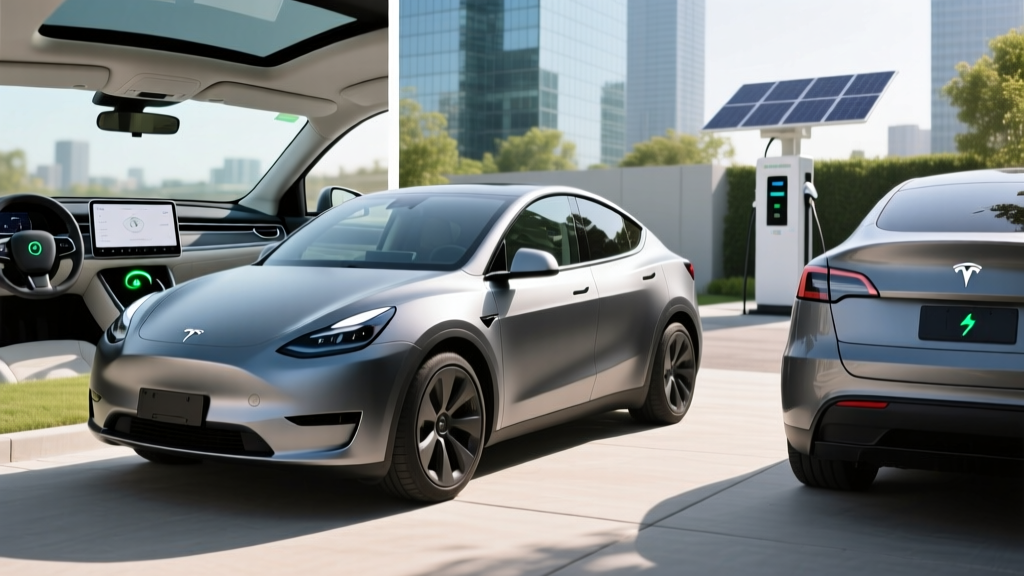
The Juniper interior update addressed the most common Model Y complaints. The 2026 cabin now includes ventilated front seats, a rear-seat touchscreen for climate and media control, improved ambient lighting, and acoustic laminated glass on all windows. Road noise is measurably lower than the pre-2025 models.
The 15.4-inch center touchscreen remains the sole interface for nearly all vehicle controls — no physical buttons for climate, mirrors, or glovebox. This minimalism is polarizing: some owners love the clean aesthetic, while others find simple tasks like adjusting fan speed more distracting than a physical knob. The learning curve is roughly one week for most drivers.
Cargo space measures 72 cubic feet with the rear seats folded (30.2 cu ft behind the second row), competitive with the Mach-E (59.7 cu ft) and larger than the Ioniq 5 (59.3 cu ft). The front trunk (frunk) adds 4.1 cu ft for charging cables or a small bag.
Driver Assistance: Autopilot and FSD (Supervised)
Autopilot comes standard and handles adaptive cruise control and lane centering competently on highways. FSD (Supervised), an $8,000 add-on or $99/month subscription as of 2026, extends capability to city streets, traffic light recognition, and automatic turns. Real-world FSD performance has improved substantially but still requires active monitoring — expect occasional interventions at construction zones, unprotected left turns, and unusual road configurations.
Warranty and Long-Term Ownership
Tesla provides an 8-year/120,000-mile battery and drive unit warranty for the Model Y Long Range AWD (the RWD model with the LFP battery carries the same 8-year/120,000-mile coverage). The warranty guarantees at least 70% battery capacity retention over that period. In practice, Tesla's NMC packs have shown roughly 10–12% degradation at 100,000 miles based on fleet data, meaning most owners will remain well within the warranty threshold.
The basic vehicle warranty is 4 years / 50,000 miles — shorter than Hyundai's 5-year/60,000-mile basic coverage and significantly shorter than the 10-year/100,000-mile powertrain warranty Hyundai offers on the Ioniq 5. This is a notable gap for buyers who prioritize long-term peace of mind beyond the battery.
Insurance costs for the Model Y remain higher than segment averages. Expect annual premiums in the $1,800–$2,800 range depending on your state, driving record, and coverage level. Tesla's own insurance product, available in many states, uses real-time driving data to price premiums and can be 10–20% cheaper for safe drivers.
Who the 2026 Model Y Suits Best
- You want access to the most reliable and extensive DC fast-charging network (Superchargers)
- You value OTA software updates that add features post-purchase
- You need class-leading cargo space in a compact electric SUV
- You commute 40–80 miles daily and can charge at home
- You want strong resale value backed by brand recognition
- You prefer physical buttons and traditional control layouts
- You want the longest possible basic/powertrain warranty (consider Hyundai/Kia)
- You need a third row (Kia EV9 or a three-row PHEV)
- You want the absolute lowest purchase price (Chevrolet Equinox EV starts under $35,000)
- You distrust touchscreen-only vehicle interfaces
Pros and Cons
Pros
- Class-leading Supercharger network access
- Excellent efficiency (28 kWh/100 mi)
- Spacious cargo area (72 cu ft max)
- Strong OTA update track record
- Competitive real-world range (270–290 mi highway)
- Improved ride quality post-Juniper refresh
Cons
- No physical buttons — everything through the screen
- Basic warranty shorter than Korean competitors
- FSD (Supervised) costs $8,000 and still requires supervision
- Insurance premiums above segment average
- High PE ratio creates pricing and resale uncertainty
- Rear visibility limited by sloping roofline
Frequently Asked Questions
What is the real-world range of the 2026 Tesla Model Y?
Expect 270–290 miles on the highway in mild weather, 300+ in suburban/city driving with regenerative braking, and 240–260 miles in freezing temperatures. The EPA sticker says 320 miles, but plan conservatively for road trips.
How fast does the Model Y charge at home and on the road?
At home on a 240V/48A Level 2 charger, you'll add about 44 miles per hour (11.5 kW), fully recharging overnight. On a V3 or V4 Supercharger, 10–80% takes roughly 25 minutes, though peak 250 kW speeds only sustain to about 50% state of charge before tapering.
How much does the 2026 Model Y cost after the federal tax credit?
The Long Range AWD starts at $44,990 MSRP. If you qualify for the full $7,500 §30D credit (income under $300K joint, vehicle MSRP under $80K, battery sourcing compliant), the effective price drops to roughly $37,490. The base RWD model at $39,990 could fall to ~$32,490. Verify current sourcing eligibility on the IRS website before purchase.
Does the 2026 Tesla Model Y qualify for the federal EV tax credit?
Yes, all Model Y trims fall under the $80,000 SUV MSRP cap. However, the full $7,500 credit depends on your income, the battery's critical-mineral and component sourcing compliance for the current tax year, and purchasing new (not leased — leased vehicles fall under different §45W commercial rules). Consult a tax professional and check the IRS clean vehicle credit page for the latest eligibility details.
Is the Model Y worth buying vs. the Hyundai Ioniq 5 or Ford Mach-E?
The Model Y wins on charging network access, cargo volume, efficiency, and software maturity. The Ioniq 5 offers a longer basic warranty, 800V architecture for faster peak charging at compatible stations, and a more conventional interior. The Mach-E provides a more engaging driving feel and a lower starting price. If Supercharger access and OTA updates matter most, the Model Y leads. If warranty coverage or interior ergonomics are your priority, test-drive the competition.
What does the Tesla stock PE ratio mean for my purchase decision?
A high PE ratio (mid-60s in early 2026) means investors expect outsized future growth from Tesla beyond vehicle sales. For buyers, this translates to aggressive pricing moves, rapid feature iteration, and some resale-value uncertainty tied to the company's ability to execute on robotaxi and energy promises. Buy the car because it fits your needs today — not as a financial investment tied to the stock.