Quick Verdict: Can You Separate the Car From the Controversy?
The 2026 Tesla Model Y (post-Juniper refresh) remains the best-selling electric vehicle in the United States for good reason: 320 miles of EPA-estimated range, a 250 kW peak DC fast-charge rate, class-leading Supercharger network access, and a starting MSRP that undercuts many rivals. But no EV purchase in 2026 comes with more baggage. The Tesla controversy — spanning brand perception shifts, CEO Elon Musk's polarizing public political activities, customer boycotts, resale-value volatility, and ongoing debates about Autopilot/FSD safety claims — forces every prospective buyer to weigh excellent hardware against genuine ownership risk.
This review separates the engineering from the noise. We'll give you exact range, charging, pricing, and tax-credit figures, then address the controversies head-on so you can decide whether the Model Y still earns your garage space.
| Spec | Long Range AWD | Performance |
|---|---|---|
| EPA Range | 320 mi | 295 mi |
| Battery (usable) | ~75 kWh, NMC | ~75 kWh, NMC |
| Drivetrain | Dual-motor AWD | Dual-motor AWD |
| Horsepower | ~384 hp | ~510 hp |
| 0-60 mph | 4.8 sec | 3.5 sec |
| Peak DC Charge | 250 kW | 250 kW |
| 10-80% DC Time | ~25 min | ~25 min |
| Level 2 Rate | 11.5 kW (~44 mi/hr) | 11.5 kW (~44 mi/hr) |
| MPGe (combined) | 111 MPGe | 102 MPGe |
| Base MSRP | $44,990 | $51,490 |
| Battery Warranty | 8 yr / 120,000 mi | 8 yr / 120,000 mi |
Source: fueleconomy.gov and Tesla spec sheets.
Range, Efficiency, and Real-World Expectations
The 2026 Model Y Long Range AWD carries an EPA-estimated 320 miles on a full charge — essentially unchanged from the 2025 Juniper launch, though minor aero tweaks and revised thermal management have slightly improved highway efficiency. The Performance trim drops to 295 miles due to stickier tires, sportier tuning, and larger 21-inch wheels.
EPA 320 mi (Long Range). Expect ~260-285 mi on sustained highway driving at 70-75 mph, and ~210-240 mi in sub-freezing winter conditions despite the standard heat pump. City/regenerative driving can push 310+ mi. Plan road trips around 220-240 mi usable legs to keep a safety buffer.
Efficiency lands at 111 MPGe combined (Long Range), or roughly 30 kWh per 100 miles — still among the best in the compact electric SUV segment. The Model Y's heat pump, standard since 2021, continues to give it a cold-weather edge over rivals that rely on resistive heating, though 20-30% range loss below 20°F remains physics, not marketing.
Charging Speed: Supercharger Dominance, With Caveats
Tesla's 250 kW peak DC fast-charge rate is no longer class-leading on paper — Hyundai/Kia's E-GMP platform and GM's Ultium vehicles push 350 kW at compatible stations — but the sustained charge curve is remarkably flat. In real-world testing, the Model Y holds near-peak power from roughly 10% to 50% SoC before tapering, yielding a 10-80% time of about 25 minutes on a V3 or V4 Supercharger.
| Level | Power | Miles Added |
|---|---|---|
| Level 1 (120V) | ~1.4 kW | ~5 mi/hr |
| Level 2 (240V, 48A) | 11.5 kW | ~44 mi/hr |
| DC Fast (peak) | 250 kW | ~180 mi in 15 min |
| DC Fast (10-80%) | — | ~25 min |
The bigger story in 2026 is network access. Tesla opened the Supercharger network to NACS-equipped non-Tesla EVs starting in 2024, and by 2026 the vast majority of new EVs ship with native NACS ports. This erodes one of Tesla's last major moats — reliable, ubiquitous fast charging is no longer exclusive. Electrify America and other networks have also improved uptime materially, though Superchargers still lead in plug-and-go reliability per J.D. Power EVX studies.
Performance and Driving Impressions
The Long Range AWD's 4.8-second 0-60 time is brisk enough for any merge, and the dual-motor setup provides confident all-weather traction. The Performance trim's 3.5-second run is sports-car territory, though at the cost of 25 miles of range and a firmer ride. Post-Juniper, the Model Y's cabin is noticeably quieter (acoustic glass, improved seals) and the retuned suspension soaks up rough pavement far better than pre-2025 models — a longtime complaint finally addressed.
Regenerative braking remains one-pedal-friendly, though Tesla no longer offers the user-selectable regen strength of earlier years. The steering is precise but numb, and the minimalist interior still polarizes: everything routes through the 15.4-inch center touchscreen, including climate and mirror adjustments.
Interior, Cargo, and Tech
The Juniper refresh added a ventilated front row, ambient lighting, a rear touchscreen for passengers, and power-folding second-row seats. Cargo volume stands at 30.2 cu ft behind the second row and 72.1 cu ft with seats folded, plus a modest front trunk (frunk). Rear legroom is 41.6 inches — genuinely adult-friendly for a compact SUV.
Infotainment runs Tesla's proprietary OS: fast, responsive, and app-rich (Netflix, YouTube, games while parked), but with no Apple CarPlay or Android Auto — a dealbreaker for some buyers in 2026. Autopilot is standard (lane-centering, adaptive cruise). Full Self-Driving (Supervised) remains a $8,000 option or $99/month subscription.
Autopilot and FSD (Supervised) are SAE Level 2 driver-assist systems. The driver must remain fully engaged, hands on or near the wheel, and eyes on the road. They are not self-driving. Only Level 4 robotaxi services (Waymo, Zoox in limited geofenced areas) operate without a human driver in the loop.
Pricing, Tax Credit, and Total Cost
The 2026 Model Y Long Range AWD starts at $44,990 (destination included). Performance starts at $51,490. A well-optioned Long Range with FSD, paint, and wheels lands around $55,000-$58,000 before incentives.
| Trim | MSRP | §30D Credit* | Effective Price |
|---|---|---|---|
| Long Range AWD | $44,990 | Up to $7,500 | ~$37,490 |
| Performance | $51,490 | Up to $7,500 | ~$43,990 |
*Eligibility depends on IRS §30D rules: buyer AGI caps ($150K single / $300K MFJ), vehicle MSRP under $80K for SUVs, and critical-mineral/battery-component sourcing thresholds that tighten annually. Point-of-sale transfer is available at participating dealers. Verify current-year rules at IRS.gov and consult a tax professional.
The Model Y's US-built, partially domestically sourced battery has generally qualified for the full or partial credit in recent years, but 2026 sourcing thresholds are stricter than 2024-2025. Always confirm at purchase — eligibility can shift mid-year based on supply-chain changes.
Addressing the Tesla Controversy Directly
No honest 2026 Model Y review can sidestep the brand's reputational headwinds. Three issues dominate buyer conversations:
- Brand perception and boycotts: Musk's high-profile political engagements since 2024 have alienated a meaningful slice of Tesla's traditional buyer base. Multiple consumer surveys (including Morning Consult and Kelley Blue Book brand-image studies) have shown measurable declines in Tesla favorability among liberal-leaning and environmentally motivated buyers — the EV core. Some shoppers simply do not want to be seen in the car.
- Resale-value volatility: Tesla's aggressive new-car price cuts in 2023-2024 cratered used values, and while prices have stabilized, the Model Y's residual value is no longer the segment leader. Depreciation risk remains higher than for Toyota or Hyundai EVs, per ALG and Edmunds data.
- Autopilot/FSD scrutiny: NHTSA investigations into Autopilot-involved crashes and Tesla's marketing of "Full Self-Driving" have produced consent orders and ongoing oversight. FSD (Supervised) is genuinely impressive on highways, but its city-street behavior still requires vigilant supervision, and the "supervised" label is doing a lot of legal work.
None of these issues change the car's engineering. All of them can affect your ownership experience, resale outcome, and social signaling. Buyers who can compartmentalize get a superb EV at a competitive price. Buyers who cannot should test-drive the Hyundai Ioniq 5, Ford Mustang Mach-E, or Chevrolet Equinox EV instead.
Pros, Cons, and Who Should Buy
- 320-mi EPA range, best-in-class efficiency
- Supercharger network still gold-standard for reliability
- Spacious cabin, 72 cu ft cargo with seats folded
- OTA updates keep adding features post-purchase
- Strong performance across both trims
- Heat pump standard — real cold-weather advantage
- Brand/reputation risk from CEO's public activities
- No Apple CarPlay or Android Auto
- Resale value less predictable than legacy brands
- FSD marketing still outpaces capability
- Minimalist interior not for everyone
- 250 kW peak charge trails newer 800V rivals
Best for: Tech-forward commuters and small families who want a proven, efficient electric SUV with the most reliable fast-charging network in North America, and who are comfortable with Tesla's brand baggage. Road-trippers benefit enormously from Supercharger density.
Look elsewhere if: Brand image matters to you, you need CarPlay, you want the fastest possible DC charging, or you're risk-averse on resale value.
Frequently Asked Questions
What is the real-world range of the 2026 Tesla Model Y?
EPA-estimated 320 miles (Long Range AWD). Real-world highway driving at 70-75 mph typically yields 260-285 miles; cold weather below freezing drops that to roughly 210-240 miles. Plan road trips with a 220-240 mile usable leg and a 20% buffer.
How fast does the Model Y charge at home and on DC?
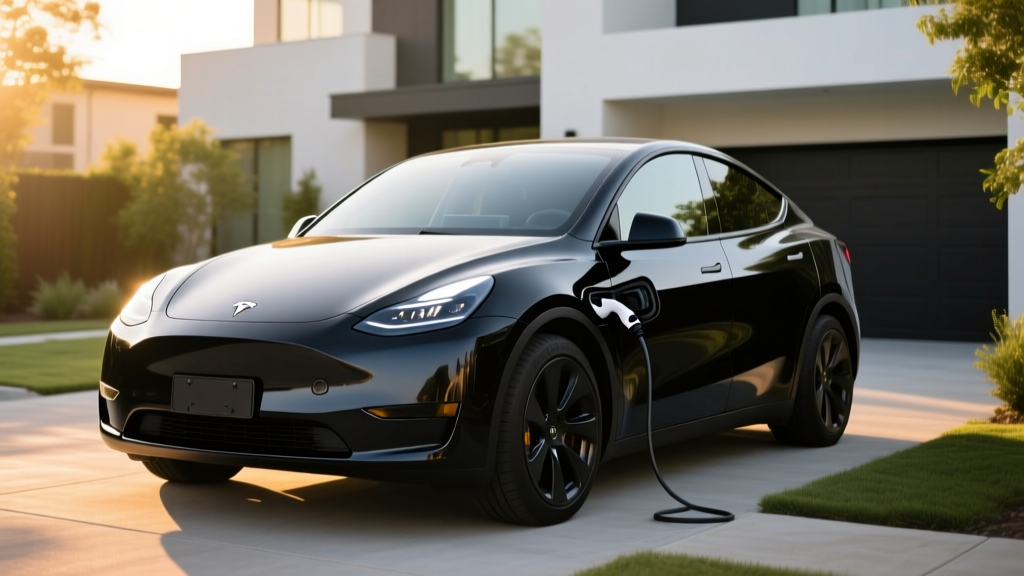
On a 240V Level 2 home charger at 48 amps, expect ~44 miles of range per hour (full overnight top-up). On DC fast charging, peak rate is 250 kW, with a 10-80% session taking about 25 minutes at a V3/V4 Supercharger.
Does the 2026 Model Y qualify for the federal EV tax credit?
It has generally qualified for up to $7,500 under IRS §30D, but eligibility depends on buyer income (AGI caps), the vehicle's MSRP (under the $80K SUV cap), and annual critical-mineral/battery-sourcing thresholds that tighten each year. Confirm at purchase via the IRS portal and your tax professional.
Is the Model Y worth buying versus competitors in 2026?
On specs and charging infrastructure, yes — it remains the benchmark. On brand perception and resale stability, rivals like the Hyundai Ioniq 5, Ford Mustang Mach-E, and Chevrolet Equinox EV have closed the gap and carry less reputational baggage. Test-drive at least two competitors before committing.
What are the biggest pros and cons?
Pros: range, efficiency, Supercharger access, cargo space, performance, OTA updates. Cons: brand controversy tied to Musk, no CarPlay, resale volatility, FSD marketing vs. reality, 250 kW charge rate trails 800V rivals.
How does the Tesla controversy affect ownership?
It doesn't change the car's engineering, but it can affect social perception, resale value, and your comfort with the brand. Some buyers report unwanted conversations or negative reactions; others don't care. Factor this honestly into your decision.
Sources: fueleconomy.gov, IRS Clean Vehicle Credits, NHTSA, Tesla official specifications.