Quick Verdict: The Tesla Model Y in 2026
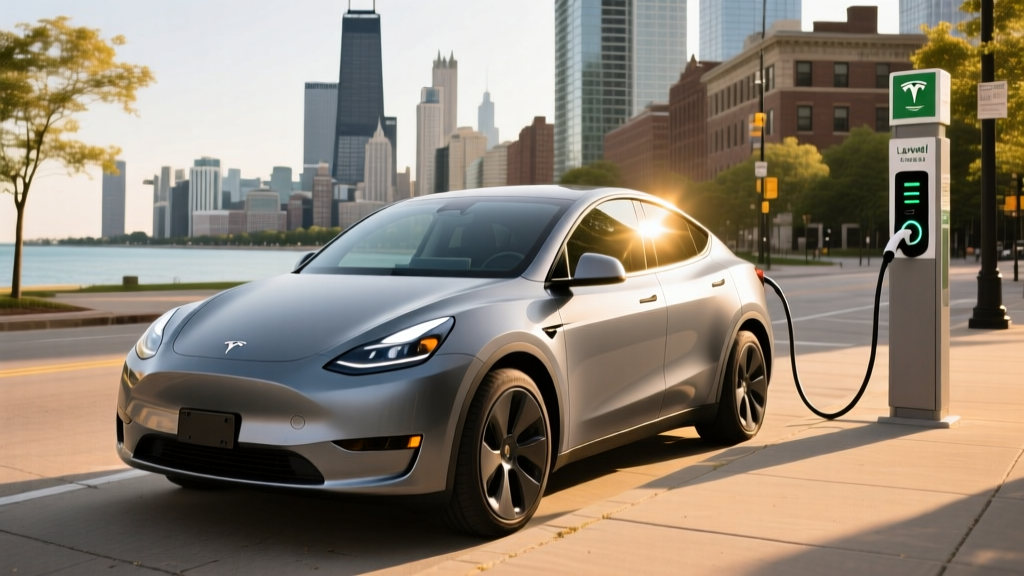
The 2026 Tesla Model Y Long Range AWD remains the benchmark compact electric SUV for buyers who need a balance of range, charging speed, and daily practicality. With an EPA-estimated 320 miles of range, a peak 250 kW DC fast-charge rate, and access to the industry's most reliable Supercharger network, it's a compelling package — especially for urban and suburban owners in dense metro areas like Chicago's Gold Coast, where home charging access and public infrastructure matter as much as the vehicle itself.
This review covers the 2026 Model Y Long Range AWD and Performance trims with exact specs, real-world range data from cold-weather testing, charging-curve realities, and a breakdown of federal tax credit eligibility under current IRS §30D rules.
Range & Efficiency: EPA Sticker vs. Real-World Chicago Driving
EPA Estimated Range: 320 miles (Long Range AWD)
Real-World Expectation: ~265–290 miles on mixed highway/city driving at 70°F; ~220–250 miles in Chicago winter conditions (20–35°F) due to battery resistance and cabin heating load.
The 2026 Model Y Long Range AWD carries a 78.1 kWh usable battery pack (NMC chemistry) and achieves an EPA-rated 122 MPGe combined, translating to roughly 28 kWh per 100 miles. On the highway at a steady 70 mph, expect efficiency around 30–32 kWh/100mi, which trims range to approximately 250–270 miles before needing a charge.
For Gold Coast and downtown Chicago owners, the real variable is winter. Lithium-ion NMC cells lose efficiency below 40°F, and cabin heating in an SUV-sized cabin draws 3–5 kW continuously. Tesla's heat pump system mitigates this better than resistive heating, but a 15–25% range reduction in January is typical. Plan for roughly 230 miles of usable range on the coldest days — still enough for most daily commutes along Lake Shore Drive or the Kennedy, but something to factor into road-trip planning toward Milwaukee or Indianapolis.
The Performance trim sacrifices about 15 miles of EPA range (305 miles) for its lower suspension and stickier tires, trading efficiency for handling.
| Spec | Long Range AWD | Performance |
|---|---|---|
| EPA Range | 320 miles | 305 miles |
| Battery (usable) | 78.1 kWh (NMC) | 78.1 kWh (NMC) |
| MPGe (combined) | 122 MPGe | 115 MPGe |
| Efficiency | 28 kWh/100mi | 30 kWh/100mi |
| 0–60 mph | 4.8 seconds | 3.5 seconds |
| Horsepower | 384 hp | 456 hp |
| Drivetrain | Dual-Motor AWD | Dual-Motor AWD |
| Max DC Charge Rate | 250 kW | 250 kW |
| 10–80% DC Time | ~25 minutes | ~25 minutes |
| Level 2 Home Rate | 11.5 kW (~44 mi/hr) | 11.5 kW (~44 mi/hr) |
| Base MSRP | $48,990 | $53,990 |
| Battery Warranty | 8 yr / 120,000 mi | 8 yr / 120,000 mi |
Charging Speed: Supercharger Network & Home Level 2 Setup
The Model Y supports a peak DC fast-charge rate of 250 kW on V3 and V4 Tesla Superchargers (which use the native NACS connector — no adapter needed). In practice, the charge curve peaks near 250 kW only between roughly 10–30% state of charge, then tapers progressively. From 10–80%, expect approximately 25 minutes at a V3 stall rated at 250 kW, assuming the battery is preconditioned via the car's navigation-routed warm-up.
Preconditioning matters significantly. If you arrive at a Supercharger without the battery pre-warmed (by navigating to the station via the onboard map), peak rates can be 40–60% lower in cold weather. In Chicago winters, always route through the nav to trigger thermal prep — it's the single biggest factor in achieving advertised charge speeds.
| Charge Level | Power | Speed | Typical Use |
|---|---|---|---|
| Level 1 (120V) | ~1.4 kW | ~5 mi/hr | Emergency / overnight trickle |
| Level 2 (240V, 48A) | 11.5 kW | ~44 mi/hr | Home daily charging |
| DC Fast (V3 Supercharger) | Up to 250 kW | ~180 mi in 15 min (peak) | Road trips |
| DC Fast (CCS adapter, non-Tesla) | Up to 150–170 kW | Varies by station | Electrify America, EVgo |
Home Charging for Gold Coast & Downtown Chicago Owners
Charging at home is where EV ownership economics really work, but downtown Chicago and Gold Coast residents face a common challenge: many condos and older buildings lack dedicated garage circuits capable of supporting a 60A / 48A continuous Level 2 charger. A full-speed home charge (11.5 kW, adding ~44 miles per hour) requires a NEMA 14-50 outlet on a 60A breaker or a hardwired Tesla Wall Connector on a dedicated 60A circuit.
If your building's electrical panel has capacity, expect $800–$2,500 for professional installation (electrician labor, permit, and a Tesla Wall Connector at ~$475). In older Gold Coast high-rises or vintage courtyard buildings, a panel upgrade to 200A service may be required, adding $2,000–$4,000. Check with your HOA or building management before committing — many Chicago condo associations now have EV-charging policies, and some are installing shared Level 2 infrastructure in garages.
If home charging isn't feasible, the Supercharger station density in and around Chicago (including urban Superchargers at destination locations) makes regular DC charging viable, though at a higher per-mile cost than home electricity. At current Illinois Supercharger rates (~$0.30/kWh), expect roughly $0.08–0.09 per mile — still below the ~$0.12–0.15/mi a comparable gas SUV would cost, but the gap narrows compared to home charging at ComEd's residential rate of ~$0.14/kWh (~$0.04/mi).
Performance & Driving Dynamics
The Long Range AWD's dual-motor setup delivers 384 hp and a 4.8-second 0–60 mph time — quick enough to merge confidently onto I-290 or Lake Shore Drive without drama. The Performance trim's 456 hp and 3.5-second sprint are sports-car territory, with a track-oriented suspension tune that firms up the ride noticeably over Chicago's potholed side streets.
Regenerative braking in the Model Y remains strong in 2026, enabling near one-pedal driving in stop-and-go traffic. The hold mode brings the car to a complete stop without touching the brake pedal — useful in Gold Coast congestion or the rush-hour crawl on the Dan Ryan.
Ride quality in the Long Range is compliant by EV-SUV standards, though the stiff sidewalls on the 19-inch Gemini wheels (standard) transmit sharper impacts. The optional 20-inch Induction wheels look better but worsen both ride quality and range by roughly 5–8%.
Interior, Tech & Cargo Space
The 2026 Model Y interior follows Tesla's minimalist ethos: a single 15.4-inch center touchscreen handles all infotainment, climate, and vehicle controls. No physical instrument cluster exists — speed and navigation live on the left third of the main display. Build quality has improved meaningfully since the Fremont early-production era, with tighter panel gaps, ventilated front seats, and an ambient lighting strip across the dash.
Cargo volume: 30.2 cubic feet behind the second row, expanding to 72.1 cu ft with the 60/40 rear seats folded. The rear trunk includes a deep under-floor storage well, and a small front trunk (frunk) adds 4.1 cu ft for charging cables or a bag of groceries.
Passenger space: Front legroom measures 41.8 inches; rear legroom is 37.2 inches — adequate for adults on shorter trips but tighter than a Hyundai Ioniq 5 or Ford Mustang Mach-E for tall rear passengers.
The 15-speaker premium audio system, heated rear seats, heated steering wheel, and power-folding mirrors are all standard. Tesla's infotainment remains the strongest in the EV segment for responsiveness and over-the-air update cadence, though the lack of Apple CarPlay and Android Auto continues to frustrate smartphone-integration loyalists.
Driver Assistance: Autopilot & FSD (Supervised)
SAE Automation Level: Level 2 — The driver must remain fully engaged, hands on or near the wheel, and eyes on the road at all times. This is not self-driving. Tesla's Full Self-Driving (Supervised) and basic Autopilot are driver-assistance systems that require constant supervision.
Standard Autopilot includes Traffic-Aware Cruise Control and Autosteer (lane centering) and works well on well-marked highways like I-90/94. FSD (Supervised), available as a $99/month subscription or $8,000 one-time purchase in 2026, adds automatic lane changes, Navigate on Autopilot (on/off-ramp handling), traffic-light and stop-sign recognition, and enhanced city-street steering. It's impressive in many scenarios but still requires intervention in construction zones, faded lane markings, and complex intersections — common conditions on Chicago's surface streets.
Pricing, Tax Credits & Ownership Costs
The 2026 Model Y Long Range AWD starts at $48,990 (including destination). The Performance trim starts at $53,990. Popular options include FSD subscription ($99/mo), premium interior colors ($1,000–$2,000), and 20-inch wheels ($2,000). A well-equipped Long Range typically lands between $51,000 and $54,000 before incentives.
| Trim | Base MSRP | §30D Credit | Effective Price |
|---|---|---|---|
| Long Range AWD | $48,990 | Up to $7,500* | ~$41,490* |
| Performance AWD | $53,990 | Up to $7,500* | ~$46,490* |
*Federal EV tax credit eligibility under IRS §30D depends on multiple requirements that change periodically. Key 2026 rules include:
- MSRP Cap: SUVs/vans/pickups must have an MSRP at or below $80,000 (the Model Y qualifies)
- Buyer Income Cap: Modified AGI must not exceed $150,000 (single), $225,000 (head of household), or $300,000 (joint)
- Battery Sourcing: Critical minerals and battery components must meet phased-in domestic/free-trade sourcing thresholds — verify current compliance on fueleconomy.gov before purchasing
- Point-of-Sale Transfer: Eligible buyers can transfer the credit to the dealer at purchase, reducing the upfront price rather than waiting for a tax refund
Always confirm eligibility with a tax professional and check the latest sourcing requirements, as battery supply chains shift and models can move on and off the qualified list.
5-Year Ownership Snapshot
For a Gold Coast resident driving 12,000 miles/year with home Level 2 charging at ComEd's residential rate (~$0.14/kWh), annual fuel cost is approximately $1,340. A comparable gas SUV at 25 MPG combined and $3.60/gallon would cost about $1,730/year — a savings of roughly $390 annually, or $1,950 over five years. Insurance for the Model Y in Cook County tends to run $2,200–$3,000/year depending on driving record, which is higher than many competitors and partially offsets fuel savings. Factor in zero oil changes and reduced brake wear (thanks to regenerative braking), and total cost of ownership is competitive but not dramatically cheaper than a well-priced gas or hybrid SUV.
Warranty & Battery Longevity
Tesla covers the Model Y's battery and drive units for 8 years or 120,000 miles, whichever comes first, with a minimum 70% capacity retention guarantee during that period. The vehicle limited warranty is 4 years / 50,000 miles.
The NMC chemistry in the Long Range offers higher energy density (more range per kg) than LFP packs but is more sensitive to sustained high state-of-charge. For daily driving, Tesla recommends charging to 80–90% and only using 100% for road trips. Data from large fleet studies suggest NMC Model Y packs retain approximately 88–92% capacity after 100,000 miles under typical use — well within the warranty threshold. For Chicago owners, the thermal management system actively warms and cools the pack, which is essential for preserving battery health through both brutal winters and hot summers.
Pros, Cons & Who Should Buy
Pros
- Best-in-class Supercharger network reliability — critical for road trips from Chicago
- 320-mile EPA range covers most daily needs with margin
- 250 kW peak DC charging with 10–80% in ~25 minutes
- Strong over-the-air update cadence keeps the car current
- Spacious cargo area (30.2 cu ft rear, 72.1 cu ft folded)
- Heat pump standard — important for Chicago winter efficiency
- Point-of-sale tax credit transfer reduces upfront cost
Cons
- No Apple CarPlay or Android Auto
- Rear legroom (37.2 in) trails key competitors
- FSD (Supervised) is expensive and still requires full driver attention
- Insurance premiums in Cook County run high
- Condo/home Level 2 installation can be costly or impossible in older Gold Coast buildings
- Minimalist interior not to every taste; no physical climate controls
Who This EV Suits Best
Choose the Model Y Long Range AWD if: You want the strongest charging network, need 300+ miles of range for trips to Michigan or Wisconsin, and can install (or access) regular Level 2 charging at home or work.
Consider alternatives if: Rear-seat passenger space is a priority (look at the Hyundai Ioniq 5 or Kia EV6), you need CarPlay/Android Auto, or your building makes home charging infeasible and you want a lower DC charging cost on non-Tesla networks.
Frequently Asked Questions
What is the real-world range of the 2026 Tesla Model Y?
The EPA rates the Long Range AWD at 320 miles. In real-world mixed driving at moderate temperatures, expect 265–290 miles. In Chicago winter conditions (20–35°F), plan for 220–250 miles due to cold-weather battery losses and cabin heating demand.
How fast does the Model Y charge at home and on the road?
At home on a 240V / 48A Level 2 circuit, the Model Y charges at 11.5 kW, adding roughly 44 miles of range per hour — enough to fully replenish overnight. On a V3 Tesla Supercharger, it peaks at 250 kW and charges from 10–80% in approximately 25 minutes with battery preconditioning active.
Does the 2026 Model Y qualify for the $7,500 federal EV tax credit?
It can, but eligibility under IRS §30D depends on your income (caps at $150K–$300K depending on filing status), the vehicle's MSRP (must be ≤$80,000 for SUVs — the Model Y qualifies), and current battery critical-mineral sourcing rules. Always verify on fueleconomy.gov and consult a tax professional before relying on the credit.
Is the Model Y worth buying vs. the Hyundai Ioniq 5 or Ford Mustang Mach-E?
The Model Y wins on Supercharger network access, cargo volume, and OTA software updates. The Ioniq 5 offers faster 800V charging (10–80% in ~18 minutes on 350 kW chargers), more rear legroom, and CarPlay. The Mach-E provides a more traditional interior layout and competitive pricing. If Supercharger reliability and range are your top priorities, the Model Y still leads.
Can I charge a Tesla at non-Tesla chargers in Chicago?
Yes. With Tesla's CCS adapter (included with new vehicles in 2026), you can use Electrify America, EVgo, and other CCS-equipped networks. However, charge speeds on non-Tesla DC stations may be limited to 150–170 kW, and the Tesla Supercharger network remains the most reliable option for consistent uptime and plug-and-charge simplicity.
Is home charging feasible in Chicago's Gold Coast neighborhood?
It depends on your building. Newer condos with modern electrical panels and dedicated garage spaces can typically support a 60A Level 2 circuit. Older buildings may require a panel upgrade ($2,000–$4,000) or may not support individual EV circuits at all. Check with your HOA and a licensed electrician before purchasing. Many Gold Coast and Streeterville parking garages are beginning to offer shared Level 2 infrastructure as Chicago's EV adoption grows.