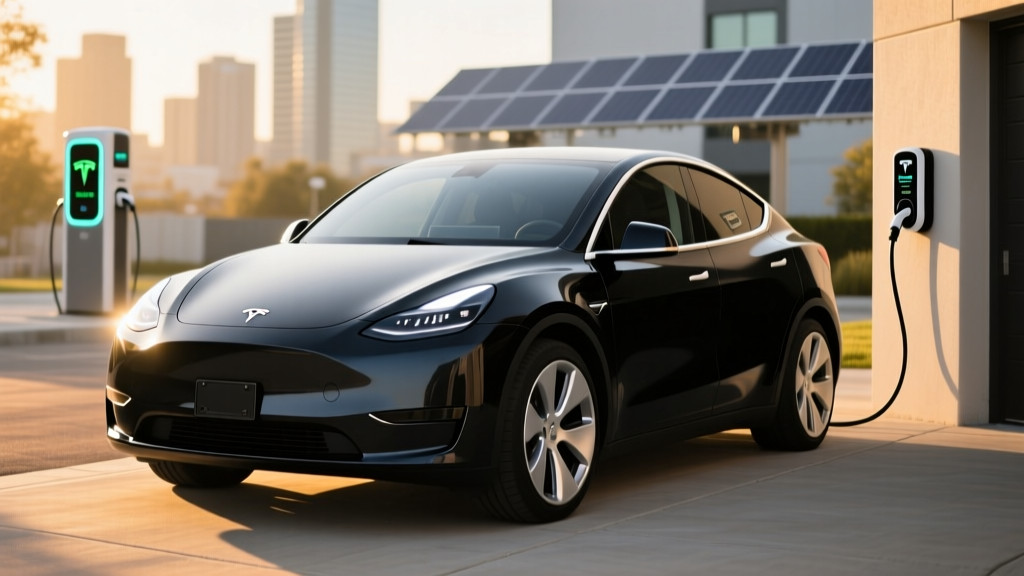
The Tesla Model Y remains the best-selling electric vehicle in the United States for good reason: it pairs crossover practicality with a charging network no competitor can match. But with the 2026 refresh bringing updated styling, a revised interior, and shifting federal incentive rules, buyers searching for the precio de Tesla Model Y need a clear, number-driven breakdown before signing on the dotted line.
This review covers every spec that matters — EPA range versus what you'll actually see on the highway, real charging speeds at Superchargers, the full MSRP-to-out-the-door pricing picture, and whether the Model Y still beats the Hyundai Ioniq 5, Ford Mustang Mach-E, and Chevrolet Equinox EV in 2026.
2026 Tesla Model Y: Quick Verdict
The 2026 Model Y (internally dubbed "Juniper") carries over the structural battery pack and 4680-cell architecture introduced in late 2024, but gains a restyled front fascia, ventilated front seats, power-folding second row, and an updated 15.4-inch center display with faster processing. The Long Range AWD variant remains the volume seller, offering 320 miles of EPA range and access to Tesla's 250 kW Supercharger network.
| Spec | Value |
|---|---|
| EPA Range | 320 miles |
| Battery (usable) | 75 kWh, NMC (nickel manganese cobalt) |
| Drivetrain | Dual-motor AWD |
| Horsepower | 384 hp combined |
| 0–60 mph | 4.8 seconds |
| DC Fast Charge (peak) | 250 kW |
| 10–80% DC Charge | ~27 minutes |
| Level 2 Home Charge | 11.5 kW (~44 mi/hr) |
| MPGe (combined) | 117 MPGe |
| Efficiency | 29 kWh/100 mi |
| Cargo (rear seats up) | 30.2 cu ft |
| Cargo (rear seats folded) | 72.1 cu ft |
| Battery Warranty | 8 years / 120,000 miles |
| Base MSRP | $44,990 |
Range and Efficiency: EPA vs. Real World
The EPA rates the 2026 Model Y Long Range AWD at 320 miles. That figure is achievable in mixed suburban driving at moderate temperatures, but real-world conditions tell a more nuanced story.
- City/suburban (65°F): ~310–325 mi (regen braking recovers energy)
- Highway (75 mph, 65°F): ~265–285 mi (aerodynamic drag dominates)
- Highway (30°F, winter): ~210–240 mi (cabin heating + battery resistance)
- Mountain/towing: ~180–210 mi (elevation gain and trailer load)
Source: fueleconomy.gov and owner-reported data.
The Model Y uses an NMC (nickel manganese cobalt) battery chemistry, which offers higher energy density than LFP (lithium iron phosphate) but is more sensitive to sustained high states of charge. Tesla recommends daily charging to 80–90% for NMC packs, reserving 100% for road trips. This preserves long-term State of Health (SoH) — expect roughly 8–12% degradation over 100,000 miles based on fleet data.
Efficiency is rated at 29 kWh per 100 miles (combined), which translates to 117 MPGe. That's competitive with the Hyundai Ioniq 5 (114 MPGe combined) but slightly behind the RWD Model 3 (132 MPGe) due to the Y's taller, heavier crossover body.
Charging Speed: Supercharger and Home
Charging speed is where Tesla still holds a structural advantage. The Model Y Long Range peaks at 250 kW on V3 Superchargers and can sustain roughly 150–180 kW through the 30–60% SoC window before tapering. Here's the full picture:
| Charging Level | Power (kW) | Miles Added per Hour | Typical Use Case |
|---|---|---|---|
| Level 1 (120V outlet) | 1.4 kW | ~5 mi/hr | Emergency/top-up |
| Level 2 (240V, 48A) | 11.5 kW | ~44 mi/hr | Home overnight |
| DC Fast (V3 Supercharger) | 250 kW peak | ~1,000 mi/hr (peak) | Road trips |
| DC Fast (CCS adapter, EA) | ~150 kW typical | ~600 mi/hr (peak) | Non-Tesla networks |
A 10–80% charge at a V3 Supercharger takes approximately 27 minutes under ideal conditions (battery preconditioned via navigation routing). Without preconditioning — for example, arriving at a charger without the car expecting it — that time can stretch to 35–40 minutes in cold weather because the battery management system limits charge rate until the pack reaches optimal temperature.
For home charging, Tesla's Wall Connector ($420) at 48 amps on a 60-amp circuit delivers 11.5 kW, adding roughly 44 miles of range per hour. A full overnight charge from 20% to 80% takes about 5 hours. Installation costs range from $800 to $2,500 depending on panel capacity and conduit run — consult a licensed electrician for a site-specific quote.
With Tesla's NACS connector now adopted industry-wide, the Model Y also accesses Electrify America, EVgo, and ChargePoint stations using a CCS-to-NACS adapter (included with 2026 models). However, peak speeds on non-Tesla networks are typically limited to 150 kW due to communication protocol differences.
Performance and Driving Dynamics
The dual-motor AWD Model Y produces 384 hp and launches from 0–60 mph in 4.8 seconds. That's brisk for a family crossover — quicker than the Mach-E Premium AWD (5.1s) and Equinox EV RS AWD (5.7s). Instant torque delivery makes merging and passing effortless, and the low center of gravity (battery pack under the floor) keeps body roll controlled through corners.
Ride quality improved noticeably with the Juniper refresh: Tesla retuned the damper rates and added acoustic laminated glass to the rear windows, reducing cabin noise at highway speeds. The steering remains quick but somewhat numb — a common Tesla trait — and the regenerative braking offers only one setting (aggressive), which most owners adapt to for one-pedal driving within a week.
Towing capacity is rated at 3,500 pounds (with the factory tow package, $500), adequate for a small utility trailer or a pair of dirt bikes but not a full-size camper. Expect range to drop 30–45% when towing near max capacity at highway speeds.
Precio de Tesla: MSRP, Trims, and Tax Credit Breakdown
The search for the precio de Tesla Model Y yields three main trim levels for 2026. Here's the complete pricing matrix, including estimated out-of-pocket cost after the federal EV tax credit:
| Trim | MSRP | §30D Credit | Effective Price | Est. Delivery |
|---|---|---|---|---|
| Long Range RWD | $39,990 | Up to $7,500* | ~$32,490 | Q1 2026 |
| Long Range AWD | $44,990 | Up to $7,500* | ~$37,490 | Available now |
| Performance AWD | $51,490 | Up to $7,500* | ~$43,990 | Available now |
*Federal §30D credit eligibility requires: buyer AGI ≤ $150,000 (single) / $300,000 (joint); vehicle MSRP ≤ $80,000 (SUVs/trucks); battery critical minerals and components sourced per IRS rules. Credit applied at point of sale. Verify current-year rules at irs.gov.
The point-of-sale transfer option, introduced in 2024, allows buyers to apply the $7,500 credit directly as a down payment reduction at purchase rather than waiting to claim it on their tax return. This effectively lowers the precio de Tesla Model Y Long Range AWD to roughly $37,490 before state incentives, destination fees ($1,390), or optional paint and wheels.
State-level incentives can stack on top: California's CVRP offers up to $2,000 for income-eligible buyers, Colorado provides a $5,000 state credit, and several utility companies offer $500–$1,500 rebates for home charger installation. Check your state energy office for current programs.
Interior, Cargo, and Technology
The 2026 Juniper interior is Tesla's most refined yet, though it still follows the minimalist single-screen philosophy. The 15.4-inch center touchscreen runs an updated infotainment OS with faster app loading, native Spotify/Apple Music integration, and a new ambient lighting strip that runs across the dashboard and door panels.
Passenger and cargo dimensions:
- Front headroom: 41.0 in | Legroom: 41.8 in
- Rear headroom: 39.4 in | Legroom: 38.2 in
- Cargo behind 2nd row: 30.2 cu ft
- Cargo (seats folded): 72.1 cu ft
- Front trunk (frunk): 4.1 cu ft
The rear seat now features a small 8-inch touchscreen for climate and media control — a welcome addition for families. Ventilated front seats are standard on Long Range and above. The power-folding second row (new for 2026) makes cargo loading easier but reduces the under-floor storage area slightly.
On the technology front, Autopilot comes standard (Traffic-Aware Cruise Control + Autosteer). Full Self-Driving (Supervised) remains an $8,000 option or $99/month subscription. Important clarification:
Both Autopilot and FSD (Supervised) are SAE Level 2 driver-assistance systems. The driver must remain fully engaged, hands on or near the wheel, and eyes on the road at all times. These systems do NOT make the Model Y a self-driving vehicle. Only Level 4 services like Waymo operate without a human driver.
Warranty, Safety, and Long-Term Ownership
Tesla's warranty coverage is competitive with legacy automakers but not class-leading:
- Basic vehicle: 4 years / 50,000 miles
- Battery and drive unit: 8 years / 120,000 miles (Long Range AWD)
- Battery capacity retention: Tesla warrants at least 70% capacity during the warranty period
The 70% retention threshold is standard across the industry (Hyundai offers 70% as well; GM guarantees 60% on some packs). In practice, fleet data from Recurrent Auto shows most Model Y packs retain 88–92% capacity at 100,000 miles, well above the warranty floor.
Safety ratings are strong: the Model Y earned a 5-star overall rating from NHTSA and was named an IIHS Top Safety Pick+ for 2025–2026. Standard active safety includes automatic emergency braking, blind-spot monitoring, lane departure prevention, and rear cross-traffic alert.
Insurance costs run 15–25% higher than comparable gas-powered crossovers, averaging $1,800–$2,400 per year depending on your state and driving record. Tesla Insurance is available in select states and may offer lower premiums for drivers with high safety scores.
Pros, Cons, and the Competition
- Class-leading Supercharger network access (20,000+ V3 stalls in North America)
- 320-mi EPA range with strong real-world highway efficiency
- Spacious cargo area (72.1 cu ft) and practical frunk
- Over-the-air updates continuously add features
- Strong resale value relative to other EVs
- No Apple CarPlay or Android Auto
- Aggressive single regen setting — not adjustable
- Panel gaps and paint quality still inconsistent on some builds
- FSD (Supervised) remains Level 2 despite the name and cost
- Higher insurance premiums than gas equivalents
Key competitors: The Hyundai Ioniq 5 ($42,600, 310 mi range, 350 kW charging) charges faster but has a smaller cargo area. The Ford Mustang Mach-E ($43,995, 320 mi range) offers a more engaging drive but lacks Supercharger access without an adapter. The Chevrolet Equinox EV ($33,000, 319 mi range) undercuts on price but charges at only 150 kW peak and has a less refined interior.
Choose the Ioniq 5 if: You prioritize ultra-fast 350 kW charging, prefer CarPlay, and want a more conventional interior layout.
Choose the Equinox EV if: Budget is your top priority and you primarily charge at home with occasional road trips.
Frequently Asked Questions
What is the real-world range of the 2026 Tesla Model Y?
The EPA rates it at 320 miles, but expect 265–285 miles on highway road trips at 75 mph, and 210–240 miles in freezing winter conditions. City driving with regenerative braking can match or slightly exceed the EPA estimate.
How fast does the Model Y charge at home and on the road?
At home on a 240V Level 2 charger (11.5 kW), it adds about 44 miles per hour — a full overnight session covers most daily needs. On a V3 Supercharger (250 kW peak), a 10–80% charge takes approximately 27 minutes with battery preconditioning.
How much does the Tesla Model Y cost after the federal tax credit?
The Long Range AWD starts at $44,990 MSRP. With the $7,500 federal §30D credit applied at point of sale (if you meet income and sourcing requirements), the effective price drops to roughly $37,490 before state incentives and destination fees.
Does the 2026 Model Y qualify for the $7,500 federal EV tax credit?
It qualifies for buyers meeting IRS §30D requirements: adjusted gross income ≤ $150,000 (single) or $300,000 (joint), and the vehicle's MSRP is under the $80,000 SUV cap. Battery critical-mineral and component sourcing rules also apply. Verify your eligibility at irs.gov or with a tax professional, as sourcing requirements tighten annually.
Is the Model Y still worth buying versus competitors in 2026?
Yes, for buyers who prioritize charging infrastructure and cargo space. The Supercharger network remains the most reliable public charging option in the US, and the 72.1 cu ft cargo area beats every competitor. However, if CarPlay support, faster peak charging, or a lower starting price matter more, the Ioniq 5 or Equinox EV deserve serious consideration.
How long will the Model Y battery last?
Tesla warranties the battery for 8 years / 120,000 miles with at least 70% capacity retention. Real-world fleet data shows most packs retain 88–92% at 100,000 miles. With proper charging habits (daily limit of 80–90%, avoiding frequent 100% charges), the pack should outlast 200,000 miles before approaching the warranty threshold.