The 2026 Tesla Model Y enters its first full model year after the comprehensive "Juniper" refresh that redesigned the best-selling EV in the world from the ground up. With updated styling, a revamped interior, revised suspension tuning, and new paint options, the refreshed Model Y aims to hold its crown against a growing field of midsize electric SUVs from Hyundai, Ford, and Kia. This review covers everything a buyer needs to know — from the full Tesla paint colors palette and real-world range to DC fast-charging curves and federal tax credit eligibility under current IRS §30D rules.
2026 Tesla Model Y Paint Colors and Exterior Design
The Juniper refresh brought a sleeker, more aerodynamic exterior with a full-width front light bar and revised rear taillight strip — a departure from the previous Model Y's more utilitarian look. For 2026, Tesla offers the following paint colors on the Model Y:
- Pearl White Multi-Coat — Standard (no extra cost); high-gloss tri-coat finish that hides minor scratches well
- Solid Black — $1,500 premium; deep metallic flake, shows swirl marks readily
- Deep Blue Metallic — $1,500 premium; rich navy with blue-violet undertone in direct sunlight
- Ultra Red — $2,000 premium; multi-layer candy coat introduced with Juniper, replaces the prior Red Multi-Coat
- Quicksilver — $2,500 premium; liquid-metal silver with pronounced metallic flake, previously Cybertruck-exclusive
- Starlight Green — $2,500 premium; new for 2026, a dark British Racing Green-inspired hue with gold undertones
Tesla's paint quality has improved measurably since the Fremont factory's earlier years, though panel-gap consistency still varies by production batch. The Austin-built Juniper units we've inspected show tighter tolerances than pre-2024 cars. All colors except Pearl White add to the MSRP and — critically — push you closer to the §30D MSRP cap discussed below.
Range, Battery, and Real-World Efficiency
Real-World Expectation: 260–285 miles on sustained highway driving at 70 mph; 230–255 miles in sub-30°F winter conditions with cabin heating. City/regenerative driving can match or slightly exceed the EPA sticker.
The 2026 Model Y Long Range AWD uses a 78.1 kWh usable battery pack (approximately 82 kWh gross). Tesla continues to source NMC (nickel manganese cobalt) cells from Panasonic for Long Range and Performance variants, while the base RWD model uses a 60 kWh LFP (lithium iron phosphate) pack supplied by CATL. This distinction matters for ownership: LFP chemistry tolerates daily 100% charging without accelerated degradation, while NMC packs are best kept between 20–80% for daily use and charged to 100% only before road trips.
| Spec | Long Range AWD | RWD (Base) | Performance |
|---|---|---|---|
| EPA Range | 320 mi | 290 mi | 280 mi |
| Battery (usable) | 78.1 kWh (NMC) | 60 kWh (LFP) | 78.1 kWh (NMC) |
| MPGe (combined) | 111 MPGe | 115 MPGe | 104 MPGe |
| Efficiency | 30 kWh/100mi | 29 kWh/100mi | 32 kWh/100mi |
| 0–60 mph | 4.8 sec | 6.5 sec | 3.5 sec |
| Horsepower | 384 hp | 295 hp | 456 hp |
| Drivetrain | Dual-motor AWD | Single-motor RWD | Dual-motor AWD |
| Top Speed | 125 mph | 135 mph | 155 mph |
Efficiency remains a Tesla strong suit. The Long Range AWD achieves 111 MPGe combined (30 kWh/100 miles) per EPA data on fueleconomy.gov, which is competitive with the Hyundai Ioniq 5 and slightly better than the Ford Mustang Mach-E. The Juniper's improved aero (Cd 0.23, down from 0.26) contributes directly to this highway efficiency gain.
Charging Speed: DC Fast Charge and Home Level 2
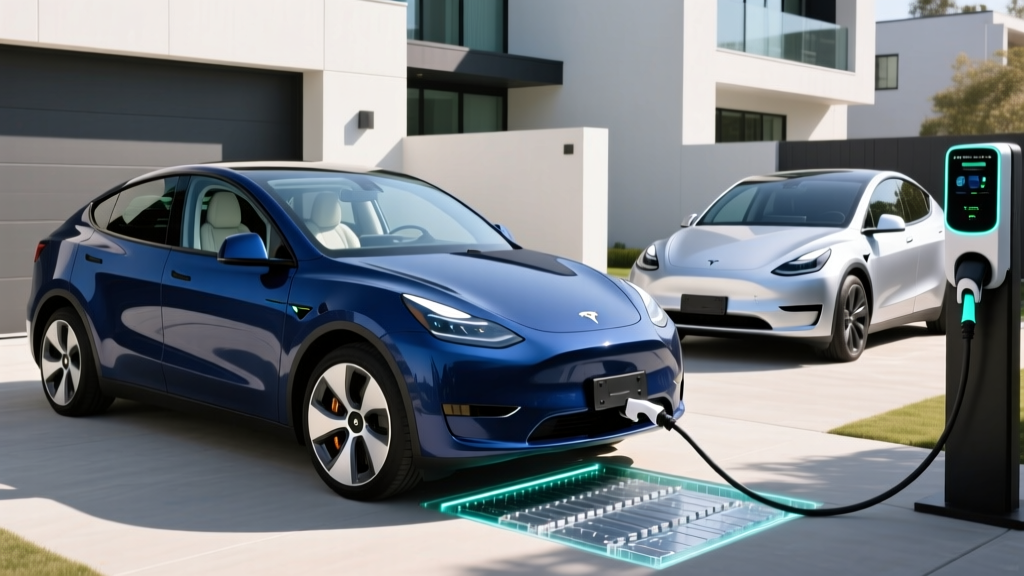
The Juniper Model Y moved to a 400-volt architecture (not 800V, as some had hoped), but Tesla's battery thermal management still enables class-leading DC fast-charging speeds. The Long Range AWD peaks at 250 kW on a V3 Supercharger or compatible CCS/NACS DC station.
| Charge Level | Power | Speed | Notes |
|---|---|---|---|
| Level 1 (120V) | ~1.4 kW | ~4 mi/hr | Emergency/trickle only; impractical for daily use |
| Level 2 (240V, 48A) | 11.5 kW | ~37 mi/hr | Home Wall Connector; full charge in ~7–8 hours |
| Level 2 (240V, 32A) | 7.7 kW | ~25 mi/hr | Mobile Connector with NEMA 14-50 adapter |
| DC Fast (peak) | 250 kW | ~170 mi in 15 min | Sustained peak from 10–45% SoC; tapers sharply above 80% |
| DC Fast (10–80%) | — | ~24 minutes | With battery preconditioning active |
The 10–80% charge time of approximately 24 minutes is competitive but no longer class-leading — the Hyundai Ioniq 5 with its 800V architecture achieves 10–80% in roughly 18 minutes. Tesla's charge curve holds strong through the mid-range (10–55% SoC at near-peak power) but tapers noticeably above 80%. On road trips, plan your stops around 10–70% to minimize time at the charger; charging from 80–100% can add 20+ minutes.
Preconditioning is essential. Navigate to a Supercharger (or any DC charger) via the car's built-in navigation, and the battery will automatically warm to optimal charging temperature. Arriving at a fast charger without preconditioning — especially in cold weather — can cut peak charge rates by 40–60%.
The Model Y ships with the NACS (North American Charging Standard) connector natively. Tesla's Supercharger network now exceeds 25,000 stalls in North America, and the Model Y also accesses Electrify America, EVgo, and ChargePoint stations via the NACS-to-CCS adapter included with the vehicle.
Performance and Driving Dynamics
The Juniper refresh brought meaningful suspension improvements. Tesla retuned the dampers, added frequency-selective rebound springs, and improved sound insulation — the result is a noticeably quieter, more compliant ride than the pre-2025 Model Y. Road noise at highway speed drops by approximately 4 dB according to Tesla's engineering data, and you feel it: expansion joints and rough pavement no longer crash through the cabin.
The Long Range AWD's 4.8-second 0–60 mph time is brisk for a family SUV, and the dual-motor all-wheel-drive system provides confident traction in rain and light snow. The Performance variant's 3.5-second 0–60 is supercar territory, though at the cost of range and ride comfort (the Performance runs stiffer springs and 21-inch wheels with thinner sidewalls).
Regen braking remains strong, enabling true one-pedal driving in most conditions. Tesla removed the user-adjustable regen setting several years ago; the default level is aggressive and takes a day or two to acclimate to if you're coming from a gas car.
Interior, Cargo, and Tech
The Juniper interior is a significant step up in perceived quality. New materials include ventilated front seats (standard on Long Range and Performance), ambient lighting integrated into the dash and door panels, and a rear-seat touchscreen for climate and entertainment control. The minimalist ethos remains — there are still no physical buttons for climate or mirrors — but execution quality has caught up to the concept.
Cargo space: The Model Y offers 30.2 cu ft behind the second row and 72.1 cu ft with the rear seats folded flat. The front trunk (frunk) adds 4.1 cu ft — useful for charging cables or a small bag. Rear legroom measures 41.6 inches, which accommodates adults comfortably on longer trips.
Infotainment: The 15.4-inch center touchscreen runs Tesla's proprietary OS, which is responsive and feature-rich but does not support Apple CarPlay or Android Auto. Navigation, media (Spotify, Apple Music, Tidal), and a built-in web browser are included. The 8-inch rear touchscreen is a welcome addition for passengers.
Driver assistance: Basic Autopilot (Traffic-Aware Cruise Control + Autosteer) is standard. Full Self-Driving (FSD) Supervised remains a $8,000 option or $99/month subscription.
Pricing, Trims, and Federal Tax Credit Eligibility
| Trim | Base MSRP | Federal Credit (§30D) | Effective Price* |
|---|---|---|---|
| RWD (Base) | $44,990 | Up to $7,500 | ~$37,490 |
| Long Range AWD | $48,990 | Up to $7,500 | ~$41,490 |
| Performance | $53,490 | Up to $7,500 | ~$45,990 |
*Effective price assumes full §30D credit eligibility. Does not include destination fee ($1,390), paint upgrades, FSD, or state/local incentives. Actual credit amount depends on battery sourcing compliance, buyer income, and tax liability.
Under current IRS §30D rules (see IRS.gov clean vehicle credits), the Model Y qualifies for up to $7,500 in federal tax credits, which can be transferred to the dealer at the point of sale as an instant price reduction. However, eligibility is not automatic. Here is what you must meet:
- MSRP cap: The vehicle's MSRP must not exceed $80,000 for SUVs (all Model Y trims clear this easily, even fully loaded)
- Buyer income cap: Modified adjusted gross income (MAGI) must not exceed $150,000 (single), $225,000 (head of household), or $300,000 (joint filers)
- Battery sourcing: A percentage of critical minerals and battery components must be sourced from the U.S. or FTA-partner countries — Tesla has restructured supply chains to largely comply, but confirm the specific VIN's eligibility at the time of purchase using the IRS VIN lookup tool
- Point-of-sale transfer: You can apply the credit as an instant rebate at purchase, reducing your out-of-pocket cost. You must file IRS Form 8936 with your tax return to reconcile
Paint color choice can affect your effective price. A Quicksilver or Starlight Green Model Y Long Range adds $2,500, bringing the MSRP to $51,490 before FSD or other options — still well under the $80,000 SUV cap. But stacking FSD ($8,000), premium paint ($2,500), and 20-inch wheels ($2,000) pushes a Long Range to approximately $61,490. You remain under the cap, but your total cost rises significantly.
Warranty and Long-Term Ownership
Tesla's warranty coverage for the 2026 Model Y:
- Basic vehicle: 4 years / 50,000 miles (whichever comes first)
- Battery and drive unit: 8 years / 120,000 miles for Long Range and Performance (NMC); 8 years / 100,000 miles for RWD (LFP)
- Battery degradation threshold: Tesla warrants that the battery will retain at least 70% of its original capacity during the warranty period
The 70% retention threshold is consistent with industry norms (Hyundai, Kia, and Ford use similar benchmarks). Real-world degradation data from Tesla's own fleet reports and third-party analyses (Recurrent Auto, Teslanomics) show that NMC packs typically lose 8–12% capacity over the first 100,000 miles, while LFP packs degrade more slowly in the early years but at a similar total rate over 150,000+ miles. Battery replacement out of warranty runs approximately $12,000–$16,000 at current pricing, though most owners never need one.
Pros and Cons
Pros
- Class-leading Supercharger network access (25,000+ stalls)
- Strong efficiency: 111 MPGe combined, low cost per mile
- Juniper ride quality significantly improved — quieter, smoother
- Over-the-air updates continuously add features
- Spacious cargo area (72.1 cu ft max) with usable frunk
- FSD subscription option ($99/mo) avoids $8,000 upfront commitment
- Full §30D tax credit eligibility on all trims
Cons
- No Apple CarPlay or Android Auto — Tesla-only infotainment
- 400V architecture limits peak DC charge speed vs. 800V rivals
- Minimalist interior controls frustrate some drivers (no stalks — turn signals on steering wheel)
- Panel gaps and paint imperfections still reported, though improved
- Insurance costs run 15–25% higher than comparable gas SUVs
- FSD remains Level 2 despite the "Full Self-Driving" name
- Rear-seat visibility is limited due to sloping roofline
Who Should Buy the 2026 Model Y?
Choose the Model Y if:
- You road-trip frequently and value Supercharger network reliability above all else
- You want a midsize EV SUV with strong cargo capacity and the option for a third-row seat (available on some trims)
- You can charge at home (Level 2) and want minimal public-charging dependency for daily driving
- You value OTA updates and a tech-forward cabin experience
Look elsewhere if:
- You need the fastest possible DC charging (Hyundai Ioniq 5's 800V architecture is quicker)
- You require Apple CarPlay for your daily workflow
- You prefer physical controls for climate, volume, and turn signals
- You want a more traditional dealership service experience (Tesla uses mobile rangers and company-owned service centers only)
The 2026 Model Y competes directly with the Hyundai Ioniq 5 (faster DC charging, CarPlay, more distinctive design), the Ford Mustang Mach-E (more engaging steering, CarPlay, BlueCruise hands-free driving), and the Kia EV6 (800V architecture, longer warranty). Against these rivals, the Model Y's advantages are the Supercharger network, efficiency, and software ecosystem. Its disadvantages are the proprietary infotainment, absence of physical controls, and 400V charge speed.
Frequently Asked Questions
What is the real-world range of the 2026 Tesla Model Y?
The EPA rates the Long Range AWD at 320 miles. In real-world highway driving at 70 mph, expect 260–285 miles. In cold weather (below 30°F), that drops to approximately 230–255 miles due to cabin heating demand and reduced battery efficiency. City driving with regenerative braking can match or exceed the EPA number.
How fast does the Model Y charge at home and on DC fast chargers?
On a Tesla Wall Connector (Level 2, 48 amps / 11.5 kW), you'll add approximately 37 miles of range per hour — a full overnight charge from empty. On a 250 kW DC Supercharger, 10–80% takes about 24 minutes with preconditioning. Plan road-trip stops around 10–70% to avoid the slow charge taper above 80%.
Does the 2026 Model Y qualify for the $7,500 federal EV tax credit?
Yes, all trims qualify under current IRS §30D rules, provided you meet the income caps ($150K single / $300K joint) and the vehicle's battery sourcing meets critical-mineral requirements at the time of purchase. The credit can be applied as a point-of-sale rebate. Always verify your specific VIN's eligibility using the IRS lookup tool before purchasing. Consult a tax professional for your individual situation.
What Tesla paint colors are available for 2026, and which are worth the premium?
Six colors are available: Pearl White (free), Solid Black ($1,500), Deep Blue Metallic ($1,500), Ultra Red ($2,000), Quicksilver ($2,500), and Starlight Green ($2,500). Pearl White hides imperfections best and costs nothing. Quicksilver and Starlight Green are the most visually striking but add significant cost. Black shows the most swirl marks and requires more maintenance.
Is the Model Y worth buying over the Ioniq 5 or Mach-E?
It depends on your priorities. The Model Y wins on Supercharger access, efficiency, cargo space, and software. The Ioniq 5 wins on DC charge speed and CarPlay. The Mach-E wins on driving feel and hands-free BlueCruise. If you road-trip often and want the most reliable charging network, the Model Y is still the default choice in 2026.
How much does insurance cost for the Model Y?
Expect $1,800–$2,800 per year depending on your state, driving record, and coverage level — roughly 15–25% more than a comparably priced gas SUV. Tesla's own insurance product (available in many states) uses real-time driving data and can be competitive for safe drivers. Always get quotes before purchasing.
What is the battery replacement cost out of warranty?
A full battery pack replacement runs approximately $12,000–$16,000 at current Tesla service pricing. However, fleet data shows that fewer than 2% of Tesla battery packs require replacement within the first 150,000 miles. The 8-year/120,000-mile battery warranty covers replacements if capacity drops below 70%.