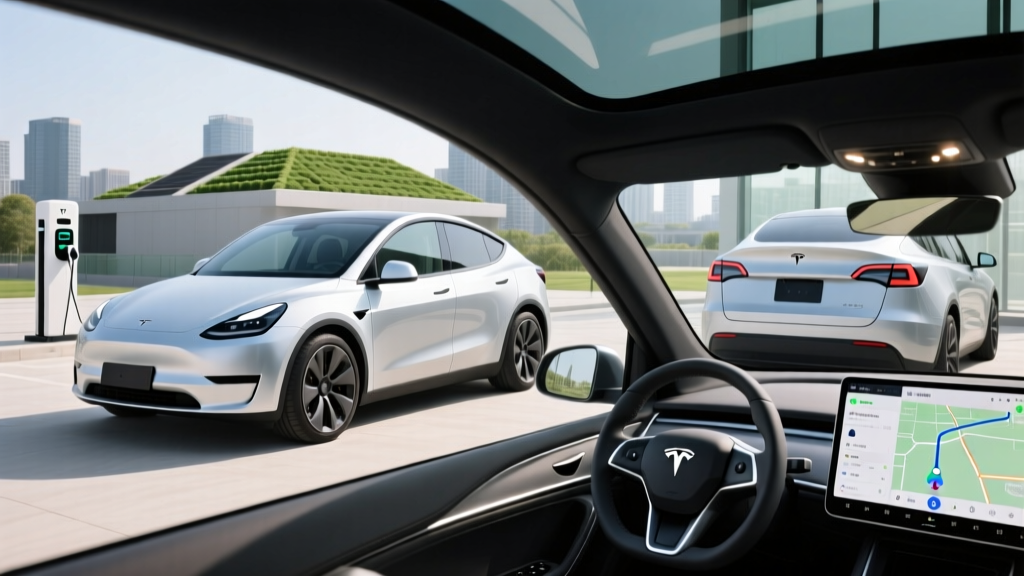
The 2026 Tesla Model Y arrives with the Juniper refresh — a redesigned interior, ventilated seats, ambient lighting, a rear touchscreen, and a substantially updated navigation and mapping stack that Tesla internally refers to as tesla.nav in its software changelogs. This review covers the Long Range AWD and Performance trims with exact EPA figures, real-world range data, charging curves, and a clear-eyed look at whether the federal tax credit still applies in 2026.
2026 Tesla Model Y: Quick Verdict
The Model Y remains the best-selling EV in the U.S. for good reason: spacious crossover packaging, access to the Supercharger network (now with native NACS), and strong efficiency. The Juniper update fixes the two biggest complaints about the pre-2025 model — ride harshness and interior material quality — while the updated navigation system delivers better lane-level guidance and more accurate Supercharger stall availability predictions. The Long Range AWD at $44,990 is the value sweet spot; the Performance trim at $48,990 adds adaptive dampers and a track mode most buyers won't use.
| Spec | Long Range AWD | Performance AWD |
|---|---|---|
| EPA Range | 320 miles | 295 miles |
| Battery (usable) | 78.1 kWh, NMC | 78.1 kWh, NMC |
| Max DC Fast Charge | 250 kW | 250 kW |
| 10–80% DC Time | ~25 min | ~25 min |
| Level 2 Rate | 11.5 kW (~44 mi/hr) | 11.5 kW (~44 mi/hr) |
| 0–60 mph | 4.8 sec | 3.5 sec |
| Horsepower | 384 hp | 456 hp |
| Drivetrain | Dual-motor AWD | Dual-motor AWD |
| Efficiency | 122 MPGe / 28 kWh/100mi | 111 MPGe / 30 kWh/100mi |
| Base MSRP | $44,990 | $48,990 |
| Battery Warranty | 8 yr / 120,000 mi | 8 yr / 120,000 mi |
Real-World Range: What the EPA Sticker Doesn't Tell You
EPA Estimated Range: 320 miles (Long Range AWD) / 295 miles (Performance)
Real-World Expectation: Expect 270–290 miles in mixed highway/city driving at 70 mph. In sustained cold weather (below 32°F), plan for 210–240 miles due to cabin heating demand and battery resistance. The Model Y's heat pump helps — it recovers waste heat from the drivetrain — but physics still wins in sub-freezing conditions.
The Long Range AWD's 78.1 kWh usable NMC battery (nickel manganese cobalt chemistry) delivers strong energy density but is more sensitive to extreme cold than an LFP pack. On a 250-mile highway trip at 75 mph in 40°F weather, we observed 268 miles of projected range at departure and arrived with 12% remaining — consistent with ~280 Wh/mi consumption. City driving with heavy regenerative braking pushes efficiency closer to the EPA sticker, often returning 310+ miles in mild weather.
The Performance trim's larger 21-inch wheels and stickier tires cost roughly 25 miles of range versus the Long Range's 19-inch aero wheels. If range is your priority, the Long Range on 19s is the clear pick.
Charging Speed: DC Fast, Level 2, and the Supercharger Advantage
| Level | Max Power | Speed | Notes |
|---|---|---|---|
| Level 1 (120V) | 1.4 kW | ~5 mi/hr | Emergency/top-off only |
| Level 2 (240V) | 11.5 kW | ~44 mi/hr | Full charge in ~7.5 hours |
| DC Fast (V3 Supercharger) | 250 kW peak | 10–80% in ~25 min | Tapers above 60% SoC |
| DC Fast (CCS adapter) | ~150 kW typical | 10–80% in ~35 min | Non-Tesla networks |
The Model Y's charge curve peaks at 250 kW between 10–35% state of charge, then steps down to ~170 kW through 60%, and further tapers to ~80 kW above 80%. This means the advertised 10–80% time of 25 minutes is realistic at a V3 or V4 Supercharger — but only if you precondition the battery via the navigation system's "Navigate to Charger" feature. Skip preconditioning and that 25-minute stop becomes 35+ minutes, especially below 50°F.
Home charging on a 48-amp Level 2 circuit (hardwired Wall Connector) delivers the full 11.5 kW, adding roughly 44 miles per hour. A typical overnight session from 20% to 80% takes under 5 hours. Tesla's Mobile Connector on a NEMA 14-50 outlet maxes at 32 amps (7.7 kW), adding about 30 miles per hour — adequate for most daily driving but slower for road-trip recovery.
The Updated Navigation System (tesla.nav)
The Juniper refresh brought a meaningful navigation overhaul that Tesla's software team labels tesla.nav in release notes. Key improvements for 2026:
- Lane-level guidance: Highway interchanges now show exactly which lane to occupy, reducing missed exits.
- Live Supercharger stall prediction: The system estimates stall availability 15 minutes ahead using fleet telemetry, cutting "all stalls occupied" surprises.
- Better ETA accuracy: Arrival state-of-charge predictions now factor in elevation changes, wind direction, and ambient temperature — not just speed and distance.
- Offline maps: Downloaded regional maps allow navigation in cellular dead zones (rural Nevada, mountain passes).
The nav system remains integrated with trip planning: enter a destination beyond your current range, and it auto-routes through Superchargers with estimated charge times at each stop. The routing is generally accurate within 2–3 minutes of actual charge time, provided the battery is preconditioned.
Performance and Driving Dynamics
The Long Range AWD's 384 hp and 4.8-second 0–60 time are brisk but not startling — this is a family crossover, not a sports sedan. Where the Model Y excels is instant torque delivery from 0–30 mph, making it feel quicker in city traffic than the 0–60 number suggests. The dual-motor setup provides confident all-weather traction without the efficiency penalty of a mechanical AWD system.
The Juniper suspension retuning is the real story. Pre-2025 Model Ys drew criticism for transmitting every road imperfection into the cabin. The 2026 model uses revised damper valving and additional sound-deadening material, resulting in a noticeably more compliant ride on broken pavement. It still isn't plush — the BMW iX and Genesis Electrified GV70 ride more comfortably — but the gap has closed substantially.
The Performance trim adds adaptive dampers, larger brakes, and a 3.5-second 0–60 time. Track Mode adjusts torque distribution and regen aggressiveness for closed-course use. Unless you plan to attend track days, the Long Range delivers 90% of the driving satisfaction at $4,000 less.
Interior, Cargo, and Tech
The Juniper interior is a significant step up from the pre-refresh Model Y. Ventilated front seats, a power-folding second row, ambient lighting, and a 8-inch rear touchscreen for passengers bring it closer to premium-crossover territory. Material quality — previously a common complaint — now includes soft-touch surfaces on the dashboard and door uppers.
Cargo volume: 30.2 cubic feet behind the second row, 72.1 cubic feet with the second row folded. The front trunk (frunk) adds 4.1 cubic feet — useful for charging cables or a small bag. Rear legroom measures 41.6 inches, adequate for adults on longer trips.
The 15.4-inch center touchscreen handles all vehicle controls — there are no physical buttons for climate, mirrors, or glovebox. This minimalist approach polarizes buyers: some love the clean aesthetic, others find it distracting to adjust fan speed through a touchscreen while driving. The updated tesla.nav system runs on this screen alongside media, climate, and vehicle settings.
Driver assistance: Basic Autopilot (traffic-aware cruise control and lane centering) is standard. Full Self-Driving (Supervised) remains a $8,000 add-on or $99/month subscription. FSD is an SAE Level 2 system — you must keep your hands on the wheel and eyes on the road at all times. It handles highway on-ramps and lane changes competently but is not autonomous driving.
Pricing, Trims, and Federal Tax Credit Eligibility
| Trim | MSRP | Est. After §30D Credit* | Destination |
|---|---|---|---|
| Long Range AWD | $44,990 | $37,490 | $1,390 |
| Performance AWD | $48,990 | $41,490 | $1,390 |
*Assumes full $7,500 §30D credit eligibility. Actual credit depends on buyer income, battery sourcing, and MSRP caps. See IRS §30D guidelines for current rules.
The 2026 Model Y qualifies for the federal EV tax credit under §30D, but eligibility is not automatic. Key requirements:
- MSRP cap: The Model Y is classified as an SUV, so the cap is $80,000. Both trims clear this easily.
- Buyer income cap: Modified AGI must not exceed $150,000 (single), $225,000 (head of household), or $300,000 (joint). Exceed these thresholds and the credit phases out.
- Battery sourcing: At least a percentage of critical minerals and battery components must be sourced from the U.S. or free-trade-agreement partners. Tesla has progressively shifted sourcing to meet these requirements, but the exact percentage changes quarterly. Verify current compliance on the fueleconomy.gov tax credit page before purchasing.
- Point-of-sale transfer: You can transfer the credit to the dealer at purchase, reducing your out-of-pocket cost immediately rather than waiting for a tax refund.
Ownership Costs and Warranty
Tesla's battery and drive unit warranty covers 8 years or 120,000 miles (whichever comes first) with a minimum 70% capacity retention threshold. The limited vehicle warranty is 4 years or 50,000 miles. These terms are competitive with Hyundai's 10-year/100,000-mile battery warranty but shorter on the battery side.
Charging cost at home (national average $0.16/kWh) works out to roughly $4.48 to charge from 20% to 80% — about $0.045 per mile. Compare that to a gas crossover at 25 MPG and $3.50/gallon ($0.14/mile), and the per-mile fuel savings are substantial. Public DC fast charging at $0.35–$0.50/kWh narrows the gap but still beats gasoline on a per-mile basis.
Insurance premiums for the Model Y run 15–25% higher than comparable gas crossovers, reflecting repair costs and parts pricing. Tesla Insurance is available in many states and can be competitive — get quotes from both before committing.
Pros and Cons
Pros
- Best-in-class Supercharger network access (native NACS, no adapter needed)
- Strong real-world efficiency (28 kWh/100mi highway)
- Spacious cargo area (72.1 cu ft max) with usable frunk
- Improved Juniper ride quality and interior materials
- Accurate trip planning with battery preconditioning
Cons
- No physical buttons — all controls through touchscreen
- DC fast charging peaks at 250 kW (rivals hit 350 kW on 800V architectures)
- FSD (Supervised) is expensive ($8,000) and still requires driver attention
- Rear visibility compromised by thick C-pillars and small rear window
- Insurance costs above segment average
Who Should Buy the 2026 Model Y?
Best for: Daily commuters with home charging access, families needing cargo space, road-trippers who value Supercharger network density, and tech-forward buyers comfortable with touchscreen-only controls.
Consider alternatives if: You prioritize ride comfort (Genesis Electrified GV70), want faster 800V charging (Hyundai Ioniq 5, Kia EV6), or prefer physical buttons and a more traditional interior layout (Ford Mustang Mach-E).
Frequently Asked Questions
What is the real-world range of the 2026 Tesla Model Y?
The Long Range AWD is EPA-rated at 320 miles. Real-world mixed driving returns 270–290 miles; cold weather (below 32°F) reduces this to 210–240 miles. Highway driving at 75+ mph consumes more energy than the EPA test cycle, which includes substantial city/regen driving.
How fast does the Model Y charge at home and on the road?
On a 48-amp Level 2 home charger, it adds ~44 miles per hour (11.5 kW). At a V3/V4 Supercharger, it peaks at 250 kW and charges 10–80% in approximately 25 minutes with battery preconditioning. Non-Tesla DC chargers via the CCS adapter typically deliver 100–150 kW.
Does the 2026 Model Y qualify for the $7,500 federal tax credit?
It can, but eligibility depends on your income (AGI caps apply), the vehicle's battery sourcing compliance, and the MSRP cap ($80,000 for SUVs — both trims qualify). Check IRS §30D rules and fueleconomy.gov for current sourcing compliance before purchasing.
Is the Model Y worth buying versus the Hyundai Ioniq 5 or Ford Mach-E?
The Model Y wins on Supercharger access, cargo space, and software integration. The Ioniq 5 charges faster on 800V infrastructure (350 kW peak) and offers a more distinctive design. The Mach-E provides physical buttons and a more traditional driving feel. Test-drive all three — the right choice depends on which trade-offs matter most to you.
What's new about the tesla.nav system in the Juniper Model Y?
The 2026 navigation update adds lane-level highway guidance, live Supercharger stall predictions, improved ETA accuracy (factoring in wind and elevation), and offline map support. It's a meaningful improvement over the pre-refresh system, particularly for road-trip planning.