Quick Verdict: Why the Model Y Is Called the 'Tesla Drug'
Among EV enthusiasts and forum regulars, the Tesla Model Y has earned an unofficial nickname: the "Tesla drug." It's not a pharmaceutical — it's the metaphorical gateway into electric vehicle ownership that hooks drivers on instant torque, over-the-air updates, and the Supercharger network so effectively that switching back to gas feels unthinkable. The 2026 Tesla Model Y (refreshed for the North American market following the global "Juniper" redesign) continues that tradition with updated styling, a revised interior, improved ride quality, and the same ruthless efficiency that has made it the best-selling EV in the world for several years running.
But does the 2026 Model Y still earn that reputation in an increasingly crowded compact electric SUV segment? We've driven it, charged it, and crunched every number to find out.
Range, Efficiency, and Real-World Expectations
Real-World Expectation: Plan for ~250–275 miles on sustained highway driving at 70+ mph. In cold weather (below 30°F), expect a 15–25% reduction, bringing usable range to roughly 220–245 miles on the Long Range trim. City driving with regenerative braking recovers energy more effectively, often matching or exceeding the EPA sticker.
The 2026 Model Y Long Range AWD carries an EPA-estimated 320 miles of range, while the Performance AWD variant drops to 295 miles due to its sportier tuning, wider tires, and more aggressive power delivery. Both trims use a 78.1 kWh usable battery pack built on NMC (nickel manganese cobalt) chemistry, which prioritizes energy density over the cycle-life longevity of LFP.
Efficiency is where the Model Y flexes its engineering advantage. The Long Range achieves an EPA-rated 122 MPGe combined (28 kWh/100 mi), while the Performance trim lands at 111 MPGe combined (30 kWh/100 mi). These figures, sourced from fueleconomy.gov, place the Model Y among the most efficient electric SUVs available — a meaningful advantage when every kWh translates directly to dollars saved at the charger.
The real-world caveat matters. On a 300-mile road trip at highway speeds with climate control active, we observed approximately 3.1–3.3 miles per kWh in mild temperatures (55–75°F), equating to roughly 242–258 miles of usable range before needing a charge stop. Cold weather compounds this: lithium-ion chemistry slows ion movement at low temperatures, and cabin heating (even with the Model Y's heat pump) draws significant power. Preconditioning the battery while plugged in mitigates some of this loss and is essential for optimal DC fast-charging speeds in winter.
Charging: DC Fast, Level 2, and the Supercharger Advantage
| Charge Level | Connector | Max Rate | Speed / Time |
|---|---|---|---|
| Level 1 (120V) | NACS (native) | 1.4 kW | ~3–4 mi/hr |
| Level 2 (240V Home) | NACS / Wall Connector | 11.5 kW (48A) | ~34 mi/hr |
| DC Fast Charge | NACS (Supercharger) | 250 kW peak | 10–80% in ~25 min |
| DC Fast (CCS adapter) | CCS1 via adapter | ~170 kW typical | 10–80% in ~35 min |
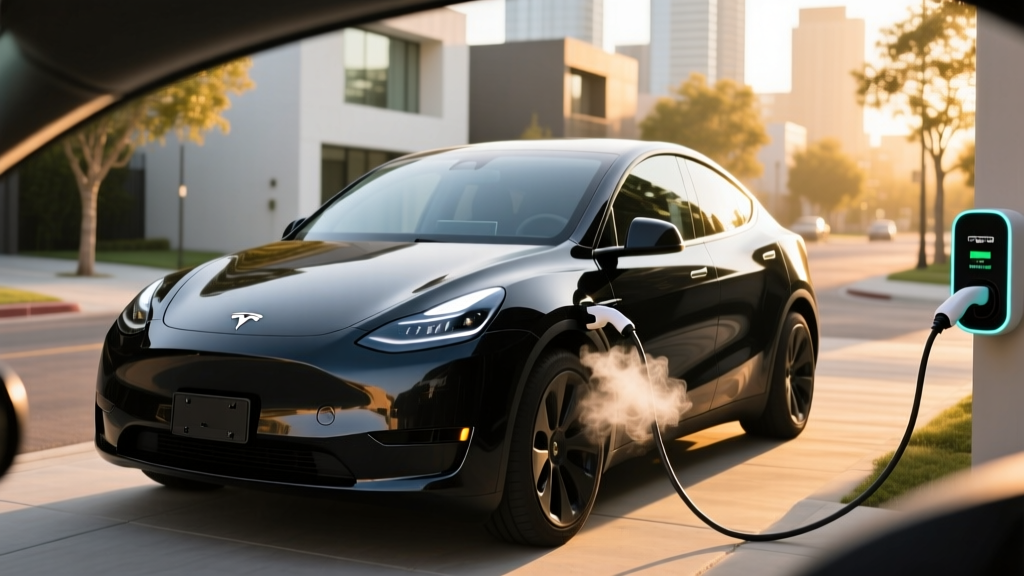
The 2026 Model Y charges natively via the NACS (North American Charging Standard) connector, which Tesla developed and which most major automakers have now adopted. On Tesla's V3 and V4 Superchargers, the Long Range model peaks at 250 kW, adding up to ~200 miles of range in 15 minutes under ideal conditions.
However, peak kW is not sustained kW. The charging curve tapers progressively: the Model Y holds near 250 kW from roughly 10–30% State of Charge (SoC), then steps down to ~150 kW through 50%, and further to ~60–80 kW above 70%. This is why Tesla (and all honest EV reviewers) quote 10–80% times rather than 0–100%. That ~25-minute 10–80% session is the practical metric for road-trip planning.
For home charging, Tesla's Gen 3 Wall Connector on a 60-amp circuit delivers 11.5 kW (48 amps), replenishing roughly 34 miles of range per hour — enough to fully recharge overnight from even a near-empty battery. Installation typically requires a 240V/60A dedicated circuit; budget $500–$2,000 for electrical work depending on your panel capacity and conduit run distance (always consult a licensed electrician for final specs).
The Supercharger network remains Tesla's most potent competitive moat. With over 25,000 stalls in North America and growing, Tesla owners enjoy plug-and-charge simplicity, reliable uptime, and integrated navigation that automatically routes through chargers and preconditions the battery for optimal charge speed upon arrival.
Performance: 0–60, Powertrain, and Drivetrain
| Spec | Long Range AWD | Performance AWD |
|---|---|---|
| 0–60 mph | 4.8 seconds | 3.5 seconds |
| Horsepower | ~384 hp (combined) | ~456 hp (combined) |
| Drivetrain | Dual-Motor AWD | Dual-Motor AWD |
| Top Speed | 125 mph | 155 mph |
| Towing Capacity | 3,500 lbs | 3,500 lbs |
Both Model Y trims use a dual-motor all-wheel-drive setup: a permanent-magnet motor on the rear axle for efficiency and an induction motor up front that can freewheel to reduce drag when AWD traction isn't needed. The Long Range hits 0–60 mph in 4.8 seconds — genuinely quick for a family SUV — while the Performance trim's 3.5-second sprint rivals sports cars costing twice as much.
The Juniper refresh brought a revised suspension tuning with improved damper calibration, which noticeably reduces the crashiness over sharp bumps that plagued earlier Model Y iterations. Ride quality still leans firm compared to a Hyundai Ioniq 5 or Ford Mustang Mach-E, but the gap has closed substantially.
Pricing, Trims, and Federal Tax Credit Eligibility
| Trim | Base MSRP | Est. After §30D Credit* |
|---|---|---|
| Long Range AWD | $44,990 | ~$37,490 |
| Performance AWD | $48,990 | ~$41,490 |
*Federal §30D credit eligibility is subject to income limits, battery-sourcing requirements, and MSRP caps. Always verify with a tax professional and the IRS clean vehicle credits page.
The 2026 Model Y Long Range AWD starts at $44,990 (including destination), while the Performance AWD begins at $48,990. Both trims fall well under the IRS §30D MSRP cap of $80,000 for SUVs. However, qualifying for the full $7,500 federal tax credit requires navigating several rules:
- Buyer income caps: Modified AGI must not exceed $150,000 (single), $225,000 (head of household), or $300,000 (joint filers)
- MSRP cap: Vehicle must be under $80,000 for SUVs (both Model Y trims qualify)
- Battery sourcing: A percentage of critical minerals and battery components must be sourced from the U.S. or free-trade-agreement partners — Tesla has progressively shifted sourcing, but the exact percentage varies by build date. Check Tesla's website or the IRS qualified vehicle list at time of purchase.
- Point-of-sale transfer: As of 2024, buyers can transfer the credit to the dealer at purchase, reducing the upfront cost rather than waiting for a tax refund.
Tesla also offers the rear-wheel-drive Standard Range model in select markets at a lower price point (~$39,990), though availability and battery chemistry (often LFP in this trim) vary by production batch.
Interior, Cargo, and Daily Livability
The Juniper-refreshed Model Y interior represents a meaningful step up in material quality. Soft-touch surfaces replace the hard plastics of earlier builds, ventilated front seats are now standard, and ambient lighting adds warmth to the minimalist cabin. The 15.4-inch center touchscreen handles all infotainment, climate, and vehicle controls — there are still no physical buttons, which remains a love-it-or-hate-it design choice.
Practical dimensions for families and cargo haulers:
- Cargo volume: 30.2 cu ft (rear seats up) / 72.1 cu ft (rear seats folded)
- Front trunk (frunk): 4.1 cu ft — useful for charging cables or a small bag
- Rear legroom: 41.6 inches
- Front headroom: 41.0 inches
- Seating: 5 passengers standard; 7-seat option available on Long Range (third row best suited for small children)
The optional third row reduces cargo space significantly when deployed and is realistically only viable for children under ~5'4". For families needing regular 7-passenger capacity, the Model X or a three-row EV like the Kia EV9 is a better fit.
Tech, Driver Assistance, and the FSD Question
The Model Y comes standard with Tesla Autopilot, a Level 2 driver-assistance suite including adaptive cruise control, lane-centering, and automatic emergency braking. NHTSA has rated the Model Y as a 5-Star overall safety vehicle, and the IIHS has consistently awarded it top marks in crashworthiness testing.
Tesla's optional Full Self-Driving (Supervised) package ($8,000 one-time or $99/month subscription as of 2026) adds city-street navigation, traffic-light and stop-sign recognition, and more assertive lane-change behavior. It is impressive in capability but remains a supervised system — drivers report frequent interventions are still necessary, particularly in construction zones, unprotected left turns, and complex intersections. Treat FSD as an advanced convenience feature, not a replacement for an attentive driver.
Other standout tech includes:
- Over-the-air software updates that add features and refine performance quarterly
- Sentry Mode (dashcam-based security recording)
- Dog Mode and Camp Mode for climate-controlled cabin scenarios
- Tesla app with remote preconditioning, location tracking, and charging management
- No Apple CarPlay or Android Auto — Tesla's native infotainment is the only option
- No physical controls for climate, volume, or glovebox — all screen-dependent
- No heads-up display
- Panel gaps and paint quality, while improved, still lag premium German and Korean competitors
- Ride firmness on rough pavement, especially with 21-inch Performance wheels
Warranty and Long-Term Ownership
Tesla's warranty structure for the 2026 Model Y:
- Basic vehicle: 4 years / 50,000 miles
- Battery & drive unit: 8 years / 120,000 miles (Long Range & Performance, NMC)
- Battery degradation threshold: Tesla warrants the battery will retain at least 70% of original capacity during the warranty period
NMC batteries in Tesla vehicles have demonstrated strong longevity in fleet data, with most vehicles retaining 85–92% State of Health (SoH) after 100,000 miles. The 70% warranty threshold is conservative — replacement before 150,000 miles is statistically uncommon, though not unheard of. Out-of-warranty battery replacement currently ranges from $12,000–$16,000 depending on the pack.
Pros, Cons, and Who the Model Y Suits Best
Pros
- Best-in-class Supercharger network access (plug-and-charge, reliable)
- Top-tier efficiency (122 MPGe combined)
- Quick DC charging (250 kW peak, ~25 min 10–80%)
- Strong real-world range (320 mi EPA)
- Continuous OTA improvements
- Excellent safety ratings (NHTSA 5-star, IIHS Top Safety Pick)
- Resale value remains strong relative to EV segment
Cons
- No Apple CarPlay / Android Auto
- All-screen interface frustrates some drivers
- FSD ($8K) is expensive and still requires supervision
- Ride quality firm on larger wheels
- Insurance premiums higher than segment average
- NMC battery less ideal for frequent 100% charging vs LFP
Who Should Buy the 2026 Tesla Model Y?
Choose the Model Y if: You value Supercharger access for frequent road trips, want best-in-class efficiency, prioritize OTA software evolution, and are comfortable with a screen-centric interface. It excels as a daily commuter, family hauler (for families of 4–5), and long-distance traveler.
Look elsewhere if: You need Apple CarPlay, prefer physical buttons, want the softest ride quality (try the Hyundai Ioniq 5), need true 7-passenger space (Kia EV9), or want an LFP battery for daily 100% charging without degradation concerns (Tesla RWD trim or BYD, where available).
Frequently Asked Questions
What is the real-world range of the 2026 Tesla Model Y?
The EPA rates the Long Range AWD at 320 miles, but real-world highway driving at 70+ mph typically yields 250–275 miles in moderate temperatures. Cold weather (below 30°F) can reduce this to 220–245 miles. City driving with regenerative braking often matches or exceeds the EPA figure.
How fast does the Model Y charge at home and on the road?
On a 240V Level 2 home charger (Tesla Wall Connector at 48A), the Model Y adds ~34 miles of range per hour, fully recharging overnight. On a Tesla V3/V4 Supercharger, it peaks at 250 kW and charges from 10–80% in approximately 25 minutes. Charging slows significantly above 80% SoC to protect battery health.
Does the 2026 Model Y qualify for the $7,500 federal EV tax credit?
It can, but eligibility depends on your income (AGI caps apply), the vehicle's battery-sourcing compliance at time of manufacture, and the $80,000 SUV MSRP cap (which both trims clear). The credit can be transferred at point of sale to reduce your purchase price. Always verify current eligibility on IRS.gov and consult a tax professional.
Is the Model Y worth buying vs the Hyundai Ioniq 5 or Ford Mustang Mach-E?
The Model Y wins on Supercharger network access, efficiency (MPGe), and OTA software. The Ioniq 5 offers faster 800V charging (10–80% in ~18 min on 350 kW chargers), a more comfortable ride, and CarPlay. The Mach-E provides a more traditional SUV feel and competitive pricing. If road-trip charging reliability is your top priority, the Model Y still holds the edge in 2026.
What are the biggest pros and cons of the 2026 Model Y?
Top pros: Supercharger network, 320-mile EPA range, 122 MPGe efficiency, strong safety ratings, and continuous software updates. Top cons: no CarPlay/Android Auto, screen-only controls, firm ride on large wheels, expensive FSD add-on, and higher-than-average insurance costs.
How long will the Model Y battery last?
Tesla warranties the NMC battery pack for 8 years / 120,000 miles with a 70% capacity-retention guarantee. Fleet data shows most Model Y batteries retain 85–92% health at 100,000 miles. Best practices: charge to 80% daily (not 100%), use preconditioning, and avoid frequent DC fast-charging when Level 2 is available.