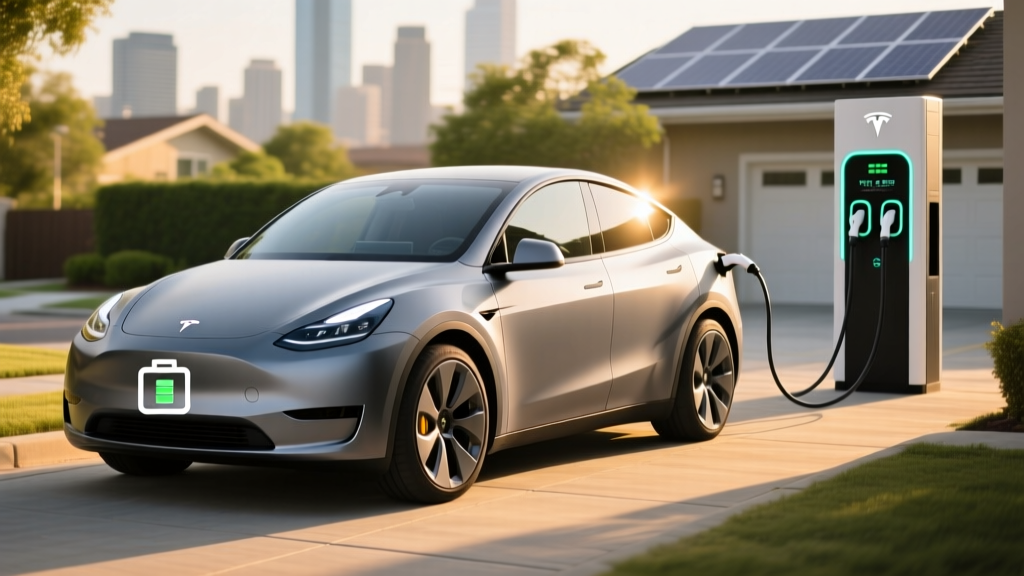
The Tesla 2025 update — internally known as the "Juniper" refresh — brought the Model Y its most significant overhaul since launch. Revised styling, a retuned suspension, an updated interior with ambient lighting and ventilated seats, and minor powertrain efficiency tweaks all arrived for the 2025 model year. But beneath the cosmetic changes, the core question for buyers remains: does the refreshed Model Y still lead the midsize electric SUV segment, or have rivals closed the gap?
We've spent time with the 2025 Model Y Long Range AWD and Performance variants to bring you exact numbers on range, charging behavior, pricing, and federal tax credit eligibility under current IRS §30D rules.
2025 Model Y Specifications at a Glance
| Spec | Long Range AWD | Performance |
|---|---|---|
| EPA Range | 320 miles | 294 miles |
| Battery (usable) | ~75 kWh, NMC | ~75 kWh, NMC |
| Drivetrain | Dual-motor AWD | Dual-motor AWD |
| Horsepower | 384 hp | 456 hp |
| 0–60 mph | 4.8 sec | 3.5 sec |
| Peak DC Fast Charge | 250 kW | 250 kW |
| 10–80% DC Time | ~27 min | ~27 min |
| Level 2 Charge Rate | 11.5 kW (~44 mi/hr) | 11.5 kW (~44 mi/hr) |
| MPGe (combined) | 111 MPGe | 103 MPGe |
| kWh/100 mi | 30 kWh | 33 kWh |
| Cargo (rear seats up) | 30.2 cu ft | 30.2 cu ft |
| Cargo (rear seats folded) | 72.0 cu ft | 72.0 cu ft |
| Rear Legroom | 41.6 in | 41.6 in |
| Battery Warranty | 8 yr / 120,000 mi | 8 yr / 120,000 mi |
| Base MSRP | $44,990 | $51,490 |
Sources: fueleconomy.gov, Tesla Model Y design page. Specs reflect 2025 model year as published. Verify trim-level details at time of purchase.
Range: EPA Sticker vs. Real-World Expectations
EPA estimate: 320 miles (Long Range AWD)
Real-world highway (70–75 mph, mild weather): ~270–290 miles
Cold weather (below 32°F, mixed driving): ~230–260 miles
City/regenerative driving (moderate temps): ~300–320 miles
The 2025 Model Y Long Range carries a 320-mile EPA estimate — a modest improvement over the outgoing model, driven by the Juniper refresh's slightly improved aerodynamics and thermal management refinements. But as with every EV, the sticker number assumes a specific blend of city and highway driving at moderate temperatures.
In sustained highway driving at 70–75 mph in 60–75°F conditions, expect roughly 270–290 miles before needing to plug in. The Model Y's efficiency of 30 kWh/100 mi is competitive for the segment, though the Hyundai Ioniq 5 and Kia EV6 edge slightly ahead on the highway thanks to their 800V architectures enabling more aggressive regenerative tuning.
Cold weather is where the NMC battery chemistry and Tesla's heat pump work together. Tesla's octovalve thermal management system is among the best in the industry at scavenging waste heat from the drivetrain to warm the cabin and battery. Even so, plan for 20–25% range reduction in sustained sub-freezing temperatures. If your commute is under 40 miles round-trip, this won't matter day-to-day. For winter road trips, build in a charging stop 50 miles earlier than your summer plan.
Charging Speed: DC Fast Charging and Home Level 2
The 2025 Model Y retains a peak DC fast-charge rate of 250 kW on Tesla's V3 and V4 Supercharger stalls. On the CCS/NACS connector (Tesla's native plug, now adopted industry-wide as the North American Charging Standard), you'll see the charge curve ramp quickly to ~250 kW at low state of charge, then taper progressively.
| Charging Level | Power (kW) | Speed (mi/hr added) | Notes |
|---|---|---|---|
| Level 1 (120V household) | ~1.4 kW | ~5 mi/hr | Emergency/top-up only |
| Level 2 (240V, 48A home) | 11.5 kW | ~44 mi/hr | Full charge in ~7 hr |
| DC Fast (V3 Supercharger) | Up to 250 kW | Up to ~1,000 mi/hr peak | 10–80% in ~27 min |
| DC Fast (non-Tesla CCS) | Up to 250 kW (adapter) | Varies by station | Requires NACS-to-CCS adapter |
The 10–80% charge time of roughly 27 minutes is solid but no longer class-leading. The Hyundai Ioniq 5 and Kia EV6, with their 800V architectures, can complete 10–80% in approximately 18 minutes on a 350 kW charger. Tesla's 400V architecture limits peak charge rate to 250 kW. For most owners who charge at home overnight, this matters mainly on road trips — and Tesla's Supercharger network reliability still outpaces third-party CCS networks like Electrify America in real-world uptime.
For home charging, the onboard charger accepts up to 11.5 kW (48 amps on a 60-amp circuit). A full charge from near-empty takes about 7 hours. Most owners install a Tesla Wall Connector or equivalent NACS Level 2 unit; expect $500–$800 for the equipment and $800–$2,000 for electrician labor depending on panel proximity and local permit requirements. If your home has a 200-amp electrical panel with spare capacity, installation is straightforward. Older 100-amp panels may require a $2,000–$4,000 upgrade.
Performance and Driving Dynamics
The Long Range AWD's dual-motor setup delivers 384 hp and a 4.8-second 0–60 mph time — brisk for a family SUV and more than adequate for highway merging and passing. The Performance trim bumps output to 456 hp and drops the sprint to 3.5 seconds, putting it in sports-car territory.
The Juniper refresh brought a retuned suspension with revised damper rates and updated bushings. The result is noticeably improved ride quality over pre-2025 models, which drew criticism for firmness and road noise. Cabin noise levels are lower thanks to additional acoustic glass and insulation. The steering remains precise and communicative by EV standards, though it's weighted toward comfort rather than sportiness in the standard driving mode.
Regenerative braking in the Model Y remains single-pedal-friendly. Tesla removed the user-adjustable regen setting several years ago, so you get one fixed (strong) regen level. Most owners adapt within a week and rarely touch the friction brake pedal in daily driving. The brake-by-wire system blends regen and friction braking seamlessly.
Interior, Cargo, and Technology
The 2025 Juniper interior is where the most visible changes landed. Tesla added:
- Ambient lighting strips across the dashboard and door panels
- Ventilated front seats (previously heated only)
- A rear-seat touchscreen for climate and media control
- Revised center console with improved storage
- Updated materials including softer-touch surfaces on the dash and armrests
Cargo capacity remains generous at 30.2 cubic feet behind the second row and 72.0 cubic feet with the 60/40-split rear seats folded. The front trunk (frunk) adds roughly 4.1 cubic feet — useful for charging cables or a small bag. Rear legroom of 41.6 inches is competitive with the Ford Mustang Mach-E and slightly trails the Hyundai Ioniq 5's flat-floor cabin.
The 15.4-inch center touchscreen runs Tesla's proprietary infotainment OS, which remains one of the most responsive and feature-rich systems available. Navigation, media, climate, vehicle settings, and the Tesla app ecosystem all run through this single display. There is no Apple CarPlay or Android Auto — a dealbreaker for some buyers who prefer phone-mirroring interfaces. The built-in navigation with real-time Supercharger routing and battery preconditioning is excellent and reduces the need for phone projection on road trips.
On the driver-assistance front, the Model Y ships with basic Autopilot (lane centering + adaptive cruise control), which is an SAE Level 2 system — you must keep your hands on the wheel and eyes on the road at all times. Full Self-Driving (Supervised) is an optional $8,000 upgrade (or $99/month subscription) that adds automatic lane changes, traffic light/stop sign recognition, and enhanced navigation-based routing. Despite the name, FSD Supervised is also SAE Level 2 and requires constant driver engagement. It is not autonomous driving.
Tesla Autopilot and FSD (Supervised) are SAE Level 2 driver-assistance systems. The driver must remain fully engaged — hands on wheel, eyes on road — at all times. These systems do not make the vehicle self-driving. Only Level 4 services like Waymo operate without a human driver, and those are limited to geofenced areas.
Pricing, Trim Levels, and Federal Tax Credit Eligibility
As of the 2025 model year, Tesla offers the Model Y in two main configurations:
| Trim | Base MSRP | Destination | Total Before Incentives |
|---|---|---|---|
| Long Range AWD | $44,990 | $1,390 | $46,380 |
| Performance AWD | $51,490 | $1,390 | $52,880 |
The Long Range AWD at $46,380 (including destination) falls under the IRS §30D MSRP cap of $80,000 for SUVs, making it potentially eligible for the federal tax credit. The Performance trim at $52,880 also clears the cap comfortably.
- MSRP cap: Vehicle must be ≤ $80,000 for SUVs — both Model Y trims qualify ✓
- Buyer income cap: Modified AGI ≤ $300,000 (joint), $225,000 (head of household), $150,000 (single)
- Battery sourcing: Must meet critical minerals and battery component requirements (phased thresholds increase annually — verify current-year rules on irs.gov)
- Assembly: Vehicle must undergo final assembly in North America — Model Y (Fremont/Austin) qualifies ✓
- Point-of-sale transfer: As of 2024+, eligible buyers can transfer the credit to the dealer for an immediate price reduction at purchase
- Credit amount: Up to $7,500, split between critical minerals ($3,750) and battery components ($3,750) — partial credit possible if only one requirement is met
Tax credit rules are subject to change. Consult a tax professional and verify current eligibility at irs.gov before purchasing.
If you qualify for the full $7,500 credit, the effective price of the Long Range AWD drops to approximately $38,880 — a compelling value for a 320-mile AWD electric SUV. The point-of-sale transfer option means you don't need to wait until tax filing to benefit; the credit reduces your purchase price at the dealership (or, in Tesla's case, at delivery).
Pros, Cons, and the Competition
- Best-in-class Supercharger network access
- 320-mile EPA range with strong real-world efficiency
- Excellent thermal management / cold-weather performance
- Class-leading cargo space and practicality
- Over-the-air updates continuously add features
- Strong resale value relative to EV segment average
- Improved ride quality with Juniper refresh
- 250 kW peak charge rate trails 800V rivals (Ioniq 5, EV6)
- No Apple CarPlay or Android Auto
- FSD (Supervised) is expensive and still Level 2
- Minimal physical controls — everything via touchscreen
- Insurance premiums run 15–30% above segment average
- Turn-signal stalk removed (steering-wheel buttons) — polarizing
The Model Y's most direct competitors in the midsize electric SUV segment include the Hyundai Ioniq 5 (faster charging, more physical controls, CarPlay), the Ford Mustang Mach-E (sportier handling, CarPlay, BlueCruise), and the Kia EV6 (similar platform to Ioniq 5, striking design). The Chevrolet Equinox EV undercuts on price with a similar range but trails in performance and charging speed.
Where the Model Y still wins decisively is the Supercharger network. Even as Tesla opens Superchargers to non-Tesla EVs, Tesla vehicles benefit from seamless plug-and-charge integration, automatic routing with battery preconditioning, and the highest station density along major US corridors. For frequent road-trippers, this remains a significant ownership advantage.
Who Should Buy the 2025 Model Y?
- Choose the Model Y Long Range if: You want a practical family EV with excellent range, top-tier charging infrastructure, and strong cargo versatility — and you don't need Apple CarPlay.
- Choose the Model Y Performance if: You want sports-car acceleration in an SUV body and are willing to sacrifice ~26 miles of range for it.
- Consider the Ioniq 5 or EV6 instead if: Faster DC charging (18-min 10–80%), physical buttons, and Apple CarPlay/Android Auto are priorities.
- Consider the Mach-E instead if: You prefer a more engaging driving experience, want Ford's BlueCruise for hands-free highway driving, and value CarPlay integration.
- Consider the Equinox EV instead if: Budget is the primary driver and you can accept slower charging and lower performance.
The 2025 Model Y is best suited for families and commuters who value range confidence, road-trip practicality, and access to the most reliable fast-charging network in the US. It's a rational, data-backed choice — not the most exciting EV to drive, but one of the most livable.
Frequently Asked Questions
What is the real-world range of the 2025 Tesla Model Y?
The EPA rates the Long Range AWD at 320 miles. In real-world highway driving at 70–75 mph in mild weather, expect 270–290 miles. In cold weather (below 32°F), plan for 230–260 miles. City driving with regenerative braking can approach or match the EPA figure.
How fast does the 2025 Model Y charge at home and on DC fast chargers?
On a DC fast charger (Tesla V3 Supercharger), the Model Y peaks at 250 kW and charges from 10–80% in approximately 27 minutes. At home on a Level 2 (240V, 48A) charger, it adds about 44 miles of range per hour, with a full charge taking roughly 7 hours.
Does the 2025 Model Y qualify for the $7,500 federal EV tax credit?
Both trims fall under the $80,000 SUV MSRP cap and are assembled in the US, so they meet two key §30D requirements. However, eligibility also depends on your income (≤ $300K joint / $150K single), and the vehicle's battery must meet critical-mineral and component-sourcing thresholds that tighten annually. Verify current-year rules at irs.gov and consult a tax professional.
Is the 2025 Model Y worth buying vs. the Hyundai Ioniq 5 or Ford Mach-E?
It depends on your priorities. The Model Y wins on Supercharger network access, cargo space, and overall efficiency. The Ioniq 5 wins on DC charging speed (18-min 10–80% on 350 kW) and offers CarPlay. The Mach-E wins on driving engagement and hands-free highway capability with BlueCruise. All three are strong choices — test-drive each and compare what matters most for your daily use.
What is the battery warranty on the 2025 Model Y?
Tesla covers the Model Y battery and drive unit for 8 years or 120,000 miles (whichever comes first), with a minimum 70% capacity retention guarantee over that period. This is competitive with the segment; Hyundai/Kia offer 10-year/100,000-mile battery coverage.
Is Tesla's Full Self-Driving actually self-driving?
No. FSD (Supervised) is an SAE Level 2 driver-assistance system. Despite the name, it requires you to keep your hands on the steering wheel and monitor the road at all times. It does not make the vehicle autonomous. Level 4 driverless operation is currently limited to geofenced robotaxi services like Waymo in select cities.