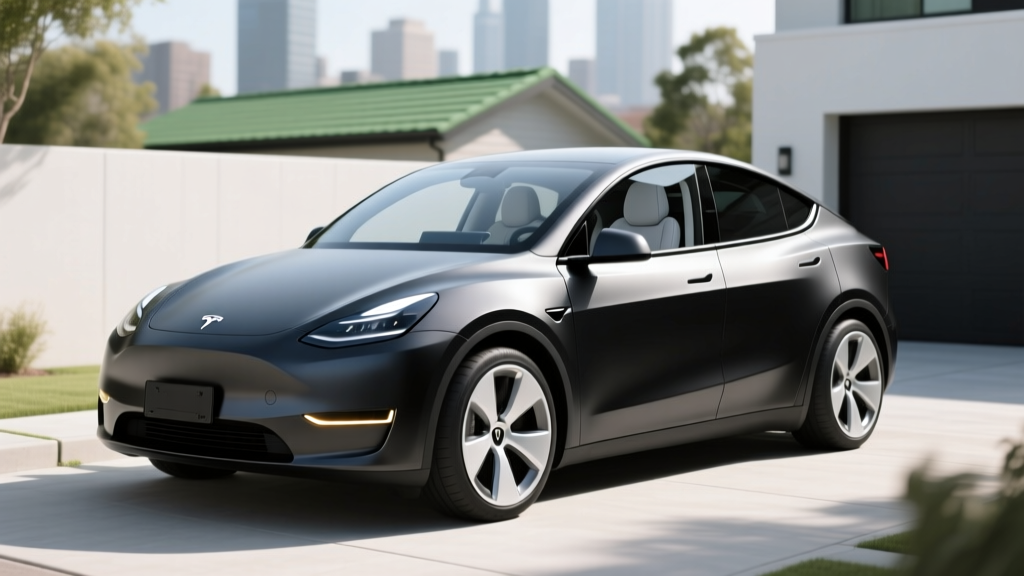
The Tesla Model Y remains America's best-selling electric vehicle for good reason: it threads the needle between range, space, charging speed, and price better than almost anything else on the market. But the 2025 model year brought a significant interior overhaul — dubbed the "Juniper" refresh — that finally addresses the cabin complaints that dogged earlier builds. This review covers the 2025 Model Y's interior quality, real-world range, charging behavior, and whether it still holds up against a rapidly closing competitive field in 2026.
Quick Verdict: Who the 2025 Model Y Is For
The 2025 Tesla Model Y Long Range AWD is the default recommendation for buyers who need a practical, fast-charging electric crossover with strong Supercharger network access. It's ideal for families who road-trip frequently, commuters with home Level 2 charging, and tech-forward buyers who want over-the-air updates. It's less suited to buyers who prioritize button-based controls, luxury material quality at the BMW iX level, or those without reliable home charging access in apartment settings.
Choose the Model Y if: You value Supercharger reliability, best-in-class cargo space, and minimalist tech. Look at the Hyundai Ioniq 5 or Ford Mustang Mach-E instead if: You prefer physical climate controls, 800V ultra-fast charging, or a more traditional cockpit layout.
Tesla Model Y 2025 Interior: What the Juniper Refresh Actually Changed
The headline for the 2025 model year is the interior. Tesla overhauled the cabin with higher-grade materials, improved acoustic insulation, ventilated front seats, ambient lighting strips across the dash and doors, and a rear-seat touchscreen for climate and media control. The result is a cabin that finally feels commensurate with a $45,000+ vehicle rather than a $30,000 one.
Key interior upgrades include:
- Acoustic glass: Laminated front and rear side windows reduce highway wind noise substantially compared to the 2024 model.
- Ventilated front seats: Perforated leatherette with active cooling — a long-requested feature for hot-climate owners.
- Ambient lighting: A continuous light strip across the dashboard and door panels with customizable color, replacing the previous sparse footwell lighting.
- Rear 8-inch touchscreen: Mounted on the back of the center console, it controls rear climate, heated seats, and media — reducing the "everything through the front screen" frustration for rear passengers.
- Improved materials: Soft-touch surfaces on the dashboard upper, door armrests, and center console lid replace the hard plastics of prior years.
- Power-folding second row: Available on select trims, improving cargo flexibility.
The 15.4-inch front touchscreen remains the command center for nearly all vehicle functions. The steering wheel integrates turn signals and gear selection (no stalks), which continues to polarize buyers. Wireless phone charging, USB-C ports front and rear, and a premium 16-speaker audio system round out the tech.
Cargo and Passenger Dimensions
| Measurement | 2025 Model Y Long Range AWD |
|---|---|
| Cargo volume (rear seats up) | 30.2 cu ft |
| Cargo volume (rear seats folded) | 72.1 cu ft |
| Front legroom | 41.8 in |
| Rear legroom | 41.6 in |
| Front headroom | 41.0 in |
| Rear headroom | 39.4 in |
| Frunk (front trunk) | 4.1 cu ft |
The Model Y's cargo capacity remains a segment leader. For reference, the Hyundai Ioniq 5 offers 27.2 cu ft behind the rear seats, and the Ford Mustang Mach-E provides 29.7 cu ft. The Model Y's tall roofline and boxy rear hatch give it a practical edge for strollers, camping gear, and Costco runs.
Range, Battery, and Efficiency: EPA vs. Real World
The 2025 Model Y Long Range AWD carries an EPA-estimated range of 320 miles, powered by a 78.1 kWh usable battery pack using NMC (nickel manganese cobalt) chemistry. The Long Range RWD variant achieves 335 miles EPA with a slightly different motor configuration. The base (Standard Range) model was discontinued for 2025 in the US market.
EPA Range: 320 miles (Long Range AWD)
Real-World Expectation: 270–295 miles on mixed highway/city driving at 70 mph; 240–260 miles in sub-freezing winter conditions (below 32°F). Highway efficiency drops to roughly 3.8–4.0 miles/kWh at sustained 75+ mph speeds. City driving with regen braking can exceed the EPA estimate, reaching 330+ miles in mild weather.
Efficiency is rated at 122 MPGe combined (city 127 / highway 117) per fueleconomy.gov, translating to approximately 28 kWh per 100 miles. This remains among the most efficient electric crossovers available, thanks to Tesla's heat pump, aerodynamic optimization, and powertrain efficiency.
Battery Chemistry: NMC vs. LFP — What It Means for You
The Long Range AWD uses NMC chemistry, which offers higher energy density (more range in a smaller, lighter pack) but is more sensitive to sustained 100% state of charge. Tesla recommends daily charging to 80% for NMC packs, reserving 100% for road trips. If you want an LFP (lithium iron phosphate) battery — which tolerates daily 100% charges with minimal degradation — you'll need to look at the Standard Range variants sold in other markets, or wait for potential future US offerings.
| Factor | NMC (Long Range AWD) | LFP (Standard Range, where available) |
|---|---|---|
| Energy density | Higher (more range per kg) | Lower |
| Daily charge recommendation | 80% SoC | 100% SoC OK |
| Cold-weather performance | Better low-temp output | More range loss in cold |
| Cycle life | ~1,500–2,000 cycles | ~3,000+ cycles |
| Cost | Higher | Lower |
Charging Speed: DC Fast, Level 2, and the Supercharger Advantage
Charging speed is where the Model Y's Supercharger network access becomes a decisive advantage for road-trippers. The 2025 Model Y supports up to 250 kW peak DC fast charging on V3 Superchargers and compatible CCS stations (via the built-in NACS port, which is now the North American standard).
| Charging Level | Power / Rate | Speed / Time |
|---|---|---|
| DC Fast Charge (V3 Supercharger / CCS) | 250 kW peak | 10–80% in ~25 minutes; adds ~175 miles in 15 min |
| DC Fast Charge (V4 Supercharger) | Up to 250 kW (vehicle-limited) | Similar to V3; V4 hardware supports higher, but Model Y caps at 250 kW |
| Level 2 (Home / Public AC) | 11.5 kW (48A) | ~37 miles per hour of charging; 0–100% in ~8.5 hours |
| Level 1 (120V household outlet) | ~1.4 kW (12A) | ~4 miles per hour; emergency/trickle only |
Charging curve reality: The 250 kW peak is not sustained across the entire session. Expect peak rates between 10–30% SoC, tapering to ~150 kW by 50%, and ~60 kW above 80%. A 10–80% session on a V3 Supercharger takes approximately 25 minutes in warm conditions. In cold weather without preconditioning, this can stretch to 35+ minutes — always use the car's navigation to route to a Supercharger, which triggers battery preconditioning automatically.
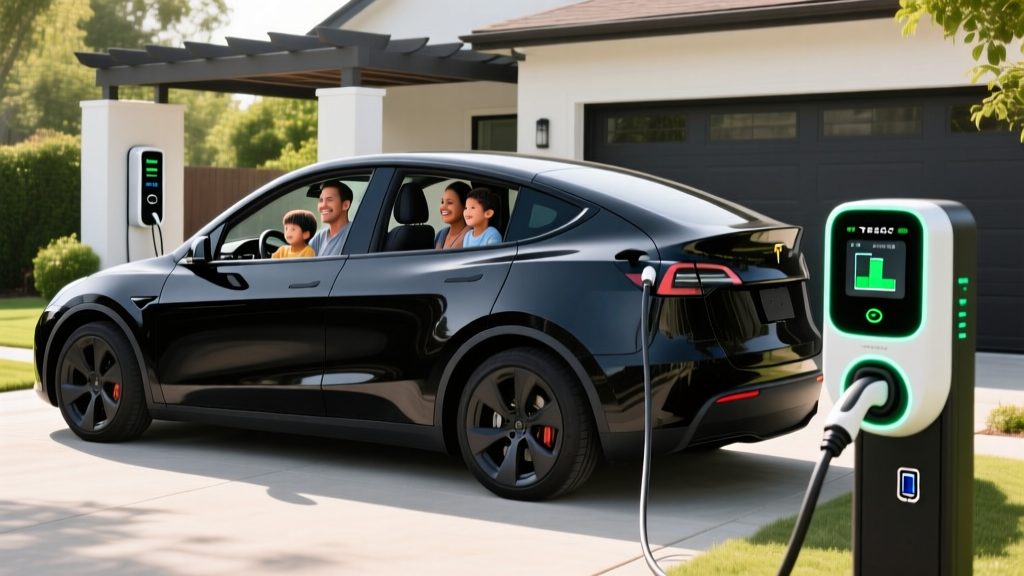
For home charging, a 48-amp Level 2 wall connector on a 60-amp circuit is the recommended setup. Installation typically costs $500–$1,500 depending on panel proximity and local permitting. Tesla's Wall Connector retails for approximately $475.
Performance: 0–60, Horsepower, and Drivetrain
The 2025 Model Y Long Range AWD uses a dual-motor all-wheel-drive setup producing 384 horsepower and 375 lb-ft of torque. The 0–60 mph time is 4.8 seconds — quick enough for confident highway merging and passing, if not as thrilling as the Performance variant's 3.5-second sprint.
| Spec | Long Range AWD |
|---|---|
| 0–60 mph | 4.8 seconds |
| Horsepower | 384 hp |
| Torque | 375 lb-ft |
| Drivetrain | Dual-motor AWD |
| Top speed | 135 mph |
| Towing capacity | 3,500 lbs (with tow package) |
Ride quality improved for 2025 with retuned dampers and revised suspension bushings, reducing the crashy low-speed ride that characterized 2022–2024 models. It's still firm compared to a Hyundai Ioniq 5 or Kia EV6, but no longer objectionable on rough pavement.
Pricing, Trims, and Federal Tax Credit Eligibility
The 2025 Model Y Long Range AWD starts at $44,990 MSRP (before destination). A fully loaded example with Full Self-Driving (Supervised), red paint, and 20-inch wheels can reach approximately $54,000.
| Trim | Base MSRP | Est. After §30D Credit |
|---|---|---|
| Long Range AWD | $44,990 | ~$37,490 (if eligible) |
| Long Range AWD + FSD (Supervised) | $52,990 | ~$45,490 (if eligible) |
Does It Qualify for the Federal EV Tax Credit?
The 2025 Model Y Long Range AWD may qualify for up to $7,500 under IRS §30D, but eligibility depends on several factors that change frequently:
- MSRP cap: SUVs/crossovers must be under $80,000 MSRP — the Model Y qualifies.
- Buyer income cap: Modified AGI must not exceed $150,000 (single), $225,000 (head of household), or $300,000 (joint). Check your prior-year or current-year AGI, whichever is lower.
- Battery sourcing: Critical minerals and battery components must meet phased-in percentage thresholds from US or free-trade-agreement countries. Tesla's US-built packs have generally met these requirements, but sourcing rules tighten annually. Verify current eligibility at fueleconomy.gov before purchase.
- Point-of-sale transfer: As of 2024+, you can transfer the credit to the dealer at purchase, reducing your out-of-pocket cost immediately rather than waiting for tax filing.
Critical caveat: Tax credit rules shift with new IRS guidance and supply-chain changes. Always confirm eligibility with your tax professional and the official IRS clean vehicle list before signing a purchase agreement.
Driver Assistance and Tech: Autopilot, FSD, and Safety
Every 2025 Model Y includes Basic Autopilot (Traffic-Aware Cruise Control and Autosteer) as standard. The optional Full Self-Driving (Supervised) package ($8,000) adds automated lane changes, Navigate on Autopilot, traffic light/stop sign recognition, and Autopark.
SAE Level 2 — Driver Supervision Required. Both Autopilot and FSD (Supervised) are Level 2 driver-assistance systems. You must keep your hands on the wheel and eyes on the road at all times. These are NOT self-driving systems. Only Level 4 services like Waymo operate without a human driver in defined areas.
What FSD (Supervised) does NOT do: It does not handle construction zones reliably, may not detect emergency vehicles consistently, can struggle in heavy rain/snow, and requires constant driver engagement. You are legally responsible for the vehicle at all times.
The 2025 Model Y earned a 5-star overall safety rating from NHTSA and is an IIHS Top Safety Pick+. Standard active safety features include automatic emergency braking, blind-spot monitoring, lane departure warning, and rear cross-traffic alert.
Warranty, Ownership Costs, and Longevity
Tesla's warranty coverage for the 2025 Model Y:
- Basic vehicle: 4 years / 50,000 miles
- Battery & drive unit: 8 years / 120,000 miles (whichever comes first), with a minimum 70% capacity retention guarantee
- Roadside assistance: 4 years / 50,000 miles
The 8-year/120,000-mile battery warranty is competitive with Hyundai's 10-year/100,000-mile offering. Real-world degradation data from Tesla's fleet suggests NMC packs retain approximately 88–92% capacity after 100,000 miles under normal use patterns (daily 80% charge, occasional 100%). Battery replacement out of warranty currently runs $12,000–$16,000 depending on pack configuration.
Insurance premiums for the Model Y tend to run 15–25% higher than comparable gas crossovers due to repair costs and parts pricing. Get a quote before purchasing — in some states, Model Y insurance can exceed $2,500/year for a clean-record driver under 40.
Pros, Cons, and the Competition
Pros
- Supercharger network reliability remains unmatched for road trips
- Best-in-class cargo space (72.1 cu ft max)
- Excellent efficiency (122 MPGe combined)
- Significantly improved interior for 2025
- Strong over-the-air update cadence
- Federal tax credit eligible (subject to sourcing/income rules)
Cons
- No physical buttons or stalks — all controls via touchscreen
- 250 kW DC peak charge rate trails Hyundai/Kia's 800V/350 kW architecture
- FSD (Supervised) remains Level 2 and polarizing in value
- Insurance costs above segment average
- Ride quality improved but still firm vs. competitors
- No Apple CarPlay or Android Auto
Model Y vs. Key Competitors
Against the Hyundai Ioniq 5: The Ioniq 5 charges faster (800V architecture, 10–80% in ~18 min at 350 kW), offers physical climate buttons, and has a more distinctive design. But it has less cargo space (27.2 cu ft) and lacks Supercharger access (though this is changing as Hyundai adopts NACS).
Against the Ford Mustang Mach-E: The Mach-E offers a more engaging driving experience and traditional cockpit layout. Range is comparable (EPA 320 mi for Extended Range AWD), but the Supercharger advantage and cargo space favor the Model Y.
Against the BMW iX xDrive50: The iX offers genuinely premium materials, a quieter cabin, and 300+ miles of range — but starts above $85,000, well beyond the Model Y's price bracket.
Frequently Asked Questions
What is the real-world range of the 2025 Tesla Model Y?
Expect 270–295 miles in mixed driving at highway speeds in moderate temperatures. In winter conditions below 32°F, range drops to 240–260 miles. City driving with regenerative braking can exceed the 320-mile EPA estimate in mild weather.
How fast does the Model Y charge at home and on road trips?
On a V3 Supercharger, 10–80% takes approximately 25 minutes at up to 250 kW. At home on a 48-amp Level 2 charger, you'll add about 37 miles per hour, fully charging overnight in roughly 8.5 hours.
Does the 2025 Model Y qualify for the $7,500 federal tax credit?
It may, depending on your income (under $150K single / $300K joint AGI), the vehicle's MSRP (under $80K — it qualifies), and current battery-sourcing compliance. Verify at fueleconomy.gov and with a tax professional before purchasing.
Is the 2025 Model Y interior actually better than the 2024?
Yes — meaningfully so. The Juniper refresh added acoustic glass, ventilated seats, ambient lighting, rear touchscreen, and upgraded soft-touch materials. It's a substantial improvement in perceived quality and noise isolation.
Should I buy the Model Y or wait for the next refresh?
The Juniper refresh is current for 2025–2026. No major redesign is expected before 2028. If the current specs meet your needs, there's no compelling reason to wait.
Does the Model Y have Apple CarPlay or Android Auto?
No. Tesla uses its proprietary infotainment system exclusively. Phone integration is limited to Bluetooth for calls/media and the Tesla app for remote features.