Tesla's 1.99% APR Offer: What Buyers Need to Know
Tesla periodically rolls out promotional financing to move inventory, and the Tesla Model Y 1.99% APR offer is one of the most aggressive incentive structures the company has deployed for its best-selling crossover. For qualified buyers, this rate dramatically reduces the cost of borrowing compared to prevailing auto loan rates, which hover around 6-8% for new vehicles in 2026. But a low APR only matters if the underlying vehicle — and its total cost of ownership — makes sense for your driving needs.
This review covers the 2026 Tesla Model Y in full: range, charging speed, interior practicality, tax credit eligibility, and how the 1.99% APR financing stacks up against cash purchase or competing EVs. We'll also address the real-world limitations that spec sheets don't show.
2026 Tesla Model Y: Core Specifications
| Spec | Long Range RWD | Long Range AWD | Performance |
|---|---|---|---|
| EPA Range | 320 mi | 308 mi | 285 mi |
| Battery (usable) | ~75 kWh (LFP) | ~75 kWh (NMC) | ~75 kWh (NMC) |
| Drivetrain | Rear-Wheel Drive | Dual-Motor AWD | Dual-Motor AWD |
| 0-60 mph | 5.8 sec | 4.8 sec | 3.5 sec |
| Horsepower | 346 hp | 384 hp | 456 hp |
| Top Speed | 135 mph | 135 mph | 155 mph |
| MPGe (combined) | 122 MPGe | 115 MPGe | 111 MPGe |
| Efficiency (kWh/100mi) | 28 kWh | 30 kWh | 31 kWh |
| Base MSRP | $44,990 | $47,990 | $52,490 |
| Cargo Volume | 76 cu ft (rear seats folded) / 34 cu ft (behind 2nd row) | ||
| Rear Legroom | 40.5 in | ||
Source: fueleconomy.gov, Tesla spec sheets. Specs reflect 2026 model year.
Real-World Range: What the EPA Number Doesn't Tell You
Real-World Highway (70 mph, mild weather): ~260-280 miles
Real-World Cold Weather (below 30°F, mixed driving): ~210-240 miles
City / Moderate Climate: ~290-310 miles
The EPA range figure is a blended-cycle estimate that includes generous city-regen recovery. On sustained highway drives at 70+ mph, expect to lose roughly 12-18% versus the sticker. Cold weather compounds this: lithium-ion cells lose efficiency below freezing, and cabin heating draws significant power even with the Model Y's heat pump system. In our experience, a 300-mile winter road trip requires at least one DC fast-charge stop for comfortable margin.
The LFP (lithium iron phosphate) battery in the RWD trim offers slightly lower energy density than NMC but tolerates regular 100% charging without accelerated degradation — a meaningful advantage for daily commuters who want full range every morning.
Charging Speed: DC Fast, Level 2, and the Supercharger Advantage
| Charging Method | Power (kW) | Rate / Time | Notes |
|---|---|---|---|
| DC Fast Charge (Supercharger V4) | Up to 250 kW peak | 10-80% in ~22 min | Sustained rate drops above 60% SoC; full curve tapers significantly past 80% |
| DC Fast Charge (3rd-party CCS via NACS adapter) | Up to 150-200 kW | 10-80% in ~28-35 min | Depends on station; Electrify America, EVgo compatible with included adapter |
| Home Level 2 (Tesla Wall Connector, 48A) | 11.5 kW | ~37 miles/hr added | Full charge in ~7-8 hours; requires 60A circuit |
| Home Level 2 (standard 240V/32A outlet) | 7.7 kW | ~25 miles/hr added | Adequate for most daily driving; 10-12 hr full charge |
| Level 1 (120V standard outlet) | ~1.4 kW | ~4 miles/hr added | Emergency / trickle only; ~45+ hr full charge |
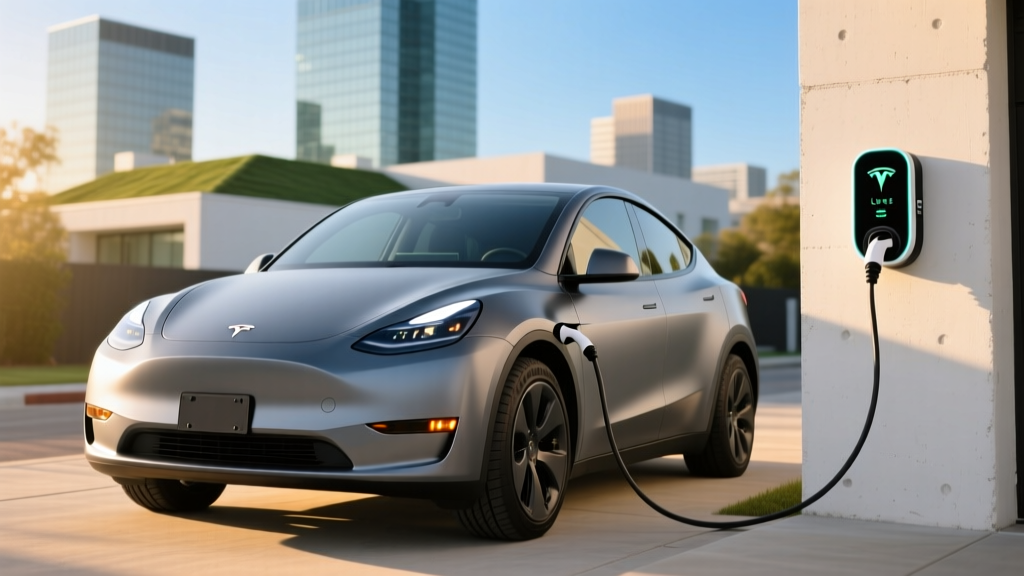
Tesla's NACS (North American Charging Standard) connector is now the dominant plug in North America. The Model Y ships with NACS natively, giving it seamless access to the Tesla Supercharger network — over 20,000 stalls in the US alone. For non-Tesla networks, Tesla includes a CCS adapter (or sells one) that opens up Electrify America and EVgo stations, though peak speeds are often lower on third-party hardware.
The 250 kW peak rate is only sustained briefly, typically between 10-30% SoC. Above 60%, the charge curve tapers to protect battery health. Plan road-trip stops around the 10-80% window for optimal time efficiency — charging from 80-100% can add 20+ minutes for relatively few miles.
Pricing, the 1.99% APR Deal, and Tax Credit Math
The Tesla Model Y 1.99% APR financing is typically offered for 36- to 60-month terms on well-qualified buyers (generally FICO 720+). Here's what that looks like versus a standard-rate loan on the Long Range AWD at $47,990 MSRP:
| Financing Scenario | Loan Term | Monthly Payment (est.) | Total Interest Paid |
|---|---|---|---|
| Tesla 1.99% APR (promo) | 60 months | ~$841 | ~$2,470 |
| Standard bank loan (6.9% APR) | 60 months | ~$949 | ~$8,950 |
| Cash purchase (no financing) | N/A | $0 | $0 |
Interest savings with 1.99% APR: roughly $6,400 over 60 months compared to prevailing market rates. This is a meaningful offset to the Model Y's premium pricing.
Federal Tax Credit Eligibility (§30D)
- Maximum credit: $7,500 (if both battery-sourcing and critical-minerals requirements are met; $3,750 if only one is met)
- MSRP cap: Vehicle must be under $80,000 (SUVs/crossovers) — Model Y qualifies at all trims
- Buyer income cap: AGI must not exceed $150,000 (single) / $300,000 (joint) / $225,000 (head of household)
- Battery sourcing: Must meet escalating critical-mineral and battery-component requirements per IRS §30D rules
- Point-of-sale transfer: Eligible buyers can transfer the credit to the dealer for an immediate price reduction at purchase
Eligibility varies by buyer and model year. Consult a tax professional and verify current-year rules at irs.gov before purchase.
The Model Y's battery sourcing has historically qualified for at least partial credit. If you meet income thresholds and the vehicle meets sourcing requirements, the effective price drops by $3,750-$7,500 — bringing the Long Range AWD to approximately $40,490-$44,240 after credit. Combined with the 1.99% APR financing, the total cost of ownership becomes highly competitive with mid-range gas crossovers.
Interior, Tech, and Daily Usability
The Model Y's interior follows Tesla's minimalist philosophy: a single 15-inch center touchscreen handles all infotainment, climate, and vehicle controls. There is no traditional instrument cluster — speed and navigation appear on the screen's left edge. The 2026 refresh (Project Juniper) brought updated ambient lighting, ventilated front seats, power-folding second-row seats, and a rear passenger touchscreen.
Cargo and passenger space:
- 34 cu ft behind second row (76 cu ft with seats folded)
- Front trunk (frunk): ~4.1 cu ft — useful for charging cables or a small bag
- Rear legroom: 40.5 in (competitive with mid-size SUVs)
- Seating: 5-passenger standard; 7-seat option available on some trims (third row is very tight, best for small children)
Driver assistance:
Tesla's Autopilot (standard) and Full Self-Driving Supervised ($8,000 option) are Level 2 driver-assist systems. They provide adaptive cruise control, lane centering, and automated lane changes — but the driver must remain attentive, keep hands on the wheel, and be prepared to take over immediately. These systems are not autonomous. Only Level 4 services like Waymo operate without a human driver.
Standard Autopilot is competent for highway commuting. FSD Supervised adds traffic-light recognition, city-street navigation, and more assertive lane management, but its performance varies by geography and road complexity. For most buyers, standard Autopilot is sufficient; FSD is an expensive upgrade that doesn't yet deliver on its full promise.
Warranty, Reliability, and Ownership Costs
| Coverage | Term |
|---|---|
| Basic Vehicle Warranty | 4 years / 50,000 miles |
| Battery & Drive Unit Warranty | 8 years / 120,000 miles (Long Range/Performance); 8 years / 100,000 miles (RWD) |
| Battery Capacity Retention | Minimum 70% over warranty period |
Tesla's battery warranty guarantees at least 70% capacity retention over 8 years or the stated mileage. Real-world degradation data from high-mileage owners suggests most Model Y packs retain 88-92% capacity at 100,000 miles, with the steepest drop occurring in the first 10,000-20,000 miles before leveling off. LFP batteries in the RWD model tend to degrade more slowly but start with slightly lower energy density.
Notable ownership considerations:
- Insurance: Model Y premiums run 15-30% higher than comparable gas crossovers due to repair costs and parts pricing. Get a quote before committing.
- Tires: EVs are heavy and torque-dense; expect tire replacement every 25,000-35,000 miles. Budget $800-$1,400 for a set of EV-optimized tires.
- Maintenance: No oil changes, spark plugs, or transmission fluid. Brake pads last far longer due to regenerative braking. Annual cabin air filter and wiper service runs ~$100-150.
- Charging cost: At the US average electricity rate of ~$0.16/kWh, a full 75 kWh charge costs ~$12. Home charging is dramatically cheaper than gas; Supercharger rates ($0.25-$0.40/kWh) narrow the gap but still beat gasoline per mile.
How the Model Y Compares to Key Competitors
| Tesla Model Y LR AWD | Ford Mustang Mach-E ER AWD | Hyundai Ioniq 5 Limited AWD | Kia EV6 GT-Line AWD | |
|---|---|---|---|---|
| EPA Range | 308 mi | 290 mi | 290 mi | 282 mi |
| Peak DC Charge | 250 kW | 150 kW | 240 kW | 240 kW |
| 10-80% Time | ~22 min | ~38 min | ~18 min | ~18 min |
| Base MSRP | $47,990 | $48,995 | $53,500 | $52,900 |
| Cargo (rear up) | 34 cu ft | 29.7 cu ft | 27.2 cu ft | 24.4 cu ft |
| Charging Network | NACS (Supercharger native) | NACS (adapter) | NACS (adapter) | NACS (adapter) |
The Model Y's primary advantages are cargo volume, Supercharger network access (native NACS, no adapter needed), and over-the-air software updates that continually add features. The Ioniq 5 and EV6 charge faster on compatible 800V infrastructure, and the Mach-E offers a more traditional interior layout. None match the Model Y's combination of range, space, and charging infrastructure breadth.
Pros and Cons
- Class-leading cargo space (76 cu ft max)
- Native Supercharger network access
- 1.99% APR financing saves ~$6,400 vs. market rates
- Strong efficiency (115+ MPGe combined)
- Continual OTA software improvements
- Competitive 0-60 performance across all trims
- Minimalist interior not for everyone (no physical buttons)
- Insurance premiums above segment average
- FSD Supervised ($8K) underdelivers vs. marketing
- Ride quality firm on larger wheel options
- No Apple CarPlay / Android Auto
- Service center wait times can be long in some markets
Who Should Buy the Tesla Model Y (and Who Shouldn't)
Buy it if:
- You need a practical family crossover with strong cargo capacity and road-trip range
- You have access to home Level 2 charging and want low running costs
- You value Supercharger network reliability for frequent long-distance travel
- You qualify for the §30D tax credit and the 1.99% APR financing, maximizing savings
- You prefer tech-forward, minimalist interiors and OTA updates
Look elsewhere if:
- You want physical buttons, traditional gauges, or Apple CarPlay
- You live in an apartment without charging access and rely entirely on public infrastructure
- You need a third row with real adult-sized seating (consider the Kia EV9 or Rivian R1S)
- Your budget is strictly under $35,000 (the Model Y, even after credits, starts above $40K)
Frequently Asked Questions
What is the real-world range of the 2026 Tesla Model Y?
The EPA rates the Long Range RWD at 320 miles and the Long Range AWD at 308 miles. In real-world highway driving at 70 mph, expect roughly 260-280 miles. In cold weather below freezing, plan for 210-240 miles of usable range. The heat pump helps but doesn't eliminate winter range loss.
How fast does the Model Y charge at home and on the road?
On a Tesla Supercharger V4, the Model Y peaks at 250 kW and charges from 10-80% in about 22 minutes. At home on a Level 2 Wall Connector (48A/11.5 kW), it adds roughly 37 miles of range per hour, fully charging overnight in 7-8 hours. On a standard 240V/32A outlet, expect ~25 miles per hour of charging.
How much does the Model Y cost after the federal tax credit?
If you qualify for the full $7,500 §30D credit (meeting income caps, MSRP limits, and battery-sourcing requirements), the Long Range AWD drops from $47,990 to approximately $40,490. With partial credit ($3,750), it's about $44,240. The 1.99% APR financing further reduces total cost by saving ~$6,400 in interest versus a standard 6.9% loan.
Does the Tesla Model Y qualify for the federal EV tax credit?
The Model Y qualifies as an SUV under the IRS §30D MSRP cap of $80,000. Whether you receive $3,750 or $7,500 depends on current battery-sourcing and critical-minerals compliance (which can change by model year) and your personal income. The credit can be transferred to the dealer at point of sale for an immediate price reduction. Always verify current-year eligibility on irs.gov or with a tax professional.
Is the Model Y worth buying over the Hyundai Ioniq 5 or Ford Mach-E?
For buyers who prioritize cargo space, Supercharger network access, and over-the-air updates, the Model Y remains the benchmark. The Ioniq 5 charges faster on 800V stations (10-80% in ~18 minutes) and offers a more conventional interior. The Mach-E provides a more engaging driving feel. If Supercharger access matters to your travel patterns, the Model Y's native NACS advantage is significant.
How long will the Model Y battery last?
Tesla warranties the battery for 8 years/120,000 miles (Long Range/Performance) or 8 years/100,000 miles (RWD), guaranteeing at least 70% capacity retention. Real-world data from high-mileage owners shows most packs retain 88-92% at 100,000 miles. Full battery replacement (rare) costs approximately $12,000-$16,000 out of warranty.