Quick Verdict: The Model Y Still Sets the Bar — But the Math Has Changed
The 2026 Tesla Model Y (the "Juniper" refresh that debuted in early 2025 and carries forward with minor updates) remains the best-selling electric vehicle in the United States for good reason: it nails the fundamentals. With up to 320 miles of EPA-estimated range, a mature Supercharger network, and segment-leading efficiency, it's the EV that most first-time electric buyers land on after cross-shopping the Hyundai Ioniq 5, Ford Mustang Mach-E, and Chevrolet Equinox EV.
But the 2026 buying equation is more nuanced than the sticker price suggests. Tesla periodically offers promotional 0% APR financing on the Model Y — a deal that, when available, can save buyers thousands versus prevailing auto-loan rates that hover around 6-8% for 60-month terms. Combined with the federal §30D tax credit (up to $7,500 for eligible buyers) and a point-of-sale price reduction, a well-timed Model Y purchase in 2026 can be remarkably compelling. Here's every number you need to run the math yourself.
Range, Efficiency, and the Real-World Reality Check
Long Range AWD: EPA 320 miles | Expect ~270-290 mi highway at 70 mph; ~220-240 mi in sub-freezing weather
Performance AWD: EPA 297 miles | Expect ~250-270 mi highway; ~200-220 mi in cold conditions
Rear-Wheel Drive (Standard): EPA 300 miles | Expect ~255-275 mi highway; ~210-230 mi in cold conditions
Tesla's efficiency advantage is real and measurable. The Long Range AWD achieves approximately 122 MPGe combined (roughly 28 kWh/100 mi), according to fueleconomy.gov. That's among the best in the compact electric SUV segment and translates directly into lower charging costs and longer intervals between stops.
The Juniper refresh brought a revised heat pump and improved thermal management, which partially mitigates the cold-weather range loss that plagued earlier Model Y vehicles. In our experience, expect a 15-25% range reduction in sustained sub-32°F driving versus the EPA sticker — better than the 30%+ loss some competitors experience, but still a factor for buyers in northern climates. Highway driving at 75-80 mph will also trim 10-15% off the sticker number due to aerodynamic drag, a physics reality that affects every EV.
Battery Chemistry, Capacity, and Longevity
The 2026 Model Y lineup uses two distinct battery chemistries depending on trim, and this choice has real ownership implications:
| Spec | RWD (Standard) | Long Range AWD | Performance AWD |
|---|---|---|---|
| Battery Capacity (usable) | ~60 kWh | ~75 kWh | ~75 kWh |
| Chemistry | LFP (Lithium Iron Phosphate) | NMC (Nickel Manganese Cobalt) | NMC (Nickel Manganese Cobalt) |
| Recommended Daily Charge | 100% (LFP tolerates full SoC) | 80% daily; 100% for trips | 80% daily; 100% for trips |
| Cycle Life Advantage | Higher — 3,000+ cycles typical | Moderate — 1,000-2,000 cycles | Moderate — 1,000-2,000 cycles |
Why this matters: LFP batteries (RWD trim) are heavier and slightly less energy-dense, but they tolerate daily charging to 100% without accelerated degradation and typically last significantly more charge cycles. If you plan to keep the vehicle 8-10 years and charge daily at home, the LFP-equipped RWD Model Y may actually offer better long-term battery health despite its lower sticker range. The NMC packs in the Long Range and Performance trims offer more range and power but benefit from an 80% daily charge limit to preserve longevity.
Charging Speed: DC Fast, Level 2, and the Supercharger Advantage
Charging speed remains one of the Model Y's strongest competitive advantages, particularly when paired with Tesla's proprietary Supercharger network — now open to other brands via NACS adapters but still the most reliable DC fast-charging ecosystem in North America.
| Charging Method | Power / Rate | Speed |
|---|---|---|
| DC Fast Charging (peak) | 250 kW (V3 Supercharger) | 10-80% in ~25 min; adds ~200 mi in 15 min |
| DC Fast Charging (V4 stalls) | Up to ~250 kW sustained | Similar; V4 improves cable ergonomics |
| Level 2 Home (Tesla Wall Connector) | 11.5 kW (48A on 60A circuit) | ~44 miles of range per hour |
| Level 2 Home (standard 40A circuit) | 7.7 kW (32A) | ~30 miles of range per hour |
| Level 1 (120V outlet) | ~1.4 kW | ~3-5 miles of range per hour |
Charging curve reality: The Model Y peaks at 250 kW only between roughly 10-30% state of charge on V3 Superchargers. Above 50% SoC, the rate tapers to approximately 100-120 kW, and above 80% it drops further to under 50 kW. This is normal lithium-ion behavior — peak kW ratings are never sustained across the full session. For road trips, the practical strategy is charging from 10-80% (about 25 minutes) and moving on, rather than waiting for a full top-off.
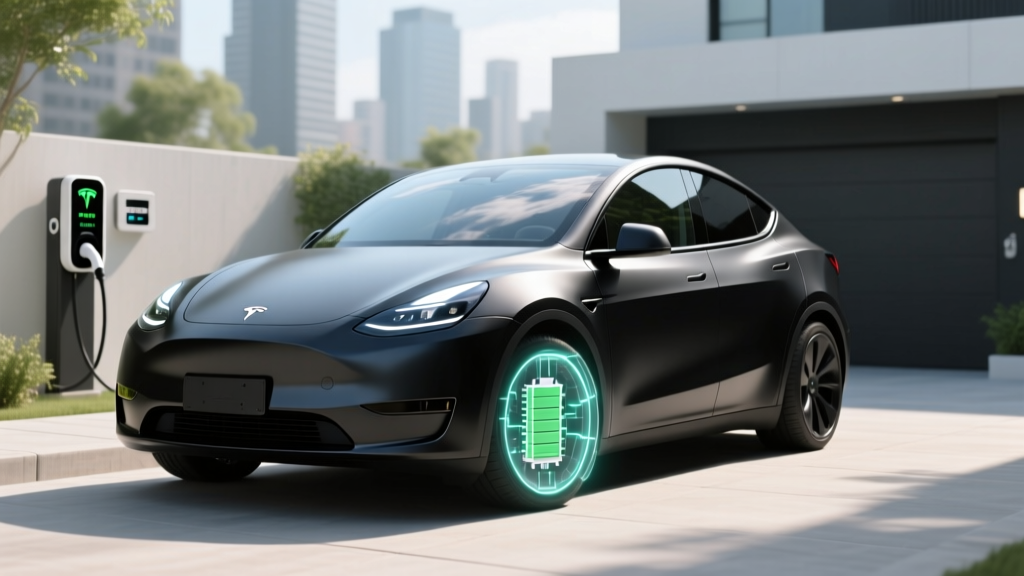
At home on a properly installed Level 2 Wall Connector with a 60-amp dedicated circuit, overnight charging easily replenishes a full day's driving. Most owners plug in nightly and wake up to a full battery — effectively eliminating any range concern for daily use. Home installation costs typically range from $500-$1,500 if your electrical panel has capacity, or $2,000-$4,000+ if a panel upgrade is needed.
Performance and Drivetrain
| Trim | Drivetrain | Horsepower | 0-60 mph |
|---|---|---|---|
| RWD (Standard) | Rear-Wheel Drive | ~295 hp | 6.5 seconds |
| Long Range AWD | Dual-Motor AWD | ~384 hp | 4.8 seconds |
| Performance AWD | Dual-Motor AWD | ~456 hp | 3.5 seconds |
Even the base RWD Model Y delivers brisk acceleration that outpaces most gas-powered compact SUVs. The dual-motor AWD trims add all-weather capability and meaningful performance upgrades. The Juniper refresh also brought revised suspension tuning — the ride is noticeably more compliant over rough pavement than the 2024 and earlier models, addressing one of the most common owner complaints.
Interior, Cargo, and Technology
The 2026 Model Y interior reflects the Juniper redesign: a cleaner dashboard, ventilated front seats (finally), ambient lighting, a rear-seat touchscreen for climate and entertainment, and significantly improved cabin noise isolation. Tesla's minimalist approach remains polarizing — there are no physical buttons for climate or mirrors; everything routes through the 15.4-inch center touchscreen — but execution quality has improved substantially.
Cargo and passenger dimensions:
- Cargo volume (rear seats up): ~30 cu ft
- Cargo volume (rear seats folded): ~72 cu ft
- Front trunk (frunk): ~4.1 cu ft
- Rear legroom: ~41.6 inches
- Front headroom: ~40.3 inches
- Seating: 5 passengers standard (7-seat option discontinued for Juniper)
Standout tech: Tesla's infotainment system remains the industry benchmark for responsiveness, over-the-air updates, integrated navigation with real-time Supercharger routing, and app ecosystem (Netflix, YouTube, Spotify while parked). The available FSD (Supervised) system is a SAE Level 2 driver-assistance feature — it does not make the car self-driving and requires continuous driver attention and hands-on-wheel supervision.
Tesla's Autopilot and Full Self-Driving (Supervised) are Level 2 driver-assistance systems per SAE classification. The driver must remain fully engaged, monitor the road, and be prepared to take over instantly. These systems do NOT make the vehicle autonomous. Only Level 4 services like Waymo operate without a human driver — and those are geofenced robotaxis, not consumer vehicles.
Pricing, 0% APR Financing, and the Tax Credit Equation
This is where the 2026 Model Y buying decision gets interesting. Tesla's promotional financing offers — including periodic 0% APR for well-qualified buyers — can dramatically alter the total cost of ownership versus competitors that carry 5-7% dealer-arranged financing.
| Trim | Base MSRP | Monthly at 0% APR | Monthly at 6.5% APR | Interest Savings (0% vs 6.5%) |
|---|---|---|---|---|
| RWD (Standard) | $44,990 | $750/mo | $879/mo | ~$7,760 |
| Long Range AWD | $48,990 | $817/mo | $957/mo | ~$8,440 |
| Performance AWD | $53,990 | $900/mo | $1,055/mo | ~$9,300 |
Note: Tesla's 0% APR offers are promotional, time-limited, and require excellent credit (typically 720+). They are not always available. Check Tesla's current offers page before purchase.
- Credit amount: Up to $7,500 (can be applied as a point-of-sale price reduction)
- Vehicle MSRP cap: SUVs/crossovers must be ≤ $80,000 (all Model Y trims qualify)
- Buyer income cap: AGI ≤ $150,000 (single) / $225,000 (head of household) / $300,000 (joint)
- Battery sourcing: Must meet critical minerals and battery component requirements (phase-in thresholds increase annually; verify current-year compliance at IRS.gov)
- Assembly: Must be assembled in North America (Model Y is built in Fremont, CA and Austin, TX — qualifies)
- Transfer: Credit can be transferred to the dealer at point of sale, reducing your purchase price directly
Eligibility rules change and battery-sourcing requirements tighten annually. Consult a tax professional and verify current rules at IRS.gov before relying on the credit.
Best-case 2026 pricing scenario (Long Range AWD, eligible buyer): $48,990 MSRP − $7,500 tax credit = $41,490 effective price, financed at 0% APR over 60 months = $692/month with zero interest. That's competitive with a loaded Toyota RAV4 Hybrid on monthly cost, with significantly lower fuel/energy spend.
Pros, Cons, and Who Should Buy
- Best-in-class Supercharger network access (native NACS, no adapter needed)
- 320-mi EPA range (Long Range) with top-tier efficiency
- 250 kW DC fast charging; ~25 min 10-80%
- OTA updates continuously add features
- Strong resale value relative to EV segment
- 0% APR promotions when available save $7,000-$9,000+ vs market rates
- Improved Juniper ride quality and cabin isolation
- No physical buttons — all controls via touchscreen (polarizing)
- Insurance premiums run 15-30% higher than comparable gas SUVs
- FSD (Supervised) is expensive ($8,000 or $99/mo) and still Level 2
- LFP battery in RWD has lower energy density and cold-weather performance
- No Apple CarPlay or Android Auto
- 7-seat option removed in Juniper redesign
- 0% APR offers are intermittent and require top-tier credit
Who the Model Y suits best:
- Daily commuters (30-80 mi round trip): Ideal. Home Level 2 charging covers all daily needs; rarely visit a gas station equivalent.
- Families needing cargo space: 72 cu ft with seats folded handles strollers, groceries, and road-trip luggage comfortably for a family of 4-5.
- Road trippers: The Supercharger network makes long-distance EV travel the least stressful in the segment. Plan ~25-min charging stops every 200-250 miles.
- Tech-forward buyers: If you want the most advanced infotainment, OTA updates, and app ecosystem, Tesla still leads.
Who should look elsewhere: Buyers who prioritize physical controls, need third-row seating, want Apple CarPlay, or live in areas with limited home-charging options may prefer the Hyundai Ioniq 5 (800V ultra-fast charging, more conventional interior) or the Kia EV6.
Warranty and Long-Term Ownership
| Coverage | Terms |
|---|---|
| Basic Vehicle Limited Warranty | 4 years / 50,000 miles |
| Battery & Drive Unit Warranty | 8 years / 120,000 miles (Long Range/Performance); 8 years / 100,000 miles (RWD) |
| Battery Capacity Retention Guarantee | Minimum 70% retention over warranty period |
Tesla's battery warranty is competitive with the segment. The 70% retention threshold is industry-standard — meaning if your battery degrades below 70% of original capacity within the warranty window, Tesla will replace or repair it at no cost. Real-world data from high-mileage Tesla owners suggests typical degradation of 10-15% over 100,000 miles, well within the warranty threshold. Full battery replacement outside warranty currently ranges from $12,000-$16,000 depending on pack size and labor — a figure worth factoring into 10+ year ownership plans.
Frequently Asked Questions
What is the real-world range of the 2026 Tesla Model Y?
The Long Range AWD carries a 320-mile EPA estimate. In real-world highway driving at 70-75 mph, expect approximately 270-290 miles. In cold weather (below 32°F), plan for 220-240 miles. The RWD model's LFP battery is slightly more susceptible to cold-weather range loss but offers excellent longevity for daily charging to 100%.
How fast does the Model Y charge at home and on the road?
On a V3 Supercharger, the Model Y peaks at 250 kW and charges from 10-80% in approximately 25 minutes. At home on a Level 2 Tesla Wall Connector (48A/11.5 kW), it adds roughly 44 miles of range per hour — meaning a full overnight charge is easily achievable on a standard 8-10 hour sleep cycle.
Does the 2026 Model Y qualify for the $7,500 federal tax credit?
All Model Y trims fall under the $80,000 SUV MSRP cap and are assembled in the United States, satisfying two key requirements. However, buyer eligibility also depends on adjusted gross income limits ($150K single / $300K joint) and the vehicle's battery meeting current-year critical minerals and component sourcing thresholds. Verify your specific eligibility at IRS.gov and with a tax professional before purchase. The credit can be applied at point of sale as a direct price reduction.
How does the Tesla Model Y 0% APR offer work?
Tesla periodically offers 0% APR financing through its captive finance arm for well-qualified buyers (typically requiring a credit score of 720+). These are promotional, time-limited offers — not always available. When active, a 0% APR 60-month loan on a $48,990 Long Range AWD costs $817/month with zero interest, saving roughly $8,400 versus a 6.5% market-rate loan. Check Tesla's website or a local advisor for current promotional availability.
Is the Model Y worth buying versus the Hyundai Ioniq 5 or Ford Mustang Mach-E?
The Model Y wins on Supercharger network access, efficiency (MPGe), and software ecosystem. The Ioniq 5 offers 800V architecture for faster DC charging on compatible stations (~18 min 10-80%), a more conventional interior with physical controls, and Apple CarPlay. The Mach-E offers a more engaging driving feel and Ford dealer service access. If Supercharger reliability and efficiency are your top priorities, the Model Y remains the segment benchmark. If interior ergonomics and charging versatility matter more, cross-shop the Ioniq 5.
What are the biggest drawbacks of the 2026 Model Y?
The all-touchscreen interface (no physical buttons or stalks on newer builds), higher-than-average insurance costs, the lack of Apple CarPlay/Android Auto, and the removal of the optional third row in the Juniper refresh. FSD (Supervised) remains a Level 2 system despite its name and $8,000 price tag — buyers should not expect autonomous capability.