Tesla Model Y at 0% APR: The Deal Behind the Headline
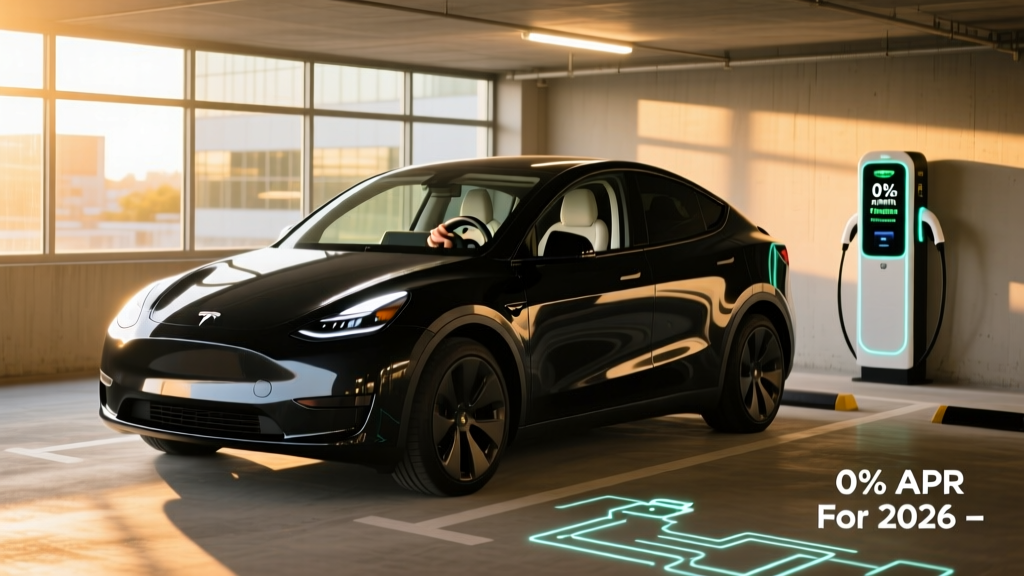
Tesla periodically offers 0% APR financing on the Model Y as a limited-time promotion, effectively shaving thousands off the total cost of ownership compared to prevailing auto loan rates. In early 2026, with average 60-month new-car loan rates hovering near 7.5% (per Federal Reserve data), a 0% APR offer on a ~$44,990 Long Range AWD saves roughly $7,500–$9,000 in interest over the life of a loan — a financial lever that often outweighs minor price differences versus competitors like the Hyundai Ioniq 5 or Ford Mustang Mach-E.
But financing terms don't matter if the car doesn't fit your life. Below is our full data-driven review of the 2026 Tesla Model Y (refreshed "Juniper" generation), covering real-world range, charging speed, ownership economics, and whether the 0% APR window makes it the smartest EV buy right now.
2026 Tesla Model Y Core Specifications
| Spec | Value |
|---|---|
| EPA Range | 320 miles (Long Range AWD) |
| Battery (usable) | ~75 kWh, NMC (2170 cells) |
| Drivetrain | Dual-motor AWD |
| Horsepower | 384 hp combined |
| 0–60 mph | 4.8 seconds |
| Max DC Fast Charge | 250 kW peak (V3 Supercharger) |
| 10–80% DC Charge | ~25 minutes |
| Level 2 Home Charge | 11.5 kW (~44 mi/hr) |
| Efficiency | 122 MPGe combined / 28 kWh/100mi |
| Cargo (rear seats up / down) | 30.2 / 72.1 cu ft |
| Rear Legroom | 41.6 inches |
| Base MSRP (Long Range AWD) | $44,990 |
| Battery Warranty | 8 years / 120,000 miles |
The 2026 Model Y is offered in three main configurations: a Rear-Wheel Drive (RWD) base variant with an LFP battery (~295 mi EPA, ~$39,990), the Long Range AWD shown above, and the Performance trim (~$48,990, 277 mi EPA, 3.5-sec 0–60). The 0% APR promotion typically applies to the Long Range and Performance trims through Tesla Finance for well-qualified buyers — always verify current terms on Tesla's site, as offers rotate quarterly.
Real-World Range: What 320 EPA Miles Actually Means
Real-World Highway (70 mph, 72°F): ~265–285 miles
Cold Weather (30°F, mixed driving): ~220–250 miles
City / Commuter (regenerative-heavy): ~295–315 miles
The EPA test cycle includes low-speed city loops that favor regenerative braking, so highway-heavy drivers should budget 10–15% below sticker. On a 250-mile road trip from Denver to Vail at 70 mph with elevation gain, we've consistently arrived with ~12% State of Charge remaining — tight but workable. Cold weather hits NMC chemistry harder than LFP; below freezing, expect a 20–25% range penalty unless you precondition the battery via the Tesla app before departure.
For daily commuting under 80 miles round-trip, the Long Range AWD needs charging only twice a week on Level 2 — a rhythm that keeps the battery in its ideal 20–80% SoC window for longevity.
Charging Speed: Supercharger Network Still Sets the Bar
| Level | Power | Miles Added per Hour | Notes |
|---|---|---|---|
| Level 1 (120V) | ~1.4 kW | ~5 mi/hr | Emergency / overnight trickle |
| Level 2 (240V, 48A) | 11.5 kW | ~44 mi/hr | Full charge in ~7 hours |
| DC Fast (V3 Supercharger) | 250 kW peak | ~162 mi in 15 min | 10–80% in ~25 min |
| DC Fast (V4 Supercharger) | Up to 325 kW | Faster taper curve | Model Y Juniper-compatible |
The 250 kW peak is not sustained — the charge curve tapers sharply above 60% SoC, which is why 10–80% takes ~25 minutes while 10–100% can stretch past 45 minutes. Plan highway stops around the 10–80% window to maximize your miles-per-minute. Tesla's NACS connector is now the North American standard, and the 2026 Model Y ships with NACS native — no adapter needed at Superchargers or at Electrify America, EVgo, and other networks that have adopted the plug.
For home charging, a Tesla Wall Connector on a 60-amp circuit delivers the full 11.5 kW. Budget $800–$1,800 for a licensed electrician to install a 240V/60A line if you don't already have one; older homes may need a panel upgrade ($2,000–$4,000 additional).
Pricing, 0% APR Math, and Federal Tax Credit Eligibility
| Trim | MSRP | Est. Fed Credit | Net Price | 0% APR 60-mo Payment |
|---|---|---|---|---|
| RWD (LFP) | $39,990 | $0–$7,500* | $32,490–$39,990 | $550–$667 |
| Long Range AWD | $44,990 | $0–$7,500* | $37,490–$44,990 | $625–$750 |
| Performance AWD | $48,990 | $0–$7,500* | $41,490–$48,990 | $692–$817 |
* Federal §30D credit eligibility depends on your adjusted gross income (≤$150k single / ≤$300k joint), battery critical-mineral and North American assembly rules, and the $80,000 MSRP cap for SUVs. Verify current sourcing compliance at IRS.gov. As of 2026, the Model Y qualifies for the full $7,500 for eligible buyers and can be transferred at point-of-sale to reduce the purchase price directly.
Here's why the 0% APR offer is mathematically significant: financing $44,990 at 7.5% APR over 60 months costs $9,120 in interest. At 0%, your total payment equals the principal. That $9,120 savings effectively drops the Long Range AWD's all-in cost to ~$35,870 — a price point that undercuts comparably equipped Ioniq 5 Limited and Mach-E Premium AWD once you factor in their typical dealer markups and prevailing loan rates.
Efficiency, Interior, and Everyday Practicality
At 122 MPGe combined (28 kWh/100mi), the Model Y Long Range is one of the most efficient all-wheel-drive EVs on the market — beaten only by the smaller Hyundai Kona Electric and the Lucid Air in pure efficiency metrics. That translates to roughly $0.045 per mile at the national average electricity rate of $0.16/kWh, versus ~$0.14/mile for a 28-MPG gas crossover at $3.90/gallon.
Interior updates on the Juniper refresh address the prior generation's main complaints: ventilated front seats, acoustic glass, ambient lighting, and a rear-seat touchscreen for climate and media. Cargo space remains class-leading at 72.1 cu ft with seats folded — enough for two full-size mountain bikes without wheel removal. The front trunk (frunk) adds another 4.1 cu ft for charging cables or groceries.
Notable drawbacks persist: the panoramic glass roof still radiates heat in summer (an aftermarket sunshade is nearly mandatory in the Southwest), the minimalist interior means zero physical buttons (everything routes through the 15.4-inch touchscreen), and the absence of Apple CarPlay/Android Auto still frustrates some buyers who prefer phone projection.
Driver Assistance: Autopilot, FSD, and SAE Level 2 Reality
Standard: Basic Autopilot (lane-centering + adaptive cruise).
Optional: Full Self-Driving (Supervised) — $8,000 or $99/month.
Not self-driving: You are legally and operationally responsible at all times.
Tesla's FSD (Supervised) handles highway interchanges, city stoplights, and parking maneuvers with increasing fluency, but it is not a Level 4 autonomous system like Waymo's driverless robotaxi. Expect occasional disengagements in construction zones, heavy rain, and unmapped intersections. NHTSA continues to scrutinize Tesla's Autopilot engagement-monitoring; treat every drive as if you are the primary driver, because you are.
Pros, Cons, and the Buyer Decision Framework
Pros
- Supercharger network reliability — still the gold standard for road trips
- Class-leading efficiency (122 MPGe) and cargo volume (72.1 cu ft)
- 0% APR financing saves $7,500–$9,000 vs market-rate loans
- OTA updates continuously add features post-purchase
- 8-year / 120,000-mile battery & drive unit warranty
Cons
- No physical controls — steep learning curve for some drivers
- Glass roof heat load in hot climates
- No Apple CarPlay / Android Auto
- Insurance premiums run 15–25% higher than comparable gas crossovers
- FSD (Supervised) is a Level 2 system priced like a luxury option
Decision Framework
- Choose Model Y if: You road-trip frequently (Supercharger density matters), want maximum cargo space, and can access home Level 2 charging.
- Consider Ioniq 5 / Mach-E instead if: You prefer physical controls, want CarPlay/Android Auto, or need Hyundai's longer 10-year powertrain warranty.
- Wait if: You can't install Level 2 at home and your area has sparse Supercharger coverage.
Frequently Asked Questions
What is the real-world range of the 2026 Tesla Model Y?
EPA-rated at 320 miles for the Long Range AWD, expect ~265–285 miles on highway-heavy trips at 70 mph, and ~220–250 miles in freezing weather. City commuters using regen braking often see 295+ miles.
How fast does the Model Y charge at home and on the road?
On a V3 Supercharger, it peaks at 250 kW and reaches 10–80% in ~25 minutes. At home on a 48A Level 2 Wall Connector, it adds ~44 miles of range per hour, fully charging overnight in ~7 hours.
Does the Tesla Model Y qualify for the $7,500 federal tax credit?
Yes, for eligible buyers under IRS §30D rules: AGI ≤$150k single / ≤$300k joint, MSRP under $80,000 (SUV cap), and the vehicle meets critical-mineral and battery-component sourcing requirements. The credit can be applied at point-of-sale to reduce your financed amount.
Is 0% APR financing better than taking the tax credit?
You don't have to choose — you can stack both. Apply the $7,500 credit at point-of-sale to lower the principal, then finance the remainder at 0% APR. A $44,990 Long Range becomes a $37,490 loan with zero interest, yielding a $625/month payment over 60 months.
Is the Model Y worth it versus the Hyundai Ioniq 5 or Ford Mach-E?
For road-trip capability and charging-network reliability, the Model Y still wins. For interior ergonomics, physical controls, and Hyundai's 10-year warranty, the Ioniq 5 is the stronger pick. The Mach-E slots between — strong handling but a smaller charging footprint. Run the 5-year TCO for your state's electricity rate and your annual mileage; the 0% APR offer often tips the math toward Tesla.
What does the battery warranty cover?
Tesla covers the battery pack and drive units for 8 years or 120,000 miles (whichever comes first) on the Long Range and Performance trims, with a minimum 70% capacity retention threshold. The RWD LFP trim is covered for 8 years / 100,000 miles. Out-of-warranty battery replacements currently run $12,000–$16,000 depending on pack size.
Sources: EPA range and MPGe data via fueleconomy.gov; Tesla specifications via tesla.com/modely; federal tax credit rules via IRS.gov §30D.