The 2026 Tesla Model Y: Quick Verdict
The Tesla Model Y remains the benchmark compact electric SUV against which every rival is measured. For 2026, Tesla has refreshed the Model Y with a revised interior, improved thermal management, and the continuation of its Juniper styling update introduced in 2025. Buyers searching for 0-60 Tesla Model Y performance data will find three distinct flavors: the rear-wheel-drive base model, the dual-motor Long Range, and the dual-motor Performance — each delivering markedly different acceleration, range, and pricing profiles.
This is not a luxury SUV in the traditional sense. The Model Y wins on efficiency, Supercharger network access, and over-the-air updates rather than plush materials or dealership pampering. If you prioritize acceleration per dollar and road-trip charging infrastructure, the Model Y still leads its class. If you want a quiet cabin, premium ride quality, or physical controls, competitors like the Hyundai Ioniq 5 or BMW iX may suit you better.
Performance & 0-60 MPH Times by Trim
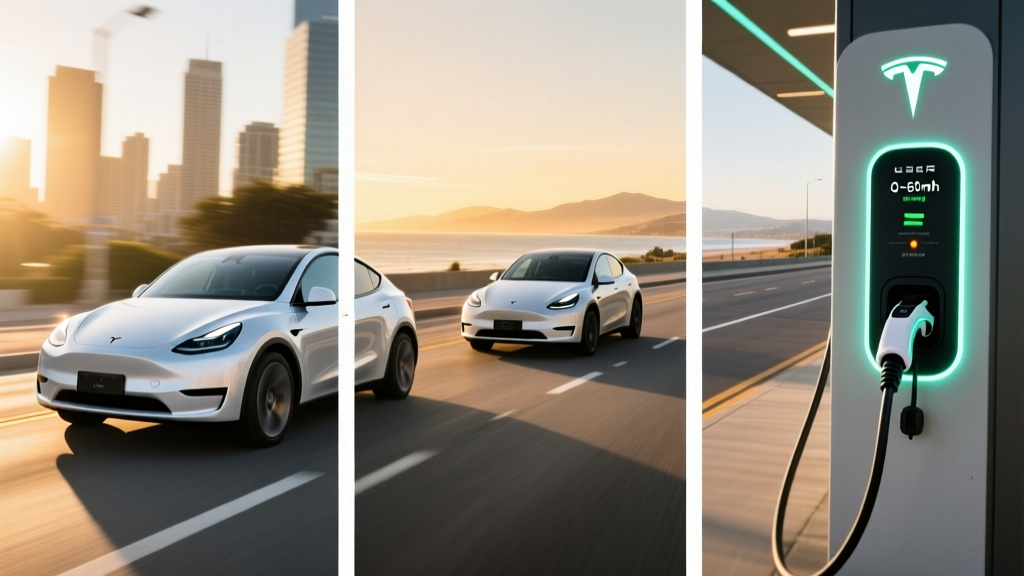
The question most enthusiasts ask: how quick is the Model Y off the line? Tesla publishes 0-60 mph times that are measured with a 1-foot rollout subtracted (a drag-strip convention), meaning real-world stopwatch times from a standstill are typically 0.2–0.3 seconds slower. Here is the complete breakdown for 2026:
| Specification | Long Range RWD | Long Range AWD | Performance AWD |
|---|---|---|---|
| 0-60 mph (Tesla-rated, 1-ft rollout) | 5.8 seconds | 4.8 seconds | 3.5 seconds |
| 0-60 mph (real-world estimate) | ~6.1 seconds | ~5.1 seconds | ~3.7 seconds |
| Horsepower (combined) | ~346 hp | ~384 hp | ~456 hp |
| Drivetrain | Rear-Wheel Drive | Dual-Motor AWD | Dual-Motor AWD |
| Top Speed | 125 mph | 125 mph | 155 mph |
| EPA Range | 320 miles | 300 miles | 277 miles |
The Performance model's 3.5-second 0-60 time places it in sports-car territory — quicker than a Porsche Cayenne S and rivaling the BMW X3 M. The instant torque delivery from the dual permanent-magnet and induction motor pair means there is zero lag, and the all-wheel-drive system manages traction seamlessly. The Long Range AWD at 4.8 seconds is more than adequate for highway merging and passing, while the RWD variant trades acceleration for maximum range and the lowest entry price.
Real-World Range vs. EPA Estimates
- Long Range RWD: EPA 320 mi → Expect ~280–300 mi mixed driving; ~240–260 mi sustained highway at 75 mph; ~220–240 mi in freezing weather
- Long Range AWD: EPA 300 mi → Expect ~260–280 mi mixed; ~225–245 mi highway; ~210–230 mi in freezing weather
- Performance AWD: EPA 277 mi → Expect ~240–260 mi mixed; ~210–230 mi highway; ~190–210 mi in freezing weather
Cold weather (below 32°F) can reduce range by 20–30% due to battery heating demands and cabin climate use. The 2026 Model Y's heat pump mitigates this better than older resistive heaters, but the physics of lithium-ion chemistry in cold temperatures remain a factor. Preconditioning while plugged in recovers significant range.
The 2026 Model Y Long Range RWD achieves its 320-mile EPA rating thanks in part to the LFP (lithium iron phosphate) battery in the base RWD configuration and an NMC (nickel manganese cobalt) pack in the AWD variants. Tesla has improved the aerodynamic drag coefficient to approximately 0.23 Cd with the Juniper refresh, and the heat pump introduced in prior years continues to reduce HVAC energy draw.
According to fueleconomy.gov, the Long Range AWD achieves 111 MPGe combined (30 kWh/100 mi), making it one of the most efficient electric SUVs in its class. The Performance trim drops to approximately 101 MPGe combined due to stickier tires, more aggressive calibration, and added weight from the performance brake hardware.
Battery, Chemistry & Charging Speed
Understanding the Model Y's battery and charging capabilities requires distinguishing between kW (kilowatts — the rate of energy flow, like water pressure from a hose) and kWh (kilowatt-hours — the total energy stored, like the size of the tank).
| Specification | Long Range RWD | Long Range AWD | Performance AWD |
|---|---|---|---|
| Battery Capacity (usable) | ~60 kWh (LFP) | ~75 kWh (NMC) | ~75 kWh (NMC) |
| Battery Chemistry | LFP (Lithium Iron Phosphate) | NMC (Nickel Manganese Cobalt) | NMC (Nickel Manganese Cobalt) |
| Max DC Fast Charge Rate | ~170 kW | 250 kW | 250 kW |
| 10–80% DC Fast Charge Time | ~28 minutes | ~25 minutes | ~25 minutes |
| Level 2 Home Charging (max) | 11.5 kW / 44 mi/hr | 11.5 kW / 44 mi/hr | 11.5 kW / 44 mi/hr |
| Charging Port | NACS (native Tesla) | NACS (native Tesla) | NACS (native Tesla) |
How the charging curve actually works: The 250 kW peak rate on AWD models is not sustained for the entire session. In real-world Supercharger testing, the Model Y Long Range AWD typically holds 230–250 kW from roughly 10% to 35% State of Charge (SoC), then tapers to ~150 kW by 55%, and drops below 75 kW above 80%. This is why Tesla quotes 10–80% times rather than 0–100% — charging above 80% is dramatically slower and is best reserved for destination charging at home.
The LFP battery in the RWD model has a lower peak charge rate (~170 kW) but offers a significant ownership advantage: Tesla recommends you can charge LFP batteries to 100% regularly without accelerating degradation, whereas NMC batteries benefit from daily limits of 80–90% for longevity. This means the RWD's 60 kWh pack effectively gives you more usable daily range than the raw numbers suggest.
The Model Y uses the NACS (North American Charging Standard) connector natively. This gives you direct access to over 20,000 Tesla Supercharger stalls across North America — currently the most reliable public DC fast-charging network. You can also use CCS-equipped chargers (Electrify America, EVgo) with a NACS-to-CCS adapter, though charge speeds may be limited by the adapter or station protocol.
Pricing, Trims & Federal Tax Credit Eligibility
| Trim | Base MSRP | Est. Federal Credit (§30D) | Effective Price |
|---|---|---|---|
| Long Range RWD | $44,990 | Up to $7,500* | ~$37,490* |
| Long Range AWD | $47,990 | Up to $7,500* | ~$40,490* |
| Performance AWD | $51,490 | Up to $7,500* | ~$43,990* |
*Federal tax credit caveats — read carefully: The IRS §30D Clean Vehicle Credit provides up to $7,500, split into two $3,750 halves based on battery component manufacturing and critical mineral sourcing requirements. As of 2026, the Model Y is assembled at Giga Texas and Giga Shanghai (for some markets). Eligibility for the full $7,500 depends on current-year battery sourcing rules that the IRS updates periodically. Additionally:
- MSRP cap: SUVs must have an MSRP at or below $80,000 — all Model Y trims qualify
- Income cap: Adjusted gross income must not exceed $150,000 (single), $225,000 (head of household), or $300,000 (joint filing)
- Point-of-sale transfer: You can apply the credit as a down-payment reduction at purchase rather than waiting for tax filing
- Battery sourcing: Verify current eligibility on the IRS clean vehicle credit page before purchasing, as sourcing requirements tighten annually
Common options that increase as-tested price: Full Self-Driving (Supervised) capability at $8,000, premium paint colors ($1,000–$2,500), 20-inch wheels ($2,000 on Long Range), and tow hitch ($1,000). A fully optioned Performance model can approach $62,000 before credits.
Interior, Cargo & Daily Practicality
The 2026 Model Y Juniper refresh brought meaningful interior improvements: ventilated front seats, ambient lighting, a rear-seat touchscreen, power-folding second row, and improved acoustic glass that noticeably reduces road noise compared to pre-2025 models. The minimalist interior remains polarizing — there are still no physical buttons for climate or wipers, and everything routes through the 15.4-inch center touchscreen.
| Dimension | Measurement |
|---|---|
| Front Headroom | 41.0 in |
| Front Legroom | 41.8 in |
| Rear Headroom | 39.4 in |
| Rear Legroom | 37.0 in |
| Cargo (behind 2nd row) | 30.2 cu ft |
| Cargo (2nd row folded) | 72.1 cu ft |
| Front Trunk (Frunk) | 4.1 cu ft |
| Max Towing Capacity | 3,500 lbs (with hitch) |
Cargo space is generous for the class. The 30.2 cu ft behind the second row comfortably fits four carry-on suitcases plus a stroller, and the 72.1 cu ft with seats folded rivals midsize SUVs. The 4.1 cu ft frunk is useful for charging cables, a small cooler, or groceries you want to keep separate. The 3,500-lb towing capacity covers a small utility trailer or a pair of jet skis but falls short of the Ford Mustang Mach-E's absence of towing and the Rivian R1S's 7,700-lb rating.
Driver Assistance, Tech & Safety
Tesla Autopilot and Full Self-Driving (Supervised) are Level 2 driver-assistance systems under the SAE J3016 standard. This means the driver must remain attentive, keep hands on the wheel (or demonstrate engagement via the cabin camera), and be prepared to take over at any moment. FSD (Supervised) does not make the vehicle autonomous. Only Level 4 services like Waymo One operate without a human driver.
Standard Autopilot includes Traffic-Aware Cruise Control and Autosteer (lane-centering) and is included on every Model Y. Full Self-Driving (Supervised) adds Navigate on Autopilot (automatic highway interchanges), Auto Lane Change, Autopark, Summon, Smart Summon, and traffic light/stop sign recognition. At $8,000, FSD remains a premium option that impresses in specific scenarios (highway driving, mapped urban routes) but can still make puzzling decisions in construction zones or unmapped areas.
The 2026 Model Y earned a 5-star overall safety rating from NHTSA and has historically performed well in IIHS testing. Standard active safety features include automatic emergency braking, blind-spot monitoring, lane departure warning, and rear cross-traffic alert. The cabin camera monitors driver attention when Autopilot is engaged.
Warranty & Long-Term Ownership
| Component | Coverage |
|---|---|
| Basic Vehicle | 4 years / 50,000 miles |
| Battery & Drive Unit (Long Range / Performance) | 8 years / 120,000 miles (min 70% retention) |
| Battery & Drive Unit (RWD) | 8 years / 100,000 miles (min 70% retention) |
Tesla's battery warranty guarantees that the pack will retain at least 70% of its original capacity during the warranty period. If it drops below that threshold, Tesla will repair or replace it. Real-world data from fleet operators and owner surveys suggests that NMC Model Y packs typically degrade approximately 8–12% over the first 100,000 miles, while LFP packs show even slower degradation due to the chemistry's inherent stability and the ability to cycle to 100% without stress.
Ownership costs beyond the purchase price include electricity (roughly $0.04–$0.06 per mile at home, $0.12–$0.18 per mile on public DC chargers), insurance (typically 15–30% higher than comparable gas SUVs due to repair costs), and tire replacement (EVs wear tires faster due to weight and instant torque — budget $800–$1,400 for a set of four every 25,000–35,000 miles).
Pros, Cons & Who Should Buy
Pros
- Class-leading efficiency (111 MPGe combined)
- Access to 20,000+ Supercharger stalls with native NACS
- Performance model: 3.5s 0-60 rivals sports sedans
- Continuous OTA updates add features post-purchase
- Best-in-class cargo volume for compact EV SUV
- Strong resale value relative to EV peers
- LFP option allows daily 100% charging without degradation worry
Cons
- No physical controls — all functions via touchscreen
- Ride quality firm on 20-inch wheels; road imperfections transfer
- Rear visibility limited by sloping roofline (no rear wiper)
- FSD (Supervised) at $8,000 remains Level 2, not autonomous
- Insurance premiums above segment average
- Service center wait times can be long in some metro areas
- Performance trim sacrifices 43 mi of range vs. Long Range RWD
Who the 2026 Model Y Suits Best
- Daily commuters with home charging: Wake up to a full battery every morning; 300+ mi range means weekly charging at most
- Families needing cargo flexibility: 72 cu ft with seats down handles big-box runs, sports gear, and road-trip luggage
- Road trippers: Supercharger network makes 500+ mile trips practical with one or two 20-minute stops
- Performance seekers on a budget: The Performance trim's 3.5s 0-60 at ~$51K undercuts comparable ICE performance SUVs by $20K+
- Tech-forward buyers: OTA updates, app integration, Sentry Mode, and the best EV infotainment system available
Look elsewhere if: You prioritize ride comfort over sportiness, need a third row, want physical buttons, or require a luxury badge for professional image.
Frequently Asked Questions
What is the real-world range of the 2026 Tesla Model Y?
Expect 280–300 miles in mixed driving for the Long Range RWD (EPA 320), 260–280 for the Long Range AWD (EPA 300), and 240–260 for the Performance (EPA 277). Sustained highway driving at 75+ mph reduces these figures by roughly 15%, and freezing temperatures can cut range by 20–30% depending on cabin heating demands and whether you precondition.
How fast does the Model Y charge at home and on the road?
On a home Level 2 charger (48-amp / 11.5 kW), the Model Y adds approximately 44 miles of range per hour — a full overnight charge from 20% to 100% takes about 7–8 hours. On a 250 kW Supercharger, the Long Range AWD and Performance models charge from 10% to 80% in approximately 25 minutes. The RWD model peaks at ~170 kW and takes roughly 28 minutes for the same interval.
Does the 2026 Model Y qualify for the $7,500 federal EV tax credit?
The Model Y qualifies for up to $7,500 under IRS §30D, subject to battery sourcing requirements that change periodically. The buyer must also meet income caps ($150K single / $300K joint) and the MSRP must remain under $80,000 for SUVs (all trims qualify). You can transfer the credit to the dealer at point of sale as a down-payment reduction. Always verify current eligibility at fueleconomy.gov before purchasing.
Is the Tesla Model Y worth buying vs. the Hyundai Ioniq 5 or Ford Mustang Mach-E?
The Model Y wins on Supercharger network access, efficiency, and cargo volume. The Ioniq 5 offers faster 800V charging (10–80% in ~18 min on a 350 kW charger), a more comfortable ride, and physical controls. The Mach-E provides a more engaging driving feel and a traditional dealership experience. If you road-trip frequently and value charging reliability above all, the Model Y's Supercharger advantage is decisive. If ride comfort and interior quality matter more, test-drive the Ioniq 5.
How does the Model Y's LFP battery compare to NMC?
LFP (lithium iron phosphate) offers slower degradation, no risk of thermal runaway, and the ability to charge to 100% daily — but it has lower energy density (hence the smaller 60 kWh pack) and slightly reduced cold-weather performance. NMC provides higher energy density and better cold-weather range but benefits from being charged to 80–90% daily. For high-mileage commuters who charge at home nightly, LFP is often the more practical choice.
What is the 0-60 time on the Tesla Model Y Performance in real-world conditions?
Tesla rates the Performance at 3.5 seconds using a 1-foot rollout. Independent testing with standard GPS timing from a true standstill typically yields 3.7–3.9 seconds. Surface conditions, tire temperature, ambient temperature, and battery SoC all affect the result. At below 50% SoC, expect 0-60 times to increase by 0.3–0.5 seconds due to reduced power delivery.