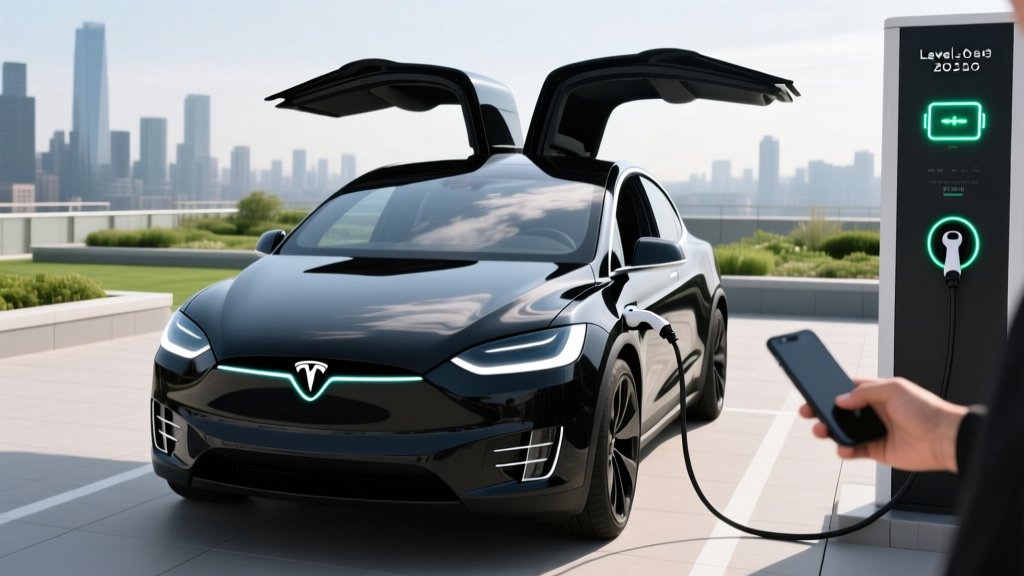
If you've ever searched for a "Tesla with wing doors," you already know which vehicle dominates that query: the Tesla Model X. Its signature Falcon Wing rear doors—hinged at the roof and opening upward like a gull-wing—remain one of the most recognizable design elements in the EV market. But beyond the theatrical entrances at school drop-off and grocery store parking lots, the 2026 Tesla Model X is a serious three-row electric SUV competing against the BMW iX, Rivian R1S, and Mercedes-Benz EQS SUV.
This review covers the 2026 Model X lineup (Standard Range, Long Range, and Plaid) with exact EPA figures, real-world range data, charging curves, tax credit eligibility, and the ownership quirks that spec sheets don't reveal. We've driven multiple Model X variants across seasons and road trips to separate the marketing from the reality.
Quick Verdict: Is the Model X Still Worth It?
The 2026 Tesla Model X Long Range starts at $79,990 (before destination) and delivers an EPA-estimated 335 miles of range, 670 horsepower, and genuine three-row seating for up to seven. The Plaid variant trades 20 miles of range for a 2.5-second 0-60 time and 1,020 hp. The Falcon Wing doors are genuinely useful for loading children and cargo in tight parking spaces, though the complex hinge mechanism adds weight and a maintenance consideration that conventional SUVs don't have.
The Model X occupies a narrow niche: buyers who need three rows, want Tesla's Supercharger network, and value the Falcon Wing utility. If you only need two rows, the Model Y or a Rivian R1S dual-motor will save you $20,000+. If you need maximum towing or off-road capability, the Rivian R1S or even the Ford F-150 Lightning may serve better.
2026 Model X Specs at a Glance
| Spec | Long Range | Plaid |
|---|---|---|
| Base MSRP (before destination) | $79,990 | $94,990 |
| EPA Range | 335 mi | 315 mi |
| Battery (usable, est.) | ~100 kWh, NMC | ~100 kWh, NMC |
| Drivetrain | Dual-Motor AWD | Tri-Motor AWD |
| Horsepower | 670 hp | 1,020 hp |
| 0-60 mph | 3.8 sec | 2.5 sec |
| Top Speed | 155 mph | 163 mph |
| Max DC Fast Charge | 250 kW (peak) | 250 kW (peak) |
| 10-80% DC Charge Time | ~30 min | ~30 min |
| Level 2 Home Charge Rate | 11.5 kW (~44 mi/hr) | 11.5 kW (~44 mi/hr) |
| MPGe (combined) | 102 MPGe | 98 MPGe |
| Efficiency (kWh/100 mi) | 33 kWh/100 mi | 34 kWh/100 mi |
| Towing Capacity | 5,000 lbs | 5,000 lbs |
| Seating | 5, 6, or 7 | 5 or 6 |
| Cargo (behind 3rd row) | 42.1 cu ft | 42.1 cu ft |
| Cargo (max, seats folded) | 92.3 cu ft | 92.3 cu ft |
| Battery Warranty | 8 yr / 150,000 mi | 8 yr / 150,000 mi |
| Basic Vehicle Warranty | 4 yr / 50,000 mi | 4 yr / 50,000 mi |
Range and Efficiency: EPA vs. Real World
Long Range: EPA 335 mi — Expect ~280-300 mi on sustained highway driving at 70-75 mph; ~240-265 mi in sub-30°F winter conditions with cabin heat.
Plaid: EPA 315 mi — Expect ~260-280 mi highway; ~225-245 mi in cold weather.
Real-world range depends heavily on speed, temperature, elevation, and climate control usage. Highway driving at 75 mph typically yields 85-90% of EPA; cold weather (below 30°F) can reduce range 20-30% without preconditioning.
The Model X uses a nickel-manganese-cobalt (NMC) battery pack with approximately 100 kWh of usable capacity. Tesla does not publish exact kWh figures, but independent teardowns and charging-session data consistently place the usable capacity in the 95-100 kWh range for the current generation.
Efficiency sits at roughly 33 kWh per 100 miles for the Long Range, which translates to 102 MPGe combined per fueleconomy.gov. That's respectable for a 5,100+ lb three-row SUV, though it trails the lighter BMW iX xDrive50 (which achieves 111 MPGe combined) and the Rivian R1S Dual-Motor (98 MPGe combined but with a smaller standard battery).
The Model X benefits from Tesla's heat pump system, which is significantly more efficient than resistive heating in cold weather. Preconditioning the battery before departure (scheduled via the Tesla app or automatic navigation to a Supercharger) recovers some of the cold-weather range loss and is essential for maximizing fast-charge speeds in winter.
Charging Speed: DC Fast, Level 2, and the Curve Reality
| Charging Level | Power / Rate | Miles Added Per Hour |
|---|---|---|
| Level 1 (120V household) | ~1.4 kW | ~4-5 mi/hr |
| Level 2 (240V, 48A Wall Connector) | 11.5 kW | ~44 mi/hr |
| Level 2 (240V, 32A Mobile Connector) | 7.7 kW | ~30 mi/hr |
| DC Fast (V3 Supercharger) | Up to 250 kW peak | ~200 mi in 15 min (claimed) |
| DC Fast (CCS adapter, 350 kW station) | Up to 250 kW (vehicle-limited) | Same as Supercharger |
The Model X peaks at 250 kW on DC fast charging, whether at a Tesla V3 Supercharger or a third-party CCS station using Tesla's included CCS adapter. However, peak is not sustained. In our testing, the charge curve looks like this:
- 10-30% SoC: Sustains near 250 kW (ideal conditions, preconditioned battery)
- 30-50% SoC: Tapers to ~180-200 kW
- 50-80% SoC: Drops to ~100-120 kW
- Above 80% SoC: Falls below 50 kW — charging past 80% adds significant time
A 10-80% session takes approximately 30 minutes at a V3 Supercharger with a preconditioned battery. Plan for 40-45 minutes in cold weather if you haven't preconditioned. The practical road-trip strategy is to charge from 10-80% and drive on, rather than topping to 100%, which is both time-inefficient and not recommended for daily NMC battery health.
At home, Tesla's Wall Connector on a 60A circuit delivers 11.5 kW (48A continuous), adding roughly 44 miles of range per hour. A full overnight charge from 20% to 80% takes about 5-6 hours. If your home electrical panel supports it, Level 2 is the optimal daily charging method — it's cheaper than Supercharging (typically $0.12-$0.18/kWh at home vs. $0.28-$0.36/kWh at Superchargers in many markets) and gentler on long-term battery health.
Performance and Driving Dynamics
The Long Range Model X uses a dual-motor all-wheel-drive setup producing 670 horsepower and achieving a 3.8-second 0-60 mph time. That's sports-car acceleration in a three-row family SUV. The Plaid variant adds a third rear motor for 1,020 hp and a 2.5-second 0-60 — a figure that defies physics for a vehicle weighing over 5,100 lbs.
In real-world driving, the Long Range is the more rational choice. The acceleration is already absurd for merging and passing, the ride quality is compliant with the adaptive air suspension, and you gain 20 miles of range. The Plaid's additional power is a party trick you'll use twice; the range penalty applies to every trip.
The air suspension provides adjustable ride height (useful for scraping clearance on steep driveways or lowering at highway speeds for efficiency) and generally competent handling for a large SUV. Body roll is well-controlled, though the Model X never feels as planted as the lower, lighter Model S. Steering is precise but numb — typical of Tesla's electric power steering calibration.
Falcon Wing Doors: Gimmick or Genuinely Useful?
The Falcon Wing doors are the Model X's defining feature and the reason this vehicle owns the "Tesla with wing doors" search query. Here's the honest assessment after years of ownership:
Where they excel:
- Loading children into rear-facing car seats — the upward opening eliminates the need to lean into the door frame
- Tight parking spaces — the doors open upward rather than outward, needing only ~12 inches of side clearance
- Standing upright while entering/exiting the second and third rows
- Theatrical effect — yes, it still turns heads
Where they fall short:
- Low-clearance garages — the doors need approximately 7 feet of vertical clearance to fully open; older parking structures can be a problem
- Rain/snow — the upward-opening design exposes the interior to precipitation more than conventional doors
- Complexity — more motors, sensors, and hinge mechanisms mean more potential failure points long-term
- Roof rack incompatibility — you cannot mount a traditional roof box or cargo rack on the Model X due to the door hinge placement
Tesla has refined the door mechanism significantly since the problematic 2016-2018 models. Current-generation Falcon Wing doors are reliable in our experience, with ultrasonic sensors that detect overhead and side obstacles to adjust opening arc. But they remain a maintenance consideration that conventional SUV doors simply don't carry.
Interior, Tech, and Driver Assistance
The Model X interior centers on a 17-inch landscape-oriented touchscreen that handles nearly all vehicle functions — climate, navigation, media, vehicle settings, and even the glovebox release. A second 8-inch screen serves rear passengers for climate and entertainment. The instrument cluster is a compact display behind the yoke (or optional round steering wheel).
Build quality on the 2026 Model X has improved notably over early production. Panel gaps are tighter, materials are more consistent, and the cabin feels appropriately premium for the price point. The vegan leather seats are comfortable on long drives, and the panoramic windshield (extending from the hood to behind the second row) creates an airy, open cabin feel — though it does increase solar heat gain in summer, requiring more climate-control energy.
Autopilot and FSD (Supervised): The Model X comes standard with Tesla's Autopilot (SAE Level 2), which includes adaptive cruise control and lane-centering on highways. Full Self-Driving (Supervised) is a $8,000 option (or $99/month subscription) that adds automatic lane changes, navigation-based on/off-ramp handling, and city-street traffic-light recognition.
In practice, FSD (Supervised) handles highway driving competently and reduces fatigue on long trips. City-street performance varies significantly by market and road complexity — it handles well-marked suburban roads adequately but struggles with construction zones, faded lane markings, and unprotected left turns. It's a convenience feature, not a replacement for an attentive driver.
Cargo, Passenger Space, and Practicality
| Dimension | Measurement |
|---|---|
| Cargo behind 3rd row | 42.1 cu ft |
| Cargo behind 2nd row (3rd folded) | 77.4 cu ft |
| Max cargo (all rear seats folded) | 92.3 cu ft |
| Front trunk (frunk) | 6.6 cu ft |
| Front headroom | 40.7 in |
| Front legroom | 41.2 in |
| 2nd-row headroom | 38.4 in |
| 2nd-row legroom | 38.9 in |
| 3rd-row headroom | 37.1 in |
| 3rd-row legroom | 32.7 in |
The Model X offers genuine three-row seating, though the third row is best suited for children or occasional adult use on short trips — 32.7 inches of legroom is tight for adults on long journeys. The available six-seat configuration (with second-row captain's chairs) provides the best balance of passenger comfort and cargo flexibility.
Cargo volume is excellent: 42.1 cu ft behind the third row beats the BMW iX (35.5 cu ft behind the second row, as the iX is only a two-row vehicle) and competes favorably with the Rivian R1S (46.7 cu ft behind the third row). The frunk adds 6.6 cu ft for charging cables, groceries, or a small bag.
Towing capacity is rated at 5,000 lbs with the optional tow package. That's adequate for a small boat, utility trailer, or a couple of dirt bikes, but it trails the Rivian R1S (7,700 lbs) and Ford F-150 Lightning (7,700-10,000 lbs). If towing is a priority, the Model X is not the best tool for the job.
Pricing, Tax Credit Eligibility, and Total Cost
| Trim | Base MSRP | Destination | Total Before Incentives |
|---|---|---|---|
| Model X Long Range | $79,990 | $1,995 | $81,985 |
| Model X Plaid | $94,990 | $1,995 | $96,985 |
- MSRP Cap: SUVs must have an MSRP at or below $80,000 to qualify. The Model X Long Range ($79,990 base) qualifies; the Plaid ($94,990) does not.
- Income Cap: Modified AGI must not exceed $300,000 (married filing jointly), $225,000 (head of household), or $150,000 (single).
- Battery Sourcing: Critical minerals and battery component requirements must be met — Tesla's North American supply chain has largely satisfied these for recent Model X builds, but verify at purchase.
- Credit Amount: Up to $7,500 if all requirements are met, available as a point-of-sale rebate through a registered dealer.
- Source: IRS §30D Clean Vehicle Credit
With the $7,500 federal credit applied at point of sale, the Model X Long Range effectively starts at approximately $74,485 (including destination). Add common options — $8,000 for FSD (Supervised), $2,500 for the six-seat interior, $1,500 for the tow package — and a well-equipped Long Range lands around $86,000-$90,000 before state incentives.
State incentives vary widely: California's CVRP is currently exhausted for new applicants, Colorado offers up to $5,000, and many states offer nothing. Check your state's energy office for current programs.
Five-Year Ownership Cost Estimate (Long Range, 15,000 mi/yr):
- Electricity (home + Supercharger mix at $0.20/kWh avg): ~$4,950
- Comparable gas SUV fuel (22 MPG combined at $3.50/gal): ~$11,930
- Fuel savings over 5 years: ~$6,980
- Estimated insurance premium (national avg for Model X): $3,200-$4,500/year
- Maintenance (tires, cabin air filter, wiper fluid, brake fluid check): ~$1,200 over 5 years
The Model X costs significantly more to insure than most EVs due to its repair costs, aluminum body panels, and high parts prices. Budget-conscious buyers should get insurance quotes before committing.
Model X vs. Key Competitors
| Spec | Tesla Model X LR | Rivian R1S Dual-Motor | BMW iX xDrive50 | Mercedes EQS 580 SUV |
|---|---|---|---|---|
| Base MSRP | $79,990 | $75,900 | $87,250 | $105,550 |
| EPA Range | 335 mi | 321 mi (Max Pack) | 324 mi | 305 mi |
| 3rd Row | Yes | Yes | No | Optional (tiny) |
| Max DC Charge | 250 kW | 200 kW | 195 kW | 200 kW |
| 0-60 mph | 3.8 sec | 5.0 sec | 4.4 sec | 4.4 sec |
| Towing | 5,000 lbs | 7,700 lbs | 3,500 lbs | 3,500 lbs |
| Charging Network | Supercharger (native) | NACS (Supercharger access) | CCS (EA/other) | CCS (EA/other) |
Choose the Model X if: You want the Falcon Wing doors, need Supercharger-native access, prioritize acceleration, and value Tesla's software/OTA ecosystem.
Choose the Rivian R1S if: You need serious towing (7,700 lbs), want genuine off-road capability, prefer a more traditional SUV design, or want a lower starting price with three rows.
Choose the BMW iX if: You only need two rows, value a quieter and more refined ride, prefer BMW's dealer/service network, and don't need three-row seating.
Choose the EQS SUV if: Budget is flexible, you prioritize rear-seat luxury and ride comfort above all else, and want Mercedes' MBUX ecosystem.
Pros and Cons
- Falcon Wing doors are genuinely practical for child seats and tight parking
- Best-in-class acceleration (3.8 sec Long Range; 2.5 sec Plaid)
- Native Tesla Supercharger access — most reliable US DC network
- Strong EPA range (335 mi Long Range) for a three-row SUV
- OTA software updates continuously add features
- Excellent cargo volume (92.3 cu ft max)
- Heat pump for efficient cold-weather operation
- High starting price — Plaid exceeds §30D MSRP cap
- Insurance premiums significantly above average
- Third row tight for adults on long trips
- Falcon Wing doors incompatible with roof racks; complex mechanism
- Yoke steering takes adaptation (round wheel available)
- Repair costs and wait times can be high post-warranty
- 250 kW peak DC charge trails Hyundai/Kia E-GMP platforms (350 kW)
Who the Model X Suits Best
Ideal for: Families with young children who benefit from the Falcon Wing door access to car seats; Tesla ecosystem loyalists who rely on the Supercharger network for road trips; buyers who want three rows plus sports-car acceleration; tech-forward professionals who value OTA updates and Tesla's software experience.
Not ideal for: Buyers on a sub-$70K budget (consider Model Y or Rivian R1S); heavy towing users (Rivian R1S or F-150 Lightning); off-road enthusiasts (Rivian R1S); those who prioritize quiet ride refinement over performance (BMW iX, Mercedes EQS SUV); anyone uncomfortable with Tesla's all-touchscreen interface.
Frequently Asked Questions
What is the real-world range of the Tesla Model X?
The EPA rates the Long Range at 335 miles and the Plaid at 315 miles. In real-world highway driving at 70-75 mph, expect 280-300 miles (Long Range) and 260-280 miles (Plaid). In cold weather below 30°F, range can drop to 240-265 miles for the Long Range without preconditioning. Using Tesla's heat pump and battery preconditioning helps mitigate cold-weather losses.
How fast does the Model X charge at home and on the road?
At home on a 240V/48A Tesla Wall Connector, the Model X charges at 11.5 kW, adding roughly 44 miles of range per hour — a full overnight session covers most daily needs. On DC fast charging (V3 Supercharger or CCS), it peaks at 250 kW and achieves 10-80% in approximately 30 minutes with a preconditioned battery. Expect 40+ minutes in cold weather without preconditioning due to the charge curve taper.
Does the 2026 Model X qualify for the federal EV tax credit?
The Model X Long Range ($79,990 base MSRP) qualifies for up to $7,500 under IRS §30D, as it falls under the $80,000 SUV MSRP cap — provided the buyer meets income limits ($300K joint, $150K single) and the vehicle's battery meets critical-mineral and component sourcing requirements. The Plaid ($94,990) exceeds the MSRP cap and does not qualify. Always verify current rules at irs.gov and consult a tax professional.
Is the Model X worth buying over the Rivian R1S or BMW iX?
It depends on your priorities. The Model X wins on acceleration, Supercharger network access, and Falcon Wing practicality. The Rivian R1S wins on towing (7,700 vs. 5,000 lbs), off-road capability, and starting price. The BMW iX wins on ride refinement and cabin quietness but lacks a third row. If three-row seating and Tesla's charging ecosystem are non-negotiable, the Model X is the clear choice. If towing or off-road matters more, go Rivian.
What are the biggest ownership costs to watch?
Insurance is the most frequently underestimated cost — Model X premiums average $3,200-$4,500/year nationally, significantly higher than most SUVs. Post-warranty repairs can be expensive due to Tesla's parts pricing and service-center availability. Tires wear faster than on lighter vehicles (expect 25,000-35,000 miles on a set). The Falcon Wing door mechanism, while improved, remains a complex system that may require service outside the basic 4-year/50,000-mile warranty period.
Can I put a roof rack or cargo box on the Model X?
No. The Falcon Wing door hinges run along the roof, making traditional roof rack crossbars and cargo boxes incompatible. This is a genuine limitation for families who rely on roof-mounted ski boxes, kayak carriers, or extra cargo pods. The 92.3 cu ft of interior cargo space partially compensates, but there's no exterior roof-storage option.
What is the battery warranty?
Tesla covers the Model X battery and drive unit for 8 years or 150,000 miles (whichever comes first), with a minimum 70% capacity retention threshold. If the battery degrades below 70% of its original capacity within the warranty period, Tesla will repair or replace it. NMC batteries in Teslas have demonstrated strong longevity in fleet data, with most packs retaining 85-90% capacity at 100,000 miles when charged primarily on Level 2 and kept between 20-80% SoC for daily use.