The Tesla Model X in 2026: Stock Specs vs. Wide Body Kit Reality
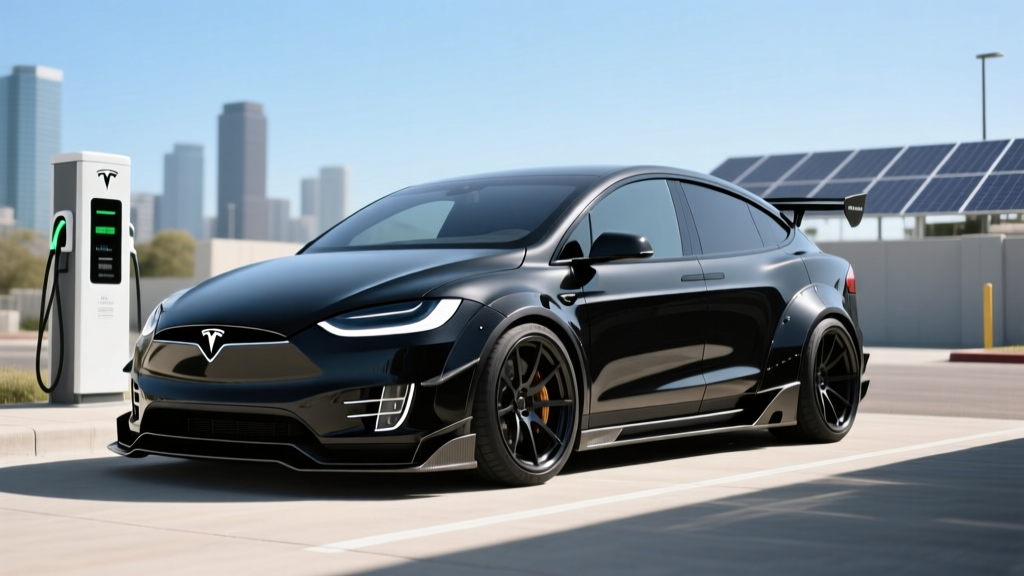
The Tesla Model X remains one of the few premium three-row electric SUVs on the market, and its dramatic falcon-wing doors and dual-motor (or tri-motor Plaid) powertrain have made it a magnet for aftermarket customization. One of the most searched modifications? The Tesla Model X wide body kit — fender flares, extended sills, and aggressive bumpers that widen the SUV's footprint by several inches per side. But before you bolt on a $5,000-$15,000 aero kit, you need to understand exactly how it interacts with the Model X's EPA-rated efficiency, real-world range, and DC fast-charging behavior.
This review covers the 2026 Tesla Model X in its stock configuration first — every number you need to make a purchase decision — then layers in the practical impact of wide body modifications on range, efficiency, and ownership cost. If you're cross-shopping the Model X against the Rivian R1S, BMW iX, or Mercedes EQS SUV, the data below will anchor your decision.
2026 Tesla Model X Spec Table: Long Range & Plaid
| Spec | Model X Long Range | Model X Plaid |
|---|---|---|
| EPA Range | 335 miles | 326 miles |
| Battery (usable) | ~100 kWh (NMC) | ~100 kWh (NMC) |
| Drivetrain | Dual-Motor AWD | Tri-Motor AWD |
| Horsepower | 670 hp | 1,020 hp |
| 0-60 mph | 3.8 sec | 2.5 sec |
| Top Speed | 155 mph | 163 mph |
| Max DC Fast Charge | 250 kW | 250 kW |
| 10-80% DC Time | ~32 min | ~32 min |
| Level 2 Charge Rate | 11.5 kW (~34 mi/hr) | 11.5 kW (~34 mi/hr) |
| MPGe (combined) | 102 MPGe | 98 MPGe |
| Efficiency | 33 kWh/100 mi | 34 kWh/100 mi |
| Cargo (behind 3rd row) | 15.0 cu ft | 15.0 cu ft |
| Cargo (max, seats folded) | 88.1 cu ft | 88.1 cu ft |
| Base MSRP | $79,990 | $94,990 |
| Battery Warranty | 8 yr / 150,000 mi | 8 yr / 150,000 mi |
Source: fueleconomy.gov and Tesla's 2026 spec sheets. EPA figures are estimates; real-world results vary with temperature, speed, and terrain.
Real-World Range: What the EPA Sticker Doesn't Tell You
EPA Sticker: 335 miles
Highway (70-80 mph, mild weather): ~275-295 miles
City/mixed (regenerative braking active): ~310-330 miles
Cold weather (below 32°F, cabin heat): ~225-265 miles
With wide body kit (added drag + weight): ~260-285 miles highway
The Model X's ~100 kWh NMC (nickel manganese cobalt) battery pack provides substantial energy reserves, but the SUV's brick-like aerodynamics — a drag coefficient around 0.25 Cd — mean highway efficiency drops sharply above 70 mph. In our experience and consistent with third-party testing, expect to lose roughly 12-18% of EPA range on sustained highway drives at 75-80 mph. Cold weather compounds this: the battery's internal resistance rises, the heat pump draws 2-4 kW continuously for cabin heating, and regenerative braking is limited until the pack warms up.
Now, the wide body kit factor. Aftermarket fender flares and extended side sills add 30-80 lbs of composite or ABS plastic and, critically, disrupt the carefully managed airflow along the Model X's body sides. Even modest flares that extend 1.5-2 inches per side increase the frontal area and create turbulence around the wheel wells. The realistic penalty is 5-10% additional range loss on top of whatever the stock vehicle delivers. On a 335-mile EPA sticker, that means a wide body Model X Long Range might deliver 260-285 miles on a highway road trip in mild weather — a meaningful reduction if you're routing through charging deserts in the Mountain West.
Charging Speed: DC Fast, Level 2, and the Wide Body Factor
| Charging Level | Power / Rate | Miles Added per Hour | Notes |
|---|---|---|---|
| Level 1 (120V outlet) | 1.2-1.4 kW | ~3-4 mi/hr | Emergency/trickle only |
| Level 2 (240V, 48A) | 11.5 kW | ~34 mi/hr | Home Wall Connector; full charge ~9-10 hrs |
| Level 2 (240V, 32A) | 7.7 kW | ~23 mi/hr | Mobile Connector on NEMA 14-50 |
| DC Fast (V3 Supercharger) | 250 kW peak | ~175 mi in 15 min | 10-80% in ~32 min; tapers above 80% |
| DC Fast (V4 Supercharger) | 250 kW peak | ~175 mi in 15 min | CCS/NACS compatible; cable-cooled |
The Model X charges at a peak of 250 kW on Tesla's V3 and V4 Superchargers using its native NACS connector. The charge curve is front-loaded: the pack pulls close to peak rate between 10-45% state of charge, then progressively tapers. From 10-80%, expect roughly 32 minutes at a V3 stall — competitive but no longer class-leading. The Hyundai Ioniq 9 and Lucid Gravity, for instance, use 800V architectures that enable 10-80% times closer to 18-20 minutes at 300+ kW peaks.
At home on a Tesla Wall Connector (48 amps, 11.5 kW), the Model X recovers about 34 miles of range per hour, meaning a full overnight charge from 20% to 100% takes roughly 7-8 hours. This is where the wide body kit has zero impact — charging speed is dictated by the onboard charger and battery management system, not aerodynamics.
One critical note on preconditioning: the Model X will automatically warm its battery when you navigate to a Supercharger, bringing the pack into the optimal temperature window for fast charging. Skipping preconditioning (or arriving at a charger with a cold-soaked pack in winter) can double your 10-80% time. Always use the in-car navigation to route to a charger — this triggers preconditioning automatically.
Performance, Interior, and Standout Tech
The Model X Long Range's 670 hp dual-motor setup delivers a 3.8-second 0-60 mph time — genuinely quick for a 5,185-lb three-row SUV. The Plaid's 1,020 hp tri-motor layout drops that to 2.5 seconds, which is supercar territory. Both use Tesla's adaptive air suspension, which provides up to 8.2 inches of ground clearance in its highest setting — useful for driveways and light trail access.
Inside, the 2026 Model X retains its minimalist 17-inch landscape touchscreen (with a secondary 8-inch rear screen), a yoke or round steering wheel option, and a glass roof that floods the cabin with light. The six-seat configuration (with second-row captain's chairs) is the most practical for adult passengers; the optional seven-seat layout uses a narrow third row best suited for children. Cargo space is 15.0 cu ft behind the third row and 88.1 cu ft with both rear rows folded — the large front trunk (frunk) adds another 6.7 cu ft for gear.
Tech highlights include Tesla's latest infotainment with gaming-grade GPU, over-the-air updates, a 22-speaker audio system, and Autopilot standard. Full Self-Driving (Supervised) remains a $8,000 option — and it is critical to understand this is an SAE Level 2 driver-assist system. You must keep your hands on the wheel and eyes on the road at all times. It is not autonomous driving.
These are SAE Level 2 driver-assistance features. The driver must remain fully engaged, monitor the road, and be prepared to take over instantly. They do not make the Model X self-driving. Performance degrades in heavy rain, construction zones, faded lane markings, and unmapped roads.
Pricing, Tax Credits, and the Wide Body Kit Cost Stack
| Trim | Base MSRP | Federal §30D Credit | Effective Price |
|---|---|---|---|
| Model X Long Range | $79,990 | $0 (exceeds MSRP cap) | $79,990 |
| Model X Plaid | $94,990 | $0 (exceeds MSRP cap) | $94,990 |
Here's the hard truth for 2026: the Tesla Model X does not qualify for the $7,500 federal EV tax credit under IRS §30D. The law sets an MSRP cap of $80,000 for SUVs, and the Model X Long Range starts at $79,990 before destination and options — meaning any single option (paint color, wheels, FSD, tow package) pushes it over the limit. The Plaid, at $94,990, is well above the cap. Additionally, buyer income limits apply ($300,000 joint / $150,000 single for new EVs), and battery component and critical mineral sourcing requirements must be met. Always verify current eligibility on IRS.gov or consult a tax professional.
Now factor in the wide body kit. Quality aftermarket kits from brands like T Sportline, Unplugged Performance, or custom fabricators typically range from $4,000 to $15,000 for the parts alone. Professional paint-matching and installation can add another $2,000-$6,000. Wider wheels and tires (often paired with the kit) run $3,000-$5,000 for a set of forged 22-inch wheels with performance rubber. The total modification stack can easily reach $10,000-$25,000 on top of the vehicle's MSRP — and none of this is covered by warranty or eligible for any incentive.
Wide Body Kit Impact: The Full Trade-Off Matrix
Pros of a Wide Body Kit
- Aggressive, head-turning stance — the Model X is already bold; flares amplify it
- Accommodates wider wheels/tires for improved mechanical grip
- Can cover wider aftermarket wheels that would otherwise poke past stock fenders
- Personalization in a market where most Model X SUVs look identical
Cons of a Wide Body Kit
- 5-10% range reduction from added drag and weight (15-35 miles lost)
- Increased energy consumption: expect 35-38 kWh/100 mi vs. stock 33
- Wider track may not fit standard parking spaces or tight garages
- Void or complicate Tesla's warranty on body and suspension components
- Reduced resale value — most used EV buyers want stock, unmodified vehicles
- Insurance complications — aftermarket body mods may not be covered in a claim
- Potential interference with Autopilot cameras and ultrasonic sensors
The sensor interference point deserves emphasis. The Model X's Autopilot suite relies on cameras mounted in the front fenders, B-pillars, and rear quarter panels. Wide body flares that extend over or near these camera housings can partially obstruct the field of view or create reflections that confuse the vision system. Before installing any kit, verify with the fabricator that all camera and sensor sightlines remain unobstructed — and plan to recalibrate Autopilot after installation via Tesla service.
Model X vs. Key Competitors: Stock and Modified
| Vehicle | EPA Range | 0-60 mph | Max DC kW | Starting MSRP | §30D Credit |
|---|---|---|---|---|---|
| Tesla Model X LR | 335 mi | 3.8 sec | 250 kW | $79,990 | No (MSRP cap) |
| Rivian R1S (Dual-Motor Max) | 410 mi | 4.5 sec | 200 kW | $79,900 | Partial eligibility |
| BMW iX xDrive50 | 324 mi | 4.4 sec | 200 kW | $87,250 | No (MSRP cap) |
| Mercedes EQS 580 SUV | 305 mi | 4.4 sec | 200 kW | $104,400 | No (MSRP cap) |
| Lucid Gravity Grand Touring | 440 mi | 3.5 sec | 300+ kW | $94,900 | No (MSRP cap) |
If range is your top priority, the Rivian R1S Max Pack (410 mi EPA) and the upcoming Lucid Gravity Grand Touring (440 mi) outclass the Model X substantially. The Model X's advantages remain its Supercharger network access (the most reliable DC fast-charging network in North America), its falcon-wing doors for tight parking access, and the Plaid's unmatched acceleration for the price. But if you're adding a wide body kit, you're prioritizing aesthetics over efficiency — and at that point, the Rivian R1S's boxy-adventure styling may already deliver the aggressive look you want without aftermarket compromise.
Who Should Buy the Model X (With or Without a Wide Body Kit)?
Buy the stock Model X Long Range if: You need a three-row electric SUV with Supercharger access for family road trips, value falcon-wing doors for tight urban parking, and want 335 miles of EPA range without modification penalties.
Buy the stock Model X Plaid if: You want the fastest production SUV on the planet and accept 326 miles of range and a ~$95K price with no federal credit.
Add a wide body kit if: You primarily drive in urban/suburban settings where the 15-35 mile range penalty is tolerable, you have a home Level 2 charger (so daily range loss is manageable), you accept potential warranty and insurance complications, and you value visual differentiation over maximum efficiency.
Look at the Rivian R1S instead if: You want aggressive styling out of the factory, best-in-class range (410 mi Max Pack), genuine off-road capability, and potential partial tax credit eligibility.
Frequently Asked Questions
What is the real-world range of the Tesla Model X?
The EPA rates the Model X Long Range at 335 miles and the Plaid at 326 miles. In real-world highway driving at 75-80 mph in mild weather, expect 275-295 miles (Long Range) and 265-285 miles (Plaid). Cold weather (below 32°F) can reduce range by 20-30%, dropping the Long Range to roughly 225-265 miles. Adding a wide body kit typically costs another 5-10% due to increased aerodynamic drag and weight.
How fast does the Model X charge at home and on the road?
On a Tesla V3 or V4 Supercharger, the Model X peaks at 250 kW and charges from 10-80% in approximately 32 minutes. At home on a Level 2 Tesla Wall Connector (48A, 11.5 kW), it recovers about 34 miles of range per hour, with a full charge taking roughly 9-10 hours. A wide body kit does not affect charging speed — only driving efficiency.
Does the Tesla Model X qualify for the federal EV tax credit?
Effectively, no. Under IRS §30D rules, the new EV credit is capped at vehicles with an MSRP of $80,000 or less for SUVs. The Model X Long Range starts at $79,990, but adding any option — including destination charges, premium paint, or FSD — pushes the MSRP above the cap. The Plaid at $94,990 is well above it. Additionally, buyer income limits ($300K joint / $150K single) and battery sourcing requirements apply. Always check IRS.gov for current rules.
Will a wide body kit void my Tesla warranty?
Tesla's warranty (4 yr / 50,000 mi basic; 8 yr / 150,000 mi battery and drive unit) covers defects in materials and workmanship. A wide body kit itself won't void the battery warranty, but if the installation damages wiring, sensors, or suspension components, Tesla can deny claims on those specific parts. Body-related claims (rust, paint defects) on modified panels will likely be rejected. Document everything and use a reputable installer.
Is the Tesla Model X worth buying vs. the Rivian R1S or BMW iX?
It depends on your priorities. The Model X wins on Supercharger network access, acceleration (Plaid), and falcon-wing practicality. The Rivian R1S wins on range (410 mi Max Pack), off-road capability, and factory-aggressive styling that doesn't require aftermarket mods. The BMW iX offers a more traditional luxury interior and ride quality but trails on range and charging speed. If you're drawn to the Model X specifically for wide body customization, weigh the $10K-$25K modification cost and 5-10% range penalty against simply choosing a vehicle whose stock design already delivers the presence you want.
For official safety ratings, check NHTSA.gov and IIHS.org for the latest crash-test results on the current Model X.