Quick Verdict: Is the Model X Still the King of Three-Row EV Cargo?
The 2026 Tesla Model X occupies a specific niche that no competitor has fully matched: a three-row electric SUV with genuinely usable third-row seating, a rear liftgate that opens to a massive cargo hold, and a front trunk (frunk) that adds practical storage on top. For buyers specifically researching Model X trunk space and real-world cargo versatility, the numbers tell a compelling story — 88.1 cubic feet with both rear rows folded, 44.1 cubic feet behind the second row, and an additional 6.5 cubic feet in the frunk. But cargo volume is only part of the ownership equation. This review covers everything from real-world range to DC fast-charging speed, tax credit eligibility, and how the Model X stacks up against the Rivian R1S, BMW iX, and Mercedes EQS SUV when it comes to hauling people and gear.
Tesla Model X Spec Sheet: Range, Battery, Performance & Pricing
| Specification | Long Range AWD | Plaid (Tri-Motor AWD) |
|---|---|---|
| EPA Range | 329 miles | 320 miles |
| Battery (usable) | ~100 kWh (NMC) | ~100 kWh (NMC) |
| Horsepower | 670 hp | 1,020 hp |
| 0–60 mph | 3.8 seconds | 2.5 seconds |
| Drivetrain | Dual-Motor AWD | Tri-Motor AWD |
| Max DC Fast Charge | 250 kW | 250 kW |
| 10–80% DCFC Time | ~32 minutes | ~32 minutes |
| Level 2 Home Charge | 11.5 kW (~34 mi/hr) | 11.5 kW (~34 mi/hr) |
| Efficiency | 102 MPGe / 33 kWh/100mi | 100 MPGe / 34 kWh/100mi |
| Base MSRP | $79,990 | $94,990 |
| Federal Tax Credit (§30D) | See eligibility below | See eligibility below |
Sources: EPA Fueleconomy.gov, Tesla Model X Design Page
Real-World Range: What You'll Actually See on the Road
EPA Estimated: 329 miles (Long Range AWD) / 320 miles (Plaid)
Real-World Highway (70–75 mph): Expect ~265–285 miles
Cold Weather (below 32°F): Expect ~230–260 miles depending on cabin heating and battery preconditioning
Mixed City/Suburban: ~290–315 miles — closest to EPA sticker
The Model X Long Range carries a roughly 100 kWh usable NMC (nickel-manganese-cobalt) battery pack. Tesla's thermal management system is among the best in the industry — it includes a heat pump as standard equipment, which significantly reduces range loss in cold weather compared to EVs relying on resistive cabin heating. On a 75°F day with mixed driving, hitting 300+ miles is realistic. But sustained 75 mph highway driving, especially with roof crossbars or a full passenger load, will pull efficiency down to roughly 350–370 Wh/mile, cutting range to around 270 miles.
In sub-freezing conditions, the battery management system consumes energy to keep the pack at optimal temperature. Even with preconditioning enabled (which you should always use before fast charging or departing on a trip), plan for a 15–25% range reduction in deep winter. This is physics, not a Tesla-specific flaw — but it matters for road-trip planning in northern climates.
Charging Speed: DC Fast Charging and Home Level 2
Charging speed is where the Model X's age relative to newer 800V platforms shows. The 2026 Model X runs on a 400V architecture and peaks at 250 kW on DC fast chargers — specifically Tesla Supercharger V3 stalls and compatible CCS stations via the NACS connector (now standard on all new Teslas).
| Charging Level | Power | Speed | Notes |
|---|---|---|---|
| Level 1 (120V) | ~1.4 kW | ~3–4 mi/hr | Emergency/trickle only |
| Level 2 (240V, 48A) | 11.5 kW | ~34 mi/hr | Full overnight charge in ~10 hrs |
| DC Fast (Supercharger V3) | 250 kW peak | 10–80% in ~32 min | Tapers significantly above 80% |
| DC Fast (V4 Supercharger) | 250 kW (vehicle-limited) | Same as V3 | Vehicle caps at 250 kW |
The charge curve matters more than peak rate. The Model X sustains near-peak charging between roughly 10–45% SoC, then tapers progressively. From 80–100%, expect charging to slow to under 40 kW. For road trips, plan stops around the 10–80% window and skip topping off to 100% unless you're ending your trip for the day.
At home on a Wall Connector with a 60A circuit (48A continuous), the Model X adds about 34 miles of range per hour — meaning a full 10% to 100% charge takes roughly 10 hours. Most owners who charge nightly from 30% to 80% will wake up fully topped off every morning. The onboard charger maxes at 11.5 kW, so upgrading to an 80A circuit provides no additional benefit.
Model X Trunk Space & Cargo Capacity: The Full Breakdown
This is the section you came for. The 2026 Model X is available in five-seat, six-seat, and seven-seat configurations, and cargo volume changes dramatically depending on the layout and which rows are folded.
| Configuration | Cargo Behind 3rd Row | Cargo Behind 2nd Row | Max Cargo (All Rear Folded) | Frunk |
|---|---|---|---|---|
| 5-Seat | N/A (no 3rd row) | 44.1 cu ft | 88.1 cu ft | 6.5 cu ft |
| 6-Seat | 12.6 cu ft | 44.1 cu ft | 88.1 cu ft | 6.5 cu ft |
| 7-Seat | 12.6 cu ft | 44.1 cu ft | 88.1 cu ft | 6.5 cu ft |
What this means in practice: With all three rows upright in the 7-seat configuration, you get 12.6 cubic feet behind the third row — enough for a few grocery bags or two carry-on suitcases stacked. This is the Model X's weakest cargo scenario. For comparison, the Rivian R1S offers roughly 10.5 cubic feet behind its third row, so the Model X holds a slight edge.
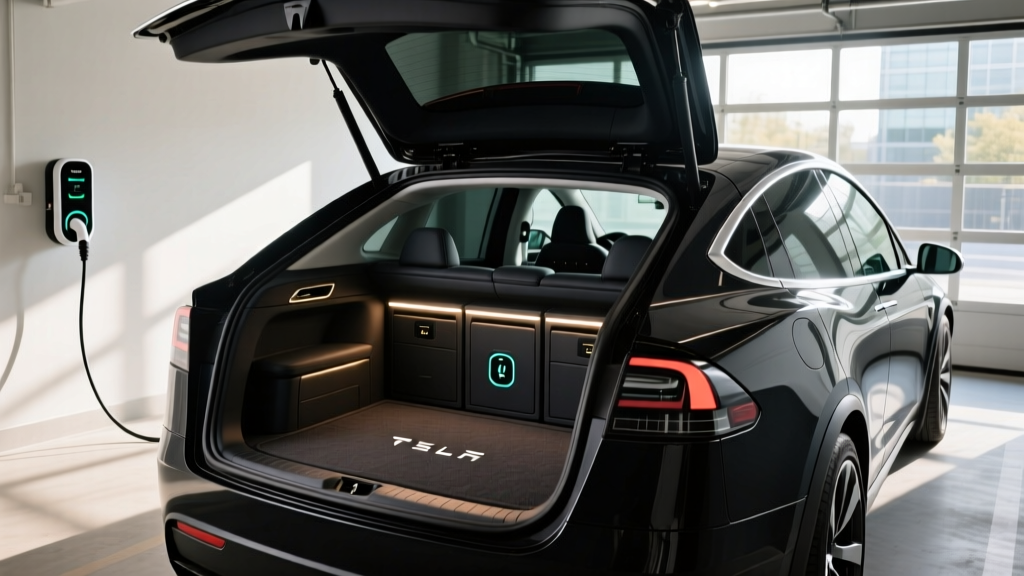
Fold the third row flat (a 50/50 split), and you unlock 44.1 cubic feet — a deep, wide, flat-floored area that easily swallows four full-size suitcases, a stroller, or a week's worth of camping gear for a family of four. The load floor is low thanks to the skateboard battery platform, and the power liftgate opens to a generous height.
Fold both rear rows and you get 88.1 cubic feet of total cargo space — approaching small cargo-van territory. The flat floor and wide opening (the falcon-wing rear doors make top-access loading uniquely easy in tight parking spots) make the Model X genuinely practical for hauling furniture, bicycles (with front wheels removed), or large dog crates.
The 6.5-cubic-foot frunk is useful for charging cables, a soft cooler, or a backpack. It's not enormous — the Model S frunk is larger — but it's a sealed, drainable space that adds real utility.
Passenger Space & Interior Dimensions
| Measurement | Front | Second Row | Third Row |
|---|---|---|---|
| Headroom | 41.7 in | 40.9 in | 37.1 in |
| Legroom | 41.2 in | 40.9 in | 32.7 in |
| Shoulder Room | 60.7 in | 56.8 in | 40.0 in |
The third row is best suited for children or adults on short trips. At 32.7 inches of legroom, a six-foot adult will find it tight for anything beyond a 20-minute ride. The second row, by contrast, is genuinely spacious — especially in the six-seat configuration with captain's chairs that provide individual armrests and easier third-row access via the center aisle.
Performance, Tech & Driver Assistance
The Model X Long Range delivers 670 horsepower from its dual-motor all-wheel-drive setup, reaching 60 mph in 3.8 seconds. That's supercar territory from a 5,100-pound three-row SUV. The Plaid variant's tri-motor setup produces 1,020 horsepower and a 2.5-second 0–60 time — largely a party trick, but the instant torque makes highway merging and mountain-pass climbing effortless in either trim.
On the technology front, the 17-inch center touchscreen runs Tesla's latest infotainment software with responsive navigation, streaming apps, and a well-integrated trip planner that automatically routes through Superchargers and precondition the battery before arrival. The second-row passengers get their own 8-inch display for climate control and entertainment.
Tesla's Autopilot and Full Self-Driving (Supervised) are SAE Level 2 driver-assistance systems. The driver must remain fully engaged, hands on or near the wheel, eyes on the road, and ready to take over at any moment. These systems do not make the Model X a self-driving vehicle. Only Level 4 services like Waymo operate without a driver. FSD (Supervised) adds features like traffic-light recognition and city-street navigation assistance, but it remains a supervised assist system — not autonomy.
The falcon-wing rear doors remain the Model X's most distinctive feature. They're genuinely useful in tight parking spaces (they require only about 12 inches of lateral clearance to open), and they make loading children into car seats significantly easier than conventional doors. However, they add mechanical complexity, can be slower to open and close than traditional doors, and have historically been a source of warranty claims for seal and sensor issues.
Pricing, Tax Credits & Total Cost
The 2026 Model X Long Range AWD starts at $79,990 (including destination). The Plaid starts at $94,990. Common options that push the as-tested price higher include:
- Seven-seat layout: $0 (standard on some configs) / Six-seat with captain's chairs: $6,500
- FSD (Supervised): $8,000 one-time or $99/month subscription
- Premium paint colors: $1,500–$2,500
- 22-inch Turbine wheels: $5,500 (reduces range by ~15 miles)
Federal Tax Credit Eligibility (IRS §30D)
| §30D Requirement | Model X Status |
|---|---|
| MSRP Cap (SUVs: ≤$80,000) | Long Range: ✅ Qualifies ($79,990) / Plaid: ❌ Exceeds cap |
| Buyer Income Cap | AGI ≤$300K (MFJ) / $225K (HoH) / $150K (single) |
| Battery Sourcing / Critical Minerals | Varies by production batch — verify at purchase via IRS guidance |
| North American Assembly | ✅ Built in Fremont, CA |
| Point-of-Sale Transfer | ✅ Available — reduces purchase price at dealer |
Key caveat: The Long Range AWD at $79,990 sits exactly at the IRS MSRP cap for SUVs. Any dealer-installed accessories or mandatory packages that push the MSRP above $80,000 could disqualify it. The Plaid at $94,990 is categorically ineligible for the §30D credit based on MSRP alone. Always confirm eligibility at the point of sale and consult IRS.gov guidance on clean vehicle credits or a tax professional before relying on the credit.
If you qualify for the full $7,500 credit on the Long Range, the effective price drops to approximately $72,490 — still premium, but more competitive against the Rivian R1S (starting around $75,900) and the Mercedes EQS SUV (starting over $104,000).
Warranty, Ownership Costs & Competitor Comparison
Tesla provides a 4-year/50,000-mile basic vehicle warranty and an 8-year/150,000-mile battery and drive unit warranty with a minimum 70% capacity retention threshold. That battery warranty is competitive — Rivian offers 8 years/175,000 miles, while BMW covers the iX battery for 8 years/100,000 miles.
Insurance is a known pain point for Model X owners. Average annual premiums run $2,800–$4,200 depending on state, driving record, and coverage levels — significantly higher than the industry average. Tesla's own insurance product (available in select states) uses real-time driving data and can be competitive for safe drivers, but availability varies.
Maintenance costs are low relative to gas SUVs: no oil changes, no spark plugs, minimal brake wear thanks to regenerative braking. Budget for cabin air filter replacement (~$150 every 2 years), tire rotation, and windshield washer fluid. Tesla recommends no scheduled service intervals beyond these consumables.
✅ Pros
- Best-in-class max cargo (88.1 cu ft)
- Supercharger network — most reliable DCFC ecosystem
- Heat pump standard — excellent cold-weather efficiency
- Falcon-wing doors aid car-seat loading
- 329-mi EPA range tops most three-row EVs
- Over-the-air updates add features post-purchase
❌ Cons
- 250 kW peak charge rate trails 800V competitors
- Plaid trim ineligible for §30D tax credit
- Third-row legroom tight for adults (32.7 in)
- High insurance premiums ($2,800–$4,200/yr avg)
- Falcon-wing door mechanical complexity
- Interior materials lag behind Mercedes/BMW at this price
How It Compares
| Metric | Tesla Model X LR | Rivian R1S Dual | Mercedes EQS 580 SUV |
|---|---|---|---|
| EPA Range | 329 mi | ~321 mi | ~305 mi |
| Max Cargo | 88.1 cu ft | ~83.5 cu ft | ~74.0 cu ft |
| Max DCFC | 250 kW | ~220 kW | 200 kW |
| Base MSRP | $79,990 | $75,900 | $104,400 |
| Off-Road Capability | Limited | Excellent | None |
Who Should Buy the 2026 Model X?
Choose the Model X if: You need maximum cargo volume in a premium EV, rely on the Supercharger network for frequent road trips, want three-row seating for school runs or family travel, and value the falcon-wing doors for car-seat loading.
Choose the Rivian R1S if: You want genuine off-road capability, a lower starting price, and don't mind slightly less range and a smaller charging network.
Choose the Mercedes EQS SUV if: Interior luxury, ride comfort, and brand prestige matter more than cargo volume or price.
Look at a PHEV (e.g., Volvo XC90 Recharge) if: You lack reliable home charging and need gas flexibility for long rural trips.
Frequently Asked Questions
Does the Model X qualify for the $7,500 federal EV tax credit?
The Long Range AWD at $79,990 MSRP qualifies on price (the SUV cap is $80,000), but you must also meet IRS income limits ($300K joint / $150K single) and the vehicle's battery components and critical minerals must meet sourcing thresholds that vary by production date. The Plaid at $94,990 does not qualify due to the MSRP cap. Always verify at the point of sale and consult IRS §30D guidance.
How much trunk space does the Model X have with all seats up?
With the third row upright in the 6- or 7-seat configuration, you get 12.6 cubic feet behind the third row. Add the 6.5-cubic-foot frunk for a combined 19.1 cubic feet — sufficient for groceries and a few carry-ons.
Can the Model X tow?
Yes. The 2026 Model X is rated to tow up to 5,000 pounds when properly equipped with the factory tow package. Expect range to drop by 30–50% when towing a loaded trailer at highway speeds.
Is the Model X battery warranty competitive?
Tesla covers the battery and drive unit for 8 years or 150,000 miles (whichever comes first) with a guaranteed minimum 70% capacity retention. This is slightly better than BMW's 8/100,000 and competitive with Rivian's 8/175,000-mile coverage. NMC chemistry in the Model X has shown average degradation of roughly 8–12% over 100,000 miles based on fleet data.
How does Model X charging compare to 800V competitors?
The Model X's 400V architecture limits it to 250 kW peak DC charging. Newer 800V vehicles like the Hyundai Ioniq 9 or Kia EV9 can peak at 350 kW and sustain higher rates longer, achieving 10–80% in roughly 18–20 minutes versus the Model X's ~32 minutes. On road trips, this means 10–15 extra minutes per charging stop in the Model X.
What's the real cost to charge a Model X at home?
At the national average electricity rate of ~$0.16/kWh, fully charging the 100 kWh battery from 10% to 90% (80 kWh) costs approximately $12.80. That provides roughly 260–280 real-world miles — equivalent to about $0.046 per mile. A comparable gas SUV at 20 MPG and $3.50/gallon costs $0.175 per mile. Home charging saves roughly $0.13 per mile, or $1,950 over 15,000 annual miles.