The Tesla Model X has always been the SUV that tries to do everything: supercar acceleration, falcon-wing doors, and three rows of seating. But for buyers specifically searching for a Model X trunk with 6 seat configuration, the real question isn't about 0-60 times — it's about whether you can actually fit luggage, groceries, and strollers behind the third row while carrying six passengers. In this 2026 review, we break down the cargo reality, range, charging speeds, and ownership economics of the six-seat Model X to help you decide if it earns its premium price tag.
2026 Tesla Model X Quick Specs at a Glance
| Spec | Value |
|---|---|
| EPA Range | 335 miles |
| Battery (usable) | ~100 kWh, NMC (nickel manganese cobalt) |
| Drivetrain | Dual-Motor AWD |
| Horsepower | 670 hp |
| 0-60 mph | 3.8 seconds |
| Peak DC Fast Charge | 250 kW (Supercharger V3/V4) |
| 10-80% DC Charge Time | ~30 minutes |
| Level 2 Home Charge Rate | 11.5 kW (~34 mi/hr) |
| Efficiency | 100 MPGe combined / 34 kWh/100 mi |
| Seating | 6 (2+2+2, captain's chairs in row 2) |
| Cargo (behind 3rd row) | 13.0 cu ft |
| Cargo (3rd row folded) | 37.1 cu ft |
| Cargo (max, all rows folded) | 74.4 cu ft |
| Base MSRP | $81,630 (Long Range AWD) |
| Federal Tax Credit (§30D) | Not eligible (MSRP & sourcing) |
| Battery/Drive Unit Warranty | 8 years / 150,000 miles (70% retention) |
The Model X Trunk With 6 Seats: What Actually Fits Back There?
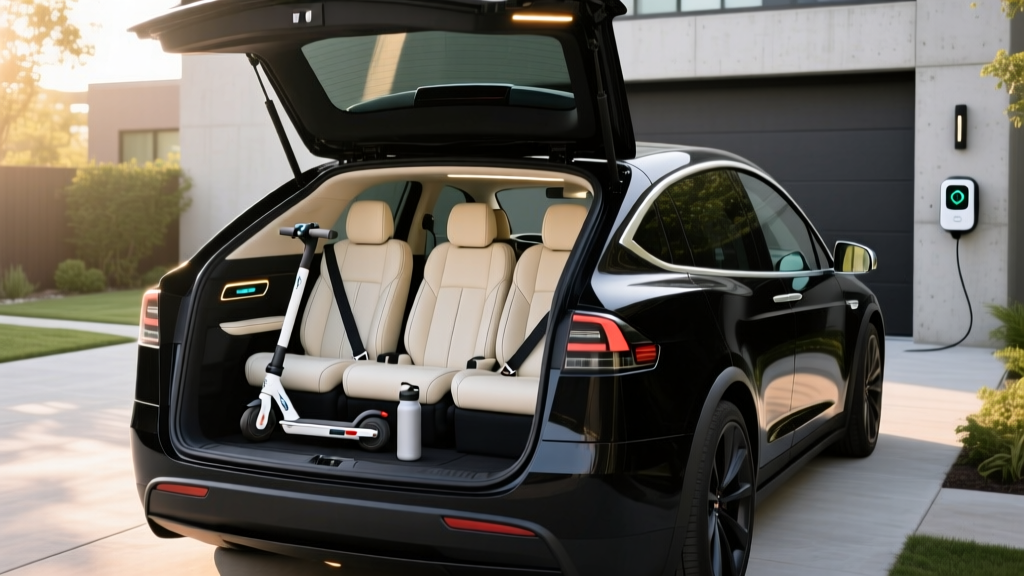
With the six-seat layout, the second row uses two individual captain's chairs separated by a center walkway. This configuration eliminates the second-row bench, which slightly changes how cargo flows through the cabin, but the trunk volume behind the third row remains 13.0 cubic feet — the same as the 7-seat variant.
What does 13.0 cu ft look like in practice? You can fit:
- Two full-size checked suitcases (stacked)
- Three to four grocery bags alongside a compact stroller
- A double jogging stroller, but it will consume nearly the entire trunk floor
The Model X also features a front trunk (frunk) rated at 6.5 cu ft, which is genuinely useful for charging cables, a laptop bag, or a small soft cooler. Combined front and rear cargo with all six seats occupied gives you roughly 19.5 cu ft — workable for a weekend trip but tight for a week-long family vacation with six people's luggage.
Pro tip for 6-seat owners: The walkway between the second-row captain's chairs lets kids or adults pass to the third row without folding seats — a real advantage over the 5-seat bench for daily use. However, that same walkway means you can't fold the second row into a flat load floor as seamlessly as the bench configuration.
Range, Efficiency, and Real-World Expectations
The 2026 Model X Long Range AWD carries an EPA-estimated 335 miles of range from its ~100 kWh NMC battery pack. Tesla uses nickel-based chemistry rather than LFP in the Model X, prioritizing energy density and cold-weather performance over the ultra-long cycle life of LFP packs found in the Model 3 RWD.
EPA sticker: 335 miles
Highway driving (75 mph, moderate temps): ~280–300 miles
Cold weather (below 32°F, highway): ~230–260 miles
City driving with regen (mild temps): 310–335 miles
The Model X's large frontal area and 5,185-lb curb weight hit efficiency hard at sustained highway speeds. Plan charging stops around 250-mile intervals on road trips to maintain a comfortable buffer.
Efficiency clocks in at 34 kWh per 100 miles (100 MPGe combined). For context, that's roughly 30% less efficient than a Model Y Long Range, which is the trade-off for the larger cabin, falcon-wing doors, and 670 hp.
Charging Speeds: Supercharger Network and Home Setup
| Charge Level | Power / Rate | Miles Added per Hour | Notes |
|---|---|---|---|
| Level 1 (120V outlet) | ~1.4 kW | ~3–4 mi/hr | Emergency/trickle only |
| Level 2 (240V, 48A Wall Connector) | 11.5 kW | ~34 mi/hr | Full charge in ~9.5 hours |
| Level 2 (240V, 32A mobile connector) | 7.7 kW | ~22 mi/hr | Standard NEMA 14-50 outlet |
| DC Fast Charge (Supercharger V3/V4) | Peak 250 kW | ~200 mi in 15 min | 10-80% in ~30 min |
| DC Fast Charge (CCS via adapter) | Up to 150 kW | Variable | Requires Tesla CCS adapter |
The Model X uses the NACS (North American Charging Standard) connector natively, meaning it plugs directly into all Tesla Supercharger stalls — now the largest and most reliable DC fast-charging network in the U.S. At a V3 or V4 Supercharger, the Model X peaks at 250 kW, though it sustains that peak only briefly before tapering. Expect the 10-80% charge to take roughly 30 minutes, with the curve flattening significantly above 80%.
Charging-curve reality: Don't plan road-trip stops around the peak 250 kW figure. The Model X's large battery means the sustained average charge rate from 10-80% is closer to 130–150 kW. Preconditioning the battery (which the navigation system does automatically when you route to a Supercharger) is critical — arriving at a charger with a cold pack can cut charge speeds by 40% or more.
At home, the Tesla Wall Connector on a 60-amp circuit delivers 11.5 kW, adding about 34 miles of range per hour. A full overnight charge from 20% to 100% takes roughly 8–9 hours — perfectly suited to daily driving needs. Most owners rarely charge past 80-90% on Level 2 except before road trips, which helps preserve long-term battery health.
Performance, Ride, and Daily Driving Impressions
Even in its base Long Range AWD trim, the Model X delivers 670 horsepower and a 3.8-second 0-60 mph time. That's sports-car acceleration in a three-row SUV — and it never stops being startling when you merge onto a highway on-ramp.
The dual-motor AWD system provides excellent traction in rain and light snow, and the adaptive air suspension adjusts ride height automatically (useful for steep driveways or speed bumps). Ride quality is firm but well-damped, though the sheer weight of the vehicle is noticeable through corners and during hard braking.
Standout tech features:
- Falcon-wing rear doors: Power-operated gull-wing doors with ultrasonic sensors to avoid obstacles. Genuinely useful for loading kids in tight parking spots, though they add weight and complexity.
- 17-inch center touchscreen: Tilting display with excellent responsiveness; runs navigation, media, and vehicle controls.
- Autopilot (standard): SAE Level 2 driver-assist with adaptive cruise and lane centering. This is not self-driving — hands-on-wheel supervision is required at all times.
- Full Self-Driving (Supervised): Optional $8,000 upgrade adding auto lane-change, traffic-light recognition, and parking assist. Still SAE Level 2 — driver must remain engaged.
- HEPA air filtration: "Bioweapon Defense Mode" with hospital-grade cabin filtration — a genuine differentiator for allergy sufferers and urban drivers.
Pricing, Tax Credits, and the Bottom Line
| Trim | Base MSRP | Federal Tax Credit (§30D) | Effective Starting Price |
|---|---|---|---|
| Long Range AWD (6-seat) | $81,630 | $0 (exceeds MSRP cap) | $81,630 |
| Plaid (6-seat) | $96,630 | $0 (exceeds MSRP cap) | $96,630 |
The 2026 Model X does not qualify for the IRS §30D federal EV tax credit. There are two compounding reasons:
- MSRP cap: The §30D credit applies only to SUVs priced at or below $80,000. The Model X Long Range starts above that threshold.
- Battery sourcing requirements: Even if pricing were within range, the credit's critical-mineral and battery-component sourcing rules (phased in through 2025-2026) disqualify many vehicles with non-compliant supply chains.
Buyers should also be aware of income caps under §30D: modified adjusted gross income cannot exceed $300,000 (joint filers), $225,000 (head of household), or $150,000 (individual). Always verify your eligibility with a tax professional and consult the latest IRS guidance, as rules are subject to legislative change.
State and local incentives may still apply depending on your jurisdiction. Some states offer rebates or HOV-lane access for EVs regardless of federal credit eligibility — check your state energy office or DMV for current programs.
How Does the Model X Compare to Key Rivals?
| Attribute | Tesla Model X LR | Kia EV9 GT-Line AWD | Rivian R1S Dual-Motor |
|---|---|---|---|
| EPA Range | 335 mi | 270 mi | 352 mi (Max Pack) |
| Base MSRP | $81,630 | $73,900 | $82,700 |
| Federal Tax Credit | $0 | Up to $7,500* | $0 (MSRP cap) |
| 3rd-Row Cargo | 13.0 cu ft | 20.2 cu ft | 18.0 cu ft |
| Peak DC Charge | 250 kW | 236 kW | 200 kW |
| 0-60 mph | 3.8 sec | 5.0 sec | 4.5 sec |
*Kia EV9 credit eligibility depends on sourcing, MSRP, and buyer income per §30D rules.
The Kia EV9 offers substantially more cargo space behind the third row and a lower price, plus potential federal credit eligibility. It's the pragmatic family pick. The Rivian R1S delivers superior off-road capability and slightly more cargo volume but costs similarly to the Model X. The Model X wins on raw performance, Supercharger access, and tech — but loses on value and cargo practicality.
- Class-leading acceleration (3.8s to 60)
- Supercharger network access
- Falcon-wing doors ease child-seat loading
- HEPA cabin filtration
- Strong over-the-air update cadence
- 335-mile EPA range
- No federal tax credit (MSRP cap)
- Tight 13 cu ft trunk with all seats up
- Premium price ($81,630+ starting)
- Panel-gap and build-quality inconsistency
- Falcon-wing doors add repair complexity
- No Apple CarPlay / Android Auto
Who Is the 6-Seat Model X Actually For?
The six-seat Model X is a niche within a niche. It makes the most sense for:
- Performance-minded families who want supercar acceleration with room for four kids (or two kids plus grandparents) and value the Supercharger network for road trips.
- Tech-forward buyers who prioritize Tesla's software ecosystem, OTA updates, and driver-assist features over traditional luxury brand cachet.
- Urban/suburban commuters who charge at home nightly, rarely fill all six seats simultaneously, and want the falcon-wing door convenience in tight garages.
It's a poor fit for buyers who:
- Regularly carry six passengers plus heavy luggage (the EV9 or a three-row minivan serves better).
- Need the $7,500 federal tax credit to justify the purchase price.
- Prefer Apple CarPlay, physical controls, or dealer-based service networks.
Frequently Asked Questions
What is the real-world range of the 2026 Model X?
The EPA rates it at 335 miles, but expect roughly 280–300 miles on highway road trips at 75 mph and as low as 230–260 miles in sub-freezing conditions. City driving with regenerative braking can approach the EPA sticker in mild weather.
How fast does the Model X charge at home and on the road?
On a Tesla Wall Connector (Level 2, 11.5 kW), it adds ~34 miles per hour and fully charges overnight in about 9.5 hours. On a V3/V4 Supercharger, it peaks at 250 kW and charges from 10-80% in roughly 30 minutes.
Does the Model X qualify for the federal EV tax credit?
No. The Model X exceeds the §30D MSRP cap of $80,000 for SUVs and faces battery-sourcing compliance challenges. Always verify current rules at irs.gov and consult a tax professional.
Is the Model X worth buying over the Kia EV9 or Rivian R1S?
If you prioritize performance, Supercharger access, and Tesla's software, yes. If cargo space, value, and tax-credit eligibility matter more, the Kia EV9 is the stronger practical choice. The Rivian R1S is competitive on range and off-road ability but similarly priced.
Can I fit a double stroller in the Model X trunk with all 6 seats occupied?
A compact double stroller will fit, but it will consume nearly all 13.0 cu ft of trunk space. A full-size jogging stroller may require removing wheels or using the frunk for overflow. For frequent stroller hauling, consider a roof cargo box.
How long will the Model X battery last?
Tesla warranties the battery and drive unit for 8 years or 150,000 miles, whichever comes first, with a minimum 70% capacity retention threshold. Real-world data from high-mileage Tesla owners suggests NMC packs typically retain 85-90% capacity at 100,000 miles when charged primarily to 80-90% on Level 2.