The Quick Verdict on Towing With a Tesla Model X
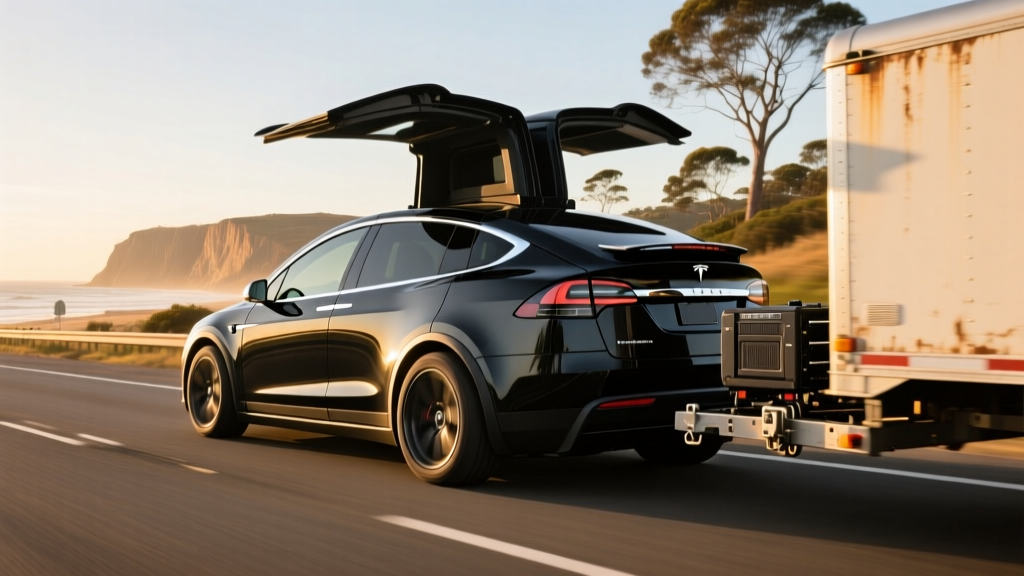
If you're researching towing with a Tesla Model X, here's what matters most: the 2026 Model X can tow up to 5,000 pounds when properly equipped, and it does so with instant torque from its dual- or tri-motor powertrain that makes gas SUVs feel sluggish off the line. But towing an EV introduces a reality many buyers underestimate — range drops dramatically under load. Expect roughly 50% of the EPA-estimated range when pulling a loaded 4,000–5,000 lb trailer. That's not a dealbreaker if your trips are planned around Supercharger stops, but it demands honest math before you hitch up.
The Model X remains one of the few electric SUVs that combines genuine three-row seating, a 5,000-lb tow rating, and access to Tesla's Supercharger network — the most reliable DC fast-charging ecosystem in North America. Whether it's the right tow vehicle for your specific trailer and route is what we'll break down with real numbers.
Model X Specs at a Glance: Towing, Range, and Powertrain
| Spec | Model X Long Range (AWD) | Model X Plaid (AWD) |
|---|---|---|
| Max Tow Rating | 5,000 lbs | 5,000 lbs |
| EPA Range | 335 miles (20" wheels) | 320 miles (21" wheels) |
| Battery (usable) | ~100 kWh (NMC) | ~100 kWh (NMC) |
| Drivetrain | Dual-Motor AWD | Tri-Motor AWD |
| Horsepower | 670 hp | 1,020 hp |
| 0–60 mph | 3.8 seconds | 2.5 seconds |
| Max DC Fast Charge | 250 kW | 250 kW |
| 10–80% DC Charge Time | ~30 minutes | ~30 minutes |
| Level 2 Charge Rate | 11.5 kW (~44 mi/hr) | 11.5 kW (~44 mi/hr) |
| MPGe (combined) | 102 MPGe | 98 MPGe |
| Efficiency | 33 kWh/100 mi | 34 kWh/100 mi |
| Base MSRP (2026) | $79,990 | $94,990 |
| Battery/Drive Unit Warranty | 8 yr / 150,000 mi | 8 yr / 150,000 mi |
Both trims share the same tow rating and battery architecture. The Plaid's tri-motor setup delivers extraordinary acceleration but sacrifices a small amount of range and efficiency. For towing purposes, the Long Range is the more practical and cost-effective choice — the extra 670 hp-to-1,020 hp jump doesn't meaningfully improve towing performance at highway speeds, and you'll appreciate the 15 extra miles of EPA range.
Real-World Range: EPA Sticker vs. What You'll Actually See
Real-World Highway (no trailer, 70 mph): ~270–290 miles
Real-World Towing (4,500 lb trailer, 65 mph): ~160–180 miles
Cold-Weather Towing (below 32°F, loaded trailer): ~130–150 miles
The EPA's 335-mile figure assumes a mix of city and highway driving with no cargo load. In practice, highway driving alone at 70–75 mph reduces range to roughly 270–290 miles because aerodynamic drag dominates at speed — and the Model X, with its wide stance and falcon-wing doors creating additional surface turbulence, isn't the most aerodynamic SUV on the road.
When towing, the math gets brutal. A 4,500-pound enclosed trailer increases energy consumption from ~33 kWh/100 mi to approximately 55–65 kWh/100 mi depending on trailer aerodynamics, speed, and terrain. That 50% range reduction is consistent across every EV tow test we've reviewed and aligns with data from fueleconomy.gov's real-world testing methodology. Flat-terrain towing at 60–65 mph yields the best results (~180 miles); mountainous routes or sustained 75 mph speeds can push consumption past 70 kWh/100 mi, dropping range below 150 miles.
Cold weather compounds this further. Lithium-ion NMC batteries lose roughly 15–20% of usable capacity in sub-freezing temperatures due to increased internal resistance and cabin/heater energy draw. When you combine cold weather with a heavy trailer, plan for 130–150 miles between charges. This means Supercharger stops every 2 to 2.5 hours on long towing trips — manageable, but a significant departure from unladen driving.
Charging Speed: Supercharger Stops While Towing
| Charging Level | Power | Speed (Unladen) | Notes |
|---|---|---|---|
| Level 1 (120V outlet) | ~1.4 kW | ~5 mi/hr | Emergency/trickle only; irrelevant for towing recovery |
| Level 2 (240V home) | 11.5 kW | ~44 mi/hr | Full overnight charge in ~9 hours; ideal for daily use |
| DC Fast (Supercharger V3) | Peak 250 kW | ~175 mi in 15 min | Peak rate only below 30% SoC; tapers significantly above 80% |
| DC Fast (Supercharger V4) | Up to 350 kW* | Model X limited to ~250 kW intake | V4 stalls deliver more power but Model X architecture caps at 250 kW |
*V4 Supercharger availability varies by location; not all stalls deliver full 350 kW.
When towing, you'll arrive at Superchargers at lower states of charge (often 10–15%), which actually puts you in the optimal zone for peak charge rates. The Model X can accept up to 250 kW at low SoC, adding roughly 100 miles of range in 10 minutes or 175 miles in about 15 minutes under ideal conditions. However, "ideal" means a warm battery and a stall not shared with another vehicle pulling max current.
The charge curve tapers hard above 80% — charging from 80–100% can take as long as 10–80%. When towing, the smart play is to charge to 80% and go, rather than wait for a full battery. This keeps your stops around 25–35 minutes, which aligns well with rest breaks for passengers and pets.
One towing-specific advantage: Tesla's navigation system automatically accounts for trailer load when routing and will pre-condition the battery before you arrive at a Supercharger, optimizing charge speed. You'll need to enable "Tow Mode" in the vehicle settings and input your trailer weight for the most accurate route planning.
Towing Performance: What It Actually Feels Like
The dual-motor AWD powertrain produces 670 horsepower and delivers it instantly — there's no turbo spool-up, no transmission hunting for gears on a grade. When merging onto a highway with a 4,500-pound trailer, the Model X pulls with a flat torque curve that makes most gas-powered three-row SUVs feel underpowered. The 0–60 time of 3.8 seconds (unladen) won't apply with a trailer, but the low-end thrust at 0–30 mph remains remarkably strong under load.
Regenerative braking is where EV towing gets interesting. On downhill grades, the Model X can recover significant energy while simultaneously reducing brake wear — a genuine advantage over gas vehicles that rely entirely on friction brakes when descending with a heavy trailer. In "Tow Mode," regen is calibrated to provide smoother deceleration that doesn't upset the trailer. You'll still want trailer brakes (electric or surge) for any load over 3,000 pounds, as required by most state laws.
The Model X includes an integrated 2-inch hitch receiver (dealer-installed or factory option, depending on configuration) and a wiring harness for trailer lights. Tesla's tow rating of 5,000 lbs applies to properly equipped vehicles with the factory tow package. Aftermarket hitches may not carry the same warranty coverage — confirm with your Tesla service center before installation.
Cargo, Passenger Space, and Practicality
The Model X seats up to seven in its three-row configuration, though the third row is best suited for children or short trips. Key interior dimensions:
- Cargo (behind 3rd row): ~15.8 cu ft
- Cargo (3rd row folded): ~43.9 cu ft
- Cargo (2nd + 3rd folded): ~88.1 cu ft
- Front trunk (frunk): ~6.5 cu ft — useful for charging cables and small gear
- 2nd-row legroom: ~40.5 inches
- 3rd-row legroom: ~32.7 inches
The falcon-wing rear doors are the Model X's signature feature and genuinely improve access to the second and third rows in tight parking spaces — they open upward rather than outward, requiring less lateral clearance. However, they add weight high on the vehicle, slightly raising the center of gravity, and they can be slow to open/close in high winds. For towing scenarios, they're mostly neutral — you'll access the cabin normally and use the rear hatch for cargo.
Pricing, Tax Credits, and Total Cost
| Trim | Base MSRP | Destination | Est. As-Tested* | Federal §30D Credit Eligible? |
|---|---|---|---|---|
| Model X Long Range | $79,990 | $1,995 | $84,000–$90,000 | No — exceeds $80,000 SUV MSRP cap |
| Model X Plaid | $94,990 | $1,995 | $99,000–$108,000 | No — exceeds $80,000 SUV MSRP cap |
*As-tested pricing reflects common options: 22" wheels, tow package, FSD capability, premium interior colors.
The Model X does not qualify for the IRS §30D federal EV tax credit. Under current rules, SUVs must have an MSRP at or below $80,000 to be eligible, and even the base Long Range trim starts at $79,990 before the mandatory $1,995 destination fee — pushing it over the cap. The Plaid is well above the threshold. Additionally, the credit has adjusted gross income limits ($300,000 joint / $150,000 single) and battery critical-mineral sourcing requirements that further restrict eligibility. Consult a tax professional for your specific situation.
Some states offer separate EV rebates or incentives that aren't bound by the federal MSRP cap — check your state's energy office or DMV for current programs. These can range from $1,000 to $5,000+ depending on jurisdiction and income eligibility.
For total cost of ownership, electricity cost per mile when towing runs approximately $0.15–$0.22/mile at public Supercharger rates ($0.35–$0.50/kWh depending on region), compared to $0.30–$0.45/mile for a comparable gas SUV getting 15–18 mpg while towing at $4.00/gallon. Home charging at $0.13/kWh drops the unladen cost to roughly $0.04/mile. Over 5 years and 75,000 miles, the fuel savings can offset a meaningful portion of the higher purchase price — but the upfront cost remains steep.
Standout Tech and Driver-Assist Features
The Model X runs Tesla's latest infotainment stack on a 17-inch center touchscreen with a secondary 8-inch rear display for passengers. Key technology highlights:
- Autopilot (standard): SAE Level 2 driver-assist with adaptive cruise, lane-keeping, and automatic emergency braking. The driver must remain engaged at all times — this is not self-driving.
- Full Self-Driving (Supervised) capability ($8,000 option): Enhanced Level 2 with automatic lane changes, navigate-on-Autopilot, and traffic light recognition. Still requires full driver supervision.
- Tow Mode with trailer-light check: Integrated trailer sway mitigation and energy routing display.
- Sentry Mode / Dog Mode: Cabin monitoring and climate control while parked — useful at rest stops.
- Over-the-air updates: Continuous feature improvements without dealer visits.
Notable drawbacks: The yoke steering wheel (optional, replacing the round wheel in some configurations) requires adaptation and can be frustrating during low-speed maneuvering — like backing up to a trailer hitch. The lack of physical buttons for climate and media means everything routes through the touchscreen, which is a distraction concern when towing in traffic. Panel gap quality, while improved from earlier Model X generations, still varies by vehicle.
How the Model X Compares to Key Towing Competitors
The electric SUV towing segment is growing, but the Model X's combination of 5,000-lb capacity and Supercharger access keeps it competitive. Here's how it stacks up:
- Rivian R1S: 7,700-lb tow rating (significantly higher), ~321 mi EPA range, starts ~$75,900. Better for heavy trailers, but uses the CCS/NACS adapter ecosystem and has a smaller fast-charging network dependency.
- BMW iX xDrive50: 3,500-lb tow rating (lower), ~324 mi EPA range, starts ~$87,250. More refined interior, but tow rating is a limiting factor for larger campers.
- Mercedes EQS SUV: 3,500-lb tow rating, ~305 mi EPA range, starts ~$104,400. Premium luxury but significantly more expensive and lower tow capacity.
- Gas alternative (Ford Expedition): 9,300-lb tow rating, ~18 mpg combined, starts ~$57,000. Far more towing headroom and no range anxiety, but higher per-mile fuel cost when towing and zero electric-only capability.
For trailers between 3,000 and 5,000 lbs (typical small campers, boat trailers, or utility trailers), the Model X is a strong choice — especially if you already use or plan to use the Tesla Supercharger network. For trailers above 5,000 lbs, the Rivian R1S is the clear electric alternative. For maximum towing with no range concerns, a gas or diesel SUV remains the pragmatic choice.
Pros and Cons of Towing With the Model X
Pros
- 5,000-lb tow rating covers most light trailers, small campers, and boat rigs
- Instant torque makes highway merging and hill climbs effortless under load
- Supercharger network provides the most reliable long-distance EV charging in North America
- Regenerative braking reduces brake wear and recovers energy on downhill grades
- Integrated Tow Mode with trailer-sway mitigation and route planning
- Three-row seating for family towing trips (up to 7 passengers)
- Low per-mile energy cost when charging at home vs. gas alternatives
Cons
- Range drops ~50% when towing — plan for frequent Supercharger stops
- Does not qualify for the $7,500 federal §30D tax credit (exceeds MSRP cap)
- Starting price above $80,000 is a significant premium over gas tow vehicles
- Cold-weather towing range can fall below 150 miles with a loaded trailer
- Falcon-wing doors add weight and complexity; potential service concern long-term
- No spare tire — relies on tire repair kit and roadside assistance
- Insurance premiums are notably higher than comparable gas SUVs
Frequently Asked Questions
What is the real-world range of the Tesla Model X when towing?
Expect approximately 160–180 miles when towing a 4,000–5,000 lb trailer at highway speeds on flat terrain. Cold weather and mountain routes can reduce this to 130–150 miles. Without a trailer, real-world highway range is roughly 270–290 miles vs. the EPA's 335-mile estimate.
Does the Model X qualify for the federal EV tax credit?
No. The IRS §30D credit caps SUV eligibility at an $80,000 MSRP. The Model X Long Range starts at $79,990 before the $1,995 destination fee, putting it above the threshold. Income limits and battery-sourcing rules further restrict eligibility for most buyers. Check your state for separate EV incentives that may apply.
How fast does the Model X charge at a Supercharger while on a towing trip?
At a V3 Supercharger, the Model X peaks at 250 kW when arriving at a low state of charge (10–20%). You can add roughly 175 miles of range in about 15–20 minutes under ideal conditions. Charging from 10–80% takes approximately 30 minutes. Plan 25–35 minute stops every 150–180 miles when towing.
Is the Model X worth buying vs. the Rivian R1S for towing?
If your trailer exceeds 5,000 lbs, the Rivian R1S (7,700-lb rating) is the better electric choice. For trailers under 5,000 lbs, the Model X offers a more mature Supercharger network, faster DC charging, and a more refined on-road experience. The R1S is better for off-road capability; the Model X is better for highway comfort and charging infrastructure.
What size trailer can the Model X realistically tow?
The 5,000-lb rating covers small travel trailers (16–20 ft), pop-up campers, small boat trailers, and light utility trailers. A loaded 19-foot Airstream (dry weight ~3,500 lbs, loaded ~4,500 lbs) is within spec. Anything approaching 5,000 lbs loaded will significantly impact range and should be reserved for shorter trips with planned charging.
How much does it cost to charge a Model X on a towing road trip?
At average Supercharger rates of $0.40/kWh and towing consumption of ~60 kWh/100 mi, you'll spend approximately $0.24 per mile — or about $72 for a 300-mile towing trip. The same trip in a gas SUV averaging 15 mpg at $4.00/gallon would cost roughly $80. Savings are modest when towing at public charger rates; the real cost advantage comes from home charging for daily, unladen driving.
What is the battery warranty on the Model X?
Tesla covers the Model X battery and drive unit for 8 years or 150,000 miles (whichever comes first), with a minimum 70% capacity retention threshold. This is among the stronger warranties in the segment. Battery degradation on Tesla's NMC packs typically runs 8–12% over 100,000 miles based on fleet data, though frequent DC fast charging and extreme temperatures accelerate wear.
Who Should Buy the Model X for Towing?
The Model X makes sense as a tow vehicle if you fall into a specific use case: you need three-row seating for family trips, your trailer stays under 5,000 lbs loaded, your typical towing routes have Supercharger coverage every 150 miles or so, and you value the low daily driving cost when you're not towing. It's an excellent dual-purpose vehicle — a comfortable, tech-forward daily driver that can pull a camper on weekends.
It does not make sense if you regularly tow heavy trailers (over 5,000 lbs), frequently tow in extreme cold or remote areas without Supercharger access, or need the federal tax credit to justify the purchase price. In those cases, the Rivian R1S, a heavy-duty gas SUV, or a diesel truck will serve you better.
For the buyer who wants one vehicle that handles school runs, grocery trips, and occasional light-trailer camping — and who can charge at home — the Model X delivers a towing experience that's smoother, quieter, and more torque-rich than any gas alternative in its class. Just plan your charging stops honestly, and don't trust the EPA range sticker when a trailer is attached.