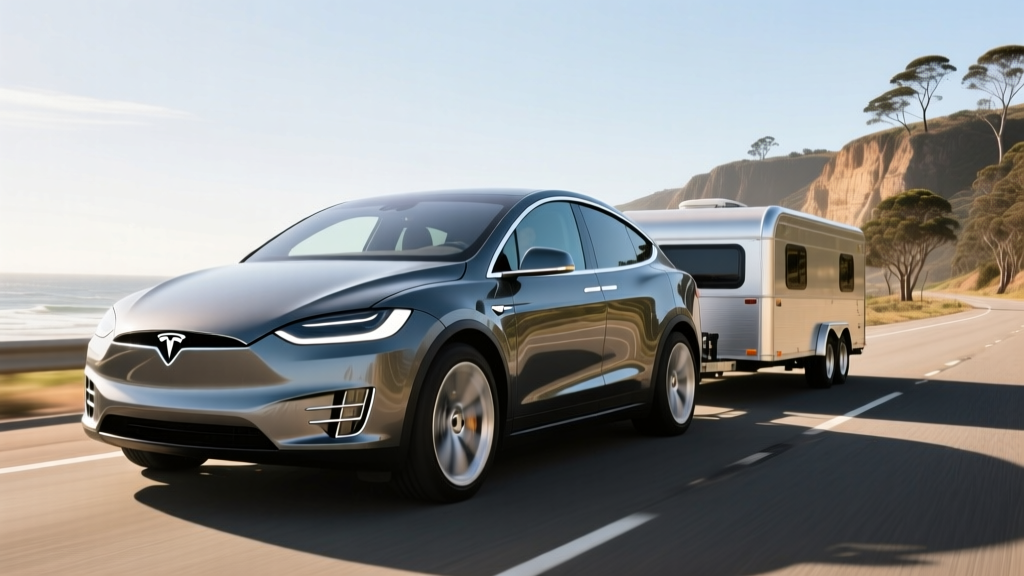
The Tesla Model X occupies a rare niche: a three-row electric SUV that can genuinely tow. While most EV buyers prioritize range and charging speed, a meaningful segment needs to pull a camper, boat, or utility trailer on weekends. For the 2026 model year, the Model X tow capacity remains rated at 5,000 pounds when properly equipped — competitive with mid-size gas SUVs but accompanied by the range-reduction realities every EV tower must understand.
This review covers the full ownership picture: EPA range versus what you'll actually see on the highway (and while towing), DC fast-charging performance, battery chemistry, pricing after federal incentives, and whether the Model X makes sense against rivals like the Rivian R1S and BMW iX.
Model X Tow Capacity and Powertrain at a Glance
Tesla offers the Model X in two primary configurations for 2026: the dual-motor Long Range and the tri-motor Plaid. Both share the same tow rating but differ substantially in performance and efficiency.
| Spec | Long Range (Dual-Motor AWD) | Plaid (Tri-Motor AWD) |
|---|---|---|
| EPA Range | 335 miles | 326 miles |
| Battery (usable) | ~100 kWh, NMC | ~100 kWh, NMC |
| Horsepower | 670 hp | 1,020 hp |
| 0-60 mph | 3.8 sec | 2.5 sec |
| Max Tow Capacity | 5,000 lbs | 5,000 lbs |
| Peak DC Charge Rate | 250 kW | 250 kW |
| 10-80% DC Charge Time | ~30 min | ~30 min |
| Level 2 Home Charge | 11.5 kW (~34 mi/hr) | 11.5 kW (~34 mi/hr) |
| Efficiency (EPA) | 101 MPGe / 33 kWh/100mi | 98 MPGe / 34 kWh/100mi |
| Base MSRP | $79,990 | $94,990 |
| Drivetrain | Dual-Motor AWD | Tri-Motor AWD |
| Battery Warranty | 8 yr / 150,000 mi | 8 yr / 150,000 mi |
The 5,000-pound tow rating applies when using the factory-installed tow hitch with integrated 4-pin and 7-pin connectors. Tesla includes trailer sway mitigation through its stability control system, and the air suspension automatically adjusts ride height when a trailer is detected.
Real-World Range: EPA Sticker vs. Highway and Towing Reality
EPA Estimated: 335 miles (Long Range) / 326 miles (Plaid)
Real-World Highway (70-75 mph): ~270-290 miles
Real-World Cold Weather (below 32°F): ~230-260 miles
While Towing (3,500-5,000 lb trailer): ~150-190 miles
The Model X's EPA range figures are achieved under controlled test cycles that don't reflect sustained highway speeds or the aerodynamic penalty of towing. Per fueleconomy.gov, the Long Range model achieves 101 MPGe combined, but real-world highway driving at 70-75 mph typically yields 270-290 miles before you need to find a charger.
The towing scenario is where physics asserts itself most forcefully. Pulling a 4,500-pound travel trailer increases energy consumption by roughly 50-80%, depending on the trailer's frontal area and aerodynamics. A boxy camper will hit your range harder than a sleek boat trailer. In our experience and consistent with owner reports, expect effective range to drop to 150-190 miles when towing near the 5,000-pound limit. This makes the Model X viable for towing to a nearby lake or campsite within ~150 miles, but cross-country towing requires careful Supercharger route planning — and patience, because you'll be stopping to charge roughly every 150 miles instead of every 270.
The 100 kWh NMC (nickel manganese cobalt) battery pack provides substantial energy reserves, but NMC chemistry is more sensitive to repeated deep discharges under heavy load than LFP packs. For owners who tow frequently, keeping the state of charge between 20% and 90% during daily driving and only charging to 100% before a tow trip will help preserve long-term battery health.
Charging Performance: Supercharger Speeds and Home Setup
| Charging Level | Power | Miles Added per Hour | Notes |
|---|---|---|---|
| Level 1 (120V outlet) | 1.4 kW | ~4 mi/hr | Emergency/trickle only |
| Level 2 (240V, 48A) | 11.5 kW | ~34 mi/hr | Full overnight charge in ~10 hrs |
| DC Fast (V3 Supercharger) | 250 kW peak | ~175 mi in 15 min | 10-80% in ~30 min |
| DC Fast (V4 Supercharger) | 250 kW peak | ~175 mi in 15 min | CCS adapter not needed; NACS native |
The Model X charges via the NACS (North American Charging Standard) connector natively — no adapter needed at Tesla Superchargers. At a V3 or V4 Supercharger, the 100 kWh pack accepts up to 250 kW peak, though as with all EVs, that peak rate only holds through roughly the 10-30% state-of-charge window. The charge curve tapers progressively: expect sustained rates around 150-175 kW through 50%, dropping to ~75 kW by 70%, and below 40 kW past 85%. This taper is why the 10-80% time is approximately 30 minutes, while 10-100% would take closer to 55-60 minutes.
For home Level 2 charging, the Model X's onboard charger accepts up to 11.5 kW (48 amps on a 60-amp circuit). A full charge from 10% to 100% takes roughly 10 hours, making overnight replenishment straightforward. Installation of a Tesla Wall Connector or equivalent NACS Level 2 unit on a dedicated 60-amp breaker typically costs $800-$2,000 depending on your electrical panel's capacity and the run length from panel to garage. If your home has a 100-amp main panel, a panel upgrade to 200 amps may be necessary — adding $1,500-$3,000 to the project.
Towing charging note: When towing on the road, plan Supercharger stops carefully. Not all Supercharger stalls are pull-through capable, meaning you may need to unhitch the trailer before charging or seek out stations specifically designed for truck-and-trailer access. Tesla's in-car navigation now flags pull-through-capable Superchargers, but availability remains limited in many regions.
Pricing, Trims, and Federal Tax Credit Eligibility
| Trim | Base MSRP | Destination | Total Before Options | §30D Federal Credit |
|---|---|---|---|---|
| Long Range AWD | $79,990 | $1,995 | $81,985 | Not eligible (MSRP cap exceeded) |
| Plaid AWD | $94,990 | $1,995 | $96,985 | Not eligible (MSRP cap exceeded) |
Under current IRS §30D rules, the federal clean vehicle credit provides up to $7,500 for qualifying new EVs. However, SUVs must have an MSRP at or below $80,000 to qualify. The Model X Long Range starts at $79,990 — but once the mandatory $1,995 destination charge is included, the total exceeds the cap, making it ineligible for the federal credit in most configurations. Adding any options (paint color, wheels, FSD capability) pushes the price further above the threshold.
Additionally, §30D imposes buyer income limits ($300,000 joint / $150,000 single filer MAGI) and battery critical-mineral and component sourcing requirements. Even if a base Model X Long Range could squeak under the MSRP cap without destination, the sourcing requirements for 2026 model-year vehicles have tightened significantly, and Tesla's battery supply chain may not meet all criteria for the full $7,500.
Bottom line: Most Model X buyers should not count on the federal tax credit. Budget based on the full MSRP. Some states offer additional rebates or incentives that may apply regardless of MSRP — check your state energy office or the AFDC state incentive database for specifics.
Cargo, Passenger Space, and Daily Practicality
The Model X remains one of the few EVs offering genuine three-row seating for up to seven passengers (a six-seat configuration with second-row captain's chairs is also available). Cargo volume is generous:
- Behind third row: 15.0 cu ft (with a deep under-floor sub-trunk adding practical storage)
- Third row folded: 43.9 cu ft
- All rear rows folded: 83.1 cu ft
- Front trunk (frunk): 6.6 cu ft — useful for charging cables or groceries
Second-row legroom measures 40.9 inches, and third-row legroom is 32.7 inches — adequate for children on longer trips but tight for adults beyond short commutes. The falcon-wing rear doors, while visually distinctive, offer a practical advantage in tight parking spaces since they require less lateral clearance than conventional doors, though they can be slow to operate and occasionally struggle in low-clearance garages.
The 17-inch center touchscreen runs Tesla's latest infotainment software, which is responsive and feature-rich but still lacks native Apple CarPlay and Android Auto. A rear 8-inch screen provides climate and entertainment controls for second-row passengers. The 22-speaker audio system is among the best in any vehicle at this price point.
Driver Assistance: Autopilot and FSD Supervised
Tesla Autopilot and Full Self-Driving (Supervised) are Level 2 driver-assistance systems. The driver must remain fully engaged — hands on or near the wheel, eyes on the road — at all times. These systems do NOT make the Model X a self-driving vehicle. Only Level 4 services like Waymo operate without a human driver in defined zones.
Every Model X ships with Tesla's Basic Autopilot (traffic-aware cruise control and lane centering). The $8,000 FSD (Supervised) upgrade adds automatic lane changes, navigate-on-autopilot for highway interchanges, traffic light and stop sign recognition, and city-street autosteer. FSD has improved substantially through 2025-2026 neural network updates, but it still requires active supervision and occasionally makes conservative or unexpected decisions in complex intersections and construction zones.
For towing, Autopilot remains functional with a trailer attached, but Tesla recommends heightened driver vigilance. The additional mass and length of a trailer change braking distances and lane-change dynamics in ways the system's sensors account for only partially.
How the Model X Compares for Towing
| Vehicle | Max Tow Rating | EPA Range | Starting MSRP | §30D Credit Eligible |
|---|---|---|---|---|
| Tesla Model X Long Range | 5,000 lbs | 335 mi | $79,990 | No (MSRP cap) |
| Rivian R1S Dual-Motor | 7,700 lbs | 352 mi | $79,900 | Varies by config |
| BMW iX xDrive50 | 3,500 lbs | 324 mi | $87,250 | No (MSRP cap) |
| Mercedes EQS SUV 580 | 3,500 lbs | 305 mi | $105,550 | No (MSRP cap) |
The Rivian R1S is the Model X's most direct towing competitor and offers a substantially higher tow rating (7,700 lbs) plus available pull-through charging partnerships. If heavy towing is your primary use case, the R1S is the stronger tool. However, the Model X counters with a more mature Supercharger network, faster DC charging infrastructure access, and a more refined on-road ride thanks to its adaptive air suspension.
The BMW iX and Mercedes EQS SUV both fall well short on tow capacity at 3,500 pounds, limiting them to light utility trailers and small boat rigs.
- 5,000-lb tow rating covers most camper/boat needs
- 335-mile EPA range is class-leading for a 3-row EV SUV
- Access to Tesla Supercharger network (17,000+ stalls in North America)
- Tri-motor Plaid offers absurd performance (2.5s 0-60)
- Spacious cargo area with frunk
- Over-the-air updates continuously add features
- Towing cuts effective range by ~50% (to 150-190 mi)
- Not eligible for $7,500 federal tax credit (MSRP cap)
- Falcon-wing doors can be slow and finicky
- No Apple CarPlay or Android Auto
- Third row is tight for adults
- High starting price vs. Rivian R1S for towing use
Who Should Buy the Model X for Towing?
- You tow a 3,000-5,000 lb trailer occasionally (weekend camper, small boat) within ~150 miles of home
- You want a three-row family EV with strong daily-driver range and Supercharger access
- You value over-the-air software updates and Tesla's tech ecosystem
- Performance matters — the Plaid variant is the fastest SUV on the market
- You regularly tow over 5,000 lbs — the Rivian R1S (7,700 lbs) is the better fit
- You need to tow cross-country frequently and can't tolerate 150-mile charge stops
- Federal tax credit eligibility is essential to your purchase math
- You prefer traditional infotainment with CarPlay/Android Auto
Frequently Asked Questions
What is the Tesla Model X tow capacity?
The 2026 Tesla Model X has a maximum tow capacity of 5,000 pounds when equipped with the factory tow package. This rating applies to both the Long Range (dual-motor) and Plaid (tri-motor) trims.
How much range do I lose when towing with the Model X?
Expect a 45-55% range reduction when towing a trailer in the 3,500-5,000 lb range. The 335-mile EPA range typically drops to 150-190 real-world miles. Aerodynamic drag from the trailer is the primary factor — a sleek teardrop camper will preserve more range than a tall box trailer.
Does the Model X qualify for the $7,500 federal EV tax credit?
No, in virtually all configurations. The IRS §30D credit caps SUV eligibility at $80,000 MSRP, and the Model X Long Range starts at $79,990 before the mandatory $1,995 destination fee. Once destination and any options are added, the vehicle exceeds the cap. Buyers should also verify income limits ($300,000 joint / $150,000 single MAGI) and battery sourcing requirements on irs.gov.
Can I use Tesla Superchargers while towing a trailer?
Yes, but with logistical caveats. Most Supercharger stalls are not pull-through, meaning you'll need to detach the trailer before plugging in, or find a station with designated pull-through stalls. Tesla's navigation now identifies pull-through-capable locations, but they remain a minority of the network.
How does the Model X tow capacity compare to the Rivian R1S?
The Rivian R1S has a significantly higher tow rating of 7,700 pounds, making it better suited for larger travel trailers and heavier loads. The Model X counters with a more extensive fast-charging network, higher EPA range (335 vs. 352 miles depending on R1S config), and a more car-like on-road driving experience.
What is the Model X battery warranty?
Tesla covers the Model X battery and drive unit for 8 years or 150,000 miles, whichever comes first, with a minimum 70% capacity retention guarantee. This is competitive with industry norms and provides long-term peace of mind given the vehicle's price point.
Is the Model X a good daily driver when not towing?
Absolutely. Without a trailer, the Model X Long Range delivers 270-290 real-world highway miles, charges in about 30 minutes at a Supercharger, and offers a quiet, comfortable ride with adaptive air suspension. The cargo space, falcon-wing doors, and tech-forward cabin make it an excellent family hauler for daily use.