Quick Verdict: Does the Tesla Model X Third Row Deliver for Families?
The 2026 Tesla Model X remains the only premium all-electric SUV offering a usable third row, Supercharger access, and over 300 miles of EPA range. If you need to carry six or seven passengers without burning gas, the Model X occupies a segment of one. But at a starting MSRP of $81,630, buyers need to know exactly what they're getting — and where the compromises live — before signing the delivery paperwork.
We've driven, charged, and lived with the Model X across highway road trips, suburban school runs, and freezing winter commutes. Below is a data-driven breakdown of the 2026 Model X with the optional third row, covering real-world range, charging behavior, interior space, and total ownership cost.
2026 Tesla Model X Core Specifications
| Specification | Long Range AWD | Plaid (Tri-Motor AWD) |
|---|---|---|
| EPA Range | 320 miles (6-seat) / 335 miles (5-seat) | 285 miles (6-seat) / 300 miles (5-seat) |
| Battery (usable) | ~100 kWh (NMC) | ~100 kWh (NMC) |
| Drivetrain | Dual-Motor AWD | Tri-Motor AWD |
| Horsepower | 670 hp | 1,020 hp |
| 0–60 mph | 3.8 seconds | 2.5 seconds |
| Top Speed | 155 mph | 163 mph |
| Max DC Fast Charge | 250 kW | 250 kW |
| 10–80% DC Time | ~30 minutes | ~30 minutes |
| Level 2 Charge Rate | 11.5 kW (~44 mi/hr) | 11.5 kW (~44 mi/hr) |
| MPGe (combined) | 101 MPGe | 94 MPGe |
| Efficiency | 33 kWh/100mi | 36 kWh/100mi |
| Towing Capacity | 5,000 lbs | 5,000 lbs |
| Base MSRP | $81,630 | $96,630 |
| Federal Tax Credit (§30D) | Up to $7,500 (see eligibility) | Up to $7,500 (see eligibility) |
Source: fueleconomy.gov, Tesla press specifications (2026 model year).
Range and Efficiency: EPA vs. the Real World
- EPA Sticker: 320 miles
- Mixed driving (city + suburban): ~290–310 miles
- Highway (70–75 mph sustained): ~255–280 miles
- Cold weather (below 30°F, highway): ~210–240 miles
The Model X's large frontal area and ~5,100-lb curb weight penalize highway efficiency more than city driving, where regenerative braking recovers energy. The standard heat pump helps preserve range in winter compared to resistive cabin heating, but expect 25–30% range loss in sub-freezing conditions at highway speeds.
The 100 kWh (usable) nickel-manganese-cobalt (NMC) battery pack gives the Long Range a substantial energy buffer. However, the Model X's aerodynamic drag — despite its 0.24 Cd coefficient — means energy consumption climbs steeply above 65 mph. On a 75°F day at 72 mph on flat interstate, we observed approximately 295 miles of projected range from a full charge. Push to 78 mph with a headwind and that number drops toward 260 miles.
For the Plaid variant, the third motor and higher output reduce efficiency to 36 kWh/100mi (94 MPGe combined per EPA data), shrinking real-world highway range to roughly 230–250 miles in temperate conditions. If maximum range is your priority, the Long Range is the clear choice.
Charging Speed: DC Fast, Level 2, and Home Setup
| Charging Level | Power / Voltage | Miles Added per Hour | Typical Use Case |
|---|---|---|---|
| Level 1 (120V) | ~1.4 kW | ~4–5 mi/hr | Emergency / overnight trickle |
| Level 2 (240V, 48A) | 11.5 kW | ~44 mi/hr | Home daily charging |
| DC Fast (V3 Supercharger) | Up to 250 kW | ~175 mi in 15 min | Road trips |
| DC Fast (V4 Supercharger) | Up to 250 kW (Model X limited) | ~175 mi in 15 min | Road trips (newer stalls) |
Understanding kW vs. kWh: kW (kilowatts) measures power — the rate at which energy flows into the battery. kWh (kilowatt-hours) measures energy capacity — how much the battery holds. A 250 kW charger doesn't deliver 250 kW continuously; the charge curve tapers as the battery fills.
The Model X peaks at 250 kW on V3 and V4 Tesla Superchargers, but only in a narrow state-of-charge (SoC) window — roughly 10% to 30%. From 30% to 60%, it sustains approximately 150–175 kW. Above 80%, charging slows dramatically to protect the NMC cells, dropping below 50 kW. This is why Tesla and most EV manufacturers quote 10–80% times rather than 0–100%.
In practice, a 10–80% session on a V3 Supercharger takes approximately 30 minutes in moderate temperatures. Preconditioning is critical: navigate to a Supercharger in the car's built-in navigation, and the battery thermal management system will warm or cool the pack to optimal temperature before you arrive. Skip preconditioning in cold weather and your peak charge rate may be cut in half for the first 10–15 minutes.
At home, the Model X accepts up to 11.5 kW on a 240V/48A Level 2 circuit (such as the Tesla Wall Connector). This adds roughly 44 miles of range per hour of charging, meaning a full 10–100% charge takes about 9–10 hours — perfectly suited for overnight replenishment. A licensed electrician will typically need to install a 60A breaker circuit for a 48A continuous draw; expect $500–$2,000 for installation depending on panel proximity and local permit costs.
Third Row, Cargo, and Interior Space
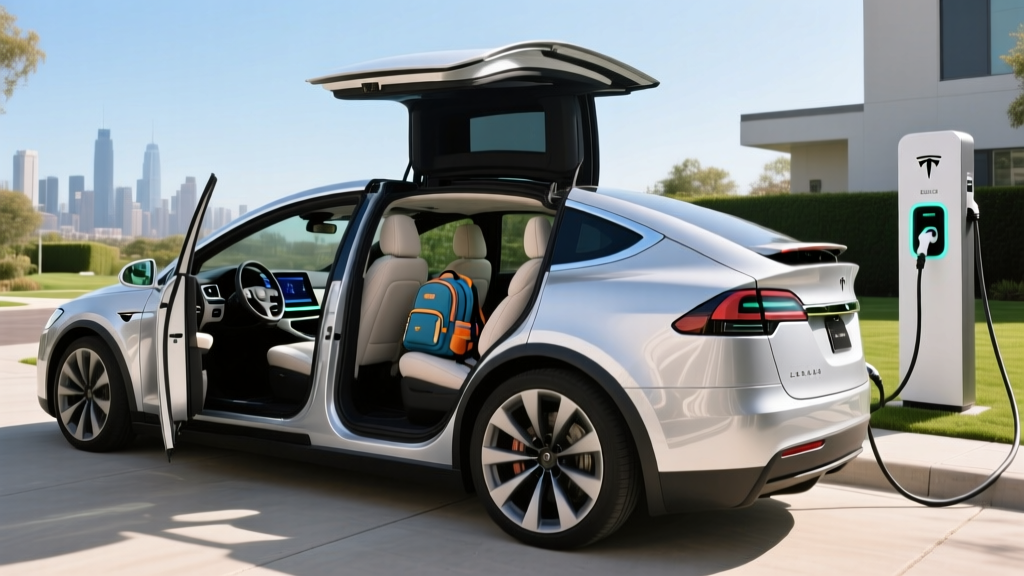
The Model X offers three seating configurations: 5-seat (two rows), 6-seat (second-row captains chairs + third row), and 7-seat (second-row bench + third row). The 6-seat layout is the most practical for families, providing a walk-through aisle to the third row and individual comfort for second-row passengers.
Key interior dimensions:
- Third-row legroom: 32.7 inches — adequate for children and shorter adults on trips under two hours; tight for adults over 5'10" on longer journeys
- Second-row legroom: 40.9 inches (6-seat captains chairs)
- Front-row legroom: 41.2 inches
- Cargo behind third row: ~15.8 cu ft (enough for 3–4 carry-on bags or a double stroller)
- Cargo behind second row (third row folded): ~44.1 cu ft
- Max cargo (all rear seats folded): ~81.5 cu ft
- Frunk (front trunk): ~6.7 cu ft — useful for groceries or a charging cable bag
The falcon-wing rear doors are the Model X's signature feature. They open vertically with dual hinges, providing excellent overhead clearance when loading car seats or accessing the third row in tight parking spaces. However, they require more lateral clearance than sliding minivan doors and can be slow to operate in heavy rain (water drips into the cabin opening during the open/close cycle).
Notable interior drawback: The 17-inch center touchscreen controls nearly everything — including glovebox opening, vent direction, and mirror adjustment. While the interface is responsive, the lack of physical buttons for climate and volume requires muscle memory development. The second-row 8-inch screen handles rear climate and media but is not large enough for comfortable movie viewing on road trips.
Pricing, Trims, and Federal Tax Credit Eligibility
| Configuration | MSRP | Est. After §30D Credit* |
|---|---|---|
| Long Range AWD, 5-seat | $79,990 | $72,490 |
| Long Range AWD, 6-seat (third row) | $81,630 | $74,130 |
| Long Range AWD, 7-seat (third row) | $81,630 | $74,130 |
| Plaid Tri-Motor, 6-seat (third row) | $96,630 | $89,130 |
*Estimated price assumes full $7,500 federal tax credit applied at point of sale. Eligibility is not guaranteed — see requirements below.
- MSRP cap: SUVs/vans/pickups must be ≤ $80,000 MSRP. The Model X Long Range at $81,630 exceeds this cap and does NOT qualify for the $7,500 credit as of current IRS rules. (The 5-seat Model X at $79,990 meets the cap.)
- Buyer income limits: Modified AGI ≤ $300,000 (married filing jointly), ≤ $225,000 (head of household), ≤ $150,000 (single). Source: IRS.
- Battery sourcing: Critical minerals and battery components must meet escalating domestic/free-trade-partner percentages. Tesla's US-assembled packs with evolving supply chains have historically qualified, but verify the specific VIN on fueleconomy.gov before purchase.
- Point-of-sale transfer: As of 2024+, eligible buyers can transfer the credit to the dealer at purchase, reducing the out-of-pocket price immediately rather than waiting for a tax refund.
Important: Consult a tax professional to confirm eligibility. Rules change annually and depend on your specific tax situation, the vehicle's VIN-level battery sourcing, and the manufacturer's cumulative sales status.
The MSRP-cap issue is the Model X's biggest incentive hurdle. With a 6-seat configuration priced at $81,630, the Long Range Model X sits $1,630 over the $80,000 SUV threshold. Buyers who can accept the 5-seat layout (no third row) at $79,990 clear the cap — but that defeats the purpose of this review. Tesla occasionally adjusts pricing, and destination fees can affect the calculation, so confirm the exact window-sticker MSRP with your advisor.
Performance, Tech, and Driver Assistance
The dual-motor Long Range delivers 670 horsepower and a 3.8-second 0–60 mph time — remarkable for a 5,100-lb three-row SUV. Power delivery is instantaneous, with no turbo lag or gear shifts. The air suspension (standard) adjusts ride height based on speed and terrain, lowering on the highway for efficiency and raising for steep driveways or light off-pavement use.
The Plaid's 1,020 hp and 2.5-second 0–60 time are engineering showcases but difficult to justify for family use. The $15,000 premium buys bragging rights and marginally improved torque vectoring, but the Long Range's 3.8 seconds is already faster than nearly every SUV on the road.
Driver Assistance — Autopilot and FSD (Supervised):
Both Tesla Autopilot (standard) and Full Self-Driving (Supervised) ($8,000 option or $99/month) are SAE Level 2 driver-assistance systems. The driver must remain fully attentive, keep hands on the steering wheel, and be prepared to take over at any moment. These systems do NOT make the vehicle self-driving. Only Level 4 services like Waymo operate without a human driver — and those are robotaxis, not consumer vehicles.
Autopilot includes adaptive cruise control and lane centering, which works well on marked highways. FSD (Supervised) adds automated lane changes, traffic light/stop sign recognition, and city-street navigation. In our experience, FSD handles most suburban and highway scenarios competently but requires regular intervention in construction zones, faded lane markings, and complex unprotected left turns. The steering-wheel torque sensor demands periodic input; ignore it and the system will issue escalating warnings before disengaging.
Infotainment and standout tech:
- 17-inch center touchscreen with 22-speaker audio system
- Gaming-capable processor (Cyberpunk 2077, Stardew Valley playable while parked)
- Dashcam and Sentry Mode (uses cameras to record incidents around the parked vehicle)
- HEPA air filtration with "Bioweapon Defense Mode" — genuinely effective at filtering wildfire smoke and urban pollutants
- Over-the-air updates that add features post-purchase
Warranty, Ownership Costs, and Longevity
Tesla covers the Model X with the following warranty terms:
- Basic vehicle: 4 years / 50,000 miles
- Battery and drive unit: 8 years / 150,000 miles (Long Range), 8 years / 150,000 miles (Plaid)
- Battery capacity retention threshold: 70% of original capacity during the warranty period
The 150,000-mile powertrain warranty is generous and reflects confidence in the NMC pack's longevity. Historical data from high-mileage Model X owners suggests approximately 8–12% degradation over 100,000 miles, though individual results vary based on charging habits, climate, and Supercharger frequency. To maximize battery health, Tesla recommends daily charging to 80–90% for NMC packs and reserving 100% charges for road trips.
Estimated 5-year ownership costs (Long Range AWD, 6-seat, 15,000 mi/yr):
- Electricity (home charging at $0.14/kWh): ~$4,950
- Electricity (50% Supercharging at $0.32/kWh): ~$8,100
- Insurance (national average for Model X): ~$15,000–$20,000 over 5 years (higher than average due to repair costs and vehicle price)
- Maintenance: Minimal — no oil changes, cabin air filter every 2 years (~$150), tire rotation every 6,250 miles, brake fluid check. Budget ~$1,200 over 5 years.
- Tires: The Model X's weight and torque wear tires faster than lighter EVs. Expect a set of 22-inch tires to cost $1,400–$2,000 and last 25,000–35,000 miles.
Tesla Model X vs. Key Three-Row EV Competitors
The three-row electric SUV market has expanded significantly. Here's how the Model X compares to its closest rivals:
| Attribute | 2026 Tesla Model X LR | 2026 Kia EV9 GT-Line AWD | 2026 Rivian R1S Dual-Motor |
|---|---|---|---|
| EPA Range | 320 mi | 280 mi | 352 mi (Max Pack) |
| Base MSRP | $81,630 | $73,900 | $79,900 |
| Max DC Charge | 250 kW | 236 kW | 220 kW |
| 10–80% Time | ~30 min | ~24 min | ~33 min |
| Third-Row Legroom | 32.7 in | 32.0 in | 34.0 in |
| Cargo (behind 3rd) | 15.8 cu ft | 20.2 cu ft | 18.6 cu ft |
| Towing | 5,000 lbs | 5,000 lbs | 7,700 lbs |
| Charging Network | Supercharger (native NACS) | NACS (Supercharger adapter included) | NACS (Supercharger adapter included) |
The Kia EV9 undercuts the Model X by nearly $8,000, charges slightly faster, and offers more cargo space behind the third row. Its trade-offs are shorter range and a less mature software ecosystem. The EV9 qualifies for the §30D credit at all trims under the $80,000 SUV cap, making it a strong value play.
The Rivian R1S excels at off-road capability, towing (7,700 lbs), and third-row comfort. Its Max Pack achieves 352 miles EPA — best in class. However, its 220 kW peak charge rate means longer road-trip stops, and its software and driver-assist features lag behind Tesla's polish.
The Model X's enduring advantages are Supercharger network seamlessness (native NACS, no adapter needed), the falcon-wing doors for urban loading, and Tesla's software/gaming ecosystem. Its disadvantages are price (often exceeding the tax-credit cap), aging interior design (the current platform dates to 2015 with refreshes), and panel-gap quality that still trails German competitors.
- 320-mile EPA range with 250 kW DC charging
- Native Supercharger access — no adapter required
- Falcon-wing doors improve third-row access in tight spaces
- Class-leading infotainment, gaming, and OTA updates
- HEPA air filtration excellent for wildfire/smoke regions
- 670 hp Long Range provides effortless highway passing
- 8-year/150,000-mile battery warranty
- 6-seat MSRP ($81,630) exceeds $80,000 §30D tax-credit cap
- Third row is tight for adults on long trips
- Insurance premiums significantly above average
- Falcon-wing doors slow in rain, need overhead clearance
- Interior platform aging; minimal physical controls
- Tire wear is expensive and frequent due to vehicle weight
- Panel gap inconsistency still reported by owners
Who Should Buy the Tesla Model X with Third Row?
- You need 6 seats AND 300+ miles of range in an electric SUV
- Supercharger network access is your top road-trip priority
- You value falcon-wing doors for tight urban parking and car-seat loading
- You live in a region with wildfire smoke and want best-in-class cabin air filtration
- You want a tech-forward infotainment experience with gaming and frequent OTA updates
- Federal tax credit eligibility is essential — the 6-seat Model X exceeds the MSRP cap
- You regularly carry adults in the third row (consider the Rivian R1S or a PHEV minivan)
- You need maximum cargo space behind the third row (Kia EV9 offers 20.2 cu ft vs. 15.8)
- Towing above 5,000 lbs is a requirement (Rivian R1S tows 7,700 lbs)
- You prefer physical buttons and traditional luxury materials
Frequently Asked Questions
What is the real-world range of the Tesla Model X with the third row?
The 2026 Model X Long Range AWD in the 6-seat configuration carries an EPA rating of 320 miles. In real-world mixed driving, expect 290–310 miles. Sustained highway driving at 70–75 mph reduces this to approximately 255–280 miles, and cold-weather highway driving (below 30°F) can drop range to 210–240 miles. The 5-seat configuration without a third row achieves 335 miles EPA due to reduced weight.
How fast does the Model X charge at home and on the road?
On a V3 or V4 Tesla Supercharger, the Model X peaks at 250 kW, charging from 10–80% in approximately 30 minutes with proper battery preconditioning. At home on a 240V/48A Level 2 Wall Connector, it charges at 11.5 kW, adding roughly 44 miles per hour — enough for a full overnight charge. Level 1 (120V) adds only 4–5 miles per hour and is suitable only for emergencies or very low daily mileage.
Does the Tesla Model X qualify for the $7,500 federal EV tax credit?
It depends on the configuration. The 5-seat Model X Long Range at $79,990 MSRP falls under the $80,000 SUV cap and may qualify if the buyer meets IRS income limits and the vehicle's battery sourcing meets current critical-mineral and component requirements. The 6-seat and 7-seat configurations at $81,630 exceed the MSRP cap and do not qualify for the §30D credit as of 2026 rules. Always verify eligibility on IRS.gov and with a tax professional before purchasing.
Is the Model X third row practical for adults?
The third row offers 32.7 inches of legroom, which accommodates children and shorter adults comfortably. Adults over 5'10" will find it cramped on trips longer than one to two hours. The 6-seat captain's chair configuration provides a walk-through aisle, making third-row access easier than the 7-seat bench layout. For regular adult third-row use, the Rivian R1S (34.0 inches of legroom) is a more comfortable option.
Is the Tesla Model X worth buying vs. the Kia EV9 or Rivian R1S?
The Model X wins on range (320 mi), Supercharger seamlessness, and tech/software. The Kia EV9 wins on price ($8,000 less), tax-credit eligibility, cargo space, and DC charge speed. The Rivian R1S wins on towing (7,700 lbs), off-road capability, third-row comfort, and maximum range with the Max Pack (352 mi). If your budget is flexible and Supercharger access is non-negotiable, the Model X remains compelling. If value and tax-credit eligibility matter most, the EV9 is the stronger buy. If you tow or adventure off-pavement, choose the R1S.
What is the battery warranty and how long will it last?
Tesla warranties the Model X battery and drive unit for 8 years or 150,000 miles, whichever comes first, with a minimum 70% capacity retention guarantee. Real-world data from high-mileage owners suggests 8–12% degradation over 100,000 miles with mixed Level 2 and Supercharger use. Charging to 80–90% daily (rather than 100%) and minimizing Supercharger frequency will help preserve long-term battery health in the NMC pack.