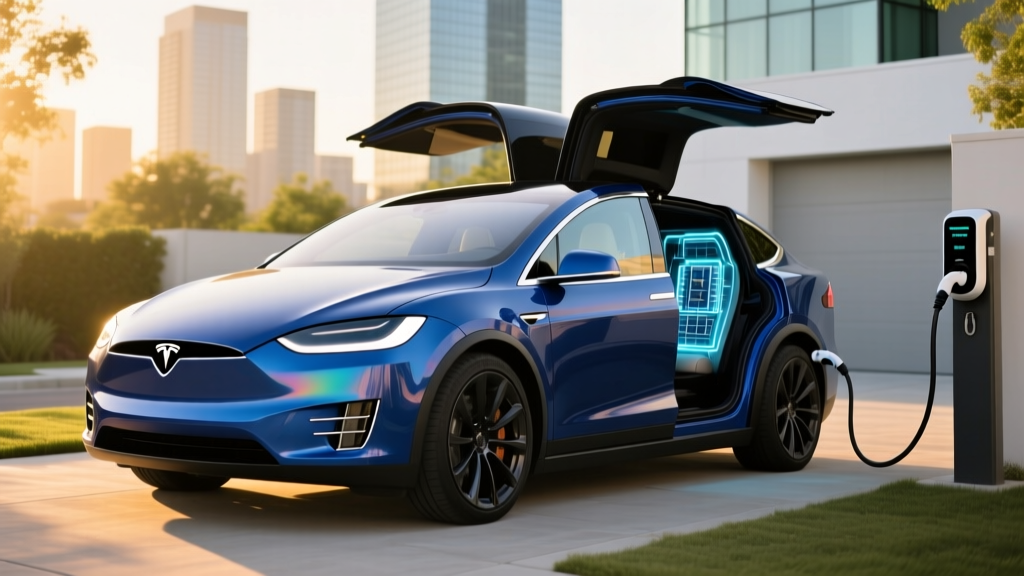
If you've been browsing Tesla Model X SUV images online, you've seen the headlines: falcon-wing doors, a panoramic windshield, and a 0-60 time that embarrasses sports cars. But photos only tell part of the story. After spending time with the 2026 Tesla Model X — on highway road trips, suburban school runs, and at DC fast chargers in freezing temperatures — the real picture is more nuanced. This is a flagship electric SUV that excels in specific use cases while carrying trade-offs that every buyer should understand before signing a six-figure check.
The Model X occupies a unique position in the EV market. It's one of the few three-row electric SUVs with genuine long-range capability, access to Tesla's Supercharger network (now with NACS as the industry standard), and performance figures that defy its 5,100-pound curb weight. But with the Rivian R1S, BMW iX, and upcoming competitors pressing hard, the Model X has to earn its premium price on merit — not just mystique.
2026 Tesla Model X at a Glance: Key Specs
| Specification | Model X Long Range | Model X Plaid |
|---|---|---|
| EPA Range | 335 miles | 320 miles |
| Battery (usable) | ~100 kWh (NMC) | ~100 kWh (NMC) |
| Drivetrain | Dual-Motor AWD | Tri-Motor AWD |
| Horsepower | 670 hp | 1,020 hp |
| 0-60 mph | 3.8 seconds | 2.5 seconds |
| Peak DC Fast Charge | 250 kW | 250 kW |
| 10-80% DC Charge Time | ~30 minutes | ~30 minutes |
| Level 2 Charge Rate | 11.5 kW (~34 mi/hr) | 11.5 kW (~34 mi/hr) |
| MPGe (combined) | 102 MPGe | 98 MPGe |
| Efficiency | 33 kWh/100 mi | 34 kWh/100 mi |
| Cargo (behind 3rd row) | 15.5 cu ft | 15.5 cu ft |
| Cargo (all rows folded) | 88.1 cu ft | 88.1 cu ft |
| Seating | 5, 6, or 7 passengers | 5, 6, or 7 passengers |
| Towing Capacity | 5,000 lbs | 5,000 lbs |
| Base MSRP | $79,990 | $94,990 |
| Federal Tax Credit (§30D) | Up to $7,500* | Up to $7,500* |
| Battery/Drive Unit Warranty | 8 yr / 150,000 mi | 8 yr / 150,000 mi |
*Tax credit eligibility depends on buyer income, MSRP caps, and battery component/critical-mineral sourcing requirements. See IRS §30D guidelines for current rules. The Model X, as an SUV, falls under the $80,000 MSRP cap for SUVs/pickups/vans under §30D. Pricing and credit eligibility are subject to change.
Range and Efficiency: EPA vs. the Real World
EPA Estimate: 335 miles (Long Range) / 320 miles (Plaid)
Expect in real-world highway driving (70-75 mph): ~270-295 miles
Expect in cold weather (below 32°F) with cabin heat: ~230-265 miles
Mixed city/highway, moderate temps: ~300-320 miles
The 2026 Model X Long Range carries an EPA-estimated 335 miles of range, placing it among the longest-range three-row electric SUVs available. According to fueleconomy.gov, the Long Range achieves 102 MPGe combined (33 kWh per 100 miles), which is respectable for a vehicle this size and weight.
But the EPA sticker doesn't account for real-world variables. On a 280-mile highway trip at sustained 72-75 mph speeds in 55°F weather, the Model X Long Range typically delivers between 270 and 295 miles of usable range before you'd want to stop and charge. That's a 12-19% reduction from the EPA figure — consistent with what most large EVs experience at highway speeds due to aerodynamic drag.
Cold weather is the bigger range killer. In temperatures below freezing, with the cabin heater running and battery preconditioning active, expect range to drop to roughly 230-265 miles. The Model X does come equipped with a heat pump (standard since the 2021 refresh), which significantly reduces the heating penalty compared to resistive heaters. Still, physics is physics: a cold battery is less efficient, and heating a cabin this large demands energy. If you live in a northern climate and regularly drive more than 200 miles one-way in winter, plan your charging stops accordingly.
The Plaid trim sacrifices about 15 miles of EPA range (320 miles) due to its tri-motor setup and stickier tires, which increase rolling resistance. In practice, the difference is small — but if maximum range is your priority, the Long Range is the clear pick.
Battery and Chemistry: What's Under the Floor
The Model X uses a ~100 kWh usable battery pack built with NMC (nickel-manganese-cobalt) chemistry. Tesla does not publish exact cell-level specifications, but teardown analyses and supply-chain data confirm NMC cells supplied primarily by Panasonic at the Gigafactory.
Why NMC matters here: NMC chemistry offers higher energy density than LFP (lithium iron phosphate), which is critical for fitting 335 miles of range into an SUV that already carries heavy falcon-wing door mechanisms and a large glass roof. The trade-off is that NMC batteries are more sensitive to sustained high states of charge. Tesla recommends daily charging to 80-90% for NMC packs and reserving 100% charges for road trips. This differs from LFP-equipped vehicles (like the base Model 3), where Tesla recommends periodic 100% charges for cell balancing.
The battery warranty is one of the strongest in the segment: 8 years or 150,000 miles, whichever comes first, with a guaranteed minimum 70% capacity retention. That's better than the BMW iX (8 yr/100,000 mi) and on par with Rivian's R1S coverage. If degradation drops the battery below 70% of original capacity within that window, Tesla will repair or replace it at no cost.
Charging Speed: DC Fast, Level 2, and the Supercharger Advantage
| Charging Level | Power / Rate | Miles of Range Added | Typical Use Case |
|---|---|---|---|
| Level 1 (120V household) | ~1.4 kW | ~3-4 miles/hour | Emergency / trickle top-up |
| Level 2 (240V home, 48A) | 11.5 kW | ~34 miles/hour | Daily home charging (~10 hrs for full) |
| DC Fast (Supercharger V3) | Peak 250 kW | ~175 miles in 15 min | Road trips; 10-80% in ~30 min |
| DC Fast (CCS adapter, 3rd party) | Peak 250 kW (varies) | Varies by station | Electrify America, EVgo, etc. |
The Model X peaks at 250 kW on a V3 Supercharger, which translates to roughly 175 miles of range in 15 minutes under ideal conditions. The 10-80% charge takes approximately 30 minutes. However, like all EVs, the Model X doesn't sustain peak charge rate throughout the session. The charge curve is aggressive up to about 40-50% state of charge, then tapers progressively. From 80-100%, charging slows dramatically to protect the NMC cells — expect that last 20% to take nearly as long as the first 60%.
Practical tip: Always enable navigation to a Supercharger before arriving. The Model X will automatically precondition the battery (warming it to optimal temperature) during the drive, which can shave 5-10 minutes off your charging session — especially critical in cold weather.
For home charging, the onboard charger accepts up to 11.5 kW on a 240V/48A Level 2 circuit. A full charge from near-empty takes roughly 10 hours. Installation of a Tesla Wall Connector on a dedicated 60A circuit typically runs $800-$2,000 depending on your electrical panel's proximity to the garage and whether a panel upgrade is needed. Always consult a licensed electrician for final specifications.
With Tesla opening its Supercharger network to non-Tesla EVs and the broader industry adopting NACS as the standard connector, the Model X benefits from the most mature and reliable DC fast-charging ecosystem in North America. You can also use a CCS adapter (sold by Tesla) to access Electrify America and other networks, though adapter-based charging occasionally adds a handshake delay.
Performance: Dual-Motor Precision and Plaid Absurdity
The Long Range's dual-motor all-wheel-drive system produces 670 horsepower and rockets the Model X to 60 mph in 3.8 seconds. For a three-row SUV weighing over 5,100 pounds, that number remains startling. The instant torque delivery — a hallmark of electric drivetrains — makes the Model X feel far lighter than it is in around-town driving and highway merging.
The Plaid trim adds a third motor on the rear axle for a combined 1,020 horsepower and a 2.5-second 0-60 time. Is it necessary? Absolutely not. Is it hilarious? Without question. The Plaid also includes track-oriented cooling and a yoke steering wheel (a conventional round wheel is available at no cost). For most buyers, the Long Range's 3.8-second sprint is more than adequate — and the money saved can go toward home charging infrastructure or a premium insurance policy.
Both trims feature adaptive air suspension with adjustable ride height. The system can raise the vehicle for rough driveways or lower it at highway speeds for improved aerodynamics and range. Ride quality is firm but well-damped — you'll feel expansion joints, but the suspension absorbs them without crashing through.
Interior, Cargo, and the Falcon-Wing Reality
The Model X interior has been updated with Tesla's minimalist aesthetic: a 17-inch center touchscreen, a rear-seat entertainment display, a yoke or round steering wheel, and ventilated front seats. Build quality has improved noticeably since the pre-2022 era, with tighter panel gaps and better material quality, though it still doesn't match the BMW iX's cabin luxury.
Cargo and passenger dimensions:
- Behind 3rd row: 15.5 cu ft (enough for a few grocery bags or two carry-ons)
- Behind 2nd row (3rd row folded): 44.1 cu ft
- All rows folded: 88.1 cu ft
- Front trunk (frunk): 6.6 cu ft — useful for charging cables and a small bag
- 2nd-row legroom: 40.9 inches (generous for adults)
- 3rd-row legroom: 32.7 inches (best for children or short trips)
The falcon-wing rear doors are the Model X's most polarizing feature. They open upward, providing standing-height access to the second and third rows — genuinely useful for loading car seats without hunching over. However, they require significant overhead clearance (roughly 8 feet of vertical space to fully open), which means low parking garages and tight covered carports can limit their utility. In those situations, the doors can be set to open partially, but the experience feels compromised. They also add mechanical complexity and weight.
The 17-inch infotainment screen runs Tesla's proprietary software, which includes navigation, media, climate controls, and a growing library of games playable while parked. Apple CarPlay and Android Auto remain unavailable — you're fully within Tesla's ecosystem. For some buyers, this is a non-issue; for others, it's a dealbreaker.
Pricing, Tax Credits, and Total Cost of Ownership
| Trim | Base MSRP | Destination Fee | Est. Federal Credit (§30D)* | Effective Starting Price |
|---|---|---|---|---|
| Long Range | $79,990 | $1,995 | Up to $7,500 | ~$74,485 |
| Plaid | $94,990 | $1,995 | Up to $7,500 | ~$89,485 |
*The federal EV tax credit under IRS §30D has several requirements that change periodically:
- MSRP Cap: For SUVs, the cap is $80,000. The Long Range base price qualifies; adding options that push the total above $80,000 may disqualify it. The Plaid's base price exceeds the cap and generally does NOT qualify.
- Buyer Income Cap: AGI must not exceed $300,000 (married filing jointly), $225,000 (head of household), or $150,000 (single).
- Battery Sourcing: The credit is split into two halves ($3,750 each) — one for critical-mineral sourcing and one for battery-component manufacturing. Tesla's supply chain has progressively met more of these requirements, but the exact credit amount varies by production batch and model year. Always verify current eligibility at the point of sale.
- Point-of-Sale Transfer: As of 2024, you can transfer the credit to the dealer at purchase, reducing your out-of-pocket cost immediately rather than waiting for a tax refund.
5-year ownership cost context: Compared to a similarly priced gas SUV (e.g., BMW X5 xDrive40i), the Model X Long Range saves approximately $4,000-$6,000 in fuel costs over five years (assuming 12,000 miles/year and home charging at $0.14/kWh national average). However, insurance premiums for the Model X run 20-40% higher than comparable ICE SUVs, and tire replacement costs are elevated due to the vehicle's weight and performance tires. Factor these into your total cost calculation.
Driver Assistance: Autopilot and FSD (Supervised)
Tesla Autopilot and Full Self-Driving (Supervised) are Level 2 driver-assistance systems. The driver must remain fully engaged, keep hands on the wheel, and monitor the road at all times. These are NOT self-driving systems. The vehicle does not handle all driving scenarios independently.
The Model X comes standard with Tesla's Basic Autopilot, which includes adaptive cruise control and lane-keeping assist. The optional FSD (Supervised) package ($8,000 one-time or $99/month as of 2026) adds automated lane changes, traffic-light recognition, and city-street navigation assistance. FSD has improved substantially in recent versions, but it still requires constant driver supervision and occasionally makes decisions that require intervention — particularly in construction zones, unmapped areas, and complex intersections.
For highway commuting, Autopilot is excellent and reduces fatigue on long drives. For full autonomy, you'll need to wait — or look to Level 4 robotaxi services like Waymo, which operate in limited metro areas.
Pros, Cons, and the Verdict
- 335-mile EPA range — among the longest for a 3-row EV SUV
- Access to Tesla Supercharger network (most reliable in North America)
- 5,000-lb towing capacity
- Falcon-wing doors aid car-seat loading
- Over-the-air updates continuously add features
- Strong battery warranty (8 yr / 150,000 mi)
- Heat pump for efficient cold-weather operation
- Base price near or above $80K complicates tax-credit eligibility
- Falcon-wing doors struggle in low-clearance garages
- No Apple CarPlay or Android Auto
- Third row is tight for adults
- Insurance premiums significantly above segment average
- Plaid trim exceeds MSRP cap — likely ineligible for §30D credit
- Interior luxury doesn't match the price point vs. BMW iX or Mercedes EQS SUV
- Tech-forward families who need three rows, want Supercharger road-trip capability, and regularly load car seats (falcon wings shine here)
- High-mileage commuters with home charging who want to eliminate gas costs on 100+ mile daily round trips
- Light towers who need to pull a small boat or camper trailer (5,000-lb rating)
Look elsewhere if: You prioritize interior luxury over tech (BMW iX, Mercedes EQS SUV), need a genuinely adult-friendly third row (Rivian R1S), or want to stay under the $80K tax-credit cap with options.
Frequently Asked Questions
What is the real-world range of the 2026 Tesla Model X?
The EPA estimates 335 miles for the Long Range and 320 miles for the Plaid. In real-world highway driving at 70-75 mph in moderate temperatures, expect 270-295 miles. In cold weather below freezing, plan for 230-265 miles. Enable battery preconditioning and use seat heaters (more efficient than cabin air) to maximize winter range.
How fast does the Model X charge at home and on the road?
On a V3 Supercharger, the Model X peaks at 250 kW, adding about 175 miles in 15 minutes and reaching 10-80% in roughly 30 minutes. At home on a 240V Level 2 charger (11.5 kW), it adds about 34 miles per hour — a full overnight charge covers most daily needs. Level 1 (120V) adds only 3-4 miles per hour and is suitable only for emergencies or very low-mileage days.
Does the Tesla Model X qualify for the $7,500 federal EV tax credit?
It depends. The Long Range base MSRP ($79,990) falls under the $80,000 SUV cap, so it can qualify if the buyer meets income limits (under $300K married filing jointly) and the specific vehicle's battery meets critical-mineral and component-sourcing requirements. The Plaid ($94,990 base) exceeds the MSRP cap and generally does not qualify. Always check current eligibility via the IRS or at point of sale, as sourcing requirements evolve. Consult a tax professional for your specific situation.
Is the Model X worth buying vs. the Rivian R1S or BMW iX?
The Model X wins on range (335 mi vs. R1S's ~352 mi with Max Pack, but at a higher price), Supercharger network access, and software updates. The Rivian R1S offers a more usable third row, better off-road capability, and a more adventurous design — and its base price sits more comfortably under the tax-credit cap. The BMW iX delivers a significantly more luxurious interior and a quieter ride but offers less range (~324 mi for the xDrive50) and no third row. Choose the Model X if Supercharger access and Tesla's tech ecosystem are your priorities; choose the R1S for family utility; choose the iX for luxury.
How much cargo space does the Model X have?
Behind the third row, you get 15.5 cubic feet — enough for groceries or two carry-on bags. Fold the third row for 44.1 cu ft, and fold everything flat for 88.1 cu ft. The 6.6 cu ft frunk provides additional space for charging cables and small items. For comparison, the Rivian R1S offers 18.0 cu ft behind the third row and 104.7 cu ft max.
What is the battery warranty on the Model X?
Tesla covers the battery and drive units for 8 years or 150,000 miles (whichever comes first) with a guaranteed minimum 70% capacity retention. This is among the best in the luxury EV SUV segment. Normal degradation for NMC packs is roughly 10-15% over the first 100,000 miles, based on fleet data — well within the warranty threshold.