Quick Verdict: The Fastest SUV You Can Actually Buy
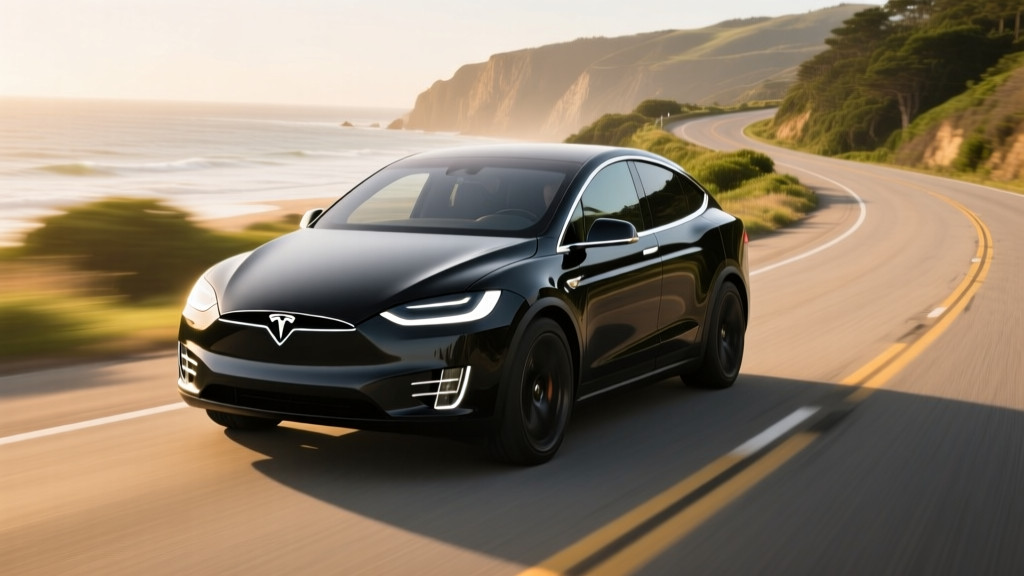
If you've ever typed "how fast is Tesla Model X" into a search bar, the short answer is: absurdly fast. The 2026 Tesla Model X Plaid hits 60 mph in 2.5 seconds, making it one of the quickest production vehicles on the planet — SUV or otherwise. But the dual-motor Long Range variant is the one most buyers actually take home, and its 3.8-second sprint is hardly sluggish. Beyond the stoplight sprints, the Model X remains a three-row electric family hauler with falcon-wing doors, Supercharger access, and an EPA-estimated range reaching 335 miles.
This profile covers the numbers that matter to real buyers: real-world range expectations, DC fast-charge curves, Level 2 home charging, battery chemistry, IRS §30D tax-credit eligibility, and how the Model X stacks up against the Rivian R1S, BMW iX, and Mercedes EQS SUV.
2026 Tesla Model X Spec Sheet at a Glance
| Specification | Long Range | Plaid |
|---|---|---|
| Base MSRP | $79,990 | $94,990 |
| EPA Range | 335 mi | 311 mi |
| Battery (usable) | ~100 kWh, NMC | ~100 kWh, NMC |
| Drivetrain | Dual-Motor AWD | Tri-Motor AWD |
| Horsepower | 670 hp | 1,020 hp |
| 0–60 mph | 3.8 sec | 2.5 sec |
| Top Speed | 155 mph | 163 mph |
| Peak DC Charge Rate | 250 kW | 250 kW |
| 10–80% DC Time | ~32 min | ~32 min |
| Level 2 Rate | 11.5 kW (44 mi/hr) | 11.5 kW (44 mi/hr) |
| MPGe (combined) | 103 MPGe | 98 MPGe |
| Efficiency | 33 kWh/100 mi | 35 kWh/100 mi |
| Battery Warranty | 8 yr / 150,000 mi | 8 yr / 150,000 mi |
| Seating | 5, 6, or 7 | 5 or 6 |
0–60, Horsepower, and the Physics of a 5,400-lb SUV
The question driving this review — how fast is the Tesla Model X — deserves context. The Plaid's tri-motor setup (one front, two rear) delivers 1,020 hp and a 2.5-second 0–60 time. For reference, that matches a Lamborghini Huracán STO and beats the Porsche 911 Turbo S. In a three-row SUV that weighs roughly 5,400 pounds.
Tesla achieves this through instant torque vectoring across the tri-motor layout, a low center of gravity from the floor-mounted battery pack, and a pre-conditioned launch mode that warms the battery to optimal temperature. The Long Range dual-motor variant produces 670 hp and runs 0–60 in 3.8 seconds — still quicker than a BMW X5 M Competition.
Real-world caveat: those headline 0–60 numbers require a battery state of charge (SoC) above 90%, a warm battery (preconditioned via navigation to a drag strip or launch point), and a high-grip surface. At 50% SoC on a cold morning, expect the Plaid to run closer to 3.2 seconds and the Long Range around 4.5 seconds. Performance EVs are battery-state-sensitive in a way that gasoline cars are not.
Real-World Range: What the EPA Sticker Doesn't Tell You
EPA Estimate: 335 miles (Long Range) / 311 miles (Plaid)
Real-World Expectation: ~270–290 miles highway (70–75 mph, mild weather); ~230–250 miles in sub-freezing cold; ~300+ miles city/regen-heavy driving
The Model X Long Range carries an EPA-estimated 335 miles of range, while the Plaid drops to 311 miles due to its tri-motor weight and higher rolling-resistance tires. These are combined-cycle figures blending city and highway driving.
In sustained highway driving at 70–75 mph in 65–80°F weather, expect roughly 85–88% of the EPA sticker — so around 280–295 miles for the Long Range before you need to find a charger. Cold weather (below 32°F) compounds the loss: battery internal resistance increases, cabin heating draws significant energy (the Model X uses a heat pump, which helps, but doesn't eliminate the penalty), and regenerative braking is limited until the pack warms. Plan for 230–250 miles of usable range on a frigid winter road trip.
The ~100 kWh usable battery uses NMC (nickel manganese cobalt) chemistry, which offers higher energy density than LFP but is more sensitive to sustained 100% SoC storage. Tesla recommends daily charging to 80–90% for NMC packs, reserving 100% for road trips. This means your practical daily range is closer to 270 miles (Long Range) — still ample for most commutes.
Charging Speed: DC Fast, Level 2, and the Supercharger Advantage
| Charging Level | Power (kW) | Speed (miles/hr) | Typical Use |
|---|---|---|---|
| Level 1 (120V) | ~1.4 kW | ~4 mi/hr | Emergency / overnight trickle |
| Level 2 (240V, 48A) | 11.5 kW | ~44 mi/hr | Home / workplace daily |
| DC Fast (V3 Supercharger) | 250 kW peak | ~750 mi/hr (peak) | Road trips |
| DC Fast (V4 Supercharger) | 250 kW peak* | ~750 mi/hr (peak) | Road trips (newer stations) |
*The Model X architecture caps at 250 kW even at V4 Supercharger posts capable of higher output.
At a V3 or V4 Supercharger, the Model X peaks at 250 kW but — and this is critical — it does not sustain that rate. The charge curve is aggressive at low SoC (roughly 5–30%) where you'll see 230–250 kW, then tapers progressively. By 60% SoC, you're typically seeing 120–140 kW; above 80%, the rate drops to 40–60 kW as the battery management system protects cell longevity. A 10–80% session takes approximately 32 minutes in ideal (warm-battery) conditions.
At home on a Level 2 Wall Connector (240V, 48-amp circuit, requiring a 60-amp breaker), the onboard charger accepts 11.5 kW, adding roughly 44 miles of range per hour. A full 10–80% home charge takes about 7–8 hours — plug in at night, wake up ready. Installation typically runs $800–$2,000 depending on panel proximity and local permit requirements; a 200-amp electrical panel is usually sufficient, but older homes may need a panel upgrade ($1,500–$3,000 additional).
The Model X uses the NACS (North American Charging Standard) connector natively, meaning full access to Tesla's 6,000+ Supercharger stalls in North America without adapters. This remains a significant practical advantage, as Tesla's network consistently delivers higher uptime and plug-and-charge simplicity compared to most third-party CCS networks.
Interior, Cargo, and Family Practicality
The Model X offers three seating configurations: 5-seat (two rows), 6-seat (captain's chairs in row two with a center aisle), and 7-seat (bench in row two). The 6-seat layout is the most popular for families — it provides easy third-row access and individual comfort for second-row passengers.
Cargo volume is generous for the class: approximately 75 cubic feet behind the front row (with rows two and three folded), 41 cubic feet behind the second row, and 13 cubic feet behind the third row. The front trunk (frunk) adds roughly 6.5 cubic feet — enough for a carry-on or charging cables.
Legroom measures 41.2 inches up front, 38.4 inches in the second row, and 32.7 inches in the third row. The third row is best suited for children or short trips; adults will find it tight on longer drives. The falcon-wing rear doors are the Model X's party trick — they open upward, providing excellent overhead clearance for loading car seats or reaching into the third row in tight parking spaces. However, they're slower to open/close than conventional doors, and low-clearance garages (under ~7 feet) can trigger sensor-based partial openings that feel awkward.
The 17-inch center touchscreen runs Tesla's latest software with a responsive interface, built-in navigation with Supercharger routing, Netflix/YouTube streaming while parked, and a gaming computer capable of running Cyberpunk 2077. A secondary 8-inch screen serves rear passengers for climate and media control. The yoke steering wheel is standard; a round wheel is available as a no-cost option. Wireless phone charging, HEPA air filtration ("Bioweapon Defense Mode"), and a 22-speaker audio system round out the tech.
Pricing, Tax Credit Eligibility, and Total Cost
| Trim | Base MSRP | Destination | §30D Credit Eligible? | Est. After Credit |
|---|---|---|---|---|
| Long Range | $79,990 | $1,990 | No (exceeds MSRP cap) | $81,980 |
| Plaid | $94,990 | $1,990 | No (exceeds MSRP cap) | $96,980 |
Here's the critical detail many buyers miss: the Tesla Model X does not qualify for the IRS §30D federal EV tax credit. Under current rules, SUVs must have an MSRP at or below $80,000 to be eligible. The Long Range starts at $79,990, but adding the mandatory $1,990 destination fee pushes the total past the cap. Any additional options (paint, wheels, FSD) compound the ineligibility. The Plaid, at $94,990, is well above the threshold.
Even if the MSRP fit, §30D eligibility requires meeting battery critical-mineral and component sourcing requirements, buyer adjusted gross income caps ($300,000 joint / $150,000 single), and the vehicle must be new and placed in service for personal use. Tesla's battery sourcing has varied by quarter, so eligibility can shift — always verify on the IRS qualified vehicle list before purchasing.
Some states offer their own rebates or tax credits (California's CVRP, Colorado's innovative motor vehicle credit, etc.), but amounts and eligibility vary by jurisdiction. Check your state energy office or department of revenue for current programs.
Driver Assistance: Autopilot and FSD (Supervised)
SAE Automation Level: Level 2 — The driver must remain fully engaged, hands on the wheel (or torque-applied with the yoke), and eyes on the road at all times. This is not self-driving.
Every Model X ships with basic Autopilot: traffic-aware cruise control and lane-centering on highways. The optional Full Self-Driving (Supervised) package ($8,000 one-time or $99/month as of 2026) adds automated lane changes, navigation-guided on/off-ramp transitions, traffic-light and stop-sign recognition, and a city-streets capability that can navigate intersections and turns. FSD has improved markedly, but it remains a Level 2 system requiring constant driver supervision. Expect occasional disengagements in construction zones, faded lane markings, and complex unprotected left turns.
How It Compares: Model X vs. Rivian R1S, BMW iX, and Mercedes EQS SUV
The Model X doesn't exist in a vacuum. Here's how it stacks up against the three closest competitors in the luxury electric SUV space:
- Rivian R1S (Dual-Motor Max): ~400 miles EPA range, ~$90,000, more off-road capable, traditional SUV styling, no Supercharger access (CCS/NACS adapter available). Better for adventure-oriented buyers; less third-row space.
- BMW iX xDrive50: ~324 miles EPA, ~$87,000, more refined ride quality and interior materials, CCS charging (slower network access). Better for luxury-first buyers who prioritize comfort over performance.
- Mercedes EQS SUV 450+: ~305 miles EPA, ~$105,000, ultra-quiet cabin, Hyperscreen dash, CCS charging. Best for buyers who want S-Class-level luxury in an EV; significantly pricier.
The Model X wins on performance (nothing in this segment touches 2.5 seconds), Supercharger network access, and software/OTA updates. It loses on interior material quality (the BMW and Mercedes feel more premium at the price), third-row comfort, and — crucially — federal tax-credit eligibility. A Rivian R1S or BMW iX in eligible configurations can net up to $7,500 off the effective price, narrowing the gap considerably.
Pros, Cons, and Who Should Buy the Model X
Pros
- Class-leading acceleration (2.5s Plaid, 3.8s Long Range)
- Supercharger network: best public charging infrastructure in North America
- Falcon-wing doors improve car-seat and third-row access
- Over-the-air updates continuously add features
- Strong efficiency (103 MPGe combined) for a 5,400-lb SUV
- Generous cargo space with frunk + fold-flat rows
Cons
- No federal §30D tax credit (MSRP exceeds $80K cap)
- 250 kW peak DC charge rate trails 350 kW competitors (Hyundai/Kia E-GMP, Porsche Taycan)
- Third row is tight for adults on long trips
- Interior materials don't match BMW/Mercedes at this price point
- Falcon-wing doors are slow and struggle in low-clearance garages
- FSD (Supervised) remains Level 2 — not a substitute for an attentive driver
Best for: Performance-oriented families who want SUV practicality, Supercharger convenience for road trips, and don't need daily third-row use. Also suits tech-forward buyers who value OTA improvements and Tesla's software ecosystem.
Look elsewhere if: You need the $7,500 federal credit, prioritize luxury interior finishes, regularly carry adults in the third row, or want 350 kW+ DC charging for the fastest possible road-trip stops.
Frequently Asked Questions
How fast is the Tesla Model X from 0 to 60 mph?
The 2026 Model X Plaid hits 60 mph in 2.5 seconds with preconditioned battery and high SoC. The Long Range dual-motor variant does it in 3.8 seconds. Both times require favorable conditions — cold batteries or low charge will add 0.5–1.0 seconds.
What is the real-world range of the Tesla Model X?
Expect 270–295 miles on the highway in mild weather (Long Range), dropping to 230–250 miles in freezing temperatures. City driving with heavy regenerative braking can exceed 300 miles. The EPA combined estimate is 335 miles (Long Range) and 311 miles (Plaid).
How fast does the Model X charge at home and on the road?
At home on Level 2 (240V, 48A), the Model X charges at 11.5 kW, adding ~44 miles per hour — a full overnight session covers most needs. On DC fast chargers, it peaks at 250 kW with a 10–80% time of approximately 32 minutes under ideal conditions.
Does the Tesla Model X qualify for the $7,500 federal EV tax credit?
No. The §30D credit caps SUV MSRP at $80,000. The Model X Long Range starts at $79,990 but the destination fee and any options push it over. The Plaid at $94,990 is well above the cap. State-level incentives may still apply — check your local rules.
Is the Model X worth buying over the Rivian R1S or BMW iX?
Choose the Model X if performance, Supercharger access, and Tesla's tech ecosystem are priorities. Choose the R1S for off-road capability and longer range, or the BMW iX for ride quality and interior luxury — both may qualify for the federal credit, saving $7,500.
What battery does the Model X use and how long is the warranty?
The Model X uses an NMC (nickel manganese cobalt) lithium-ion pack with approximately 100 kWh of usable capacity. Tesla warrants the battery and drive unit for 8 years or 150,000 miles, whichever comes first, with a minimum 70% capacity retention threshold during the warranty period.