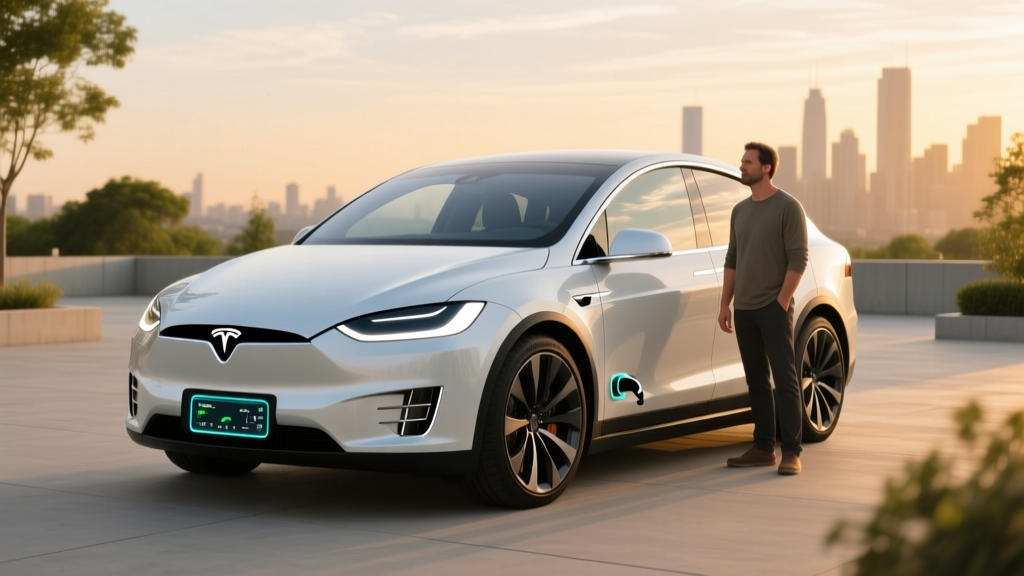
The Tesla Model X occupies a singular position in the EV market: a three-row electric SUV with falcon-wing rear doors, supercar acceleration, and enough interior volume to rival full-size crossovers. But for buyers researching the Model X size — whether that means exterior footprint, cargo capacity, or passenger room — the numbers tell a nuanced story that marketing brochures gloss over. This review breaks down every dimension, efficiency figure, and ownership cost you need to evaluate whether Tesla's flagship SUV fits your garage, your family, and your budget in 2026.
Exterior Dimensions and Garage Fit
The Model X rides on a 116.7-inch wheelbase and stretches 199.1 inches bumper to bumper — roughly the same length as a BMW X5 but with a wider track. Width is where garage planning gets tricky: at 78.7 inches with mirrors folded (88.4 inches deployed), the Model X demands more lateral clearance than most midsize SUVs. Tesla recommends a parking space at least 10 feet wide to accommodate the falcon-wing doors, which articulate upward and outward rather than swinging laterally like conventional doors.
| Measurement | Specification |
|---|---|
| Overall Length | 199.1 in |
| Width (mirrors folded) | 78.7 in |
| Width (mirrors deployed) | 88.4 in |
| Height | 64.5 in |
| Wheelbase | 116.7 in |
| Curb Weight | 5,185 lbs (Long Range) / 5,390 lbs (Plaid) |
| Ground Clearance | 6.5 in (adaptive air suspension) |
| Drag Coefficient | 0.24 Cd |
The adaptive air suspension lowers the vehicle at highway speeds for efficiency and can raise it for rough driveways or steep ramps — a practical advantage over fixed-ride-height competitors like the Rivian R1S.
Interior Volume: Passenger Space and Cargo Capacity
The Model X offers five-, six-, and seven-seat configurations, and your choice dramatically affects usable cargo volume. The five-seat layout maximizes rear storage, while the seven-seat option squeezes a third row into a footprint that's best suited for children or short-trip adults.
| Measurement | 5-Seat | 6-Seat | 7-Seat |
|---|---|---|---|
| Front Headroom | 41.7 in | 41.7 in | 41.7 in |
| Front Legroom | 41.2 in | 41.2 in | 41.2 in |
| Second-Row Legroom | 41.0 in | 39.6 in | 38.4 in |
| Third-Row Legroom | N/A | N/A | 32.7 in |
| Cargo (behind 3rd row) | N/A | N/A | 12.6 cu ft |
| Cargo (behind 2nd row) | 42.1 cu ft | 37.8 cu ft | 37.8 cu ft |
| Cargo (all seats folded) | 74.4 cu ft | 68.1 cu ft | 68.1 cu ft |
| Frunk (front trunk) | 6.6 cu ft | 6.6 cu ft | 6.6 cu ft |
For context, the Rivian R1S offers 88.2 cu ft max cargo, and the Mercedes EQS SUV provides 80 cu ft. The Model X trades some ultimate volume for its sloping roofline and the mechanical complexity of the falcon-wing hinges. The frunk adds meaningful grocery-bag space that gas-engine SUVs can't match.
Range, Battery, and Efficiency
Real-World Expectation: Plan for 270–300 miles on highway road trips at 75 mph. In freezing temperatures (below 32°F), expect a 20–30% reduction — roughly 230–270 miles — due to cabin heating demands and increased battery internal resistance, despite the Model X's heat pump system.
The 2026 Model X uses a ~100 kWh usable battery pack with NMC (nickel manganese cobalt) chemistry. Tesla does not publish exact kWh figures, but independent teardowns and EPA test data confirm usable capacity in the 98–100 kWh range. NMC chemistry provides high energy density — essential for a 5,185-pound SUV — but requires more careful charge management than LFP (lithium iron phosphate). Tesla recommends daily charging to 80–90% for longevity and 100% only for long trips.
| Trim | EPA Range | MPGe (Combined) | kWh/100 mi | Battery (usable) |
|---|---|---|---|---|
| Long Range AWD | 335 mi | 100 MPGe | 34 kWh/100 mi | ~100 kWh (NMC) |
| Plaid (Tri-Motor AWD) | 326 mi | 98 MPGe | 35 kWh/100 mi | ~100 kWh (NMC) |
Efficiency of 34–35 kWh/100 mi is competitive for a three-row electric SUV. The Rivian R1S (Dual-Motor) consumes roughly 38 kWh/100 mi, while the heavier GMC Hummer EV 3X reaches 47 kWh/100 mi. Source: EPA Fuel Economy.
Charging Speed: DC Fast Charging and Home Level 2
Charging speed is the Model X's most debated spec. Tesla's architecture supports a peak DC fast-charge rate of 250 kW on V3 Superchargers, but sustained rates depend heavily on battery temperature and state of charge.
| Charging Method | Power / Rate | Time or Miles Added |
|---|---|---|
| DC Fast Charge (V3 Supercharger, 250 kW peak) | Peak 250 kW; avg ~170 kW (10–80%) | 10–80% in ~32 minutes |
| DC Fast Charge (CCS adapter, Electrify America) | Up to ~150 kW (varies by station) | 10–80% in ~38 minutes |
| Level 2 Home (Tesla Wall Connector, 48A / 11.5 kW) | 11.5 kW | ~36 miles per hour of charging |
| Level 2 Home (32A / 7.7 kW on NEMA 14-50) | 7.7 kW | ~24 miles per hour of charging |
| Level 1 (120V household outlet) | ~1.4 kW | ~4 miles per hour |
The 10–80% DC fast-charge time of roughly 32 minutes reflects a charge curve that peaks near 250 kW between 10–30% SoC, then tapers progressively. By 60%, you're seeing ~150 kW; by 80%, roughly 60–80 kW. This is standard behavior for NMC packs with active thermal management, but it means the average charge rate matters more than the peak number.
Preconditioning the battery — which the Model X initiates automatically when you navigate to a Supercharger — is critical. Without it, cold-soaked batteries may peak at only 50–100 kW until the thermal system warms the cells to optimal temperature. Always navigate to your charge stop rather than driving there manually.
For home charging, a 48-amp Tesla Wall Connector on a 60-amp dedicated circuit delivers 11.5 kW (approximately 36 miles of range per hour). An overnight charge from 20% to 80% takes about 5.5 hours — more than adequate for daily use. Installation typically costs $800–$2,000 depending on panel proximity and local electrical codes; consult a licensed electrician for your specific setup.
Performance and Drivetrain
The Model X Long Range uses a dual-motor all-wheel-drive powertrain producing 670 horsepower. The Plaid variant adds a third rear motor for a combined 1,020 horsepower and a 0–60 mph time of 2.5 seconds — faster than a Lamborghini Urus and remarkable for a 5,390-pound SUV with three rows of seats.
| Spec | Long Range AWD | Plaid (Tri-Motor AWD) |
|---|---|---|
| Horsepower | 670 hp | 1,020 hp |
| 0–60 mph | 3.8 sec | 2.5 sec |
| Top Speed | 155 mph | 163 mph |
| Drivetrain | Dual-Motor AWD | Tri-Motor AWD |
| Towing Capacity | 5,000 lbs | 5,000 lbs |
Towing capacity is 5,000 pounds across both trims — sufficient for a small boat trailer or utility trailer, though towing will reduce range by 30–50% depending on speed and terrain. The tri-motor Plaid's torque-vectoring rear axle provides exceptional traction in snow and rain, and the adaptive air suspension adjusts ride height automatically based on speed and road conditions.
Pricing, Trims, and Federal Tax Credit Eligibility
The 2026 Model X lineup is straightforward: two trims, no options packages beyond wheel size, paint color, interior material, and seat configuration. Full Self-Driving (Supervised) capability remains a $8,000 add-on.
| Trim | Base MSRP | Destination | As-Tested (typical) |
|---|---|---|---|
| Long Range AWD | $79,990 | $1,995 | $84,000–$89,000 |
| Plaid (Tri-Motor AWD) | $94,990 | $1,995 | $99,000–$105,000 |
- MSRP Cap: SUVs must be under $80,000. The Model X Long Range at $79,990 MSRP just clears this threshold before destination charges. The Plaid at $94,990 does not qualify.
- Buyer Income Cap: Modified AGI must not exceed $150,000 (single), $225,000 (head of household), or $300,000 (married filing jointly).
- Battery Sourcing: The credit amount (up to $7,500) depends on critical-mineral and battery-component sourcing requirements that change annually. Tesla's supply chain has increasingly met these thresholds, but the exact credit amount varies — verify current-year rules at IRS.gov.
- Point-of-Sale Transfer: Eligible buyers can transfer the credit to the dealer at purchase, reducing the out-of-pocket price immediately rather than waiting for tax filing.
Note: Tax credit rules are subject to change. Consult a tax professional and verify current eligibility before purchasing.
After a potential $7,500 credit, the Long Range could effectively cost ~$74,500 (before state incentives, which vary by jurisdiction). The Plaid receives no federal credit due to its MSRP.
Technology, Driver Assistance, and Ownership
The Model X centers on a 17-inch landscape touchscreen running Tesla's proprietary infotainment OS — no Apple CarPlay or Android Auto, but native navigation, streaming, and gaming are robust. A second 8-inch screen serves rear-seat passengers for climate and entertainment control. The 22-speaker audio system is among the best in any SUV at any price point.
The Model X's battery and drive unit carry an 8-year/150,000-mile warranty with a minimum 70% capacity retention threshold. Tesla's warranty is competitive with the industry standard (most EV makers offer 8 years/100,000 miles), and the higher mileage limit reflects the premium positioning.
- Best-in-class acceleration (Plaid: 2.5 sec 0–60)
- Access to Tesla Supercharger network — the most reliable DC fast-charging network in North America
- Falcon-wing doors ease third-row and car-seat access in tight parking spaces
- Class-leading drag coefficient (0.24 Cd) for an SUV
- Over-the-air updates continuously add features
- 5,000-lb towing capacity with integrated trailer brake controller
- MSRP barely qualifies Long Range for federal tax credit; Plaid does not
- Falcon-wing doors can be slow to open/close and have had reliability complaints historically
- No Apple CarPlay or Android Auto
- Third-row space is tight for adults (32.7 in legroom)
- DC fast-charge speed (250 kW peak) trails newer 800V-architecture rivals like the Hyundai Ioniq 9 or Kia EV9 GT
- Insurance premiums run 20–40% higher than comparable gas SUVs
Who Should Buy the Model X?
The Model X fits a specific buyer profile: a family that needs three rows, values acceleration and tech, plans road trips on the Supercharger network, and has a garage wide enough to accommodate falcon-wing doors. It is not the most practical three-row SUV — the Rivian R1S offers more cargo space and a lower starting price, while the Kia EV9 provides seven seats for nearly half the cost.
Choose the Model X if you prioritize: Supercharger network access, sub-4-second 0–60 acceleration in a three-row package, and Tesla's software ecosystem. Look elsewhere if maximum cargo volume, budget-consciousness, or Apple CarPlay integration are dealbreakers.
Frequently Asked Questions
What is the real-world range of the Tesla Model X?
The EPA rates the Long Range at 335 miles and the Plaid at 326 miles. In real-world highway driving at 70–75 mph, expect 270–300 miles. In freezing weather, plan for 230–270 miles. These figures assume standard 20-inch wheels; the optional 22-inch turbines reduce range by approximately 5–8%.
How fast does the Model X charge at home and on the road?
On a Tesla V3 Supercharger (250 kW peak), the Model X charges from 10–80% in approximately 32 minutes. At home on a 48-amp Level 2 Wall Connector (11.5 kW), you gain about 36 miles per hour — a full overnight charge handles most daily needs. The Model X uses the NACS (North American Charging Standard) connector natively, and Tesla includes a CCS adapter for non-Tesla DC fast-charging networks.
Does the Tesla Model X qualify for the federal EV tax credit?
The Long Range trim at $79,990 MSRP falls under the $80,000 SUV cap and may qualify for up to $7,500 under IRS §30D, subject to buyer income limits ($300,000 married filing jointly) and battery-sourcing requirements. The Plaid at $94,990 exceeds the MSRP cap and does not qualify. Verify current rules at IRS.gov and consult a tax professional.
Is the Model X worth it vs. the Rivian R1S or Kia EV9?
The Model X wins on performance, Supercharger access, and software. The Rivian R1S offers more cargo volume, better off-road capability, and starts ~$10,000 lower. The Kia EV9 is the budget pick — seven seats, 300+ mile range, and a starting price near $55,000 — but lacks the Model X's acceleration and premium feel. Your decision hinges on budget, cargo needs, and how much you value Tesla's charging network.
How reliable are the falcon-wing doors?
Early Model X vehicles (2016–2019) experienced significant falcon-wing door issues — sensor malfunctions, misalignment, and water leaks. Tesla has iterated on the design substantially, and 2023+ models are markedly improved. However, the doors remain mechanically complex with more moving parts than conventional doors, and out-of-warranty repairs can be costly. Test the doors thoroughly during any pre-delivery inspection.
What is the Model X's towing capacity, and how does towing affect range?
Both trims tow up to 5,000 pounds with the optional tow package (includes a hitch receiver and integrated trailer brake controller). Towing at highway speeds typically reduces range by 35–50%, depending on trailer weight, aerodynamics, and terrain. Plan Supercharger stops accordingly — towing a 4,000-pound trailer on the highway may limit effective range to 170–210 miles.