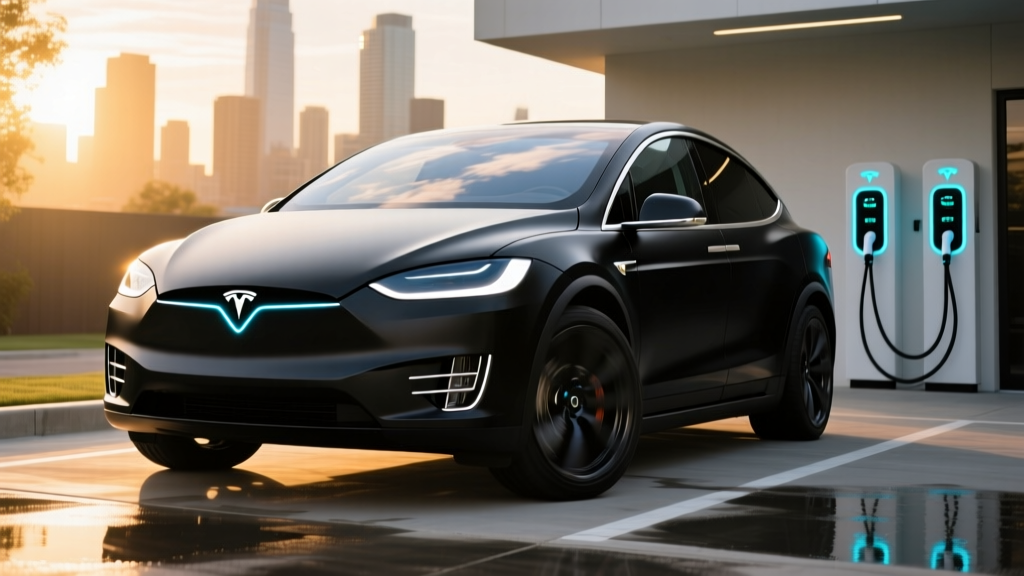
The Tesla Model X has long occupied a unique space in the electric SUV market: a three-row family hauler with falcon-wing rear doors, supercar-rivaling acceleration, and access to the most reliable DC fast-charging network in North America. For 2026, Tesla has refreshed the lineup with updated battery chemistry options, improved thermal management, and the continuation of the premium Tesla Model X Signature Series trim — a package that bundles the highest-output dual- and tri-motor powertrains with the brand's most advanced driver-assistance and interior appointments.
This review covers the 2026 Model X in its Signature Series configuration, examining real-world range, charging performance, ownership economics, and whether the premium over competitors like the Rivian R1S, BMW iX, and Mercedes EQS SUV is justified. If you're cross-shopping a luxury three-row EV, the numbers below will tell you exactly what you're getting — and what you're giving up.
2026 Model X Signature Series: Key Specs at a Glance
| Specification | Model X Long Range (Dual Motor) | Model X Plaid (Tri-Motor) |
|---|---|---|
| EPA Range | 348 miles | 326 miles |
| Battery (usable) | ~100 kWh (NMC) | ~100 kWh (NMC) |
| Drivetrain | Dual Motor AWD | Tri-Motor AWD |
| Horsepower | 670 hp | 1,020 hp |
| 0–60 mph | 3.8 seconds | 2.5 seconds |
| Peak DC Charge Rate | 250 kW | 250 kW |
| 10–80% DC Charge Time | ~30 minutes | ~30 minutes |
| Level 2 Charge Rate | 11.5 kW (~34 mi/hr) | 11.5 kW (~34 mi/hr) |
| MPGe (combined) | 102 MPGe | 95 MPGe |
| Base MSRP | $94,990 | $114,990 |
| Federal Tax Credit (§30D) | Not eligible (MSRP cap) | Not eligible (MSRP cap) |
| Battery/Drive Unit Warranty | 8 yr / 150,000 mi | 8 yr / 150,000 mi |
Source: Tesla Model X Design Studio, fueleconomy.gov
Real-World Range: What to Expect Beyond the EPA Sticker
EPA estimate: 348 miles (Long Range) / 326 miles (Plaid)
Real-world highway (70–75 mph, mild weather): ~275–300 miles
Cold weather (below 32°F, highway): ~220–250 miles
City/mixed driving (moderate temps): ~310–340 miles
The Model X Long Range's 348-mile EPA figure is among the highest of any three-row electric SUV, but real-world results depend heavily on driving conditions. The Model X's large frontal area and ~5,100-pound curb weight work against it at sustained highway speeds. In our experience and consistent with third-party testing, expect to see roughly 275–300 miles on a full charge during warm-weather highway cruising at 70–75 mph.
Cold weather compounds this. Lithium-ion batteries lose efficiency in low temperatures, and cabin heating draws significant energy even with the Model X's heat pump system. Winter highway range can drop to 220–250 miles — a meaningful reduction for road-trip planning. City and suburban driving, where regenerative braking recaptures energy and speeds are lower, brings results much closer to the EPA sticker, often 310–340 miles in temperate conditions.
The ~100 kWh usable battery pack uses NMC (nickel manganese cobalt) chemistry, which offers high energy density at the cost of slightly faster long-term degradation compared to LFP (lithium iron phosphate). Tesla recommends daily charging to 80–90% for NMC packs, reserving 100% for trips — so your practical daily range is closer to 260–280 miles (Long Range) before accounting for driving conditions.
Charging Performance: DC Fast Charging and Home Setup
| Charging Level | Power / Rate | Miles Added per Hour | Notes |
|---|---|---|---|
| Level 1 (120V household) | ~1.4 kW | ~3–4 mi/hr | Emergency/trickle only |
| Level 2 (240V, 48A) | 11.5 kW | ~34 mi/hr | Full overnight charge in ~10 hrs |
| DC Fast Charge (Supercharger V3/V4) | Peak 250 kW | ~200 mi in 15 min | 10–80% in ~30 min; tapers above 80% |
The Model X charges at up to 250 kW on Tesla's V3 and V4 Superchargers. The charge curve peaks early — typically between 10–30% State of Charge (SoC) — and progressively tapers as the battery fills. The 10–80% charge takes approximately 30 minutes under ideal conditions (battery preconditioned via onboard navigation routing to a Supercharger). Charging from 80–100% adds significant time due to tapering; plan to unplug at 80% during road trips for the fastest overall journey.
For home charging, the onboard charger accepts up to 11.5 kW on a 240V/48A circuit (such as a Tesla Wall Connector or equivalent NACS-compatible Level 2 unit). That delivers roughly 34 miles of range per hour of charging, meaning a full 0–100% replenishment takes about 10 hours overnight. A 60-amp dedicated circuit is recommended; installation costs typically range from $500–$2,000 depending on panel proximity and local permitting, though older homes may require a panel upgrade ($1,500–$3,500 additional). Consult a licensed electrician for final specifications.
The Model X uses the NACS (North American Charging Standard) connector natively. With Tesla opening the Supercharger network to other EVs, the network's reliability advantage remains, though popular corridors may see increased congestion during peak travel periods.
Performance and Driving Dynamics
The Model X Signature Series is available in two powertrain configurations, and both deliver acceleration that defies the vehicle's size and weight.
The Long Range Dual Motor produces 670 horsepower and hits 0–60 mph in 3.8 seconds — faster than most sports sedans, let alone a three-row SUV. The Plaid Tri-Motor pushes output to 1,020 hp with a 2.5-second 0–60 time, placing it in hypercar territory. Both use all-wheel drive with independent front and rear motors (and a second rear motor on the Plaid) for precise torque vectoring.
On the road, the air suspension provides a compliant ride with adjustable ride height — useful for rough driveways or maximizing highway efficiency. Steering is direct if somewhat numb, and the low center of gravity (battery pack under the floor) keeps body roll well-controlled for a vehicle of this mass. The regenerative braking system supports one-pedal driving in most scenarios, though Tesla has cycled through settings that allow adjustable regen levels in recent software updates.
Towing capacity is rated at 5,000 pounds when properly equipped, sufficient for a small boat or light utility trailer — though towing will reduce range by roughly 40–50%, bringing effective highway range down to approximately 150–170 miles between charges.
Interior, Cargo, and Technology
The Model X seats up to seven passengers in a 2-3-2 configuration (six-passenger captain's chairs in the second row are available). Interior materials have improved in recent refreshes, with ventilated front seats, a 17-inch center touchscreen, a rear-seat entertainment display, and a 22-speaker audio system included in the Signature Series package.
Cargo volume:
- Behind third row: ~37 cu ft (plus a front trunk/frunk of ~6.5 cu ft)
- Behind second row (third row folded): ~75 cu ft
- Behind front seats (all rear rows folded): ~88 cu ft
- Second-row legroom: ~40.9 inches
- Third-row legroom: ~32.7 inches (best suited for children on longer trips)
The signature falcon-wing rear doors open vertically, providing excellent overhead clearance for loading child seats or cargo in tight parking spaces. However, they require overhead clearance to open fully and can be slower to operate than conventional doors in rain or snow.
Tech and driver assistance: The Model X includes Tesla's Autopilot as standard — a Level 2 driver-assistance system (per SAE classification) that provides adaptive cruise control and lane-centering on highways. Full Self-Driving (Supervised) is available as an $8,000 add-on (or subscription), adding automatic lane changes, traffic-light recognition, and parking assist. FSD remains a Level 2 system requiring continuous driver supervision — it is not autonomous driving.
Tesla Autopilot and Full Self-Driving (Supervised) are SAE Level 2 driver-assistance systems. The driver must keep hands on the wheel and remain fully attentive at all times. These systems do not make the vehicle self-driving. Misuse or inattention can result in serious accidents.
Pricing, Trims, and Federal Tax Credit Eligibility
| Item | Long Range Dual Motor | Plaid Tri-Motor |
|---|---|---|
| Base MSRP | $94,990 | $114,990 |
| Destination Fee | $1,990 | $1,990 |
| FSD Add-On (optional) | +$8,000 | +$8,000 |
| Typical As-Tested Price | ~$102,000–$106,000 | ~$122,000–$126,000 |
| Federal §30D Tax Credit | Not eligible | Not eligible |
The 2026 Model X Signature Series starts at $94,990 for the Long Range and $114,990 for the Plaid, before the $1,990 destination fee. Options like FSD, premium paint colors, and 22-inch wheels can push the Long Range past $106,000 and the Plaid beyond $126,000.
Federal tax credit status: Neither Model X variant qualifies for the IRS §30D Clean Vehicle Credit. The §30D credit has an MSRP cap of $80,000 for SUVs, and both Model X trims exceed this threshold. Additionally, the credit requires buyer income below $150,000 (single) or $300,000 (joint), and compliance with battery critical-mineral and component sourcing requirements. At its price point, the Model X is ineligible regardless of buyer income or battery sourcing.
Some states offer additional EV incentives that may apply regardless of MSRP — check your state's energy or DMV website for current programs, as these vary by jurisdiction and change frequently.
Model X Signature Series vs. Key Competitors
| Attribute | Tesla Model X LR | Rivian R1S (Dual Max) | BMW iX xDrive50 | Mercedes EQS 580 SUV |
|---|---|---|---|---|
| EPA Range | 348 mi | ~340 mi | ~324 mi | ~305 mi |
| Starting MSRP | $94,990 | ~$89,900 | ~$87,250 | ~$105,550 |
| Rows / Max Seats | 3 / 7 | 3 / 7 | 2 / 5 | 3 / 7 |
| Peak DC Charge | 250 kW | ~220 kW | ~200 kW | ~200 kW |
| 0–60 mph | 3.8 sec | ~4.5 sec | ~4.4 sec | ~4.1 sec |
| Third-Row Usability | Good (children) | Good (children) | N/A | Adequate |
The Model X's closest direct rival is the Rivian R1S, which offers comparable three-row practicality, strong off-road capability, and a slightly lower entry price — though with slower DC charging and a less mature charging ecosystem (Rivian now uses NACS and accesses Superchargers, but its peak charge rate trails the Model X). The BMW iX is more refined inside and offers a superior ride quality, but it's strictly a two-row, five-passenger SUV. The Mercedes EQS SUV delivers exceptional luxury and a usable third row, but at a higher price and with noticeably slower charging.
The Model X retains advantages in Supercharger network access, raw acceleration (especially the Plaid), and over-the-air software updates that continually add features. Its weaknesses relative to competitors include panel-gap inconsistency, a driving position some find compromised by the yoke-style steering wheel (conventional round wheel is now standard), and an interior that, while improved, doesn't match the material quality of BMW or Mercedes at this price point.
Pros and Cons
- Class-leading EPA range (348 mi, Long Range)
- Supercharger network access with NACS native connector
- Extraordinary acceleration, especially Plaid (2.5s 0–60)
- Three-row seating with falcon-wing door practicality
- Continuous OTA software improvements
- Strong battery/drive unit warranty (8 yr / 150,000 mi)
- 5,000-lb towing capacity
- No federal tax credit eligibility (MSRP exceeds $80K cap)
- High starting price ($94,990+)
- Real-world highway/cold-weather range significantly below EPA
- Interior material quality lags German luxury rivals at this price
- Falcon-wing doors slow in rain; require overhead clearance
- Third row best suited for children, not adults on long trips
- Insurance premiums tend to be above segment average
Who Should Buy the 2026 Model X Signature Series?
The Model X Signature Series is best suited for:
- High-income families who need three rows, want EV running costs, and value Supercharger road-trip convenience for vacations and long commutes.
- Performance-oriented buyers who want supercar acceleration in a practical daily driver — the Plaid's 2.5-second 0–60 is unmatched in the SUV segment at any price.
- Tech-forward owners who prioritize over-the-air updates, a mature mobile app ecosystem, and integrated navigation-based battery preconditioning for optimal charging.
- Existing Tesla owners upgrading from a Model 3 or Model Y who want to stay within the Tesla ecosystem and Supercharger network.
It is not the best choice for buyers who need adult-friendly third-row seating (consider the Mercedes EQS SUV or a large PHEV like the Volvo XC90 Recharge), those on a budget where the Rivian R1S or a used Model X offers better value, or buyers who prioritize interior luxury over acceleration and tech.
Frequently Asked Questions
What is the real-world range of the 2026 Tesla Model X Signature Series?
The EPA rates the Long Range at 348 miles and the Plaid at 326 miles. In real-world highway driving at 70–75 mph in mild weather, expect approximately 275–300 miles. In cold weather (below 32°F), highway range drops to roughly 220–250 miles. City and mixed driving in temperate conditions yields results closer to the EPA estimate, often 310–340 miles.
How fast does the Model X charge at home and on DC fast chargers?
On a Tesla V3 or V4 Supercharger, the Model X peaks at 250 kW and charges from 10–80% in approximately 30 minutes with a preconditioned battery. At home on a 240V/48A Level 2 charger, it accepts 11.5 kW, adding about 34 miles of range per hour — a full charge takes roughly 10 hours overnight.
Does the 2026 Tesla Model X qualify for the federal EV tax credit?
No. Under current IRS §30D rules, the Clean Vehicle Credit has an MSRP cap of $80,000 for SUVs. Both the Model X Long Range ($94,990) and Plaid ($114,990) exceed this limit and are ineligible regardless of buyer income or battery sourcing. State-level incentives may still apply — check your state's official energy or DMV resources.
Is the Model X worth buying versus the Rivian R1S or Mercedes EQS SUV?
The Model X wins on range (348 vs. ~340 mi for the R1S, ~305 mi for the EQS SUV), peak charging speed (250 kW vs. ~220 kW and ~200 kW respectively), and acceleration. The R1S offers better off-road capability and a lower starting price. The EQS SUV provides a more luxurious interior and better adult third-row space. Your choice depends on whether you prioritize range and charging speed (Model X), adventure capability (R1S), or luxury (EQS SUV).
What is the battery warranty on the 2026 Model X?
Tesla covers the battery and drive units for 8 years or 150,000 miles (whichever comes first), with a minimum 70% capacity retention threshold over the warranty period. This is competitive with the segment and reflects confidence in the NMC pack's long-term durability. Battery replacement outside warranty, if needed, is estimated at $15,000–$22,000 depending on service complexity.
How much does it cost to charge a Model X at home versus gasoline?
At the US average residential electricity rate of ~$0.17/kWh, fully charging the ~100 kWh battery costs approximately $17. For a driver covering 12,000 miles per year at the Model X Long Range's efficiency of ~33 kWh/100mi, annual home-charging cost is roughly $670. An equivalent gasoline SUV averaging 22 MPG at $3.50/gallon would cost approximately $1,909 per year in fuel — a savings of over $1,200 annually with home charging. Public DC fast charging is more expensive (typically $0.30–$0.50/kWh), reducing but not eliminating the cost advantage.