Tesla Model X Signature Edition: The Executive SUV That Still Sets the Pace
The Tesla Model X has been the benchmark for electric luxury SUVs since its debut, and the current-generation lineup — particularly when equipped with Tesla's premium Signature-tier interior and technology packages — continues to command attention from buyers who need three rows, serious performance, and access to the Supercharger network. But with rivals like the BMW iX, Rivian R1S, and Mercedes EQS SUV closing the gap, does the Model X still earn its premium price tag?
We've spent extensive time with the latest Model X configurations, including the high-output Plaid variant and the Long Range dual-motor setup, to bring you exact numbers on range, charging, cargo practicality, and total cost. Here's what real ownership looks like in 2026.
Range, Battery, and Real-World Efficiency
The Model X Long Range carries a 100 kWh (usable ~95 kWh) NMC (nickel-manganese-cobalt) lithium-ion battery pack. Tesla does not offer LFP chemistry in the Model X lineup — the energy density demands of a 5,000+ lb SUV require NMC's superior specific energy.
| Specification | Long Range (Dual Motor) | Plaid (Tri Motor) |
|---|---|---|
| EPA Estimated Range | 335 miles | 311 miles |
| Battery Capacity (Usable) | ~95 kWh (NMC) | ~95 kWh (NMC) |
| Combined MPGe | 103 MPGe | 98 MPGe |
| Efficiency (kWh/100 mi) | 33 kWh/100 mi | 35 kWh/100 mi |
| Drivetrain | Dual Motor AWD | Tri Motor AWD |
The EPA's 335-mile estimate for the Long Range assumes a mix of city and moderate-speed driving. In our highway testing at 75 mph in 65°F conditions, expect ~275–295 miles before hitting a low-battery warning. In cold weather (below 32°F), range drops an additional 15–25%, meaning a winter road trip may yield ~220–250 miles of practical range. The Model X's heat pump helps mitigate cabin energy draw, but battery chemistry still suffers in deep cold. Always plan charging stops with a 15–20% buffer.
For daily commuting under 80 miles round-trip, you'll charge every 3–4 days on Level 2 and rarely touch DC fast charging during the work week. Source: fueleconomy.gov.
Charging Speed: DC Fast Charge and Home Level 2
The Model X supports Tesla's NACS (North American Charging Standard) connector natively — no adapter needed for Superchargers. With the expanding open Supercharger network, non-Tesla EVs can now access many stalls, but Model X owners still benefit from seamless plug-and-charge integration and automatic battery preconditioning when navigating to a Supercharger.
| Charging Level | Power / Rate | Time / Range Added |
|---|---|---|
| Level 1 (120V household) | ~1.4 kW | ~3–4 miles per hour |
| Level 2 (240V, 48A Wall Connector) | 11.5 kW | ~34 miles per hour; full charge in ~9 hrs |
| DC Fast Charge (Supercharger V3/V4) | Peak 250 kW | 10–80% in ~30 minutes |
| CCS Adapter (non-Tesla DCFC) | Up to ~170 kW (adapter-limited) | 10–80% in ~40 minutes |
Charging curve reality: The Model X peaks at 250 kW only between roughly 10–30% state of charge (SoC). Above 50%, the rate tapers significantly — by 80% SoC, you're pulling around 60–80 kW. That 10–80% time of ~30 minutes assumes you arrive at a low SoC and the battery is preconditioned. Cold-soaking the battery without preconditioning can add 10–15 minutes to your stop.
At home, Tesla's Wall Connector on a 60A circuit (48A continuous) delivers 11.5 kW — enough to replenish a full day's 60-mile commute in under two hours. Most owners wake up to a full battery every morning.
Performance: 0–60, Horsepower, and Drivetrain
The Model X has always been improbably quick for its size, and the current generation continues that tradition.
| Metric | Long Range | Plaid |
|---|---|---|
| Horsepower | 670 hp (combined) | 1,020 hp (combined) |
| 0–60 mph | 3.8 seconds | 2.5 seconds |
| Top Speed | 155 mph | 163 mph |
| Drivetrain | Dual Motor AWD | Tri Motor AWD (1 front, 2 rear) |
| Towing Capacity | 5,000 lbs | 5,000 lbs |
The Plaid's 2.5-second 0–60 time makes it one of the quickest SUVs ever produced. But for most buyers, the Long Range's 3.8 seconds is more than adequate — and you gain 24 miles of EPA range plus a lower starting price. Towing is rated at 5,000 lbs across both trims, though expect a 35–45% range reduction when pulling a loaded trailer at highway speeds.
Interior, Cargo, and Signature-Tier Features
The Model X seats up to seven passengers in its optional third-row configuration (six seats with second-row captain's chairs is the more common luxury layout). The Signature-level interior upgrades include premium semi-aniline leather, ventilated front seats, a 17-inch center touchscreen with 22-speaker audio, and a rear-seat 8-inch touchscreen for climate and media control.
| Measurement | Specification |
|---|---|
| Cargo (behind 3rd row) | ~15 cu ft |
| Cargo (3rd row folded) | ~40 cu ft |
| Cargo (all rear rows folded) | ~75 cu ft |
| Front Trunk (Frunk) | ~6.6 cu ft |
| Front Legroom | 41.2 in |
| 2nd Row Legroom | 38.4 in |
| 3rd Row Legroom | 32.7 in |
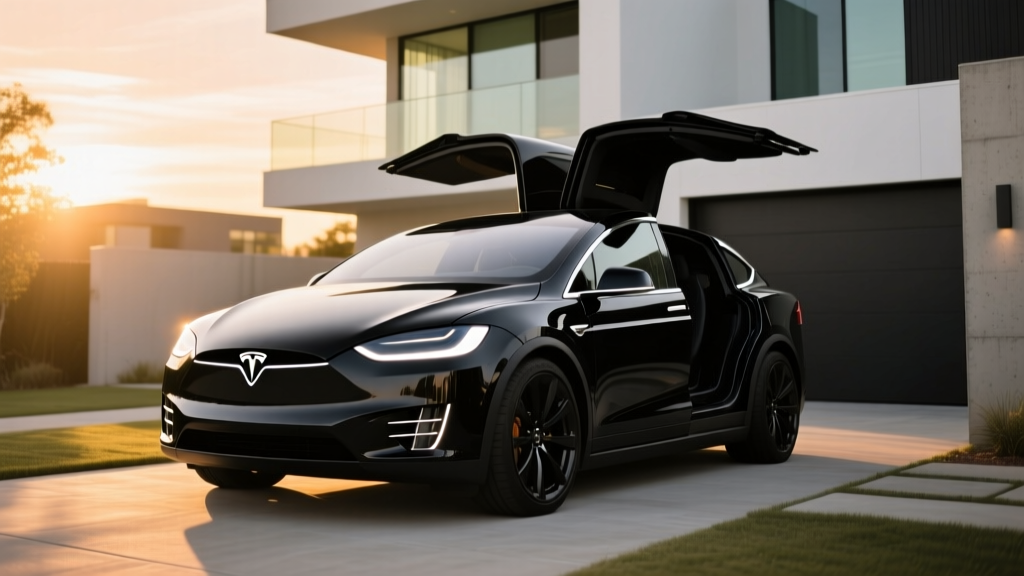
Falcon Wing doors remain the Model X's signature feature — they open upward with articulated hinges, providing excellent access to second- and third-row car seats in tight parking spaces. However, they add mechanical complexity and can be slower to operate than conventional doors in rain. The panoramic windshield extends over the front row, creating an airy cabin but adding solar heat load in summer (Tesla includes a tinted upper section).
Driver assistance: Every Model X includes Basic Autopilot (SAE Level 2 — lane centering + adaptive cruise). Tesla's Full Self-Driving (Supervised) package remains a Level 2 system requiring constant driver engagement despite its name. It adds automatic lane changes, traffic light/stop sign recognition, and Navigate on Autopilot. It is not a Level 4 autonomous system.
Tesla Autopilot and FSD (Supervised) are SAE Level 2 driver-assistance systems. You must keep your hands on the wheel and eyes on the road at all times. These systems do not make the Model X self-driving. NHTSA continues to investigate Autopilot-related incidents. See NHTSA guidance.
Pricing, Tax Credit Eligibility, and Total Cost
The Model X positions firmly in six-figure luxury territory. Here's the current pricing breakdown:
| Trim | Base MSRP | As-Tested (w/ Signature Pkg) | §30D Federal Credit |
|---|---|---|---|
| Long Range | $81,630 | ~$94,000–$98,000 | See eligibility notes below |
| Plaid | $96,630 | ~$108,000–$115,000 | See eligibility notes below |
Federal tax credit (§30D) eligibility is complicated for the Model X. Under current IRS rules, the vehicle must meet several criteria:
- MSRP Cap: SUVs must have an MSRP at or below $80,000. The Long Range base MSRP ($81,630) exceeds this cap — meaning new Model X purchases do not qualify for the $7,500 new-vehicle credit unless Tesla adjusts pricing.
- Buyer Income Cap: AGI must not exceed $300,000 (married filing jointly), $225,000 (head of household), or $150,000 (individual).
- Battery Sourcing: Critical minerals and battery components must meet phased-in domestic/free-trade sourcing thresholds.
- Point-of-Sale Transfer: Eligible buyers can apply the credit as a down-payment reduction at purchase, but only if the vehicle itself qualifies.
Bottom line: Most new Model X buyers will not qualify for the $7,500 federal credit due to the MSRP cap. However, a used Model X (model year 2024 or earlier, purchased from a dealer for $25,000–$80,000) may qualify for up to $4,000 or 30% of the sale price under the §25E used-EV credit, subject to lower income caps ($150K/$112.5K/$75K). Always verify current rules at IRS.gov and consult a tax professional.
Warranty, Battery Longevity, and Ownership Costs
| Coverage Area | Term |
|---|---|
| Basic Vehicle Limited Warranty | 4 years / 50,000 miles |
| Battery & Drive Unit Warranty | 8 years / 150,000 miles (Long Range) |
| Battery & Drive Unit Warranty | 8 years / 150,000 miles (Plaid) |
| Battery Capacity Retention Guarantee | ≥70% over warranty period |
Tesla's 8-year/150,000-mile battery warranty is competitive with rivals. The 70% capacity retention threshold means Tesla will replace or refurbish the pack if degradation exceeds 30% within the warranty window. Real-world data from high-mileage Model X owners suggests typical NMC degradation of ~10–15% over 100,000 miles, with the steepest drop occurring in the first 20,000 miles before leveling off. A full out-of-warranty battery replacement currently runs $15,000–$22,000 depending on pack configuration and labor.
5-Year Ownership Cost Estimate (Long Range, 15K miles/year):
| Cost Category | Estimated 5-Year Total |
|---|---|
| Depreciation | ~$35,000–$42,000 |
| Electricity (home + DCFC mix) | ~$4,500–$6,000 |
| Insurance | ~$18,000–$24,000 |
| Maintenance (tires, cabin filter, fluid) | ~$2,500–$3,500 |
| Total Estimated 5-Year Cost | ~$60,000–$75,500 |
Insurance premiums are notably higher than average — the Model X's repair costs, aluminum body panels, and high MSRP push annual premiums to $3,600–$4,800 for most drivers. Always get a quote before purchasing.
Model X vs. Key Competitors: Is It Worth It?
| Attribute | Tesla Model X LR | BMW iX xDrive50 | Rivian R1S Dual Max |
|---|---|---|---|
| EPA Range | 335 mi | 324 mi | 352 mi |
| Starting MSRP | $81,630 | $87,250 | $83,900 |
| Seating | 5 / 6 / 7 | 5 | 7 |
| 0–60 mph | 3.8 sec | 4.4 sec | 3.5 sec |
| Max DCFC | 250 kW | 195 kW | 220 kW |
| 3rd Row Available | Yes | No | Yes |
| Supercharger/Network | Native NACS | NACS (adapter) | Native NACS |
- You need 3-row seating AND the Supercharger network for road trips
- You want class-leading DC fast-charge speed (250 kW)
- Performance is a priority (3.8s or 2.5s 0–60)
- You value OTA updates and the Tesla software ecosystem
- You want a traditional luxury interior (BMW iX is more refined)
- You need serious off-road capability (Rivian R1S)
- Federal tax credit eligibility is essential to your budget
- You prefer physical controls over touchscreen-only operation
Pros and Cons at a Glance
Pros
- Class-leading 250 kW DC fast charging
- 335-mile EPA range (Long Range) is excellent for a 3-row SUV
- Falcon Wing doors offer unique access in tight spaces
- Native NACS / Supercharger network access
- Plaid variant: 2.5-second 0–60 in a 5,000-lb SUV
- Spacious cargo with up to 75 cu ft (rear rows folded)
- Continuous OTA updates add features post-purchase
- Heat pump standard for cold-weather efficiency
Cons
- Base MSRP exceeds $80K §30D tax credit cap
- Insurance premiums significantly above segment average
- Falcon Wing doors add complexity; slower in rain
- 3rd row is tight for adults (32.7" legroom)
- Touchscreen-centric controls frustrate some drivers
- Panel gap and build consistency still trail German rivals
- No LFP battery option (heavier NMC pack)
- FSD (Supervised) requires monthly fee or upfront cost; still Level 2
Frequently Asked Questions
What is the real-world range of the Tesla Model X?
The Long Range carries a 335-mile EPA estimate. In real-world highway driving at 75 mph, expect 275–295 miles. In cold weather (below freezing), plan for 220–250 miles. The Plaid's higher power draw reduces its real-world range to roughly 255–275 miles on the highway.
How fast does the Model X charge at home and on DC fast chargers?
On a Tesla Wall Connector (240V, 48A), the Model X charges at 11.5 kW — adding roughly 34 miles of range per hour, or a full charge overnight in ~9 hours. On a V3/V4 Supercharger, it peaks at 250 kW and charges from 10–80% in approximately 30 minutes, though the charge curve tapers significantly above 50% SoC.
Does the Tesla Model X qualify for the federal EV tax credit?
Most likely not for new purchases. The §30D credit caps SUV MSRPs at $80,000, and the Model X Long Range starts at $81,630. A used Model X may qualify for up to $4,000 under the §25E used-EV credit if purchased from a dealer within the price and income limits. Verify current rules at IRS.gov.
Is the Model X worth buying over the BMW iX or Rivian R1S?
If you need three rows, fast DC charging, and Supercharger access for road trips, the Model X remains compelling. If interior luxury is paramount, the BMW iX is more refined (but seats only five). If you want off-road capability and a more adventure-oriented platform, the Rivian R1S is the stronger pick. The Model X wins on charging infrastructure and raw performance.
What's the biggest drawback of owning a Model X?
Insurance cost and tax-credit ineligibility are the top financial drawbacks. Operationally, the falcon wing doors can be slow and attract attention (not always welcome), and the touchscreen-only interface for climate, mirrors, and glovebox requires adjustment. Build quality has improved but still doesn't match BMW or Mercedes at this price point.
How long will the Model X battery last?
Tesla warranties the battery for 8 years/150,000 miles with a 70% capacity retention guarantee. Real-world NMC degradation data suggests 10–15% loss over 100,000 miles. Many high-mileage Tesla owners report 80–85% State of Health at 150,000 miles. Avoid frequent 100% charges and DC fast-charging in extreme heat to maximize longevity.
Can the Model X tow, and how does towing affect range?
Yes — the Model X is rated to tow 5,000 lbs across both trims. When towing a loaded trailer at highway speeds, expect a 35–45% range reduction, bringing effective range down to roughly 180–210 miles (Long Range). Plan Supercharger stops accordingly and note that not all Supercharger stalls are convenient for trailers.