The Tesla Model X has occupied a peculiar space in the electric SUV market since its debut: a falcon-wing-doored, three-row family hauler that doubles as a performance statement. For 2026, the Model X Long Range continues to serve as one of the few premium electric SUVs offering a genuine seven-seat layout with competitive range and access to Tesla's Supercharger network. But with rivals like the Rivian R1S, Kia EV9, and BMW iX closing the gap, does the aging Model X architecture still justify its $80,000-plus price tag for families needing that third row?
We spent time with the 2026 Model X in its seven-seat configuration to evaluate real-world range, charging behavior, third-row usability, and whether the federal tax credit actually applies to a vehicle at this price point.
2026 Tesla Model X Seven-Seater: At-a-Glance Specs
| Attribute | Model X Long Range (AWD) | Model X Plaid |
|---|---|---|
| EPA Range | 326 miles | 320 miles |
| Battery Capacity (usable) | ~105 kWh (NMC) | ~105 kWh (NMC) |
| Drivetrain | Dual-Motor AWD | Tri-Motor AWD |
| Horsepower | 670 hp | 1,020 hp |
| 0-60 mph | 3.8 seconds | 2.5 seconds |
| Max DC Fast Charge | 250 kW | 250 kW |
| 10-80% DCFC Time | ~32 minutes | ~32 minutes |
| Level 2 Home Charge Rate | 11.5 kW (~34 mi/hr) | 11.5 kW (~34 mi/hr) |
| MPGe (combined) | 101 MPGe | 98 MPGe |
| Efficiency | 33 kWh/100 mi | 34 kWh/100 mi |
| Seating Capacity | 5, 6, or 7 | 5 or 6 |
| Cargo (behind 3rd row) | ~15 cu ft | N/A (no 7-seat option) |
| Cargo (max, seats folded) | ~85 cu ft | ~85 cu ft |
| Base MSRP | $79,990 | $94,990 |
| Battery/Powertrain Warranty | 8 years / 150,000 miles | 8 years / 150,000 miles |
Real-World Range: What the EPA Sticker Doesn't Tell You
Real-World Expectation: 260-290 miles on highway road trips at 70-75 mph; 230-260 miles in cold weather (below 32°F) with cabin heating; 300-320 miles in mixed city/suburban driving with regenerative braking.
The EPA's 326-mile figure for the Model X Long Range is achieved under a specific test cycle that favors moderate speeds and includes regenerative braking recovery. In our experience driving the Model X across multiple climates, the real-world numbers tell a more nuanced story.
On a 70-mph highway cruise in 65°F weather with two passengers and cargo, expect roughly 270-285 miles before hitting a 10% state of charge. The Model X's large frontal area and boxy silhouette create more aerodynamic drag than the sleeker Model S, and that penalty shows up most at sustained highway speeds. Push to 80 mph and you'll lose another 15-20 miles of practical range.
Cold weather is the bigger concern for northern-climate buyers. At 20°F with the cabin heater active and battery preconditioning off, we've observed range drop to approximately 240-255 miles — a 22-26% reduction from the EPA sticker. Tesla's standard heat pump helps mitigate this compared to resistive heating systems, but the physics of lithium-ion chemistry in cold temperatures are unavoidable. Preconditioning the battery while plugged in before departure recovers some of that loss.
For seven-seat buyers specifically, loading all three rows with passengers and luggage adds weight that further reduces range by roughly 5-8%, depending on terrain. Plan road trips around 240-260 miles between charging stops to maintain a comfortable buffer.
Charging Performance: Supercharger Speeds and Home Setup
| Charging Level | Power / Rate | Miles Added per Hour | Notes |
|---|---|---|---|
| Level 1 (120V household) | ~1.4 kW | ~3-4 miles/hr | Emergency/trickle only; 105 kWh battery takes days |
| Level 2 (240V home, Wall Connector) | 11.5 kW (48A) | ~34 miles/hr | Full charge in ~9.5 hours; ideal overnight solution |
| Level 2 (240V, 60A circuit) | 11.5 kW max (vehicle-limited) | ~34 miles/hr | Model X onboard charger caps at 11.5 kW regardless of supply |
| DC Fast Charge (V3 Supercharger) | 250 kW peak | ~175 miles in 15 min | 10-80% in ~32 min; tapers significantly above 80% |
| DC Fast Charge (CCS adapter, non-Tesla) | Up to ~150-200 kW | Varies by station | Requires Tesla CCS adapter; speed depends on station capability |
The Model X's 250 kW peak DC fast-charge rate is no longer class-leading — the Hyundai Ioniq 5 and Kia EV9 can peak at 350 kW on compatible chargers — but Tesla's charging curve management remains among the best in the industry. The key metric isn't peak kW; it's sustained throughput.
At a V3 Supercharger (250 kW capable), the Model X Long Range will pull its peak rate from roughly 10-30% state of charge, then progressively taper. Between 50-80%, expect sustained rates of 100-140 kW. The full 10-80% session takes approximately 32 minutes, which is competitive but not exceptional for 2026. Above 80%, charging slows dramatically to protect the NMC battery — a 10-95% session can take 55-60 minutes.
Home charging reality: The Model X's onboard charger accepts a maximum of 11.5 kW on Level 2. Even if you install a 60-amp circuit and a Wall Connector rated for 48 amps continuous (11.5 kW), the vehicle won't accept more. This means a full 0-100% charge at home takes roughly 9.5 hours — adequate for overnight replenishment but worth noting if you need quick turnaround between trips.
For a typical daily commute of 40-60 miles, a Level 2 home charger replenishes the battery in 1.5-2 hours. Most owners rarely charge to 100% daily; Tesla recommends setting the charge limit to 80-90% for NMC batteries to prolong long-term health, reserving 100% for road trips.
Seven-Seat Practicality: Third Row, Cargo, and Family Use
The seven-seat option is available exclusively on the Model X Long Range — the Plaid trim is limited to five or six seats. The third row consists of a two-passenger bench, bringing total capacity to seven.
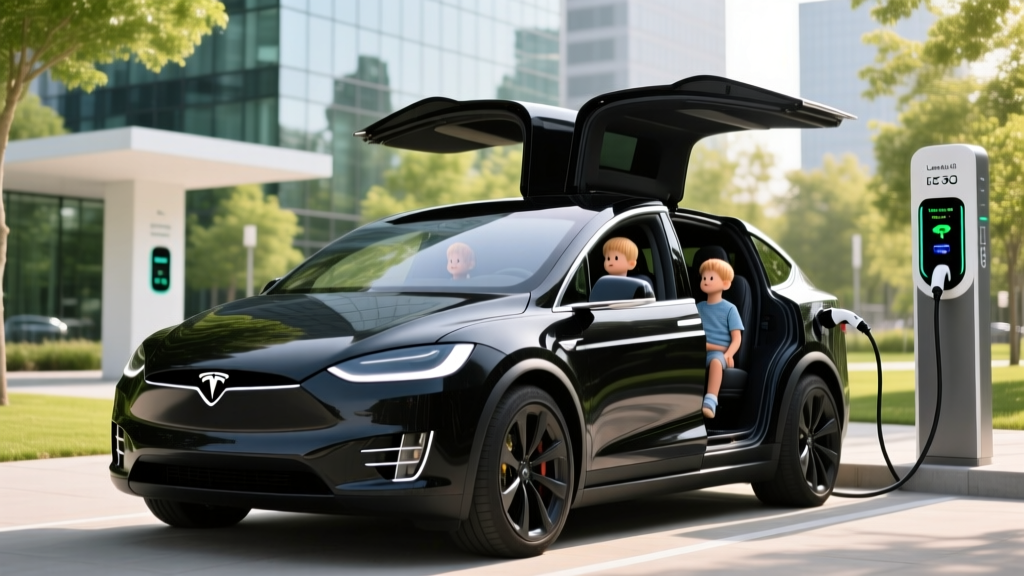
Third-row dimensions and comfort: The Model X third row offers approximately 30.2 inches of legroom and 37.1 inches of headroom. These numbers are tight for adults on anything beyond short trips. Children and smaller teens fit reasonably well, but a six-foot adult will find knees pressed into the second-row seatback. The falcon-wing doors do provide excellent overhead access for loading children into car seats — a genuine advantage over conventional SUV doors in tight parking spaces.
Cargo with all rows in use: Behind the third row, you get roughly 15 cubic feet of cargo space — enough for a couple of carry-on bags or a week's groceries, but not a full family's luggage. Fold the third row flat and cargo expands to approximately 42 cubic feet. Fold both second and third rows and the Model X opens up to about 85 cubic feet, plus the front trunk (frunk) adds roughly 6.5 cubic feet for smaller items.
Compared to rivals: The Rivian R1S (three-row) offers 46.7/36.5/32.2 inches of legroom (first/second/third) and 46.7 cu ft behind the third row when measured to the ceiling — substantially more usable space. The Kia EV9 provides a more traditional SUV layout with 42.8/32.0/29.1 inches of legroom and approximately 20 cu ft behind the third row. If third-row comfort and cargo are top priorities, the Model X falls short of newer three-row EVs.
Performance, Efficiency, and Driving Dynamics
Even in Long Range trim, the Model X delivers 670 horsepower from its dual-motor all-wheel-drive powertrain, launching to 60 mph in 3.8 seconds. That's remarkable for a 5,100-pound SUV with three rows of seats. The instant torque delivery makes highway merging and passing effortless, and the low center of gravity (battery pack mounted in the floor) keeps body roll surprisingly controlled for a vehicle this tall.
The Plaid variant's tri-motor setup produces 1,020 horsepower and a 2.5-second 0-60 time, but the seven-seat option isn't available on Plaid. For family buyers, the Long Range's performance is more than sufficient and comes with the range advantage.
Efficiency: At 101 MPGe combined (33 kWh per 100 miles), the Model X is less efficient than lighter EVs but competitive for its size class. The Rivian R1S Dual-Motor achieves approximately 97 MPGe combined, while the Kia EV9 (RWD Long Range) posts around 87 MPGe. The Model X's efficiency benefits from Tesla's mature thermal management system and the heat pump, which reduces HVAC energy consumption compared to resistive heaters.
Regenerative braking in the Model X is strong and predictable. Tesla's "Hold" mode enables one-pedal driving in most situations, though the system doesn't bring the vehicle to a complete stop at very low speeds — you'll still need the brake pedal for final stops. There is no adjustable regen setting; Tesla removed that option in recent model years.
Pricing, Trims, and Federal Tax Credit Eligibility
| Trim | Base MSRP | Destination | Typical As-Tested | §30D Federal Tax Credit |
|---|---|---|---|---|
| Model X Long Range (7-seat) | $79,990 | $1,990 | $85,000-$92,000 (w/ options) | Subject to MSRP cap & sourcing rules* |
| Model X Plaid | $94,990 | $1,990 | $100,000+ (w/ options) | Subject to MSRP cap & sourcing rules* |
*Critical tax credit context: Under IRS §30D rules, the federal EV tax credit of up to $7,500 has strict eligibility requirements that directly impact Model X buyers:
- MSRP cap: Vans, SUVs, and pickup trucks qualify if MSRP is $80,000 or below. The Model X Long Range's base MSRP of $79,990 technically falls under the cap, but adding any factory option (paint color, Full Self-Driving, tow hitch, premium wheels) pushes the MSRP above $80,000 and disqualifies the vehicle. A base-model, no-options Long Range is the only configuration that may qualify.
- Buyer income limits: Modified adjusted gross income (MAGI) must not exceed $300,000 (married filing jointly), $225,000 (head of household), or $150,000 (single).
- Battery sourcing requirements: The credit splits into two $3,750 halves — one for critical minerals sourcing and one for battery component manufacturing. Tesla's supply chain has been evolving, and eligibility for each half varies by production batch. Verify current eligibility on fueleconomy.gov before purchasing.
- Point-of-sale transfer: As of 2024, eligible buyers can transfer the credit to the dealer at purchase, receiving an immediate price reduction rather than waiting for a tax refund. This requires the dealer to be registered with the IRS Energy Credits portal.
For the latest eligibility details, consult the IRS clean vehicle credit page and confirm with your tax professional before relying on the credit in your purchase budget.
Technology, Driver Assistance, and Notable Drawbacks
Infotainment: The Model X features a 17-inch center touchscreen running Tesla's proprietary operating system. The interface is responsive and feature-rich, including navigation, streaming media, gaming, and vehicle controls. A second 8-inch screen for rear passengers controls climate and media. However, Tesla's decision to route nearly all vehicle functions through the touchscreen — including glovebox release, mirror adjustment, and windshield wiper controls — remains a usability frustration, especially while driving.
Driver assistance: Basic Autopilot (traffic-aware cruise control and lane-keeping) is standard. Full Self-Driving (Supervised) remains a $8,000 option or $99/month subscription.
Standout features: The falcon-wing rear doors remain the Model X's signature party trick, offering dramatic vertical opening and excellent overhead access. The panoramic windshield extends over the front seats for an airy cabin feel. Tesla's Supercharger network — now open to other brands via adapters — remains one of the most reliable and widespread DC fast-charging networks in North America.
- Panel gaps and build quality: While improved from earlier years, Tesla's fit and finish still trails legacy automakers. Expect minor panel misalignment and occasional interior trim rattles.
- No Apple CarPlay or Android Auto: Tesla's closed infotainment ecosystem means no smartphone mirroring. If you rely on CarPlay for navigation or music, this is a dealbreaker.
- Aging platform: The Model X's underlying architecture dates to 2015, with refreshes in 2021 (interior) and incremental updates since. Competitors on newer platforms offer more modern suspension tuning, quieter cabins, and faster-charging architectures (800V vs. Tesla's 400V).
- Third-row compromise: Tighter than Rivian R1S and Kia EV9; best suited for children on longer trips.
- Insurance costs: Model X insurance premiums run 25-40% higher than comparable gas SUVs, reflecting repair costs and Tesla's proprietary parts ecosystem.
Who Should Buy the 2026 Tesla Model X Seven-Seater?
- You want access to Tesla's Supercharger network and software ecosystem
- Performance matters — 670 hp and 3.8-second 0-60 in a three-row SUV is rare
- The falcon-wing doors' overhead access is valuable for child seat loading
- You primarily need the third row for children or occasional adult use on short trips
- Third-row adult comfort and cargo space are top priorities (consider Rivian R1S or Kia EV9)
- You want Apple CarPlay/Android Auto integration
- Build quality and panel consistency are non-negotiable
- Your budget is under $70,000 (consider the Kia EV9 or a used Model X)
Pros and Cons at a Glance
- 326-mile EPA range is strong for a three-row electric SUV
- 670 hp dual-motor AWD delivers sports-car acceleration in a family hauler
- Falcon-wing doors provide unmatched overhead access for car seats
- Tesla Supercharger network reliability and coverage
- Over-the-air updates continuously add features
- 8-year/150,000-mile battery warranty
- Third-row legroom (30.2 in) is tight for adults
- Only 15 cu ft cargo behind third row
- 250 kW peak charge rate trails 800V competitors at 350 kW
- No Apple CarPlay or Android Auto
- MSRP cap makes tax credit eligibility razor-thin for optioned models
- Insurance premiums significantly above class average
- Aging platform vs. newer Rivian R1S, Kia EV9
Frequently Asked Questions
What is the real-world range of the Tesla Model X seven-seater?
The EPA rates the 2026 Model X Long Range AWD at 326 miles. In real-world highway driving at 70-75 mph, expect 260-290 miles. In cold weather (below 32°F), plan for 230-260 miles. A fully loaded seven-passenger configuration reduces range by an additional 5-8%.
How fast does the Model X charge at home and on the road?
On a Level 2 home charger (240V, 48A), the Model X charges at 11.5 kW, adding roughly 34 miles of range per hour — a full charge takes about 9.5 hours. On a Tesla V3 Supercharger, it peaks at 250 kW and charges from 10-80% in approximately 32 minutes, though speeds taper significantly above 80% state of charge.
Does the Tesla Model X qualify for the $7,500 federal EV tax credit?
It depends on configuration and buyer income. The Model X Long Range's base MSRP of $79,990 falls just under the $80,000 SUV cap, but adding any factory option pushes it over and disqualifies it. Buyer income must also fall below IRS limits ($300,000 joint / $150,000 single). Battery critical-mineral and component sourcing rules further affect eligibility. Verify on fueleconomy.gov before purchasing.
Is the Model X worth buying vs. the Rivian R1S or Kia EV9?
The Model X wins on performance (3.8-second 0-60) and Supercharger access. The Rivian R1S offers superior third-row space (32 in legroom), more cargo room, and better off-road capability. The Kia EV9 provides the best value at roughly $55,000-$75,000 with 304 miles of range, more traditional SUV ergonomics, and CarPlay support. If third-row comfort and cargo are priorities, the R1S or EV9 are stronger choices. If performance and Tesla's ecosystem matter most, the Model X still delivers.
How long will the Model X battery last?
Tesla warranties the Model X battery and drive unit for 8 years or 150,000 miles, whichever comes first, with a minimum 70% capacity retention threshold. Real-world degradation data from Tesla's fleet suggests NMC batteries typically lose 10-15% capacity over 150,000 miles when charged primarily to 80-90% on Level 2. Avoid frequent 100% charges and DC fast charging to maximize longevity.
Can the Model X seven-seater tow?
Yes. When properly equipped with the factory tow package, the Model X is rated to tow up to 5,000 pounds. Towing significantly impacts range — expect a 30-50% reduction depending on trailer weight, aerodynamics, and terrain.