Quick Verdict: The Model X in 2026
The 2026 Tesla Model X remains the only all-electric three-row SUV that pairs falcon-wing rear doors with a 335-mile EPA range and access to Tesla's 20,000+ Supercharger network. It's a niche vehicle: a luxury family hauler that can seat up to seven, tow 5,000 pounds, and sprint to 60 mph in 2.5 seconds in Plaid form — all while returning the equivalent of 101 MPGe combined. But with a starting price near $80,000 and no federal tax credit eligibility for most buyers, the Model X demands careful consideration against rivals like the Rivian R1S, Kia EV9, and BMW iX.
This review focuses on what matters to buyers researching Tesla Model X seats, interior space, and daily usability — alongside the hard numbers on range, charging, and ownership costs that determine whether this SUV earns a spot in your garage.
Seating Configurations: 5, 6, or 7 Passengers
The Model X offers three seating layouts, and your choice affects cargo capacity, third-row usability, and second-row comfort significantly.
| Layout | Second Row | Third Row | Max Cargo (cu ft) | Best For |
|---|---|---|---|---|
| 5-Seat | Bench (3-across) | None | 88.1 (behind 2nd row) | Maximum cargo, no third-row need |
| 6-Seat | Captain's chairs (2) | 2 seats | 88.1 (behind 2nd row) | Adult second-row comfort, occasional third row |
| 7-Seat | Bench (3-across) | 2 seats | 88.1 (behind 2nd row) | Maximum passenger count, school runs |
The 6-seat configuration with second-row captain's chairs is the sweet spot for most families. The individual seats slide, recline, and offer a center walk-through to the third row — far more practical than climbing over a bench. The 7-seat layout uses a second-row bench that makes third-row access tighter, though it does maximize passenger count for carpool-heavy households.
Third-Row Reality Check
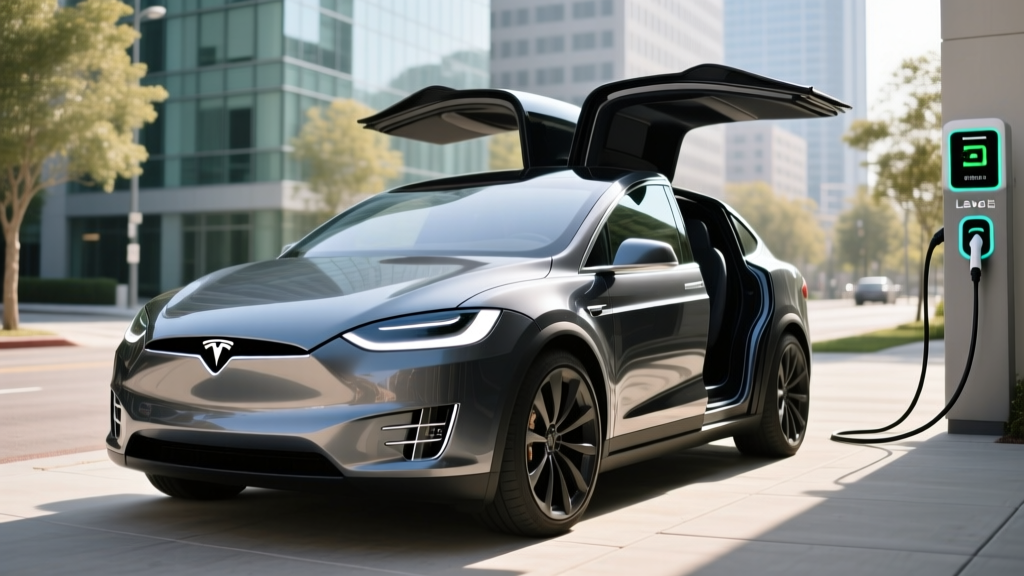
The Model X third row offers 32.7 inches of legroom — adequate for children and teens, but tight for adults on trips longer than 30 minutes. Headroom is generous at 38.4 inches thanks to the tall roofline, but the seat cushion sits low, creating a knees-up posture. Compare this to the Rivian R1S (36.3 inches of third-row legroom) or the Kia EV9 (32.0 inches), and the Model X lands in the middle of the pack. The falcon-wing doors do make third-row loading dramatically easier than conventional SUV doors in tight parking spaces — a genuine functional advantage.
Cargo Volume Breakdown
- Behind third row: 14.8 cu ft (fits 2-3 carry-on bags)
- Behind second row (third row folded): 88.1 cu ft
- Total with all rear seats folded: 92.3 cu ft
- Front trunk (frunk): 6.6 cu ft
The 14.8 cu ft behind the third row is the Model X's most significant packaging weakness. With all seven seats occupied, you'll fit a couple of soft duffels or a stroller — not a family's luggage for a week-long road trip. The Rivian R1S offers more usable rear cargo thanks to its boxier shape, though the Model X compensates with the 6.6 cu ft frunk up front.
Range, Efficiency, and Real-World Expectations
EPA estimated range: 335 miles (Long Range AWD) / 326 miles (Plaid)
Real-world highway (70 mph, moderate temps): ~275–295 miles
Real-world cold weather (below 32°F, highway): ~230–260 miles
Efficiency: 101 MPGe combined / 33 kWh per 100 miles
The Model X Long Range carries a ~100 kWh battery pack (approximately 95 kWh usable) using NMC (nickel manganese cobalt) chemistry. Tesla does not publish exact usable capacity figures, but independent teardowns and charging-data analyses consistently place it in the 95–100 kWh range.
The 335-mile EPA figure is measured on a blended cycle that includes substantial city/regenerative driving. On a sustained 70 mph highway run in 65–75°F weather, expect 275–295 miles before needing to charge. In sub-freezing conditions, battery resistance increases and cabin heating draws significant energy — plan for 230–260 miles of real range. The Model X includes a heat pump (standard since 2021), which reduces but does not eliminate cold-weather range loss. Preconditioning the battery while plugged in before departure recovers some of this deficit.
According to fueleconomy.gov, the Long Range AWD achieves 101 MPGe combined (104 city / 98 highway), translating to roughly 33 kWh per 100 miles. This is less efficient than the Model Y (122 MPGe) due to the X's greater weight (~5,185 lbs) and taller, less aerodynamic profile.
Charging Speed: DC Fast, Level 2, and Level 1
| Level | Max Power | Speed | Typical Use |
|---|---|---|---|
| DC Fast Charge (Supercharger V3/V4) | 250 kW peak | 10–80% in ~30 min; ~175 mi in 15 min | Road trips, highway corridors |
| Level 2 (Tesla Wall Connector, 48A) | 11.5 kW | ~34 miles per hour of charging | Home overnight, workplace |
| Level 1 (120V standard outlet) | ~1.4 kW | ~4 miles per hour | Emergency / trickle only |
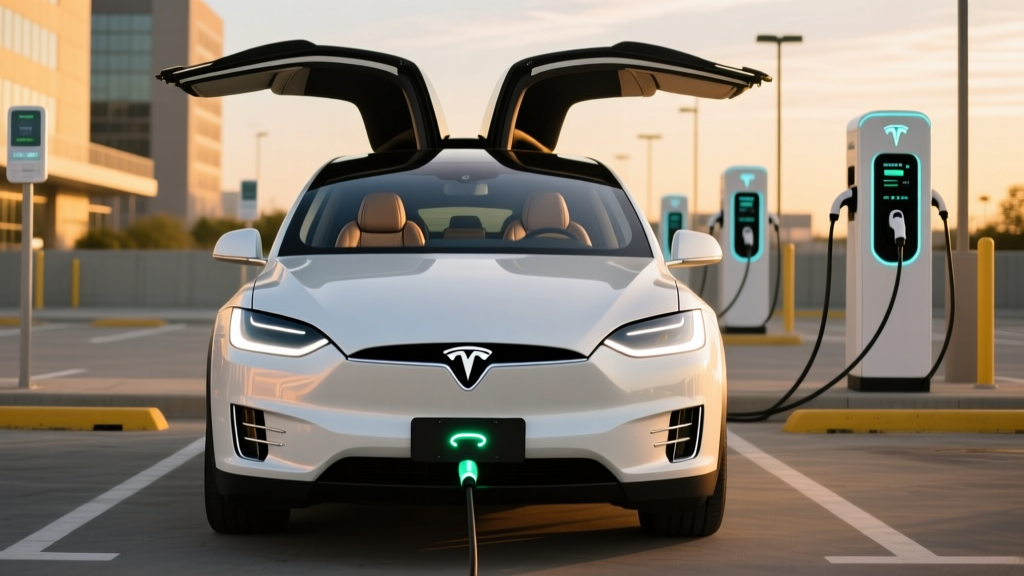
The Model X uses the NACS (North American Charging Standard) connector natively — the same Tesla proprietary plug now being adopted by Ford, GM, Rivian, and most major automakers through 2025–2026. This means the Model X accesses the full Supercharger network without adapters, a significant advantage over CCS-equipped rivals that may need a NACS adapter for Supercharger access.
Charging Curve Reality
Tesla's 250 kW peak charge rate is not sustained across the entire session. The charge curve is aggressive from roughly 5–30% State of Charge (SoC), then tapers progressively. Expect:
- 5–30% SoC: Near-peak 220–250 kW
- 30–60% SoC: 150–180 kW
- 60–80% SoC: 80–120 kW
- 80–100% SoC: 20–50 kW (significant taper)
The 10–80% time of approximately 30 minutes is competitive but no longer class-leading. The Hyundai Ioniq 5 and Kia EV6, with their 800V architectures, achieve 10–80% in roughly 18 minutes at 350 kW chargers. However, Tesla's advantage is network reliability — Superchargers consistently deliver their rated power, whereas third-party CCS networks still suffer higher downtime rates.
For home charging, the Tesla Wall Connector at 48 amps (11.5 kW on a 240V/60A circuit) adds approximately 34 miles of range per hour. A full overnight charge from 20% to 80% takes roughly 5–6 hours. Installation typically requires a 60-amp dedicated circuit; budget $800–$2,500 for professional installation depending on your panel's proximity to the garage and whether a panel upgrade is needed.
Performance and Drivetrain
| Spec | Long Range AWD | Plaid |
|---|---|---|
| Drivetrain | Dual-Motor AWD | Tri-Motor AWD |
| Horsepower | 670 hp | 1,020 hp |
| 0–60 mph | 3.8 seconds | 2.5 seconds |
| Top Speed | 155 mph | 163 mph |
| Towing Capacity | 5,000 lbs | 5,000 lbs |
| Curb Weight | ~5,185 lbs | ~5,390 lbs |
Even the "base" Long Range Model X produces 670 horsepower and hits 60 mph in 3.8 seconds — faster than most sports sedans, let alone three-row SUVs. The Plaid's tri-motor setup (one front, two rear) delivers 1,020 hp and a 2.5-second 0–60 time that borders on absurd for a vehicle that can carry seven people and their cargo.
Both trims feature dual-motor or tri-motor all-wheel drive with torque vectoring, adaptive air suspension (with adjustable ride height), and a 5,000-pound towing capacity — sufficient for a small boat trailer or a pair of jet skis. Note that towing significantly reduces range; expect roughly 50–60% of rated range when towing near maximum capacity at highway speeds.
Technology and Driver Assistance
The Model X's 17-inch center touchscreen remains one of the largest and most responsive in any production vehicle. The 2026 model runs Tesla's latest software with a redesigned UI, wireless Apple CarPlay (finally added in late 2024), and native streaming apps. A secondary 8-inch rear touchscreen controls climate, media, and entertainment for second-row passengers.
Autopilot and Full Self-Driving (Supervised)
Tesla Autopilot and FSD (Supervised) are Level 2 driver-assistance systems, not self-driving. The driver must remain fully engaged, keep hands on the steering wheel (or demonstrate attentiveness via the cabin camera), and be prepared to take over at any moment. Tesla's branding can be misleading — "Full Self-Driving" does not mean the vehicle drives itself without supervision. Only Level 4 services like Waymo operate without a human driver.
Standard Autopilot includes adaptive cruise control, lane-centering, and automatic emergency braking. The $8,000 FSD (Supervised) upgrade adds automatic lane changes, navigate-on-autopilot (highway on/off-ramp handling), traffic light and stop sign recognition, and the controversial city-streets capability. Real-world FSD performance has improved substantially through 2025–2026 neural-net updates, but it remains a supervision-required system that occasionally makes errors requiring immediate driver intervention.
Standout Tech Features
- Falcon-wing rear doors: Double-hinged with ultrasonic obstacle sensors; functional in spaces as tight as 12 inches of side clearance
- HEPA air filtration: "Bioweapon Defense Mode" with hospital-grade cabin filtration
- Over-the-air updates: Regular feature additions and performance improvements delivered wirelessly
- Sentry Mode: 360° camera-based security monitoring with cloud-stored clips
- Yoke or round steering wheel: Both available; yoke requires adaptation for low-speed maneuvering
Notable Drawbacks
- No Apple CarPlay or Android Auto wirelessly (CarPlay now supported but integration is limited vs. native Tesla UI)
- Falcon-wing doors can be slow to open/close (~5 seconds) and add repair complexity
- Minimal physical button controls — nearly everything routes through the touchscreen
- Panel gap consistency and interior material quality still lag Mercedes, BMW, and Rivian at this price point
- No heads-up display (HUD)
Pricing, Trims, and Federal Tax Credit Eligibility
| Trim | Base MSRP | Federal Tax Credit (§30D) | Effective Price |
|---|---|---|---|
| Long Range AWD (5-seat) | $79,990 | $0 (exceeds MSRP cap) | $79,990 |
| Long Range AWD (6-seat) | $81,990 | $0 | $81,990 |
| Long Range AWD (7-seat) | $81,990 | $0 | $81,990 |
| Plaid (5-seat) | $94,990 | $0 | $94,990 |
| Plaid (6-seat) | $96,990 | $0 | $96,990 |
The Tesla Model X does not qualify for the $7,500 IRS §30D federal EV tax credit. Under current IRS rules, SUVs must have an MSRP at or below $80,000 to qualify. The base Long Range 5-seat Model X at $79,990 sits right at the threshold, but destination charges ($1,390) and any options push it above the cap. Additionally, buyers must meet income limits ($300,000 joint / $150,000 single modified AGI) and the vehicle must satisfy critical-mineral and battery-component sourcing requirements. Consult a tax professional for your specific eligibility.
Destination and order fees add approximately $1,390. Common options include the $8,000 FSD (Supervised) package, $2,000 for 22-inch wheels, and $1,500–$2,500 for premium paint colors. A well-equipped Long Range 6-seat Model X with FSD typically lands in the $92,000–$96,000 range before state/local incentives.
State and Local Incentives
While the federal credit is unavailable, some states offer their own rebates or tax credits for EV purchases. California's Clean Fuel Rebate, Colorado's state tax credit, and various utility-company incentives may apply. These vary significantly by jurisdiction — check your state's energy office and local utility for current programs.
Warranty and Ownership Costs
| Component | Coverage |
|---|---|
| Basic Vehicle | 4 years / 50,000 miles |
| Battery & Drive Unit | 8 years / 150,000 miles (Long Range) |
| Battery & Drive Unit | 8 years / 150,000 miles (Plaid) |
| Battery Capacity Retention | Minimum 70% during warranty period |
Tesla's 8-year/150,000-mile battery and drive unit warranty is solid and matches the industry standard for premium EVs. The 70% capacity retention threshold means Tesla will replace or repair the battery if it degrades below 70% of original capacity within the warranty window. Real-world data from Tesla's fleet suggests typical degradation of approximately 10–12% over 100,000 miles for NMC packs — well within the warranty buffer.
Estimated 5-Year Ownership Costs
According to industry estimates and IIHS data, the Model X carries higher-than-average insurance premiums (typically $2,800–$4,200 annually depending on location and driving record) due to its repair costs and performance. Maintenance is minimal — no oil changes, minimal brake wear thanks to regenerative braking — but tire replacement costs are significant for a 5,000+ lb vehicle on 20- or 22-inch wheels (expect $1,200–$2,000 per set every 25,000–35,000 miles).
Home electricity costs for charging average $0.13–$0.17 per kWh nationally, translating to roughly $0.04–$0.06 per mile driven — compared to $0.12–$0.16 per mile for a comparable gas SUV at $3.50/gallon. Supercharging costs more ($0.25–$0.40 per kWh depending on location and time of day), but most owners do 80%+ of their charging at home.
Pros, Cons, and Who Should Buy
- 335-mile EPA range leads the three-row EV SUV segment
- Supercharger network access (NACS native, no adapter needed)
- Falcon-wing doors genuinely ease third-row loading
- 5,000-lb towing capacity with electric torque
- Tri-motor Plaid offers supercar acceleration in a family SUV
- Continuous OTA updates add features over time
- No federal tax credit (exceeds $80K MSRP cap)
- Third-row space tight for adults (32.7" legroom)
- Limited cargo behind third row (14.8 cu ft)
- High insurance premiums relative to segment
- Falcon-wing doors add mechanical complexity and repair cost
- Panel fit and interior materials lag German and Rivian rivals
Who the Model X Suits Best
Buy the Model X if: You need a three-row electric SUV with maximum range and Supercharger access for frequent road trips, you value the falcon-wing doors for car-seat loading in tight urban parking, and you can charge at home to maximize cost savings. It's ideal for tech-forward families who prioritize range and charging infrastructure over interior luxury refinement.
Look elsewhere if: Third-row adult comfort is a priority (consider the Rivian R1S), you need maximum cargo space with all seats occupied, you want the federal tax credit (the Kia EV9 at ~$55K–$65K qualifies), or you prefer traditional luxury materials and a quieter ride (BMW iX, Mercedes EQS SUV).
Frequently Asked Questions
What is the real-world range of the Tesla Model X?
The EPA rates the Long Range AWD at 335 miles and the Plaid at 326 miles. In real-world highway driving at 70 mph in moderate temperatures, expect 275–295 miles. In cold weather (below 32°F), plan for 230–260 miles. The heat pump and battery preconditioning help but don't eliminate cold-weather losses.
How fast does the Model X charge at home and on the road?
On a Tesla V3/V4 Supercharger, the Model X peaks at 250 kW and charges from 10–80% in approximately 30 minutes. At home on a Level 2 Tesla Wall Connector (48A, 11.5 kW), it adds roughly 34 miles of range per hour — a full overnight session covers most daily needs. Level 1 (120V) adds about 4 miles per hour and is only practical for emergencies.
Does the Tesla Model X qualify for the federal EV tax credit?
Effectively, no. The IRS §30D credit requires SUVs to have an MSRP at or below $80,000. While the base 5-seat Long Range lists at $79,990, destination charges ($1,390) push it over the cap. Buyers must also meet income limits ($300K joint / $150K single) and the vehicle must satisfy battery-sourcing requirements. Consult IRS guidelines and a tax professional for your situation.
Is the Model X worth buying vs. the Rivian R1S or Kia EV9?
The Model X wins on range (335 mi vs. R1S's ~352 mi with Max Pack, but at a higher price), Supercharger network access, and performance. The Rivian R1S offers better third-row space, more cargo room, a more refined interior, and a lower starting price. The Kia EV9 provides three rows at roughly $55K–$65K and qualifies for the federal credit, but with ~270 miles of range. Your priority — range, space, price, or charging network — determines the winner.
How many seats does the Tesla Model X have?
The Model X offers three configurations: 5-seat (two-row bench), 6-seat (second-row captain's chairs + two-seat third row), and 7-seat (second-row bench + two-seat third row). The 6-seat layout is the most popular for families, offering comfortable second-row seating with walk-through third-row access.
What is the battery warranty on the Model X?
Tesla covers the battery and drive unit for 8 years or 150,000 miles (whichever comes first) on both Long Range and Plaid trims, with a guaranteed minimum 70% capacity retention. Real-world fleet data shows approximately 10–12% degradation over 100,000 miles for the NMC chemistry pack.