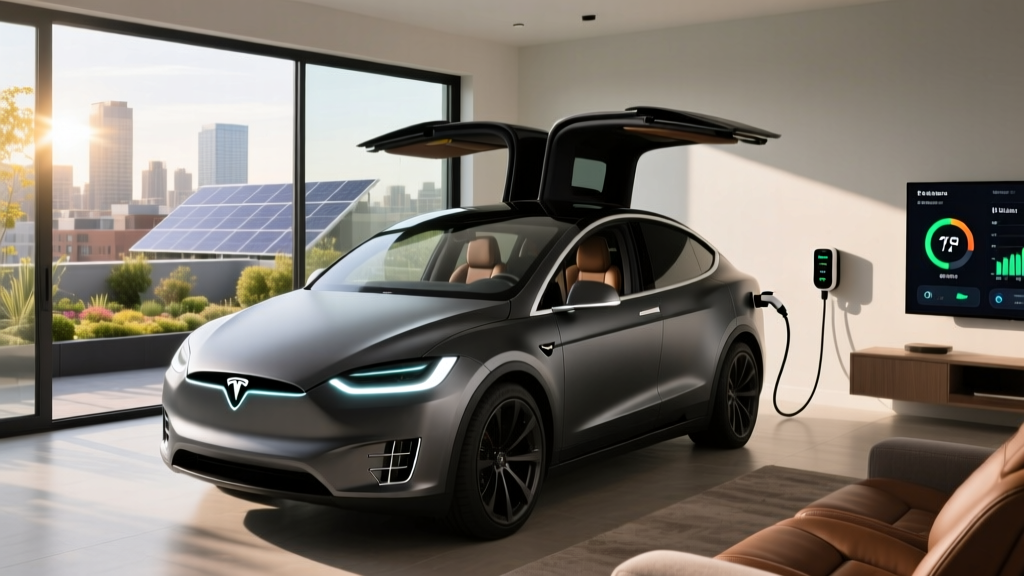
The Tesla Model X has always occupied a strange space in the EV market: a luxury SUV with supercar acceleration, falcon-wing doors, and an interior that prioritizes minimalism over traditional opulence. For 2026, Tesla continues to refine the platform with updated battery management, faster Supercharging, and flexible seating configurations that make it one of the few electric SUVs offering up to seven seats. But the Model X is also a vehicle where real-world range, charging logistics, and IRS tax-credit eligibility demand careful scrutiny before you sign.
This review breaks down every number that matters — from EPA range and battery chemistry to the exact cost of home charging and whether the Model X qualifies for the §30D federal credit in 2026.
2026 Tesla Model X Specifications at a Glance
| Spec | Model X Long Range | Model X Plaid |
|---|---|---|
| Base MSRP | $79,990 | $94,990 |
| EPA Range | 320 miles | 303 miles |
| Battery (usable) | ~100 kWh (NMC) | ~100 kWh (NMC) |
| Drivetrain | Dual-Motor AWD | Tri-Motor AWD |
| Horsepower | 670 hp | 1,020 hp |
| 0–60 mph | 3.8 sec | 2.5 sec |
| Peak DC Fast Charge | 250 kW | 250 kW |
| 10–80% DCFC Time | ~32 min | ~32 min |
| Level 2 Charge Rate | 11.5 kW (~36 mi/hr) | 11.5 kW (~36 mi/hr) |
| MPGe (combined) | 102 MPGe | 98 MPGe |
| Efficiency | 33 kWh/100 mi | 34 kWh/100 mi |
| Towing Capacity | 5,000 lbs | 5,000 lbs |
| Battery Warranty | 8 yr / 150,000 mi | 8 yr / 150,000 mi |
Seating Configurations: 5, 6, or 7 Passengers
The keyword that brings most buyers to the Model X is Tesla Model X seating — and for good reason. It's one of very few electric SUVs on the market offering three distinct seating layouts, each with meaningful trade-offs.
Five-Seat Layout (Standard)
The base configuration uses a traditional two-row bench setup: two front seats and a three-across second row. This gives you maximum cargo volume — 88.1 cubic feet behind the front seats with the second row folded, and 42.5 cu ft behind the second row. Legroom is generous at 41.2 inches up front and 38.4 inches in the second row.
Six-Seat Layout (+$6,500)
The six-seat option replaces the second-row bench with two individual captain's chairs separated by a center console. This is the configuration most family buyers prefer: easier third-row access (you walk through the gap rather than folding a seat forward), more personal space for second-row passengers, and a dedicated cupholder/armrest zone. Cargo space behind the second row drops slightly due to the wider seat frames.
Seven-Seat Layout (+$4,000)
The seven-seat configuration adds a compact third-row bench behind the second row. The third row is best suited for children or short-trip adult passengers — legroom is tight at roughly 32 inches, and the floor is elevated by the rear drive unit, creating a knees-up seating posture. With the third row upright, cargo space shrinks to approximately 15 cu ft — enough for a few grocery bags or a couple of carry-ons, not much more. Fold the third row flat and you recover most of the five-seat cargo area.
Real-world tip: If you regularly carry more than five people, the six-seat layout is the sweet spot. The third row in the seven-seat config is a compromise best reserved for occasional use. The falcon-wing doors make third-row loading easier than in most SUVs, since the roof opens upward and you don't have to duck as much.
Range and Efficiency: EPA vs. Reality
Real-World Expectation: 260–290 miles highway (70–75 mph); 220–250 miles in freezing weather with cabin heat; up to 310 miles in mild city/suburban driving with regen braking.
The Model X Long Range carries approximately 100 kWh of usable battery capacity using nickel-manganese-cobalt (NMC) chemistry. Tesla does not publish exact pack size, but teardown data and energy-content calculations from fueleconomy.gov confirm the pack supports the 320-mile EPA figure at a combined efficiency of 33 kWh per 100 miles.
NMC chemistry provides high energy density — critical in a heavy, aerodynamically challenged SUV — but it's more sensitive to sustained high-state-of-charge storage than LFP (lithium iron phosphate). Tesla recommends daily charging to 80–90% for NMC packs and 100% only before long trips. This is standard practice for NMC and doesn't indicate a defect; it's chemistry management.
Highway driving is the Model X's efficiency weakness. The SUV's tall profile, wide frontal area, and ~5,100-lb curb weight mean aerodynamic drag dominates at speed. In real-world testing at 75 mph on flat terrain in 65°F weather, expect roughly 260–280 miles before hitting a 10% state-of-charge buffer. Add winter temperatures (below 32°F), cabin heating, and mountain elevation, and 220–240 miles is a realistic planning number. The heat pump (standard on 2026 models) helps significantly compared to resistive heating, but physics is physics.
The Plaid's tri-motor setup and stickier tires reduce range to 303 miles EPA, with real-world highway figures closer to 245–270 miles.
Charging Speed: Supercharger and Home Level 2
| Charging Level | Power / Rate | Miles Added per Hour | Notes |
|---|---|---|---|
| Level 1 (120V) | ~1.4 kW | ~4 mi/hr | Emergency/trickle only; 80+ hours for full charge |
| Level 2 (240V, 48A) | 11.5 kW | ~36 mi/hr | Full charge in ~9 hours; ideal overnight home setup |
| DC Fast Charge (Supercharger V3/V4) | Peak 250 kW | Up to 175 mi in 15 min | 10–80% in ~32 min; tapers above 60% |
The Model X charges at a peak rate of 250 kW on Tesla Supercharger V3 and V4 stalls. However, peak is not sustained. The charge curve is aggressive in the 10–40% state-of-charge window, where you'll see 220–250 kW, then tapers progressively through the 40–80% range, dropping to roughly 80–100 kW near 80%. A 10–80% session takes approximately 32 minutes under ideal conditions (preconditioned battery, warm ambient temperature, V3/V4 stall availability).
Preconditioning matters. If you navigate to a Supercharger using the car's built-in navigation, the battery management system will begin warming the pack 15–30 minutes before arrival. Skip this step (by entering the charger address into a third-party app or driving to a station cold), and your peak charge rate may be limited to 120–150 kW for the first several minutes, adding 5–10 minutes to your stop.
For home charging, the Model X accepts up to 11.5 kW on Level 2 (48 amps on a 60-amp circuit using the Tesla Wall Connector). This adds roughly 36 miles of range per hour, meaning a full overnight session (8–9 hours) replenishes the entire pack. Most owners with daily commutes under 80 miles will rarely need a full charge — plugging in each evening at 80% max SoC keeps the NMC battery healthy and covers daily needs with surplus.
Home installation reality: A dedicated 240V/60A circuit requires a NEMA 14-60 outlet or hardwired Wall Connector. Expect $800–$2,000 for a straightforward install near your electrical panel; $2,500–$5,000+ if your panel needs an upgrade to 200A service or the run is long. Always get a quote from a licensed electrician before committing.
Performance: Absurd Acceleration, Competent Handling
The Model X Long Range hits 0–60 mph in 3.8 seconds with 670 horsepower from its dual-motor all-wheel-drive system. That's quicker than most sports sedans and entirely unnecessary for a family SUV — which is precisely the point. Merging onto freeways, passing on two-lane roads, and navigating uphill grades are effortless.
The Plaid's tri-motor setup produces 1,020 horsepower and a 2.5-second 0–60 time. It's a parlor trick you'll use twice and then forget about, but the third motor also provides torque vectoring that improves cornering stability. Neither trim feels particularly sporty in twisty canyon driving — the Model X is heavy and the steering is numb — but straight-line performance is beyond reproach.
Ride quality improved with Tesla's adaptive air suspension updates. The default "Comfort" setting absorbs highway expansion joints well, and the adjustable ride height is useful for steep driveways or light off-pavement use. Ground clearance ranges from 5.4 to 8.1 inches depending on setting.
Pricing, Trims, and Federal Tax Credit Eligibility
| Trim | Base MSRP | As-Tested (Typical Options) | Est. After §30D Credit |
|---|---|---|---|
| Long Range (5-seat) | $79,990 | $87,000–$92,000 | See eligibility below* |
| Plaid (5-seat) | $94,990 | $102,000–$108,000 | See eligibility below* |
*Destination fee, six- or seven-seat upgrades ($4,000–$6,500), Full Self-Driving (Supervised) capability ($8,000), and premium paint ($1,500–$2,500) add to the final price.
Federal §30D EV Tax Credit — 2026 Rules
The Model X faces significant hurdles for the $7,500 federal tax credit under current IRS §30D requirements:
- MSRP Cap: SUVs must have an MSRP at or below $80,000. The Long Range base MSRP of $79,990 technically qualifies, but adding any factory option pushes the sticker above the cap.
- Buyer Income Cap: Modified adjusted gross income must not exceed $300,000 (joint filers), $225,000 (head of household), or $150,000 (single).
- Battery Sourcing: Critical minerals and battery components must meet phased-in domestic/free-trade sourcing thresholds. Tesla's supply chain has diversified significantly, but eligibility can change quarterly — verify on the fueleconomy.gov tax credit page before purchasing.
- Point-of-Sale Transfer: If eligible, the credit can be applied at purchase to reduce the out-of-pocket price rather than waiting for a tax refund.
Bottom line: A base Long Range with no options, purchased by a buyer under the income cap, may qualify for $7,500 — bringing the effective price to roughly $72,490. But most buyers add seating upgrades or FSD, which disqualifies them. The Plaid does not qualify due to its $94,990 MSRP. Consult a tax professional for your specific situation.
Cargo, Interior Tech, and Daily Livability
Beyond seating, the Model X offers practical advantages that justify its footprint:
- Frunk (front trunk): 6.6 cu ft — enough for a charging cable bag and a small soft cooler.
- Cargo behind 2nd row: 42.5 cu ft (5-seat) — competitive with midsize luxury SUVs.
- Maximum cargo (2nd row folded): 88.1 cu ft — genuinely van-like space for furniture runs or camping gear.
- Towing: 5,000 lbs — adequate for a small boat, utility trailer, or a pair of dirt bikes. Expect a 30–40% range reduction while towing at highway speed.
The 17-inch center touchscreen runs Tesla's proprietary infotainment, which remains the most responsive and feature-rich system in any production car. Wireless Apple CarPlay and Android Auto are not supported — Tesla's ecosystem is self-contained. The rear-seat entertainment screen (8 inches) is a hit with kids on road trips. The yoke steering wheel is standard; a round wheel is available at no extra charge if you order it.
Autopilot and FSD (Supervised): Every Model X ships with basic Autopilot (traffic-aware cruise control and lane centering). The $8,000 Full Self-Driving (Supervised) upgrade adds automated lane changes, traffic-light recognition, and city-street navigation. This is a Level 2 driver-assistance system per SAE classification — you must keep your hands on the wheel and eyes on the road at all times. It is not autonomous driving.
Warranty and Long-Term Ownership
Tesla covers the Model X battery and drive unit for 8 years or 150,000 miles, whichever comes first, with a guaranteed minimum 70% capacity retention over that period. The limited vehicle warranty is 4 years / 50,000 miles.
NMC battery degradation in Tesla's 100 kWh-class packs typically follows a predictable curve: roughly 5–8% capacity loss in the first 50,000 miles, then a slow linear decline. Owners who avoid frequent 100% charges and DC fast-charging exclusively tend to see better long-term retention. A full battery replacement outside warranty currently costs $18,000–$25,000 depending on labor and pack availability — a number to factor into 10-year ownership projections.
Insurance premiums for the Model X are among the highest in the EV segment, averaging $2,800–$4,200 annually depending on state, driving record, and coverage level. Get quotes before ordering.
How the Model X Compares to Key Rivals
The Model X competes in a thin field of three-row electric SUVs. Its closest rivals:
- Kia EV9 (3-row): Starts ~$55,000, 304-mile EPA range, slower charging (210 kW peak), qualifies for §30D credit on many trims. Less performance, more practical pricing.
- Rivian R1S: Starts ~$79,900, 316-mile range (Dual-Motor Max Pack), more off-road capability, adventurous design. Six- and seven-seat options. No falcon-wing doors but a conventional, more repair-friendly tailgate.
- BMW iX (2-row only): Starts ~$87,000, 324-mile range, superior interior material quality. No third row — not a direct seating competitor.
The Model X wins on acceleration, Supercharger network access (though competitors now have NACS adapters), and the sheer spectacle of falcon-wing doors. It loses on price-per-seat, service-center wait times (Tesla's mobile service helps but doesn't cover everything), and interior build consistency.
Pros and Cons
Pros
- Flexible 5/6/7-seat layouts rare in the EV segment
- Class-leading acceleration and Supercharger access
- Massive cargo space with both rows folded
- Falcon-wing doors ease third-row loading in tight parking spots
- Best-in-class infotainment responsiveness
- Strong over-the-air update cadence keeps the car current
Cons
- Base price pushes the §30D MSRP cap — most configs won't qualify
- Real-world highway range drops significantly below EPA (260–280 mi)
- Third row is cramped for adults (7-seat config)
- High insurance premiums ($2,800–$4,200/yr average)
- Falcon-wing doors can be slow to open and expensive to repair
- Minimal physical controls — everything routes through the touchscreen
Who Should Buy the 2026 Tesla Model X?
Choose the Model X if:
- You need 6–7 electric seats and prioritize acceleration and Supercharger convenience
- You regularly haul kids and gear and want the falcon-wing door advantage in tight garages
- You can charge at home and your daily driving is under 250 miles
- You accept the premium price and higher insurance as the cost of the platform
Look elsewhere if:
- You need the full $7,500 federal tax credit — the Rivian R1S or Kia EV9 are safer bets
- You regularly drive 300+ miles between charging stops (towing or cold-climate road trips)
- Adult passengers will frequently use the third row
- You prefer traditional luxury interior materials (BMW iX, Mercedes EQS SUV)
Frequently Asked Questions
What is the real-world range of the Tesla Model X?
The EPA rates the Long Range at 320 miles and the Plaid at 303 miles. In real-world highway driving at 70–75 mph, expect 260–290 miles. In freezing weather with cabin heat, plan for 220–250 miles. City driving with regenerative braking can approach or slightly exceed the EPA number in mild weather.
How fast does the Model X charge at home and on the road?
On a Tesla Supercharger (V3/V4), it peaks at 250 kW and charges from 10–80% in roughly 32 minutes with a preconditioned battery. At home on a Level 2 Wall Connector (11.5 kW / 48A), it adds about 36 miles per hour, fully recharging overnight in ~9 hours.
Does the 2026 Tesla Model X qualify for the $7,500 federal EV tax credit?
It's complicated. The base Long Range MSRP of $79,990 sits right at the §30D SUV cap, but adding any factory option (seating upgrades, FSD, premium paint) pushes it over the $80,000 limit. The buyer must also meet income caps ($300K joint / $150K single) and the battery must meet critical-mineral and component sourcing requirements, which change periodically. Verify current eligibility at fueleconomy.gov and consult a tax professional.
Is the Model X worth buying vs. the Rivian R1S or Kia EV9?
The Model X wins on performance, Supercharger network ease, and tech. The Rivian R1S offers more rugged capability, similar seating flexibility, and potentially better tax-credit eligibility. The Kia EV9 is dramatically more affordable and family-practical but sacrifices range and performance. Your choice depends on budget, tax-credit needs, and whether you value Tesla's ecosystem.
What's the biggest drawback of the falcon-wing doors?
They're slower to open and close than conventional doors (roughly 6–8 seconds per cycle), the sensors can be overly cautious in low-clearance garages, and repair costs are higher if a hinge or actuator fails. They're also not available on the third-row side — the front doors are conventional.
How long will the Model X battery last?
Tesla warranties the battery for 8 years / 150,000 miles with a minimum 70% capacity retention guarantee. Real-world data from high-mileage Tesla owners suggests 10–15% degradation over 100,000 miles is typical for NMC packs charged responsibly (daily limit of 80–90%, occasional 100% for trips). A full out-of-warranty replacement costs $18,000–$25,000.