Tesla Model X Safety Rating and Crash-Test Performance
The Tesla Model X has consistently earned top marks in federal crash testing, and the current-generation model continues that tradition. The National Highway Traffic Safety Administration (NHTSA) awards the Model X an overall 5-star safety rating — the highest possible score. Dig into the subcategories and the picture remains strong: 5 stars in frontal crash, 5 stars in side crash, and 5 stars in rollover resistance.
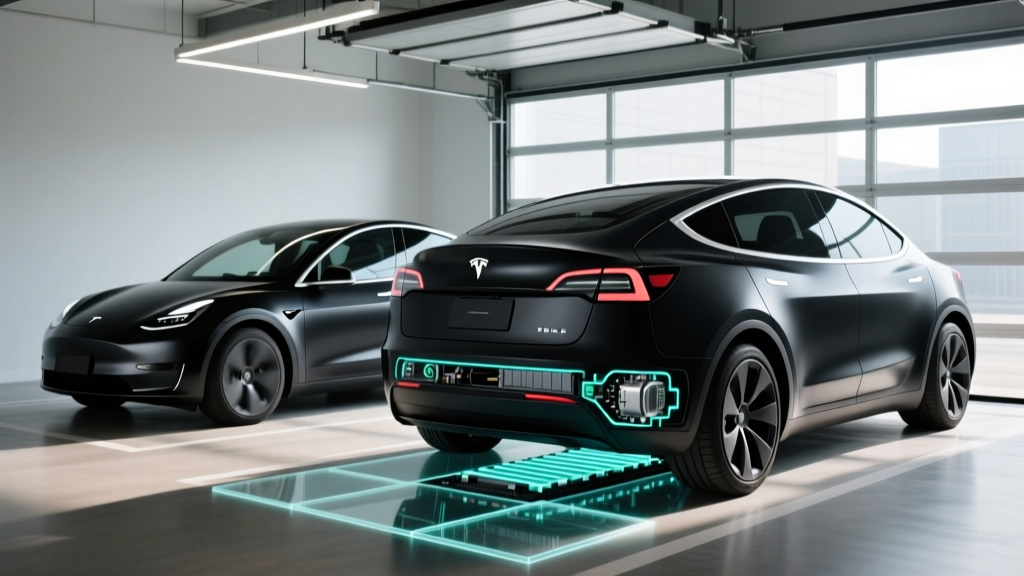
That rollover score deserves specific attention. The Model X's floor-mounted battery pack gives it an exceptionally low center of gravity for a three-row SUV. NHTSA's rollover risk calculation puts the Model X at roughly 9.3% — meaning it's far less likely to roll over in a single-vehicle loss-of-control scenario than most body-on-frame or even unibody SUVs in its class.
The Insurance Institute for Highway Safety (IIHS) has tested the Model X in previous model years, though buyers should check the latest IIHS listings for updated small-overlap and pedestrian-detection scores, as Tesla has made running hardware and software changes to the sensor suite.
Range, Efficiency, and Real-World Expectations
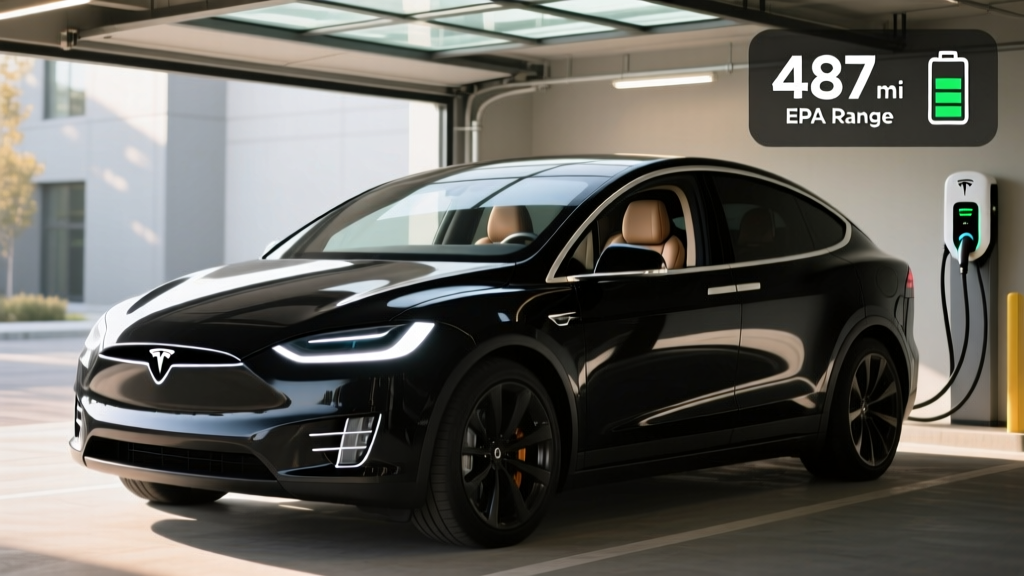
The Model X Long Range carries an EPA-estimated range of 348 miles on its dual-motor all-wheel-drive powertrain. The Plaid variant, with its tri-motor setup, drops to an EPA-estimated 320 miles due to the additional weight and power consumption of the third motor.
EPA 348 mi (Long Range) / 320 mi (Plaid)
Expect roughly 290–315 miles in mixed real-world driving on the Long Range. Sustained highway speeds above 70 mph push consumption higher — plan for 260–280 miles on a long road trip at 75–80 mph. In cold weather (below 30°F), range can drop 20–30%, putting real-world winter range at approximately 220–260 miles depending on cabin heating demands and whether you precondition. The Model X's heat pump helps mitigate this loss compared to older resistance-heater EVs, but physics still applies.
Efficiency lands at approximately 100 MPGe combined for the Long Range, translating to roughly 33–35 kWh per 100 miles. That's competitive for a 5,000+ lb three-row SUV, though smaller crossovers like the Model Y achieve significantly better efficiency figures.
Battery, Powertrain, and Performance Specs
The Model X uses a ~100 kWh battery pack (approximately 95 kWh usable). Tesla does not publicly disclose cell chemistry for current Model X packs, but industry analysis and teardown data indicate an NMC (nickel manganese cobalt) configuration, which prioritizes energy density over the cycle-life advantages of LFP chemistry. This matters for long-term ownership: NMC packs generally perform best when daily charging is limited to 80–90% State of Charge, reserving 100% charges for road trips.
| Spec | Long Range | Plaid |
|---|---|---|
| EPA Range | 348 mi | 320 mi |
| Battery (usable) | ~95 kWh (NMC) | ~95 kWh (NMC) |
| Drivetrain | Dual-motor AWD | Tri-motor AWD |
| Horsepower | 670 hp | 1,020 hp |
| 0–60 mph | 3.8 sec | 2.5 sec |
| MPGe (combined) | ~100 MPGe | ~95 MPGe |
| Top Speed | 155 mph | 163 mph |
| Towing Capacity | 5,000 lbs | 5,000 lbs |
The dual-motor Long Range produces 670 horsepower and hits 60 mph in 3.8 seconds — genuinely quick for a three-row family hauler. The Plaid's 1,020 horsepower and 2.5-second 0–60 time are supercar territory, though the real-world utility of that performance in a 5,100-lb SUV is debatable. Both variants feature adaptive air suspension that adjusts ride height for highway efficiency or rough-road clearance.
Charging Speed: DC Fast, Level 2, and Supercharger Access
The Model X supports up to 250 kW peak DC fast charging on Tesla's V3 Supercharger network — and increasingly at V4 stations as they roll out. Tesla's proprietary NACS connector is standard, though with the industry-wide shift to NACS, the Model X now shares its connector standard with most competing EVs arriving in 2025–2026.
| Level | Power | Speed | Use Case |
|---|---|---|---|
| Level 1 (120V) | ~1.4 kW | ~3–4 mi/hr | Emergency / trickle |
| Level 2 (240V home) | 11.5 kW (48A) | ~34 mi/hr | Daily / overnight |
| DC Fast (Supercharger) | 250 kW peak | 10–80% in ~30 min | Road trips |
A critical charging-curve reality: the 250 kW peak is not sustained across the entire session. The Model X hits peak charge rate at low State of Charge (roughly 10–20% SoC) and begins tapering noticeably above 50%, with significant taper above 80%. That 10–80% time of approximately 30 minutes assumes you arrive at a low SoC and the battery is properly preconditioned via the car's navigation-routed preconditioning. Arriving at a Supercharger without preconditioning — especially in cold weather — can add 10–15 minutes to your session.
Home charging at 11.5 kW via a Tesla Wall Connector (or any 48-amp Level 2 charger with a NACS plug) adds roughly 34 miles per hour of charging. A full overnight charge from 20% to 80% takes about 5–6 hours — perfectly suited for daily use.
Pricing, Trims, and Federal Tax Credit Eligibility
The 2026 Tesla Model X starts at a base MSRP of $79,990 for the Long Range. The Plaid variant commands $94,990. Destination charges, premium paint, 22-inch wheels, and six-seat interior configurations push as-tested prices higher — a well-optioned Plaid can exceed $105,000.
| Trim | Base MSRP | §30D Credit Eligible? | Est. After Credit |
|---|---|---|---|
| Long Range | $79,990 | Yes (if income/sourcing met) | ~$72,490 |
| Plaid | $94,990 | Yes (SUV MSRP cap: $80,000)* | Varies |
*The IRS §30D credit for SUVs has an $80,000 MSRP cap. The Long Range at $79,990 fits under this threshold. The Plaid at $94,990 exceeds it and does NOT qualify for the new-vehicle credit. Always verify current rules at IRS.gov.
- MSRP cap: ≤ $80,000 for SUVs/vans/pickups; ≤ $55,000 for sedans
- Income cap: AGI ≤ $300,000 (joint), $225,000 (head of household), $150,000 (single)
- Battery sourcing: Critical minerals and battery components must meet phased-in domestic/free-trade-area sourcing percentages — Tesla's US-built packs have generally met these thresholds, but verify per VIN
- Point-of-sale transfer: You can transfer the credit to the dealer at purchase for an immediate price reduction, or claim it on your tax return
- Tax liability: Credit is non-refundable — you must owe at least $7,500 in federal taxes to claim the full amount
Interior Space, Cargo, and Tech
The Model X offers seating for five, six, or seven passengers. The six-seat configuration with second-row captain's chairs is the most popular choice for families — it provides a walk-through to the third row and more comfortable second-row seating.
Cargo volume behind the third row is approximately 15 cubic feet. Fold the third row and you get roughly 40 cubic feet. Fold both rear rows and maximum cargo capacity reaches about 82 cubic feet — competitive with midsize luxury SUVs, though the floor isn't perfectly flat due to the rear motor assembly.
The front trunk (frunk) adds approximately 6.5 cubic feet of enclosed storage — useful for charging cables, groceries, or a carry-on bag.
On the tech front, the 17-inch center touchscreen remains the primary interface for nearly all vehicle functions, running Tesla's latest software with over-the-air updates. A second 8-inch rear touchscreen provides rear passengers with climate controls and entertainment. The yoke steering wheel is standard (a conventional round wheel is available as a no-cost option). Wireless phone charging, a 22-speaker audio system, and HEPA air filtration with Bioweapon Defense Mode round out the feature set.
The falcon-wing rear doors are the Model X's most distinctive feature. They open upward and outward, providing excellent access to second- and third-row seats in tight parking spaces. However, they add mechanical complexity, have historically been a source of maintenance issues, and cannot accommodate standard roof racks — a genuine limitation for active families.
Warranty Coverage
Tesla provides a 4-year/50,000-mile basic vehicle limited warranty and an 8-year/150,000-mile battery and drive unit warranty. The battery warranty guarantees at least 70% capacity retention over the 8-year/150,000-mile term. If the battery degrades below that threshold, Tesla will repair or replace it. For a $80,000+ vehicle, this coverage is competitive, though some luxury competitors offer longer basic warranty terms (Genesis Electrified GV70, for instance, provides a 10-year/100,000-mile powertrain warranty).
Who Should Buy the Model X — and Who Shouldn't
- You need three-row seating with genuine adult-sized third-row space and want an EV
- Supercharger network access is a priority for frequent road trips
- You value a 5-star NHTSA safety rating with a low rollover risk
- You want 5,000-lb towing capacity in an electric SUV
- You prioritize acceleration and performance in a family vehicle
- Your budget is under $70,000 — consider the Model Y, Kia EV9, or Hyundai Ioniq 9
- You need a conventional roof rack for bikes, kayaks, or cargo boxes
- You want a traditional dealership service experience
- You want physical buttons and knobs for climate/audio controls
- 5-star NHTSA safety across all categories
- 348-mile EPA range (Long Range) is best-in-class for 3-row EV SUVs
- Supercharger network — most reliable DC fast-charging infrastructure in the US
- Falcon-wing doors ease rear-seat access in tight spaces
- 3.8-second 0–60 (Long Range) is astonishing for its size
- Over-the-air updates continuously add features
- Plaid exceeds §30D MSRP cap — no federal tax credit
- Falcon-wing doors add complexity and block roof-rack compatibility
- Touchscreen-only controls frustrate some drivers
- 30-minute 10–80% DC charge is slower than Hyundai/Kia's 800V platforms (~18 min)
- Service center wait times remain a common complaint
- High insurance premiums relative to gas-powered SUVs
Frequently Asked Questions
What is the real-world range of the Tesla Model X?
The Long Range Model X carries a 348-mile EPA estimate. In real-world mixed driving, expect 290–315 miles. Sustained highway driving at 75+ mph drops this to roughly 260–280 miles. Cold weather below 30°F can reduce range by 20–30%, yielding approximately 220–260 miles depending on conditions and preconditioning habits.
How fast does the Model X charge at home and on the road?
At home on a 240V Level 2 charger (48A/11.5 kW), the Model X gains about 34 miles of range per hour — a full overnight session easily replenishes daily driving. On a 250 kW Tesla Supercharger, a 10–80% charge takes approximately 30 minutes with proper battery preconditioning. The charge curve tapers significantly above 80%, so plan your stops to arrive at low SoC for maximum charging speed.
Does the Tesla Model X qualify for the $7,500 federal EV tax credit?
The Long Range at $79,990 MSRP falls under the $80,000 SUV cap and is eligible — provided you meet the income limits (≤$300,000 joint AGI) and the battery sourcing requirements are satisfied for your specific VIN. The Plaid at $94,990 exceeds the MSRP cap and does not qualify for the new-vehicle §30D credit. Always verify eligibility via IRS.gov and consult a tax professional.
Is the Model X worth buying versus the Kia EV9 or Rivian R1S?
The Model X wins on range (348 mi vs. ~270–304 mi for the EV9, ~352 mi for the R1S Max Pack), Supercharger access, and raw acceleration. The Kia EV9 starts significantly lower (~$56,000) and charges faster on 800V architecture (~18 min 10–80%), but has less range. The Rivian R1S offers superior off-road capability, a more conventional SUV design, and strong build quality, but at a similar price point. If range and the Supercharger network are your top priorities, the Model X remains compelling. If budget matters more, the EV9 is the value pick.
How does the Model X safety rating compare to competitors?
The Model X's 5-star NHTSA overall rating is shared with several competitors including the Kia EV9 and Volvo EX90. Where the Model X distinguishes itself is its rollover resistance — the low-mounted battery pack gives it a lower rollover risk percentage than most body-on-frame and many unibody SUVs. Tesla's standard active safety suite is comprehensive, though the Autopilot/FSD naming continues to cause consumer confusion about the Level 2 nature of these systems.
What is the biggest drawback of owning a Model X?
Beyond the high entry price, the most common ownership complaints center on service accessibility — Tesla mobile service handles many issues, but body shop and hardware repairs can involve long wait times. The falcon-wing doors, while distinctive, add mechanical complexity and prevent roof-rack installation. Insurance premiums are typically 25–40% higher than comparable gas SUVs due to repair costs and parts pricing.