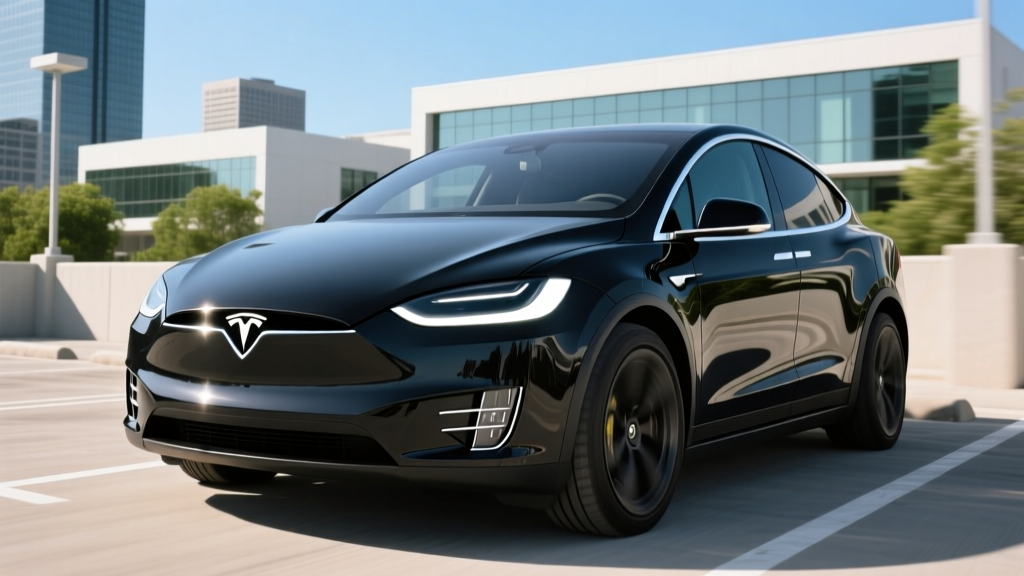
The Tesla Model X occupies a rare position in the EV market: a three-row electric SUV with supercar acceleration, falcon-wing rear doors, and one of the most scrutinized safety records in the industry. For 2026, the Model X continues with dual-motor and tri-motor powertrains, a 100 kWh battery pack, and access to Tesla's expanding Supercharger network now open to NACS-equipped competitors. But beyond the performance headlines, buyers researching the Tesla Model X safety rating need hard data on crash-test results, real-world range, charging practicality, and whether the $79,990 starting price makes sense against rivals like the Rivian R1S and BMW iX.
This review covers every number that matters — from NHTSA stars and IIHS scores to DC fast-charge taper curves and §30D tax credit eligibility — so you can evaluate the Model X as an ownership proposition, not just a spec sheet.
Tesla Model X Safety Rating: NHTSA and IIHS Results
The Tesla Model X safety rating story is split between two major testing bodies, and understanding the distinction matters for buyers comparing it against newer three-row EVs.
The NHTSA's 5-star overall rating reflects the structural advantage of a skateboard platform with a low center of gravity — the battery pack under the floor makes rollover risk significantly lower than body-on-frame SUVs. The 4-star rollover rating still outperforms most three-row gasoline SUVs.
The IIHS results are more nuanced. The updated moderate overlap front test (which now evaluates rear-seat occupant protection) has been a challenge for many EVs, and the Model X's age — its platform debuted in 2015 — shows in some edge-case evaluations. However, Tesla's over-the-air updates have improved active-safety systems continuously, and the standard AEB system earned a Superior rating for vehicle-to-vehicle crash prevention.
Range, Battery, and Real-World Efficiency
The 2026 Model X is offered in two trims with the same 100 kWh (usable capacity approximately 95 kWh) NMC (nickel-manganese-cobalt) lithium-ion battery pack. Tesla does not offer LFP chemistry in the Model X — that's reserved for the standard-range Model 3 and Model Y, where cost and cycle life outweigh the energy-density advantage of NMC.
| Specification | Model X Long Range (Dual Motor) | Model X Plaid (Tri-Motor) |
|---|---|---|
| EPA Estimated Range | 335 miles | 326 miles |
| Battery Capacity (Usable) | ~95 kWh (NMC) | ~95 kWh (NMC) |
| Drivetrain | Dual-Motor AWD | Tri-Motor AWD |
| Horsepower | 670 hp | 1,020 hp |
| 0–60 mph | 3.8 seconds | 2.5 seconds |
| EPA Efficiency (Combined) | 100 MPGe (34 kWh/100mi) | 98 MPGe (35 kWh/100mi) |
| Top Speed | 155 mph | 163 mph |
| Curb Weight | 5,185 lbs | 5,390 lbs |
The EPA rates the Model X Long Range at 335 miles. In real-world highway driving at 70–75 mph, expect approximately 275–295 miles in mild weather (65–80°F). In cold weather (below 32°F), range drops to roughly 230–260 miles due to cabin heating demands and increased battery resistance — even with Tesla's heat pump. City driving with regenerative braking can approach or slightly exceed the EPA figure. Plan road trips around 250-mile legs for a comfortable buffer.
The tri-motor Plaid sacrifices 9 miles of EPA range for 350 additional horsepower. On long road trips, that's a negligible difference; the real trade-off is efficiency at sustained highway speed, where the Plaid's third motor draws more energy. For buyers prioritizing range over acceleration, the Long Range trim is the rational pick.
Charging Speed: DC Fast, Level 2, and the Supercharger Advantage
Charging is where the Model X shows both its strengths and its age. The 2026 model supports a peak DC fast-charge rate of 250 kW on V3 Superchargers — competitive but not class-leading. The Hyundai Ioniq 9 and Rivian R1S (Gen 2) push toward 300+ kW peak rates on 800V architectures, while Tesla still uses a 400V system in the Model X.
| Charging Level | Power / Rate | Speed | Notes |
|---|---|---|---|
| Level 1 (120V) | ~1.4 kW | ~3–4 miles/hour | Emergency/trickle only; ~90+ hours for full charge |
| Level 2 (240V, 48A) | 11.5 kW | ~30–34 miles/hour | Full charge in ~9–10 hours; recommended home setup |
| DC Fast (V3 Supercharger) | Peak 250 kW | 10–80% in ~30 min | Sustained rate tapers significantly above 60% SoC |
| DC Fast (V4 Supercharger) | Up to 250 kW | Similar to V3 for Model X | V4's higher capability benefits newer architectures |
Charging curve reality: The Model X peaks near 250 kW only between roughly 10–30% State of Charge (SoC). From 30–60%, it sustains approximately 150–180 kW. Above 60%, the rate drops sharply — by 80% SoC, you're typically seeing 60–80 kW. This means the advertised 10–80% time of ~30 minutes assumes ideal battery preconditioning (navigating to a Supercharger via the car's built-in routing). Arriving at a charger without preconditioning — especially in cold weather — can add 10–15 minutes to your session.
At home on a 48-amp Level 2 circuit (requiring a 60-amp breaker), the Model X adds roughly 30–34 miles of range per hour, fully replenishing overnight. Tesla's Wall Connector costs approximately $425 for the unit, with professional installation running $500–$2,000 depending on panel proximity and whether a service upgrade is needed.
Pricing, Tax Credits, and Total Cost of Ownership
The 2026 Tesla Model X starts at $79,990 for the Long Range dual-motor trim (including destination fee). The Plaid tri-motor model begins at $94,990. These prices place the Model X in luxury-SUV territory, competing with the BMW iX xDrive50 (~$87,000), Rivian R1S Dual-Motor (~$79,900), and the Mercedes-Benz EQS SUV (~$104,000).
| Trim | Base MSRP | Est. As-Tested* | Federal §30D Credit Eligibility |
|---|---|---|---|
| Model X Long Range | $79,990 | $85,000–$90,000 | Not eligible (exceeds $80,000 SUV MSRP cap) |
| Model X Plaid | $94,990 | $100,000–$108,000 | Not eligible (exceeds $80,000 SUV MSRP cap) |
*As-tested prices reflect common add-ons: $2,000 22-inch wheels, $1,500 six-seat interior, $3,500 tow hitch and enhanced autopilot, destination.
Without the federal credit, state-level incentives become more relevant. California's CVRP program, Colorado's state credit, and various utility rebates may still apply — check your local jurisdiction for current amounts, as these change frequently.
Interior Space, Cargo, and Practicality
The Model X offers genuine three-row seating in a five-, six-, or seven-passenger configuration. The falcon-wing rear doors are more than a gimmick — they provide exceptional access to the second and third rows in tight parking spaces, with ultrasonic sensors preventing contact with nearby objects or low ceilings.
| Dimension | Measurement |
|---|---|
| Cargo (behind 3rd row) | ~15 cu ft (limited by floor slope) |
| Cargo (3rd row folded) | ~44 cu ft |
| Cargo (all rear rows folded) | ~82 cu ft |
| Front Trunk (Frunk) | ~6.6 cu ft |
| Front Headroom | 41.7 inches |
| 2nd-Row Legroom | 40.0 inches |
| 3rd-Row Legroom | 32.7 inches (best for children) |
| Ground Clearance | 6.5–8.2 inches (adaptive air suspension) |
| Towing Capacity | 5,000 lbs (with tow package) |
The third row is best suited for children or short-trip adult passengers — 32.7 inches of legroom is tight compared to the Rivian R1S (37.3 inches in the third row). Cargo space behind the third row is modest for a vehicle of this size, though folding the third row opens a generous 44 cu ft flat load floor. The 5,000-lb tow rating is adequate for small campers and boat trailers but trails the R1S's 7,700-lb capacity.
Technology, Driver Assists, and Standout Features
The Model X runs Tesla's latest infotainment software on a 17-inch center touchscreen with a secondary 8-inch rear-seat display. The yoke steering wheel (standard on Plaid, optional on Long Range) remains polarizing — it offers unobstructed screen visibility but complicates low-speed maneuvers and three-point turns. A conventional round wheel is available at no extra charge.
Standout tech:
- HEPA air filtration with Bioweapon Defense Mode — genuinely class-leading cabin air quality
- Over-the-air updates that add features, improve efficiency, and refine driver assists post-purchase
- Supercharger network access — the most reliable and extensive DC fast-charging network in North America
- Autopilot standard with adaptive cruise, lane-keeping, and automatic emergency braking
- FSD (Supervised) available as a $8,000 option or $99/month subscription — SAE Level 2 requiring full driver attention
Notable drawbacks:
- Panel gap quality and interior material finish lag BMW, Mercedes, and even Rivian at this price point
- No Apple CarPlay or Android Auto — Tesla's proprietary system is the only option
- 250 kW peak charge rate is falling behind 800V competitors
- Platform dates to 2015; refreshed but fundamentally unchanged architecture
- Third-row comfort trails body-on-frame and dedicated three-row EV competitors
How the Model X Compares: Rivian R1S, BMW iX, and Mercedes EQS SUV
| Spec | Tesla Model X LR | Rivian R1S Dual-Motor | BMW iX xDrive50 | Mercedes EQS 450+ SUV |
|---|---|---|---|---|
| EPA Range | 335 mi | 316 mi (Max Pack: 410 mi) | 307 mi | 305 mi |
| Starting MSRP | $79,990 | $79,900 | $87,250 | $104,400 |
| 0–60 mph | 3.8 sec | 4.5 sec | 4.4 sec | 6.5 sec |
| Peak DC Charge | 250 kW | 200 kW (Gen 2: 300+ kW) | 200 kW | 200 kW |
| 3rd-Row Legroom | 32.7 in | 37.3 in | N/A (2-row) | N/A (optional, tight) |
| Tow Rating | 5,000 lbs | 7,700 lbs | 3,500 lbs | Not rated |
| NHTSA Rating | 5 Stars | 5 Stars | Not fully rated | Not fully rated |
The Model X wins on acceleration and Supercharger access. The Rivian R1S wins on third-row space, towing, off-road capability, and available Max Pack range. The BMW iX offers a significantly more refined interior but seats only five. The EQS SUV is the luxury benchmark but costs substantially more and lacks a usable third row.
Choose the Rivian R1S if: You need genuine third-row adult comfort, serious towing capacity, off-road capability, or want the available 410-mile Max Pack.
Choose the BMW iX if: You only need two rows and value interior quality, ride refinement, and a quieter cabin above all else.
Warranty and Battery Longevity
Tesla covers the Model X with the following warranty structure:
| Coverage | Term |
|---|---|
| Basic Vehicle Limited Warranty | 4 years / 50,000 miles |
| Battery & Drive Unit Warranty | 8 years / 150,000 miles |
| Battery Capacity Retention Guarantee | Minimum 70% over warranty period |
The 8-year/150,000-mile battery and drive unit warranty is competitive with industry norms. Tesla guarantees the battery will retain at least 70% of its original capacity during the warranty period. Real-world data from high-mileage Tesla owners suggests NMC packs in the Model X typically degrade 8–12% over the first 100,000 miles, with the rate of degradation slowing after the initial break-in period. A full battery replacement outside warranty currently costs approximately $15,000–$20,000 at Tesla service centers, though third-party options are emerging at lower prices.
For longevity, Tesla recommends daily charging to 80–90% for NMC batteries and reserving 100% charges for road trips. Regular Supercharging (DC fast charging) does accelerate degradation slightly compared to Level 2 charging, but Tesla's thermal management system mitigates this effectively — the impact is measured in single-digit percentage points over the battery's lifetime.
Frequently Asked Questions
What is the real-world range of the Tesla Model X?
The EPA rates the 2026 Model X Long Range at 335 miles and the Plaid at 326 miles. In real-world highway driving at 70–75 mph in mild temperatures, expect 275–295 miles. Cold weather (below freezing) reduces range to approximately 230–260 miles. City driving with frequent regenerative braking opportunities can approach the EPA sticker. For road-trip planning, budget 250-mile legs to maintain a comfortable reserve.
How fast does the Model X charge at home and on DC fast chargers?
On a 48-amp Level 2 home charger (240V), the Model X charges at 11.5 kW, adding roughly 30–34 miles of range per hour — a full charge takes about 9–10 hours. On a V3 Supercharger, the peak rate is 250 kW, with a 10–80% session taking approximately 30 minutes when the battery is properly preconditioned. Charge speed tapers significantly above 60% SoC, so sessions from 80–100% are much slower.
Does the Tesla Model X qualify for the $7,500 federal EV tax credit?
No. Under IRS §30D rules, SUVs must have an MSRP at or below $80,000 to qualify. The base Model X Long Range starts at $79,990, and any options or destination charges push the final sticker above the cap. Both trims are effectively ineligible. Buyers should check state and local incentives, which may still apply. Always consult a tax professional and review current IRS guidance before making purchase decisions based on credits.
Is the Model X worth buying vs. the Rivian R1S and BMW iX?
It depends on your priorities. The Model X leads in acceleration (3.8 sec 0–60), Supercharger network access, and the practicality of falcon-wing doors for loading children and car seats. The Rivian R1S wins on third-row space, towing (7,700 lbs), and available 410-mile Max Pack range. The BMW iX is the interior-quality benchmark but only seats five. If Supercharger reliability and software updates matter most, the Model X remains compelling despite its aging platform.
What are the biggest pros and cons of the 2026 Model X?
Pros: NHTSA 5-star safety, blistering acceleration, Supercharger network, falcon-wing door practicality, excellent HEPA air filtration, continuous OTA improvements.
Cons: No federal tax credit eligibility, 250 kW charge rate trails newer 800V competitors, tight third row, interior finish lags luxury rivals at this price, no Apple CarPlay/Android Auto, platform aging (2015 origin).
How does Autopilot and FSD work — is the Model X self-driving?
No. Both Autopilot and Full Self-Driving (Supervised) are SAE Level 2 driver-assistance systems. They can manage steering, acceleration, and braking on highways and in some city scenarios, but the driver must remain fully attentive and ready to take over instantly. Tesla's camera-based vision system is capable but not infallible — it can struggle with construction zones, faded lane markings, and adverse weather. Treat it as an advanced cruise control system, not a replacement for an engaged driver.
What does a Tesla Model X battery replacement cost?
Outside of the 8-year/150,000-mile warranty, a full battery replacement at a Tesla service center currently runs approximately $15,000–$20,000 including labor. Independent EV shops are beginning to offer module-level repairs and refurbished packs at lower cost. However, real-world degradation data suggests most Model X batteries retain 88–92% capacity at 100,000 miles, making out-of-warranty replacement a low-probability event for typical ownership cycles.
The 2026 Tesla Model X remains a uniquely compelling three-row EV — no other vehicle combines this level of acceleration with Supercharger convenience and falcon-wing practicality. Its Tesla Model X safety rating from NHTSA is exemplary, though IIHS results reflect an aging platform. The biggest ownership caveats are the lack of federal tax credit eligibility, a charge rate that's falling behind newer architectures, and a third row best reserved for children. For families who prioritize performance, software, and charging infrastructure above interior luxury and maximum range, the Model X still earns its place on the shortlist.