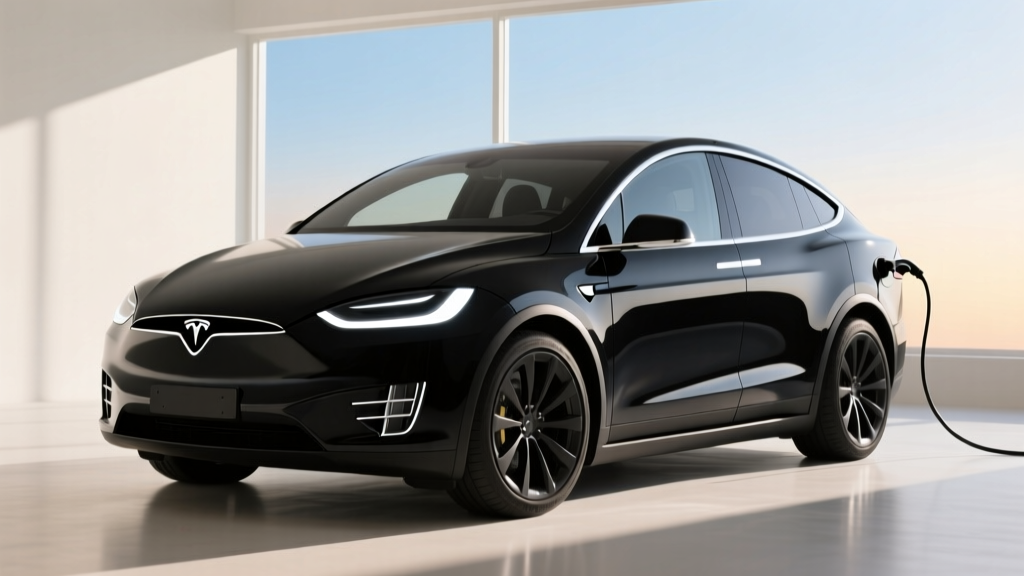
The Tesla Model X refresh—internally dubbed "Palladium"—brought subtle but meaningful updates to Tesla's flagship three-row electric SUV. While the exterior remains largely unchanged from the 2021 redesign, the 2026 Model X carries forward the powertrain, interior, and infotainment upgrades that redefined the vehicle. For buyers evaluating this large luxury EV, the real questions center on whether its 335-mile EPA range, 250 kW DC fast-charging capability, and starting price near $80,000 still hold up against the growing competition from the Rivian R1S, BMW iX, and Mercedes EQS SUV.
This review breaks down every spec that matters to an EV buyer: real-world range expectations, charging speeds at home and on the road, battery chemistry, federal tax credit eligibility under current IRS §30D rules, and who should actually put this vehicle on their shortlist.
Range and Efficiency: EPA vs. Real-World Driving
Real-World Expectation: ~280–310 miles on highway trips at 70 mph; ~240–265 miles in cold weather (below 32°F) with cabin heating active. City driving with regenerative braking recovers energy and can push closer to or slightly above the EPA figure.
The Long Range Model X uses a ~100 kWh (usable) battery pack built on NMC (nickel manganese cobalt) chemistry, which prioritizes energy density over the cycle-life longevity of LFP cells. Tesla does not publish exact usable kWh figures, but independent teardown and telemetry data consistently place usable capacity between 98–100 kWh.
Efficiency on the EPA's fueleconomy.gov listing comes in at 102 MPGe combined, translating to roughly 33 kWh per 100 miles. That's competitive for a 5,185-pound SUV, though the lighter BMW iX xDrive50 achieves 86 MPGe combined with a smaller footprint. The Model X's aerodynamic drag coefficient of 0.24 Cd—remarkably low for an SUV—helps offset its mass at highway speeds.
On a 250-mile road trip at sustained 75 mph in 45°F weather, expect to arrive with roughly 15–20% state of charge remaining if you started at 100%. Cold weather increases cabin heating demand (the Model X uses a heat pump, which helps), and battery internal resistance rises, reducing usable capacity by roughly 10–15%. Preconditioning the battery while plugged in mitigates some of this loss.
Charging Speed: DC Fast, Level 2, and Level 1
The Model X Long Range supports a peak DC fast-charge rate of 250 kW via Tesla's V3 and V4 Superchargers using the native NACS connector. On a V3 stall with a preconditioned battery, Tesla rates a 10–80% session at approximately 30 minutes. In practice, the charge curve tapers significantly above 50% state of charge—peak 250 kW holds only briefly between 10–25% SoC, then steps down through the mid-200s, dropping below 100 kW past 60%.
| Charging Level | Power (kW) | Connector | Speed | Notes |
|---|---|---|---|---|
| Level 1 (120V) | ~1.4 kW | NACS / J1772 adapter | ~3 mi/hr | Emergency/trickle only |
| Level 2 (240V, 48A) | 11.5 kW | NACS (Tesla Wall Connector) | ~34 mi/hr | Full charge in ~9 hours |
| Level 2 (240V, 32A) | 7.7 kW | NACS / J1772 adapter | ~23 mi/hr | Common public Level 2 |
| DC Fast Charge | 250 kW peak | NACS (Supercharger) | 10–80% in ~30 min | Precondition battery for peak rate |
| CCS Fast Charge | Up to 250 kW | NACS-to-CCS adapter (included) | Varies by station | Works at Electrify America, EVgo CCS stalls |
For home charging, Tesla's Gen 3 Wall Connector delivers up to 11.5 kW on a 60-amp circuit (48A continuous), adding roughly 34 miles of range per hour. That means a full 10–100% charge takes about 9 hours overnight—ideal for daily use. Installation typically costs $500–$2,000 depending on panel proximity and whether your electrical panel needs a 200A service upgrade. Always consult a licensed electrician for a site-specific quote.
Tesla now includes a NACS-to-CCS adapter with new Model X deliveries, opening access to Electrify America, EVgo, and other CCS networks. The Supercharger network remains the gold standard for reliability, with over 6,000 V3/V4 stalls across the U.S. as of early 2026.
Performance and Drivetrain
The Model X Long Range pairs a dual-motor all-wheel-drive system producing 670 horsepower. Tesla rates the 0–60 mph sprint at 3.8 seconds, which remains brisk for a three-row SUV weighing over 5,100 pounds. The Plaid variant, with its tri-motor setup producing 1,020 horsepower, drops that to 2.5 seconds—supercar territory in a family hauler—though it starts at $94,990 and sacrifices roughly 20 miles of range (EPA 311 miles).
| Specification | Long Range AWD | Plaid (Tri-Motor) |
|---|---|---|
| EPA Range | 335 miles | 311 miles |
| Battery (Usable) | ~100 kWh, NMC | ~100 kWh, NMC |
| Horsepower | 670 hp | 1,020 hp |
| 0–60 mph | 3.8 seconds | 2.5 seconds |
| Drivetrain | Dual-Motor AWD | Tri-Motor AWD |
| Top Speed | 155 mph | 163 mph |
| Towing Capacity | 5,000 lbs | 5,000 lbs |
| Base MSRP | $79,990 | $94,990 |
Regenerative braking in the Model X offers a strong one-pedal driving experience, though Tesla removed the adjustable regen strength setting in recent software updates—you get one aggressive default profile. The adaptive air suspension provides up to 8.1 inches of ground clearance in its highest setting, useful for snow or rough driveways, and automatically lowers at highway speeds for aerodynamic efficiency.
Interior, Cargo, and Standout Technology
The Model X refresh interior centers on a 17-inch center touchscreen (tilted toward the driver on the refresh), a 12.3-inch instrument cluster, and an 8-inch rear-seat entertainment display. The yoke steering wheel remains standard, though a round wheel is now a no-cost option—a concession Tesla made after widespread feedback.
Seating configurations include five-seat (two rows), six-seat (captain's chairs in the second row), and seven-seat (bench second row). Cargo volume behind the third row is 15.3 cubic feet, expanding to 40.5 cu ft with the third row folded and up to 85.1 cu ft with both rear rows down. The front trunk (frunk) adds 6.6 cu ft—useful for charging cables and groceries.
Second-row legroom measures 40.9 inches, and third-row legroom is a tight 32.7 inches, best suited for children on longer trips. The falcon-wing rear doors are the Model X's signature feature: they articulate upward with dual hinges, requiring only about 12 inches of lateral clearance to open. They make car-seat loading genuinely easier than conventional doors, though they can be slow to operate in heavy rain and have historically been a reliability concern—though Tesla has improved the actuator mechanism on post-refresh units.
Tech highlights include:
- Autopilot (standard): Adaptive cruise, lane centering, automatic emergency braking—SAE Level 2, requires active driver supervision
- Full Self-Driving (Supervised) ($8,000 option or $99/month): Adds automatic lane changes, Navigate on Autopilot, traffic light/stop sign recognition, and Smart Summon. Still SAE Level 2—driver must monitor at all times
- HEPA air filtration with Bioweapon Defense Mode (genuinely effective, hospital-grade filtration)
- Over-the-air updates that regularly add features and refine performance
- 22-speaker audio system with immersive sound
Pricing, Trims, and Federal Tax Credit Eligibility
The 2026 Tesla Model X lineup is straightforward: two trims with options limited to wheel size, paint color, interior color, seating configuration, and FSD.
| Trim | Base MSRP | Destination | Typical As-Tested | Federal §30D Credit |
|---|---|---|---|---|
| Long Range AWD (20" wheels) | $79,990 | $1,995 | $82,000–$89,000 | Not eligible (MSRP cap) |
| Plaid (Tri-Motor AWD) | $94,990 | $1,995 | $97,000–$108,000 | Not eligible (MSRP cap) |
Under current IRS §30D clean vehicle credit rules, the Model X does not qualify for the federal $7,500 tax credit. The law caps eligible SUVs at an MSRP of $80,000, and the Long Range base price of $79,990 clears that threshold by just $10—but adding destination charges pushes the total above the cap. The Plaid, at $94,990, is well above the limit.
Additionally, §30D imposes buyer income caps ($300,000 joint / $150,000 single filer modified adjusted gross income) and battery critical-mineral and component sourcing requirements. Even if the MSRP were under the cap, buyers should verify eligibility using the IRS's official tool at fueleconomy.gov and consult a tax professional before assuming credit availability.
Some states offer additional rebates or incentives that may apply to the Model X regardless of federal credit eligibility. Check your state's energy or environmental agency for current programs, as these vary significantly by jurisdiction.
Warranty and Battery Longevity
Tesla covers the Model X with the following warranty structure:
- Basic Vehicle: 4 years / 50,000 miles
- Battery & Drive Units: 8 years / 150,000 miles (whichever comes first), with a minimum 70% capacity retention guarantee
The 150,000-mile battery warranty is competitive within the luxury EV segment (BMW iX offers 8 years / 100,000 miles). NMC chemistry in the Model X typically shows 8–12% degradation over the first 100,000 miles based on fleet telemetry data, with the curve flattening significantly after the initial break-in period. Tesla's thermal management system—liquid-cooled and actively heated—plays a major role in longevity.
For maximum battery life, Tesla recommends daily charging to 80–90% for NMC packs and reserving 100% charges for road trips. Unlike LFP batteries (which Tesla recommends charging to 100% regularly), NMC cells degrade faster when held at full state of charge for extended periods.
Competitive Comparison: Model X vs. the Field
The Model X occupies a narrow niche: a three-row electric luxury SUV with Supercharger access and strong performance. Its closest competitors differ in important ways:
| Spec | Tesla Model X LR | Rivian R1S (Dual-Motor) | BMW iX xDrive50 | Mercedes EQS 580 SUV |
|---|---|---|---|---|
| EPA Range | 335 mi | 352 mi (Max Pack) | 324 mi | 305 mi |
| Starting MSRP | $79,990 | $79,900 | $87,250 | $104,400 |
| Seating | 5 / 6 / 7 | 7 | 5 | 5 / 7 (optional) |
| DC Fast Charge | 250 kW | 220 kW | 195 kW | 200 kW |
| 0–60 mph | 3.8 sec | 5.0 sec | 4.4 sec | 4.4 sec |
| Federal §30D Credit | No (MSRP cap) | Eligible (varies) | No (MSRP cap) | No (MSRP cap) |
The Rivian R1S is the most direct competitor for three-row buyers, offering comparable pricing, more off-road capability, and §30D eligibility on certain trims. The BMW iX is a more refined five-seater with a superior interior but no third row. The Mercedes EQS SUV is larger and more luxurious but costs significantly more.
Pros
- 335-mile EPA range is strong for a large SUV
- 250 kW Supercharger access with best-in-class network reliability
- Tri-motor Plaid offers unmatched performance in the segment
- Falcon-wing doors genuinely aid child-seat loading
- HEPA air filtration is legitimately class-leading
- Over-the-air updates keep the vehicle current
- 5,000-lb towing capacity with integrated trailer brake controller
Cons
- Does not qualify for $7,500 federal tax credit (MSRP cap)
- Third-row space is tight for adults (32.7" legroom)
- Yoke steering is polarizing; round wheel is a no-cost option
- Falcon-wing doors can be slow and have higher maintenance risk
- Panel gaps and interior material quality lag BMW/Mercedes at this price
- FSD costs $8,000 extra and remains Level 2 (not autonomous)
- No adjustable regenerative braking strength
Who Should Buy the Tesla Model X?
- You need three rows and prioritize Supercharger network reliability for family road trips
- You value performance (3.8-second 0–60) alongside practicality
- You live in a region with robust Supercharger coverage
- You want the falcon-wing door advantage for child-seat access
- Tax credit ineligibility doesn't change your budget calculus at this price point
- Federal tax credit eligibility is important (consider Rivian R1S or Hyundai Ioniq 9)
- Interior luxury and material quality are top priorities (BMW iX, Mercedes EQS SUV)
- You only need two rows and want a lower price (Tesla Model Y, BMW iX)
- Off-road capability matters (Rivian R1S with its 14.9" ground clearance)
The Model X remains the default choice for buyers who want a fast, long-range, three-row electric SUV with the most reliable public charging infrastructure available. Its limitations—tax credit ineligibility, polarizing design choices, and interior quality that doesn't quite match its price—are real but may not matter to its target buyer. If you've decided on a large Tesla SUV and the budget supports it, the Long Range variant is the value pick; the Plaid is for those who want to make a statement at stoplights.
Frequently Asked Questions
What is the real-world range of the Tesla Model X?
The EPA rates the Model X Long Range at 335 miles. In real-world highway driving at 70–75 mph, expect 280–310 miles. In cold weather (below freezing), range drops to approximately 240–265 miles due to cabin heating demand and reduced battery efficiency. City driving with regenerative braking can match or slightly exceed the EPA figure.
How fast does the Model X charge at home and on the road?
On DC fast charging (Supercharger V3/V4), the Model X peaks at 250 kW and charges from 10–80% in approximately 30 minutes with a preconditioned battery. At home on a Tesla Wall Connector (11.5 kW / 48A Level 2), it adds about 34 miles per hour, fully charging overnight in roughly 9 hours. A CCS adapter is included for non-Tesla fast chargers.
Does the Tesla Model X qualify for the federal EV tax credit?
No. Under current IRS §30D rules, the Model X exceeds the $80,000 MSRP cap for SUVs once destination charges are included (the Long Range base is $79,990, but the total with destination is $81,985). The Plaid at $94,990 is well above the limit. Always verify current rules at IRS.gov and consult a tax professional.
Is the Model X worth buying vs. the Rivian R1S or BMW iX?
It depends on priorities. The Model X wins on Supercharger network access, performance (especially Plaid), and falcon-wing utility for families. The Rivian R1S offers better off-road capability, §30D credit eligibility, and a more conventional interior. The BMW iX provides superior interior luxury and refinement but only seats five. If three rows and fast-charging reliability are non-negotiable, the Model X remains compelling.
What are the biggest pros and cons of the Model X refresh?
Key pros: 335-mile range, 250 kW Supercharger access, 670 hp dual-motor performance, unique falcon-wing doors, HEPA filtration, and OTA updates. Key cons: no federal tax credit, tight third row, polarizing yoke steering, interior quality below German luxury rivals at this price, and FSD remains a costly Level 2 system.
What battery chemistry does the Model X use, and how long will it last?
The Model X uses NMC (nickel manganese cobalt) lithium-ion cells with a ~100 kWh usable capacity. Tesla warranties the battery for 8 years / 150,000 miles with a minimum 70% capacity retention. Fleet data suggests 8–12% degradation over the first 100,000 miles. For longevity, charge to 80–90% daily and reserve 100% charges for trips.