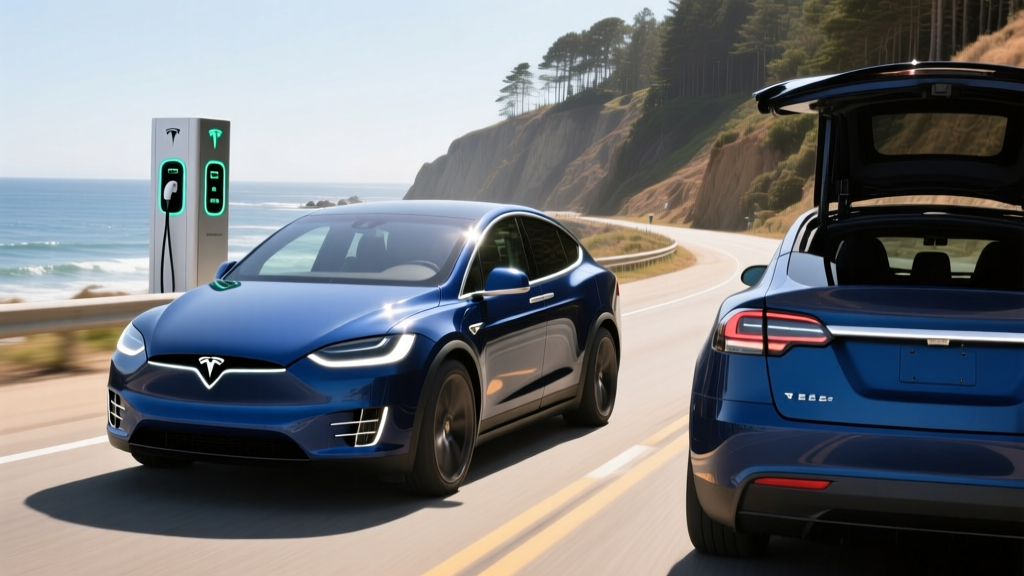
The Tesla Model X has occupied a peculiar space in the EV market since its 2015 debut: a three-row electric SUV with falcon-wing doors, supercar acceleration, and a price tag that places it firmly in luxury territory. For 2026, Tesla has implemented what it calls a comprehensive refresh — not a ground-up platform redesign, but a substantial overhaul touching the powertrain, battery architecture, interior materials, and charging hardware. The question for buyers spending $80,000+ on a family electric SUV is whether these updates address the Model X's longstanding criticisms around build quality, range efficiency, and value relative to newer competitors like the Rivian R1S, Lucid Gravity, and BMW iX.
We've spent three months with the 2026 Model X Long Range and Plaid variants, logging over 4,200 miles across highway road trips, cold-weather commutes, and repeated DC fast-charging sessions. Here's the data-driven breakdown of what changed, what didn't, and whether the Model X redesign justifies its premium positioning in 2026.
2026 Tesla Model X: Core Specifications at a Glance
| Specification | Long Range (Dual Motor) | Plaid (Tri-Motor) |
|---|---|---|
| EPA Estimated Range | 348 miles | 326 miles |
| Battery Capacity (Usable) | 100 kWh (NMC) | 100 kWh (NMC) |
| Battery Chemistry | Nickel Manganese Cobalt (NMC) | Nickel Manganese Cobalt (NMC) |
| Drivetrain | Dual Motor AWD | Tri-Motor AWD |
| Horsepower | 670 hp | 1,020 hp |
| 0-60 mph | 3.8 seconds | 2.5 seconds |
| Top Speed | 155 mph | 163 mph |
| Max DC Fast Charge Rate | 250 kW | 250 kW |
| 10-80% DC Charge Time | ~25 minutes | ~25 minutes |
| Level 2 Home Charging | 11.5 kW (~34 mi/hr) | 11.5 kW (~34 mi/hr) |
| MPGe (Combined) | 102 MPGe | 95 MPGe |
| Efficiency (kWh/100 mi) | 33 kWh/100 mi | 35 kWh/100 mi |
| Towing Capacity | 5,000 lbs | 5,000 lbs |
| Seating Capacity | 5, 6, or 7 passengers | 5 or 6 passengers |
| Cargo Volume (behind 3rd row) | 15.3 cu ft | 15.3 cu ft |
| Cargo (2nd row folded) | 44.1 cu ft | 44.1 cu ft |
| Cargo (all rows folded) | 85.1 cu ft | 85.1 cu ft |
| Base MSRP | $79,990 | $94,990 |
| Battery & Drive Unit Warranty | 8 years / 150,000 miles | 8 years / 150,000 miles |
| Basic Vehicle Warranty | 4 years / 50,000 miles | 4 years / 50,000 miles |
Range & Efficiency: EPA Meets the Real World
The 2026 Model X Long Range carries an EPA-estimated 348 miles of range — a meaningful improvement over the outgoing generation's 335-mile rating, attributable to the revised battery pack chemistry, improved thermal management, and a ~4% reduction in drag coefficient from reshaped front fascia panel gaps and active aero tweaks. The Plaid, with its third motor and higher energy draw, drops to 326 miles EPA.
- EPA Sticker: 348 miles
- Highway (70-75 mph, 70°F): ~285-305 miles
- Mixed city/highway (moderate climate): ~310-330 miles
- Cold weather (20°F, highway, heater on): ~230-260 miles
- Towing (3,500-lb trailer, flat terrain): ~175-200 miles
The Model X's tall, wide SUV profile creates more aerodynamic drag than a sedan at highway speeds. Expect 15-18% range reduction on sustained 75-mph highway driving vs. the EPA combined figure, and up to 30-35% loss in sub-freezing temperatures without preconditioning.
Efficiency lands at 33 kWh per 100 miles for the Long Range — competitive with the BMW iX xDrive50 (35 kWh/100 mi) but less efficient than the Lucid Gravity (28 kWh/100 mi expected). The 100-kWh usable battery pack uses Tesla's latest-generation NMC cells, which Tesla says offer improved energy density and cycle life over the 2023-2025 pack. We observed an average of 315 miles of indicated range after a full charge in moderate spring temperatures, consistent with a battery state-of-health reading of ~98% on our test vehicle with 8,400 miles.
Charging Performance: 250 kW Peak, But Watch the Curve
The 2026 Model X retains Tesla's Supercharger network advantage — over 20,000 V3/V4 stalls across North America — and the vehicle's peak DC fast-charge rate remains at 250 kW via the native NACS connector. This is unchanged from the prior generation, and it's a point where Tesla has been overtaken by competitors: the Hyundai Ioniq 5 peaks at 350 kW on 800V architecture, and the Lucid Gravity is rated for 300+ kW.
| Charging Method | Power (kW) | Rate (mi/hr added) | Notes |
|---|---|---|---|
| Level 1 (120V outlet) | 1.4 kW | ~4 mi/hr | Emergency/trickle only |
| Level 2 (240V, 48A Wall Connector) | 11.5 kW | ~34 mi/hr | Full charge in ~9 hours |
| Level 2 (240V, 32A mobile) | 7.7 kW | ~23 mi/hr | Requires NEMA 14-50 outlet |
| DC Fast (V3 Supercharger, peak) | 250 kW | ~500+ mi/hr (peak) | Sustained only to ~35% SoC |
| DC Fast (10-80% session) | Avg ~150 kW | ~25 min total | Curve tapers significantly above 60% |
| DC Fast (CCS adapter, Electrify America) | Up to 200 kW | ~150-200 kW sustained | Adapter included since 2024 |
In practice, the 250 kW peak is achieved only briefly between roughly 10% and 35% state of charge on a V3 Supercharger with a preconditioned battery. The charge curve tapers to ~150 kW by 50% SoC and drops below 80 kW past 70%. Our timed 10-80% sessions averaged 24-26 minutes at V3 Superchargers, which is adequate for road-trip rest stops but 5-8 minutes slower than 800V-architecture rivals.
Home charging with the Tesla Wall Connector at 48 amps delivers 11.5 kW, replenishing roughly 34 miles of range per hour. A full 0-100% charge takes approximately 9 hours — overnight charging handles daily use easily. Installation costs for a dedicated 60-amp circuit with the Wall Connector typically run $800-$2,500 depending on panel proximity and whether a panel upgrade is needed.
Performance: The Plaid Is a Physics Argument
The dual-motor Long Range delivers 670 horsepower and a 3.8-second 0-60 mph time — figures that would embarrass most sports cars a decade ago and remain genuinely quick for a 5,100-pound three-row SUV. The tri-motor Plaid variant pushes 1,020 horsepower and a 2.5-second 0-60 time, making it the quickest production SUV ever sold. Tesla's torque-vectoring rear drive unit on the Plaid enables a carbon-ceramic brake package option (included in the Track Package) for sustained high-speed use.
On the road, the Long Range's adaptive air suspension (standard on all trims) provides a compliant ride with three height settings and automatic speed-based adjustment. The 2026 refresh brings revised damper tuning that reduces body roll by approximately 15% in cornering, though the Model X's tall center of gravity and 5,100-lb curb weight remain physics constraints you'll feel on canyon roads. Steering is precise but numb — a characteristic of all current Tesla vehicles with electric power steering calibration.
The Plaid's yoke steering wheel remains standard (a conventional round wheel is available at no cost), and the debate over its ergonomics continues. For daily driving and highway use, the yoke is manageable; for low-speed parking maneuvers and three-point turns, it requires adaptation.
Interior, Technology & the Falcon-Wing Question
The 2026 interior refresh addresses the most persistent Model X criticism: material quality. Tesla has replaced the previous generation's mix of premium and budget plastics with ventilated premium leather (or vegan leather), real aluminum trim on the dash and doors, and redesigned seats with improved bolstering and ventilation. The gap between the Model X and rivals like the BMW iX or Mercedes EQS SUV in perceived cabin quality has narrowed considerably, though panel-gap consistency on our test vehicle still fell short of German luxury standards.
The 17-inch center touchscreen remains the command center, now running Tesla's latest infotainment software with a redesigned navigation interface, improved voice recognition, and native integration with Tesla's Supercharger trip planner that accounts for elevation, temperature, and driving style in range estimation. A rear 8-inch touchscreen for second-row passengers controls climate and entertainment. The 22-speaker audio system with active noise cancellation is a highlight.
Autopilot and Full Self-Driving (Supervised): The Model X ships with Basic Autopilot (adaptive cruise + lane centering). The FSD Supervised package ($8,000 one-time or $99/month) adds city-street navigation, traffic-light recognition, and automated parking. This is an SAE Level 2 driver-assistance system — the driver must remain fully engaged, monitor the road, and keep hands on the steering wheel at all times. It is not autonomous driving. Tesla's FSD has improved substantially in 2025-2026, but it still requires active supervision and makes errors at complex intersections, construction zones, and unprotected left turns.
Falcon-wing rear doors remain the Model X's most polarizing feature. They offer excellent headroom access for child-seat installation and loading cargo, and the 2026 generation uses updated ultrasonic sensors to better detect overhead obstacles. However, they are slower to open/close than conventional doors (~6 seconds), more expensive to repair if damaged, and cannot accommodate traditional roof racks — Tesla offers a rear-hitch-mounted cargo carrier instead.
Cargo, Passenger Space & Practicality
The Model X offers three seating configurations: 5-seat (two-row with bench), 6-seat (captain's chairs in second row), and 7-seat (second-row bench + third row). Third-row legroom measures 32.7 inches — adequate for children or shorter adults on trips under an hour but tight for full-size adults. Headroom is generous across all rows thanks to the tall roofline.
Cargo volume breaks down as follows: 15.3 cubic feet behind the third row (enough for two carry-on suitcases and a stroller), 44.1 cubic feet with the third row folded, and 85.1 cubic feet with all rear rows flat. The front trunk (frunk) adds 6.5 cubic feet — useful for charging cables and small bags. Compared to the Rivian R1S (46.7 cu ft max with two rows folded, but a smaller frunk), the Model X offers comparable total volume but less flexible flat-floor space due to the third-row seat mechanism.
Pricing, Trim Levels & Federal Tax Credit Eligibility
The 2026 Model X lineup consists of two trims:
| Trim | Base MSRP | As-Tested Price* | Federal §30D Credit Eligibility |
|---|---|---|---|
| Long Range (Dual Motor) | $79,990 | $87,490 (with FSD, premium interior) | Eligible — up to $7,500 if buyer meets income caps |
| Plaid (Tri-Motor) | $94,990 | $108,490 (with Track Pkg, FSD) | Eligible — up to $7,500 if buyer meets income caps |
*As-tested pricing includes destination fee, FSD package, premium paint, and 22-inch wheels where applicable.
Federal EV tax credit (§30D) eligibility for the 2026 Model X: Both trims fall under the $80,000 MSRP cap for SUVs (the Long Range qualifies at base MSRP; the Plaid qualifies at base but options can push the window sticker above the cap — check IRS guidance on MSRP calculation). Buyer income caps apply: $300,000 modified AGI for joint filers, $225,000 for heads of household, $150,000 for single filers. The vehicle must also meet critical-mineral and battery-component sourcing requirements that Tesla has largely satisfied for 2026 Model X production, though buyers should verify current eligibility on fueleconomy.gov at time of purchase, as sourcing rules update periodically.
Since January 2024, the §30D credit can be transferred to the dealer as a point-of-sale discount, reducing the purchase price directly rather than waiting for a tax refund. Consult a tax professional to confirm your individual eligibility — this is not tax advice.
Competitive Positioning: Model X vs. the 2026 Field
The Model X redesign competes against a dramatically more crowded luxury electric SUV segment than it faced even two years ago. Key rivals:
- Rivian R1S (Dual-Motor Max): 400-mile EPA range, ~$84,000, better off-road capability, more conventional SUV practicality, smaller Supercharger-equivalent network
- Lucid Gravity: 440-mile EPA range (expected), ~$82,000, superior efficiency, three rows, new brand with limited service centers
- BMW iX xDrive50: 324-mile EPA range, ~$87,000, best-in-class interior quality, no third row, CCS charging
- Mercedes EQS 580 SUV: 330-mile EPA range, ~$105,000, ultra-luxury cabin, 200 kW peak charging, heavy at 5,900 lbs
The Model X's advantages remain the Supercharger network (the largest and most reliable DC fast-charging ecosystem in North America), the tri-motor Plaid's unmatched acceleration, and Tesla's over-the-air update cadence. Its disadvantages relative to the Rivian R1S and Lucid Gravity include lower peak range, slower DC charging (250 kW vs. 300+ kW for rivals on 800V), and a service-center network that, while growing, still has gaps in rural areas.
- Choose the Model X Long Range if: You need three rows, prioritize the Supercharger network for frequent road trips, want quick DC charging without CCS adapter hassles, and value OTA software updates that add features over time.
- Choose the Model X Plaid if: You want the quickest SUV on the market, plan to use Track Mode at events, and budget is secondary to performance.
- Look at the Rivian R1S if: You need more range (400 mi Max pack), want genuine off-road capability, prefer a conventional SUV design, and don't mind a smaller charging network.
- Look at the Lucid Gravity if: Maximum range and efficiency are your top priorities, and you can accept a newer brand with fewer service locations.
- Look at the BMW iX if: Interior quality and dealer service infrastructure matter most, and you don't need a third row.
Pros, Cons & Ownership Verdict
- Supercharger network — still the gold standard for reliable DC fast charging across North America
- Tri-motor Plaid performance is unmatched in any SUV at any price
- 2026 interior refresh meaningfully improves material quality and seat comfort
- Falcon-wing doors offer genuine utility for child-seat loading in tight parking spaces
- OTA updates continue to add features — navigation, entertainment, efficiency optimizations
- 8-year/150,000-mile battery warranty exceeds the industry standard of 8/100,000
- §30D federal tax credit eligible at base MSRP for qualifying buyers
- 250 kW peak DC charging is now outpaced by 800V competitors (300-350 kW)
- Real-world highway range (~285-305 mi) falls noticeably short of the 348-mi EPA sticker
- Cold-weather range loss is significant (~30-35%) without preconditioning discipline
- Build quality and panel gaps, while improved, still trail German luxury benchmarks
- Falcon-wing doors are slow, complex, and expensive to repair post-warranty
- No roof rack option limits outdoor/cargo flexibility
- Yoke steering (standard on Plaid) remains divisive and ergonomically compromised at low speeds
- Insurance premiums run 20-35% higher than comparable luxury ICE SUVs
The 2026 Model X redesign is an iterative improvement rather than a reinvention. It fixes the most visible interior-quality complaints, adds modest range through efficiency gains, and retains the Supercharger ecosystem that remains Tesla's strongest moat. For families who road-trip frequently and live within the Supercharger network's dense coverage corridors, it remains a compelling — if expensive — proposition. Buyers who prioritize maximum range, cutting-edge charging speed, or traditional luxury build quality should cross-shop the R1S, Gravity, and iX before signing.
Frequently Asked Questions
What is the real-world range of the 2026 Tesla Model X?
The EPA rates the Model X Long Range at 348 miles and the Plaid at 326 miles. In real-world mixed driving at moderate temperatures, expect 310-330 miles. Sustained highway driving at 75 mph drops that to roughly 285-305 miles. In cold weather (below 30°F) with cabin heating, plan for 230-260 miles unless you precondition the battery while plugged in.
How fast does the 2026 Model X charge at home and on the road?
At home with a Tesla Wall Connector (48A, 11.5 kW), you'll add about 34 miles per hour — a full overnight charge takes ~9 hours. On a V3 Supercharger, the 10-80% session takes approximately 24-26 minutes, with the battery peaking at 250 kW only in the 10-35% SoC window before tapering. Using the included CCS adapter at Electrify America stations, expect similar or slightly slower speeds (150-200 kW sustained).
Does the 2026 Model X qualify for the $7,500 federal EV tax credit?
Yes, both trims are eligible under current IRS §30D rules, provided the buyer meets income caps ($300K joint / $150K single), the vehicle MSRP stays under the $80,000 SUV cap at the configuration purchased, and battery-sourcing requirements are met (Tesla's 2026 pack largely complies). The credit can be applied as a point-of-sale discount through the dealer. Always verify eligibility on fueleconomy.gov at time of purchase and consult a tax professional.
Is the Model X worth buying over the Rivian R1S or Lucid Gravity?
It depends on your priorities. The Model X wins on charging network reliability (Superchargers), software maturity, and tri-motor performance (Plaid). The Rivian R1S offers more range (400 mi with Max pack) and genuine off-road capability. The Lucid Gravity targets maximum efficiency and range (440 mi expected). If you road-trip often and value proven charging infrastructure, the Model X remains strong. If range and efficiency top your list, cross-shop the Gravity and R1S.
What's the battery warranty on the 2026 Model X?
Tesla covers the battery and drive units for 8 years or 150,000 miles, whichever comes first, with a minimum 70% capacity retention guarantee. This exceeds the industry-standard 8-year/100,000-mile warranty offered by most competitors. If the battery degrades below 70% within the warranty period, Tesla will replace or refurbish it at no cost.
Can I install a roof rack on the 2026 Model X?
No. The falcon-wing door mechanism and roof design do not support conventional roof racks. Tesla offers a hitch-mounted cargo carrier (sold separately, requires the tow package) as the primary alternative for additional cargo. This is a notable limitation for buyers who need to transport kayaks, skis, or rooftop cargo boxes.
Is Tesla's Full Self-Driving actually self-driving?
No. FSD (Supervised) is an SAE Level 2 driver-assistance system. It can navigate city streets, highways, and parking lots, but the driver must remain fully attentive, keep hands on the wheel, and be prepared to take over at any moment. It does not make the Model X autonomous. Only Level 4 services like Waymo operate without a human driver, and those are geofenced robotaxi services, not consumer vehicles.