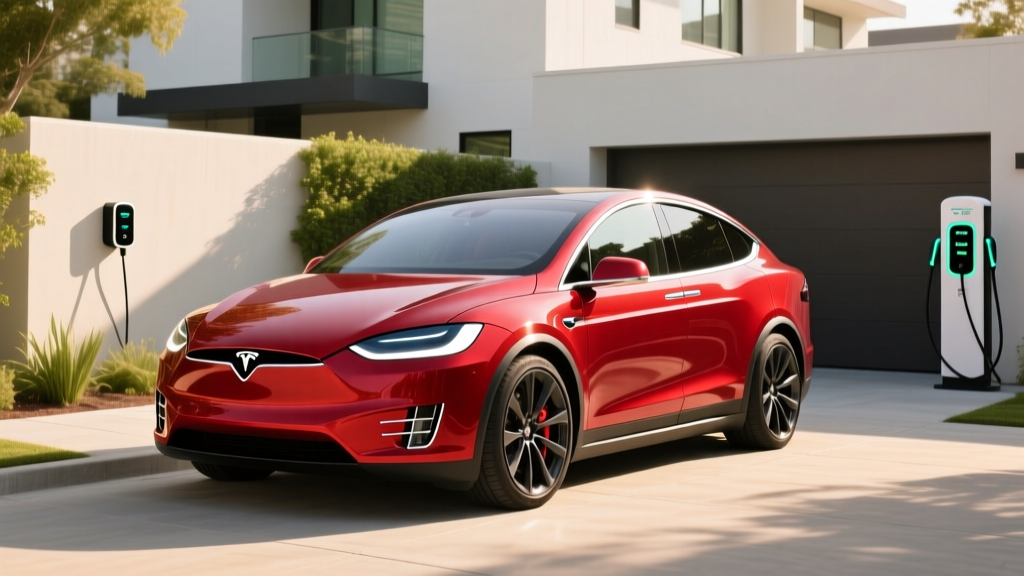
The Tesla Model X has always occupied a strange space in the EV market: a three-row family hauler with falcon-wing doors, supercar acceleration, and a price tag that crests six figures. For 2026, Tesla continues to offer the Model X in Long Range and Plaid trims, and the signature Ultra Red premium paint remains one of the most requested exterior finishes. But beyond the head-turning color, does the Model X still justify its premium against a growing field of electric SUVs?
We've spent time with the 2026 Model X across highway road trips, suburban commuting, and DC fast-charging stops to bring you exact numbers on range, charging speed, efficiency, and ownership cost. Here's everything a prospective buyer needs to know.
2026 Tesla Model X: Core Specifications at a Glance
| Specification | Long Range AWD | Plaid |
|---|---|---|
| EPA Range | 326 miles | 311 miles |
| Battery (usable) | ~95 kWh (NMC) | ~95 kWh (NMC) |
| Drivetrain | Dual-Motor AWD | Tri-Motor AWD |
| Horsepower | 670 hp | 1,020 hp |
| 0–60 mph | 3.8 seconds | 2.5 seconds |
| Top Speed | 155 mph | 163 mph |
| MPGe (combined) | 98 MPGe | 95 MPGe |
| Efficiency | 34 kWh/100 mi | 35 kWh/100 mi |
| Max DC Fast Charge | 250 kW | 250 kW |
| 10–80% DC Charge | ~32 minutes | ~32 minutes |
| Level 2 Home Charge | 11.5 kW (~34 mi/hr) | 11.5 kW (~34 mi/hr) |
| Base MSRP | $79,990 | $94,990 |
| Battery Warranty | 8 yr / 150,000 mi | 8 yr / 150,000 mi |
Source: fueleconomy.gov and Tesla specifications. Prices exclude destination fee. Ultra Red paint adds $2,500 to MSRP.
Real-World Range: What to Expect Beyond the EPA Sticker
Real-World Highway (70 mph, mild weather): ~270–290 miles
Real-World Cold Weather (below 32°F, highway): ~220–250 miles
City/Commuting (moderate speeds, regen-heavy): ~300–320 miles
The Model X Long Range carries an EPA rating of 326 miles, which is competitive for a three-row electric SUV of this size and weight (~5,185 lbs). However, as with every EV, real-world results depend heavily on driving conditions.
On a 70-mph highway cruise in 65°F weather, expect roughly 270–290 miles of usable range before needing to charge. The Model X's large frontal area and heavier mass penalize highway efficiency more than a sedan like the Model S. In cold weather (below freezing), battery resistance increases and cabin heating draws significant energy — plan for 220–250 miles of real range on a winter road trip. The heat pump (standard on 2026 models) helps mitigate this compared to older resistive-heating EVs, but physics still wins.
Around town, where speeds are lower and regenerative braking recovers energy at every stoplight, you'll get much closer to the EPA sticker — often 300+ miles. This split between highway and city efficiency is normal for EVs, but Model X buyers planning cross-country drives should budget conservatively.
Charging Speed: DC Fast Charging and Home Setup
Charging speed is where the Model X's age shows slightly. The 2026 model peaks at 250 kW on a V3 Tesla Supercharger — fast, but behind competitors like the Hyundai Ioniq 9 and Rivian R2, which target 350 kW+ architectures. Tesla's 400-volt electrical platform limits peak charge rate compared to 800-volt rivals.
| Charging Method | Power (kW) | Rate | Notes |
|---|---|---|---|
| Level 1 (120V outlet) | ~1.4 kW | ~3–4 mi/hr | Emergency/trickle only |
| Level 2 (240V, 48A Wall Connector) | 11.5 kW | ~34 mi/hr | Full charge overnight (~10 hrs) |
| DC Fast Charge (V3 Supercharger) | Peak 250 kW | ~175 mi in 15 min | 10–80% in ~32 min; tapers above 80% |
| DC Fast Charge (V4 Supercharger) | Up to 250 kW* | Similar to V3 | *Model X limited to 250 kW even on V4 posts |
Understanding the charge curve: The 250 kW peak only holds roughly between 10–30% State of Charge (SoC). From 30–60%, expect ~150–170 kW. Above 80%, charging slows dramatically to protect the NMC battery cells — often dropping below 50 kW. This is why Tesla (and we) quote 10–80% times rather than 0–100%. For road trips, plan to charge from ~10% to ~80% and then hit the road; the last 20% takes nearly as long as the first 70%.
At home, the Tesla Wall Connector on a 60-amp circuit delivers 11.5 kW (48 amps continuous), adding about 34 miles of range per hour. A full 0–100% charge takes roughly 10 hours — perfectly suited to overnight charging. Installation typically costs $500–$2,000 depending on your electrical panel's capacity and the run distance from panel to garage. Homes with older 100-amp panels may need a $1,500–$3,000 panel upgrade to support a dedicated 60-amp circuit.
Performance: Supercar Speeds in a Family SUV
The Model X Long Range hits 0–60 mph in 3.8 seconds with 670 horsepower from its dual-motor all-wheel-drive powertrain. That's quicker than most sports sedans, and the instant electric torque makes it feel even more urgent in real-world passing maneuvers.
Step up to the Plaid and you get Tesla's tri-motor setup producing 1,020 horsepower and a 2.5-second 0–60 time — making it one of the fastest production SUVs ever built. The Plaid's third motor (rear axle, dual-rotor) provides torque vectoring that sharpens cornering, though the Model X's ~5,400-lb Plaid curb weight is always present in transitions.
Both trims feature adaptive air suspension with automatic ride-height adjustment. The system lowers the vehicle at highway speeds for efficiency and raises it for rough roads or steep driveways. Towing capacity is rated at 5,000 lbs when properly equipped — adequate for a small boat or utility trailer but below the Rivian R1S (7,700 lbs).
Interior Space, Cargo, and the Falcon-Wing Reality
The Model X offers three rows of seating in either a 5-, 6-, or 7-passenger configuration. The second-row captain's chairs (6-seat layout) are the most comfortable, with individual armrests and a center pass-through to the third row.
- Cargo (behind 3rd row): 15.0 cu ft
- Cargo (3rd row folded): 43.9 cu ft
- Cargo (all rear seats folded): 85.1 cu ft
- Frunk (front trunk): 6.6 cu ft
- 3rd-row legroom: 32.7 inches (tight for adults on long trips)
- 2nd-row legroom: 40.9 inches
The signature falcon-wing rear doors open upward on a double-hinge system, creating a dramatic entrance and genuinely easing child-seat installation — you can stand nearly upright next to the second row. However, they require overhead clearance (won't work in low garages without the ultrasonic sensors detecting the ceiling) and add mechanical complexity that has historically been a maintenance concern. Tesla has improved the hinge actuators and seals in recent model years, but the system remains more failure-prone than conventional doors.
The 17-inch center touchscreen runs Tesla's latest infotainment software, which is responsive and feature-rich but lacks Apple CarPlay and Android Auto. A 12.3-inch driver display and an available 8-inch rear-seat entertainment screen round out the package. The 22-speaker audio system is among the best in any vehicle at this price point.
Pricing, Tax Credits, and Total Cost
| Item | Long Range AWD | Plaid |
|---|---|---|
| Base MSRP | $79,990 | $94,990 |
| Ultra Red Paint | +$2,500 | +$2,500 |
| Destination Fee | +$1,390 | +$1,390 |
| As-Tested (Red, 6-seat) | ~$86,380 | ~$101,380 |
| Federal §30D Tax Credit | Not eligible* | Not eligible* |
*Federal tax credit status: Under current IRS §30D rules, the Tesla Model X does not qualify for the $7,500 federal EV tax credit. Two factors disqualify it: (1) the MSRP cap for SUVs is $80,000, and even the base Long Range at $79,990 plus any options or destination fee pushes the total above that threshold; and (2) battery-component and critical-minerals sourcing requirements have tightened significantly. Always verify current eligibility on the IRS Clean Vehicle credit page before purchasing, as rules and Tesla's sourcing compliance can shift.
Income caps also apply: Even if the vehicle qualified, §30D limits eligibility to buyers with adjusted gross income below $300,000 (joint filers), $225,000 (head of household), or $150,000 (single). State-level incentives may still apply — check your state's energy office for local rebates that don't carry the same MSRP restrictions.
The Ultra Red paint itself is a $2,500 premium over the no-cost Pearl White. It's a deep, multi-coat finish that photographs beautifully and hides minor swirl marks better than solid black, but it does increase your as-tested price and insurance replacement-cost estimates.
Autopilot, FSD, and Driver Assistance
Tesla Autopilot and Full Self-Driving (Supervised) require continuous driver engagement. You must keep your hands on the wheel and eyes on the road at all times. This is not autonomous driving — Level 4 robotaxi services (Waymo, Zoox) operate without a driver, but consumer Tesla vehicles do not.
Every 2026 Model X ships with Tesla's basic Autopilot suite: Traffic-Aware Cruise Control and Autosteer (lane centering) on marked highways. The optional Full Self-Driving (Supervised) package — currently $8,000 upfront or $99/month — adds automatic lane changes, Navigate on Autopilot (on-ramp to off-ramp highway driving), traffic-light and stop-sign recognition, and the city-streets driving capability.
FSD (Supervised) has improved substantially through 2025–2026 neural-network updates, but it remains a Level 2 system. It handles most suburban and highway scenarios competently, but can still make unexpected decisions at complex intersections, construction zones, or when encountering unusual obstacles. The driver remains legally and practically responsible. Treat it as an advanced cruise-control system that reduces fatigue, not as a replacement for attention.
Standard safety features include automatic emergency braking, blind-spot monitoring, lane-departure warning, and 360-degree cameras. The Model X earned a 5-star overall rating from NHTSA, with top marks in frontal and side crash tests.
How the Model X Stacks Up Against Key Competitors
At $80,000–$100,000+, the Model X competes with a growing field. Here's how the critical numbers compare:
| Vehicle | EPA Range | 0–60 mph | Max DC Charge | Starting MSRP | 3rd Row? |
|---|---|---|---|---|---|
| 2026 Tesla Model X LR | 326 mi | 3.8s | 250 kW | $79,990 | Yes (opt.) |
| 2026 Rivian R1S (Dual Max) | 410 mi | 4.5s | 300+ kW | $79,900 | Yes (std) |
| 2026 BMW iX xDrive50 | 324 mi | 4.4s | 200 kW | $87,250 | No |
| 2026 Kia EV9 GT-Line AWD | 270 mi | 4.9s | 238 kW | $63,900 | Yes (std) |
| 2026 Mercedes EQS SUV 580 | 305 mi | 4.4s | 200 kW | $105,550 | Yes (opt.) |
The Rivian R1S is the closest rival: it offers more range (with the Max Pack), genuine off-road capability, a usable third row, and a more conventional (and reliable) door design. The Kia EV9 delivers three rows at $20,000 less but sacrifices 50+ miles of range and performance. The BMW iX is a luxury two-row benchmark but can't seat more than five. The Model X's unique combination of supercar acceleration, falcon-wing doors, Supercharger network access, and available three-row seating still occupies a niche no competitor fully replicates.
Pros and Cons: The Honest Verdict
Pros
- Class-leading acceleration (3.8s LR, 2.5s Plaid)
- Access to Tesla Supercharger network — the most reliable DC fast-charging ecosystem
- Falcon-wing doors ease child-seat loading in tight spaces
- Excellent 17-inch infotainment with regular OTA updates
- Strong 8-year / 150,000-mile battery and drivetrain warranty
- 5,000-lb towing capacity
- 5-star NHTSA safety rating
Cons
- Does not qualify for the $7,500 federal tax credit at current MSRP/sourcing
- 250 kW peak charge rate trails 800V competitors (300–350 kW)
- Third row is cramped for adults (32.7" legroom)
- No Apple CarPlay or Android Auto
- Falcon-wing door complexity and overhead-clearance limitations
- Premium price — $80K–$100K+ depending on trim and options
- Interior materials don't match Mercedes/BMW at this price point
Who Should Buy the Tesla Model X (and Who Shouldn't)?
Buy it if: You need three rows occasionally, prioritize acceleration and tech, rely on the Supercharger network for road trips, and want the most distinctive SUV in the school-dropoff lane. The Model X is ideal for tech-forward families who take weekend road trips and value the Supercharger ecosystem's reliability.
Look elsewhere if: You need a genuinely spacious third row for adults (consider the Rivian R1S or Kia EV9), you want the $7,500 federal tax credit, you prioritize luxury interior materials (Mercedes EQS SUV), or you want the longest possible range (Rivian R1S Max Pack at 410 miles).
Choose the Model X Plaid if: Performance is a priority and you'll enjoy 1,020 hp and 2.5-second sprints daily, accepting the $15,000 premium and slightly lower range.
Skip the Ultra Red paint if: You're budget-conscious — the $2,500 premium is cosmetic and doesn't affect performance or range. Pearl White or Solid Black are no-cost alternatives.
Frequently Asked Questions
What is the real-world range of the 2026 Tesla Model X?
The EPA rates the Long Range at 326 miles and the Plaid at 311 miles. In real-world highway driving at 70 mph in mild weather, expect 270–290 miles. In cold weather (below freezing), plan for 220–250 miles. City driving with regenerative braking gets you closer to the EPA sticker, often 300+ miles.
How fast does the Model X charge at home and on the road?
On a Tesla V3 Supercharger (250 kW DC), the Model X charges from 10–80% in about 32 minutes, adding roughly 175 miles in 15 minutes. At home on a Level 2 Tesla Wall Connector (11.5 kW / 48A), it adds about 34 miles per hour, fully charging overnight in ~10 hours. The 400V architecture limits peak speed compared to 800V competitors.
Does the 2026 Tesla Model X qualify for the federal EV tax credit?
Under current IRS §30D rules, the Model X generally does not qualify for the $7,500 credit. The SUV MSRP cap is $80,000, and any options or destination fees push the Long Range above that. Additionally, battery sourcing requirements must be met. Always confirm with the IRS Clean Vehicle portal and your tax professional before purchase.
Is the Tesla Model X worth buying over the Rivian R1S?
It depends on your priorities. The Model X wins on acceleration (3.8s vs 4.5s), Supercharger network access, and over-the-air software updates. The Rivian R1S wins on range (up to 410 mi with Max Pack), genuine off-road capability, a more usable third row, conventional doors, and available federal tax credit eligibility. Test-drive both before deciding.
What is the battery warranty on the Model X?
Tesla covers the Model X battery and drive unit for 8 years or 150,000 miles (whichever comes first), with a minimum 70% capacity retention guarantee over that period. This is competitive with the industry standard and reflects confidence in the NMC cell chemistry's longevity.
How much does Ultra Red paint cost on the Model X?
Ultra Red is a $2,500 premium paint option on both the Long Range and Plaid trims. It's a multi-coat deep red that is visually striking but adds to the as-tested price and may slightly increase insurance premiums due to higher repair costs for custom-color bodywork.