If you are searching for a Tesla with rear-facing seats, there is exactly one model in the lineup that qualifies: the Tesla Model X with the optional six-seat interior. No other current Tesla — not the Model Y, Model 3, Model S, nor the Cybertruck — offers a rear-facing third row. For 2026, the Model X remains a niche but compelling proposition for families who need occasional six-passenger seating, want the Supercharger network, and value the cargo flexibility that comes from a compact rear-facing bench.
This review covers the Model X Long Range AWD with the rear-facing seat option, including exact range, charging speeds, pricing, tax-credit eligibility, and real-world ownership considerations. If you are cross-shopping against three-row electric SUVs like the Rivian R1S or Kia EV9, this is the data you need.
Spec Table: 2026 Tesla Model X Long Range AWD
| Specification | Value |
|---|---|
| EPA Range | 335 miles |
| Battery Capacity | ~100 kWh usable (NMC lithium-ion) |
| Drivetrain | Dual-motor AWD |
| Horsepower | 670 hp (combined) |
| 0–60 mph | 3.8 seconds |
| Max DC Fast Charge | 250 kW (peak) |
| 10–80% DC Charge Time | ~30 minutes |
| Level 2 Home Charge Rate | 11.5 kW (~34 mi/hr) |
| Efficiency | 102 MPGe combined / 33 kWh/100 mi |
| Cargo (behind 3rd row) | ~15 cu ft |
| Cargo (3rd row folded) | ~57 cu ft |
| Battery Warranty | 8 years / 150,000 miles (min 70% retention) |
| Base MSRP | $79,990 (before options/fees) |
| Federal Tax Credit (§30D) | Up to $7,500 — subject to income, sourcing, and MSRP caps |
Range and Efficiency: EPA vs. Real-World
The EPA rates the 2026 Model X Long Range AWD at 335 miles. That figure assumes a mix of city and highway driving at moderate temperatures. In practice, the Model X's large frontal area and SUV weight (roughly 5,100 lbs) work against it on long highway runs.
- City / suburban mixed driving: 310–340 miles — close to EPA sticker thanks to regenerative braking.
- Highway (70–75 mph sustained): 260–290 miles — aerodynamic drag cuts efficiency by 15–20%.
- Cold weather (below 30°F): 230–270 miles — battery conditioning and cabin heating reduce usable capacity. Preconditioning while plugged in mitigates some loss.
- Towing (up to 3,500 lbs rated): 170–210 miles — expect roughly 40–50% range reduction under load.
Efficiency lands at approximately 33 kWh per 100 miles (102 MPGe combined per fueleconomy.gov). That is respectable for a 5,100-pound three-row SUV, though the Hyundai Ioniq 9 and Rivian R1S achieve similar or slightly better figures. For a family doing mostly local driving with occasional road trips, the real-world 270–310 mile envelope is comfortable given Tesla's Supercharger network density.
Charging: DC Fast, Level 2, and the Charge Curve
The Model X supports up to 250 kW peak on V3 (and V4) Superchargers. However, as with all EVs, peak rate is not sustained rate. The charge curve is the more useful metric for trip planning.
| Charging Method | Power (kW) | Speed | Notes |
|---|---|---|---|
| Level 1 (120V household) | ~1.4 kW | ~3–4 mi/hr | Emergency/top-up only |
| Level 2 (240V, 48A Wall Connector) | 11.5 kW | ~34 mi/hr | Full charge in ~9 hours |
| DC Fast (V3 Supercharger) | 250 kW peak | 10–80% in ~30 min | Tapers significantly above 60% SoC |
| DC Fast (CCS adapter, third-party) | Up to 150–250 kW | Varies by station | Requires Tesla CCS adapter (included with newer vehicles) |
Charge curve reality: The Model X holds close to 250 kW from roughly 10% to 30% state of charge, then steps down progressively. From 60% to 80%, expect rates closer to 70–90 kW. This means a 10–80% session takes about 30 minutes, but a 10–90% session stretches closer to 45 minutes. On road trips, Tesla's navigation will precondition the battery when a Supercharger is set as your destination — this warms the pack and unlocks faster initial charge rates, a critical advantage in cold weather.
At home, the Tesla Wall Connector on a 60-amp circuit delivers 11.5 kW, adding roughly 34 miles of range per hour. An overnight session (8–10 hours) easily replenishes a full day's driving. Installation costs for a dedicated 60A/240V circuit typically range from $800 to $2,500 depending on panel proximity and local permit requirements — consult a licensed electrician for your specific setup.
Performance and Drivetrain
The Model X Long Range AWD pairs dual permanent-magnet motors for a combined 670 horsepower and a manufacturer-claimed 0–60 mph time of 3.8 seconds. That is remarkably quick for a three-row SUV carrying over 5,000 pounds. The dual-motor AWD system provides confident traction in rain and light snow, with torque vectoring that keeps the vehicle stable under hard acceleration.
Ride quality is firm but controlled. Air suspension is standard and offers adjustable ride height — useful for loading cargo, clearing rough driveways, or lowering at highway speeds for efficiency. The air suspension also enables a "creep" lowering feature when parked, making it easier for children to climb into those rear-facing seats.
The Rear-Facing Seats: Practicality, Space, and Use Cases
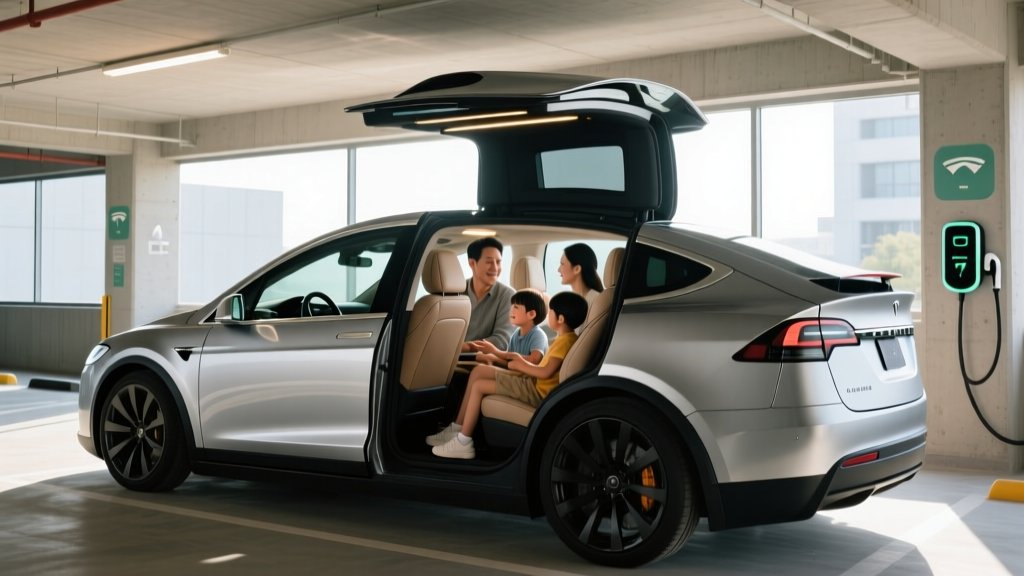
The six-seat configuration replaces the standard five-seat layout with two captain's chairs in the second row and a compact rear-facing bench in the third row. This is the only way to get a Tesla with rear-facing seats in the current lineup.
Who fits back there? The rear-facing third row is best suited for children or smaller passengers on shorter trips. Legroom is tight for adults — roughly 30 inches — and headroom is limited by the sloping roofline. Most families use these seats for kids aged 4–10, and they work well for school runs, grocery trips, and carpools. For long road trips, adults will find the space restrictive.
Cargo trade-off: With the third row upright, you get approximately 15 cubic feet of cargo space — enough for a couple of grocery bags or a stroller, but not much more. Fold the third row flat and you unlock roughly 57 cubic feet. Fold both the second and third rows and the Model X opens up to over 85 cubic feet, approaching small-crossover territory. The front trunk (frunk) adds another ~6.5 cubic feet for charging cables or a backpack.
Falcon-wing doors: The Model X's signature rear falcon-wing doors open upward, providing excellent headroom and easy access to the second and third rows in tight parking spaces. They include ultrasonic sensors to avoid overhead obstacles. However, they are mechanically complex and have historically been a maintenance concern for some owners.
Pricing, Tax Credits, and Total Cost
| Item | Amount |
|---|---|
| Model X Long Range AWD (base MSRP) | $79,990 |
| Six-seat interior with rear-facing 3rd row | +$0 (included in 6-seat config option) |
| Destination & order fee | ~$1,800 |
| FSD (Supervised) capability | +$8,000 (one-time) or $99/mo |
| Federal §30D Tax Credit (if eligible) | Up to –$7,500 |
| Estimated as-tested (6-seat, no FSD) | ~$81,790 before credit |
Federal tax credit eligibility (§30D): The Model X may qualify for up to $7,500 under the IRS §30D Clean Vehicle Credit, but eligibility depends on several factors that change periodically. Key requirements include:
- Buyer income caps: Modified AGI must not exceed $300,000 (joint filers), $225,000 (head of household), or $150,000 (single). See IRS guidelines for current-year rules.
- MSRP cap: SUVs/vans must have an MSRP at or below $80,000. The base Model X Long Range clears this, but adding FSD or premium packages may push the vehicle over the cap.
- Battery sourcing: Critical minerals and battery components must meet escalating domestic-content thresholds. Tesla sources and assembles batteries domestically for many configurations, but exact eligibility varies by production batch and model year. Confirm with your Tesla advisor at purchase.
- Point-of-sale transfer: Eligible buyers can transfer the credit to the dealer at purchase, reducing the upfront price rather than waiting for a tax refund.
Always verify current eligibility with a tax professional and the IRS before relying on the credit in your purchase budget.
Tech, Driver Assistance, and Safety
The Model X runs Tesla's current infotainment system on a 17-inch center touchscreen with a secondary 8-inch rear display for second-row passengers. The system includes navigation, streaming, gaming, and over-the-air updates. A 22-speaker audio system, wireless phone charging, and HEPA air filtration (with Bioweapon Defense Mode) are standard.
Safety ratings for the Model X are strong. The vehicle earned a 5-star overall rating from NHTSA and has historically performed well in IIHS testing, though specific 2026 model-year IIHS ratings should be confirmed at iihs.org as testing updates throughout the year.
Pros, Cons, and the Decision
Pros
- Only Tesla offering rear-facing seats (6-passenger config)
- 335-mile EPA range; 250-kW DC fast charging
- Supercharger network — largest and most reliable in the US
- Falcon-wing doors ease child-seat and 3rd-row access
- 3.8-second 0–60 mph with 670 hp AWD
- Air suspension standard; adjustable ride height
- Strong over-the-air update cadence
Cons
- Rear-facing 3rd row is very tight for adults
- Cargo space limited (15 cu ft) with 3rd row up
- $80K+ price; tax credit eligibility uncertain with options
- Falcon-wing doors: complex, historically maintenance-prone
- No CCS-native port (requires adapter for non-Tesla DC chargers)
- Real-world highway range drops to ~260–290 miles
- Interior material quality lags some luxury competitors at this price
Is the Model X with Rear-Facing Seats Worth It vs. Competitors?
The most direct competitors for a three-row electric SUV with six-passenger seating include the Rivian R1S (three rows, forward-facing), Kia EV9 (three rows, forward-facing), and Hyundai Ioniq 9 (three rows, forward-facing). None of these offer rear-facing seats — they all use conventional forward-facing third rows.
- You specifically want rear-facing seating for young children on shorter trips
- Supercharger access is a priority for your road-trip patterns
- You value falcon-wing door access in tight urban parking
- You want 335-mile EPA range and 250-kW charging in a six-seat EV
- You need a usable third row for adults or older children (forward-facing)
- Cargo space with all rows up is a priority (R1S and EV9 offer more)
- Your budget is under $60,000 (EV9 starts significantly lower)
- You prefer more traditional SUV styling and door mechanisms
Battery Warranty and Longevity
Tesla covers the Model X battery and drive units for 8 years or 150,000 miles, whichever comes first, with a minimum 70% capacity retention guarantee. The NMC (nickel-manganese-cobalt) chemistry used in the Model X offers high energy density, which is necessary for 335 miles of range in this form factor. NMC packs typically show 10–15% degradation over the first 100,000 miles based on fleet data, though individual results vary based on charging habits, climate, and Supercharger frequency.
To maximize longevity: avoid routinely charging to 100% (set daily limit to 80–90%), use preconditioning before DC fast charging, and minimize repeated deep discharges below 10% SoC. Battery replacement out of warranty, if ever needed, currently ranges from $15,000 to $22,000 depending on pack configuration and labor — a significant cost to factor into long-term ownership planning.
Frequently Asked Questions
What is the real-world range of the Tesla Model X with rear-facing seats?
The EPA rates it at 335 miles. In real-world driving, expect 270–310 miles for mixed use, 260–290 miles on sustained highway trips, and 230–270 miles in cold weather (below 30°F). Towing can reduce range to 170–210 miles.
How fast does the Model X charge at home and on DC fast chargers?
At home on a 240V/48A Tesla Wall Connector, it charges at 11.5 kW, adding about 34 miles per hour (full charge in ~9 hours). On a V3 Supercharger, it peaks at 250 kW and reaches 10–80% in approximately 30 minutes, with taper above 60% SoC.
Does the Tesla Model X qualify for the $7,500 federal EV tax credit?
It may, depending on your income (capped at $300K joint), the vehicle's final MSRP (must be ≤$80K for SUVs), and battery-component/critical-mineral sourcing compliance. Adding options like FSD can push MSRP over the cap. Verify current-year rules with a tax professional and the IRS before purchasing.
Can adults sit in the rear-facing third row?
Technically yes, but it is not comfortable for long trips. The rear-facing bench has limited legroom (~30 inches) and headroom due to the roofline. It is best suited for children or short-distance trips. For regular adult third-row use, the Rivian R1S or Kia EV9 offer conventional forward-facing rows with more space.
Is the Model X the only Tesla with rear-facing seats?
Yes. The Model X six-seat configuration is the only current Tesla that offers a rear-facing third row. The Model Y, Model 3, Model S, and Cybertruck do not offer this option. The original first-generation Model X (2016–2020) also offered rear-facing jump seats, but those were discontinued in subsequent refreshes.
What is the battery warranty?
Tesla covers the battery and drive unit for 8 years or 150,000 miles with a minimum 70% capacity retention guarantee. Out-of-warranty replacement, if needed, is estimated at $15,000–$22,000.