Quick Verdict: The Model X in 2026
The Tesla Model X remains the benchmark for three-row electric SUVs that refuse to compromise on performance. For 2026, it carries forward with incremental software and efficiency refinements rather than a full redesign. Buyers searching for Tesla Model X images will find a vehicle that still turns heads with its panoramic windshield and available Falcon Wing rear doors — but the real story is in the spec sheet: up to 335 miles of EPA-estimated range, sub-4-second 0-60 times across the lineup, and access to the industry's most reliable DC fast-charging network.
This review pairs a detailed visual walkthrough with the hard numbers every EV shopper needs: real-world range expectations, charging-curve realities, total pricing after federal incentives, and how it stacks up against the Rivian R1S and BMW iX.
Full Spec Sheet at a Glance
| Specification | Long Range AWD | Plaid |
|---|---|---|
| EPA Range | 335 miles | 326 miles |
| Battery (usable) | ~100 kWh, NMC | ~100 kWh, NMC |
| Drivetrain | Dual-Motor AWD | Tri-Motor AWD |
| Horsepower | 670 hp | 1,020 hp |
| 0-60 mph | 3.8 seconds | 2.5 seconds |
| Top Speed | 155 mph | 163 mph |
| Max DC Fast Charge | 250 kW | 250 kW |
| 10-80% DCFC Time | ~32 minutes | ~32 minutes |
| Level 2 Home Charge | 11.5 kW (~34 mi/hr) | 11.5 kW (~34 mi/hr) |
| MPGe (combined) | 101 MPGe | 98 MPGe |
| Efficiency | 33 kWh/100 mi | 34 kWh/100 mi |
| Cargo (behind 3rd row) | 15.8 cu ft | 15.8 cu ft |
| Cargo (max, seats folded) | 85.1 cu ft | 85.1 cu ft |
| Seating | 5, 6, or 7 | 5 or 6 |
| Base MSRP | $79,990 | $94,990 |
| Battery/Drive Unit Warranty | 8 yr / 150,000 mi | 8 yr / 150,000 mi |
Sources: fueleconomy.gov, Tesla.com 2026 specifications. Prices exclude destination fee.
Design Walkthrough: Tesla Model X Images and Exterior Details
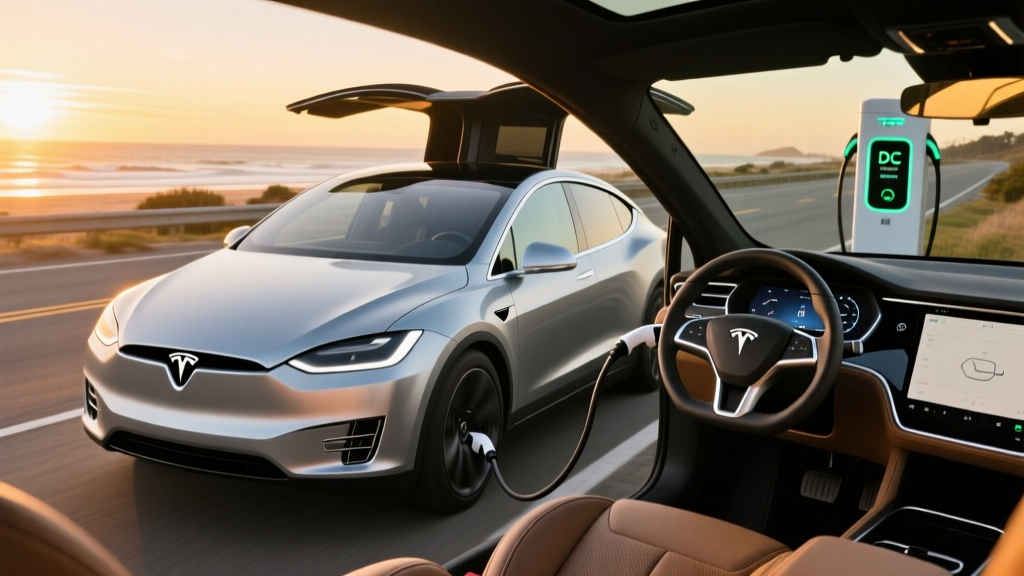
If you've been browsing Tesla Model X images online, you've likely noticed the vehicle's proportions are more minivan than traditional SUV — and that's deliberate. The sloping roofline and elongated wheelbase (116.7 inches) prioritize interior volume and aerodynamic efficiency (a 0.24 Cd drag coefficient) over upright styling. Key exterior features visible in any walkaround include:
- Falcon Wing rear doors: Double-hinged, sensor-actuated gullwing doors that open upward. They require only ~12 inches of lateral clearance — functional in tight parking spaces, though they add mechanical complexity.
- Panoramic windshield: The largest production-glass windshield in any passenger vehicle, extending over the front-row occupants' heads. It's UV- and IR-treated but offers no shade — a consideration in hot climates.
- Flush door handles and aero wheels: Standard 20-inch or optional 22-inch wheels, with the 20-inch set delivering the best range figures.
- Full LED lighting: Slim headlamp clusters and a full-width LED light bar at the rear.
The 2026 model year carries over the refreshed front fascia introduced previously, with a slightly reshaped bumper and updated ambient lighting signatures. Color options include Solid Black, Pearl White Multi-Coat, Deep Blue Metallic, Quicksilver, and Ultra Red.
Real-World Range: What the EPA Sticker Doesn't Tell You
Long Range AWD: EPA 335 miles → Expect ~280-305 miles on highway road trips (70-80 mph sustained); ~235-260 miles in freezing temperatures with cabin heat.
Plaid: EPA 326 miles → Expect ~270-295 miles highway; ~225-250 miles in freezing conditions.
Real-world range varies with speed, elevation, temperature, and HVAC use. Cold-weather losses of 20-30% are typical for NMC chemistry without consistent preconditioning.
The Model X's ~100 kWh usable battery uses NMC (nickel-manganese-cobalt) chemistry, which offers high energy density but is more temperature-sensitive than LFP. Tesla's heat pump — standard across the lineup — significantly reduces cold-weather cabin-heating energy draw compared to resistive heaters, but physics still applies: sub-32°F temperatures reduce effective range. On a 75°F day at 65 mph with light HVAC, owners consistently report hitting within 5-10% of the EPA sticker. Push speeds to 80+ mph or tow (5,000-lb max rating), and expect the lower end of the real-world estimates above.
Charging Speed: DC Fast, Level 2, and the Charge Curve
Charging speed is a top concern for three-row SUV buyers planning family road trips. Here's the full breakdown:
| Charging Level | Power | Miles Added per Hour | Typical Use Case |
|---|---|---|---|
| Level 1 (120V) | ~1.4 kW | ~3-4 mi/hr | Emergency / trickle top-off |
| Level 2 (240V, 48A) | 11.5 kW | ~34 mi/hr | Home overnight charging |
| DC Fast Charge | Up to 250 kW (peak) | ~750 mi/hr (peak) | Road trips, Supercharger network |
The charge curve matters more than peak kW. The Model X peaks at 250 kW only between roughly 10-30% state of charge. It then tapers progressively: ~150 kW at 50%, ~80 kW at 70%, and ~40 kW above 85%. A 10-80% session takes approximately 32 minutes at a V3 or V4 Supercharger. Plan road-trip stops around 20-25 minute charges from ~15% to ~75% for the fastest effective throughput. Charging past 80% is slow — only do it when your destination has no charger.
At home on a Tesla Wall Connector (48A/11.5 kW), a full overnight charge from 20% to 80% takes roughly 5.5 hours — easily covering daily needs. Note: kW (kilowatts) measures charging power, while kWh (kilowatt-hours) measures battery energy capacity. A 100 kWh battery charged at 11.5 kW takes ~8.7 hours from empty to full.
The Model X uses the NACS (North American Charging Standard) connector natively, granting access to 25,000+ Tesla Superchargers and a growing number of third-party networks adopting NACS. No adapter is needed at Superchargers; a CCS adapter is included for legacy non-Tesla DC stations.
Interior, Cargo, and Technology
The Model X cabin seats five (standard), six (optional captain's chairs with center console), or seven (compact third row). Realistically, the third row fits children or adults on short trips — legroom is 32.7 inches back there versus 41.2 inches in the second row. Cargo behind the third row is 15.8 cu ft; fold both rear rows flat and you access 85.1 cu ft, plus a 6.6 cu ft front trunk (frunk).
Tech highlights:
- 17-inch center touchscreen (landscape orientation) running Tesla's proprietary OS — responsive, feature-rich, but no Apple CarPlay or Android Auto.
- Yoke or round steering wheel: Both available; the yoke remains polarizing for low-speed maneuvering despite Tesla's variable-ratio steering.
- Rear 8-inch touchscreen: Controls climate, media, and gaming for second-row passengers.
- 22-speaker audio system with active road-noise reduction.
- Over-the-air updates: Continuous feature additions and UI improvements.
Notable drawbacks: Panel-gap consistency remains variable vs. German competitors. The minimalist interior lacks physical buttons for climate and wiper controls, routing everything through the touchscreen. The Falcon Wing doors, while dramatic, can be slow to operate in rain and have historically been a reliability concern, though newer generations are improved.
Driver Assistance: Autopilot and FSD (Supervised)
Tesla Autopilot and Full Self-Driving (Supervised) are Level 2 driver-assistance systems, not self-driving. The driver must remain fully engaged, hands on or near the wheel, and eyes on the road at all times. SAE Level 4 (true driverless operation in defined areas) is currently only available through robotaxi services like Waymo — not in any consumer vehicle.
Autopilot (standard) includes Traffic-Aware Cruise Control and Autosteer. FSD (Supervised), a $8,000 option or $99/month subscription, adds Navigate on Autopilot, Auto Lane Change, Autopark, Summon, and Smart Summon. In practice, FSD handles highway driving competently but requires active supervision — it can misread construction zones, struggle with unmapped intersections, and occasionally make unexpected lane-change decisions. Tesla's vision-only approach (no lidar or radar) differentiates it from competitors using sensor fusion, and real-world reliability varies by region and road conditions.
Pricing, Trims, and Federal Tax Credit Eligibility
| Trim | Base MSRP | Est. As-Tested* | §30D Federal Credit Eligible? |
|---|---|---|---|
| Long Range AWD | $79,990 | $85,000-$92,000 | No — exceeds $80,000 MSRP cap for SUVs |
| Plaid | $94,990 | $100,000-$115,000 | No — exceeds $80,000 MSRP cap for SUVs |
*As-tested includes destination fee, common options (FSD, premium paint, 22" wheels). Exact pricing varies by configuration.
Under current IRS §30D rules, new electric SUVs must have an MSRP at or below $80,000 to be eligible for the up-to-$7,500 federal tax credit. Both Model X trims exceed this cap, making them ineligible regardless of buyer income or battery-sourcing compliance. Additionally, buyer income caps apply ($300K MFJ / $150K single) and battery critical-mineral sourcing requirements must be met. Consult a tax professional for your specific situation. Some states offer separate rebates that may partially offset cost — check your state's energy office.
Ownership Costs, Warranty, and Who the Model X Suits
Tesla covers the Model X with a 4-year/50,000-mile basic warranty and an 8-year/150,000-mile battery and drive unit warranty (with a minimum 70% capacity retention guarantee). Insurance premiums run higher than average for the segment — expect $2,500-$4,000/year depending on your profile, driven by repair costs and vehicle value.
Who this EV suits best:
- Family road-trippers who need three rows, 300+ miles of range, and Supercharger network reliability for long-distance travel.
- Performance-oriented SUV buyers who want supercar-rivaling acceleration in a practical package.
- Tech-forward commuters who value OTA updates, a strong app ecosystem, and don't need CarPlay.
Who should look elsewhere: Budget-conscious buyers (the Model X starts near $80K with no federal credit), those who prioritize traditional luxury fit-and-finish (see BMW iX or Mercedes EQS SUV), or anyone needing best-in-class third-row space (the Rivian R1S and Kia EV9 offer more usable rear seating).
Pros
- Class-leading EPA range (335 mi Long Range)
- Access to 25,000+ Supercharger stations
- Staggering Plaid performance (2.5s 0-60)
- Spacious cargo area with seats folded (85 cu ft)
- Continuous OTA feature improvements
- Strong safety ratings (NHTSA 5-star)
Cons
- No federal tax credit (MSRP cap)
- Falcon Wing doors add complexity and cost
- Third row is tight for adults
- No Apple CarPlay or Android Auto
- Panel gaps and interior finish trail luxury rivals
- High insurance premiums
Frequently Asked Questions
What is the real-world range of the 2026 Tesla Model X?
The Long Range AWD is EPA-rated at 335 miles. In real-world highway driving at 70-80 mph, expect 280-305 miles. In freezing weather with cabin heat, plan for 235-260 miles. The Plaid delivers slightly less due to its tri-motor powertrain.
How fast does the Model X charge at home and on the road?
At home on a Level 2 Wall Connector (11.5 kW), it adds ~34 miles per hour — a full overnight session easily covers daily driving. On a 250 kW Supercharger, a 10-80% charge takes ~32 minutes, though peak speed only sustains through the first ~30% of the battery.
Does the Tesla Model X qualify for the federal EV tax credit?
No. Both trims exceed the IRS §30D $80,000 MSRP cap for SUVs. Buyer income limits and battery-sourcing rules would also apply, but the MSRP disqualifies the Model X regardless. Check your state for separate EV incentives.
Is the Model X worth buying vs. the Rivian R1S or BMW iX?
Choose the Model X if you prioritize Supercharger access, range, and straight-line performance. Choose the Rivian R1S if you need a more usable third row, better off-road capability, and a more rugged design. Choose the BMW iX if traditional luxury build quality, ride refinement, and dealer service matter most — though it has two rows only.
Are Falcon Wing doors reliable?
Tesla has significantly improved the Falcon Wing mechanism since the 2016 launch. Current-generation doors use ultrasonic sensors to detect obstacles and operate in tighter spaces. That said, they remain more complex than conventional doors and can be slower in wet weather. Factor in potential out-of-warranty repair costs for long-term ownership.
What warranty covers the Model X battery?
Tesla provides an 8-year/150,000-mile warranty on the battery and drive units, guaranteeing a minimum of 70% capacity retention over that period. If the battery degrades below 70% within the warranty window, Tesla will repair or replace it at no cost.