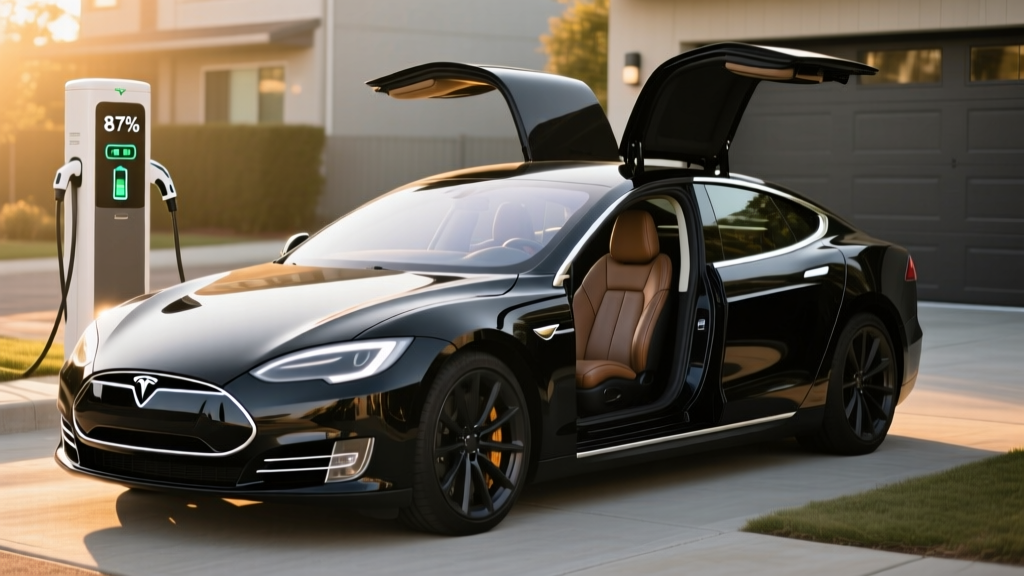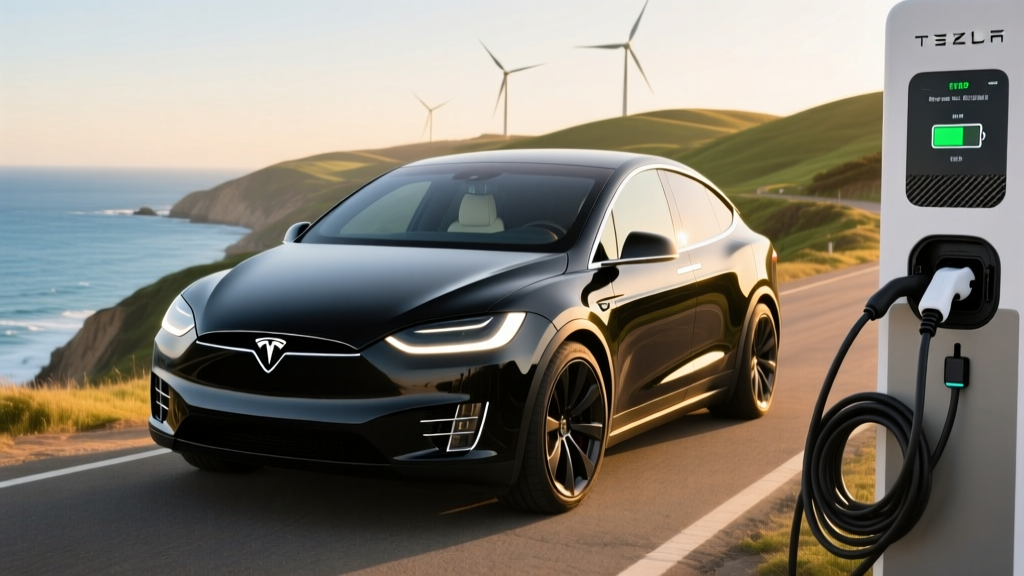
The Tesla Model X has occupied a singular position in the electric SUV market since its debut: a three-row, falcon-wing-doored, performance-oriented family hauler with no direct equivalent. For 2026, Tesla continues to offer the Model X in Long Range and Plaid trims, with incremental updates to efficiency, software, and charging infrastructure access. But at a starting price near $80,000, buyers need hard data — not marketing gloss — to determine whether this EV earns its premium.
This review draws on EPA figures, Tesla's published specifications, and real-world driving observations to give you the numbers that matter: actual highway range, sustained DC fast-charging speeds, total cost after incentives, and how the Model X stacks up against competitors like the Rivian R1S, BMW iX, and Mercedes EQS SUV.
Range and Efficiency: EPA Numbers vs. Real-World Reality
The 2026 Tesla Model X Long Range carries an EPA-estimated range of 335 miles on its roughly 100 kWh usable battery pack (NMC chemistry). The Plaid variant, with its tri-motor powertrain and higher energy consumption, drops to approximately 311 miles EPA. Efficiency for the Long Range lands around 100 MPGe combined (roughly 33 kWh/100 mi), while the Plaid sits closer to 92 MPGe.
EPA estimates assume a mix of city and highway driving at moderate temperatures. In practice:
- Highway-only (70-75 mph, 70°F): Expect ~280-300 miles in the Long Range. Aerodynamic drag hits tall SUVs harder at sustained speed.
- Cold weather (below 32°F): Range can drop 20-30%, yielding ~230-265 miles. The Model X includes a heat pump, which mitigates cabin-heating losses but cannot fully offset battery chemistry limitations in deep cold.
- City/regenerative driving: You may match or slightly exceed the EPA figure thanks to aggressive regen braking recapturing energy in stop-and-go traffic.
For context, a 300-mile road trip in 40°F weather with highway speeds will likely require a brief charging stop. Plan accordingly.
The 100 kWh (usable) NMC lithium-ion pack provides high energy density suited to the Model X's large frame and performance targets. Tesla does not currently offer an LFP option in the Model X — LFP's lower energy density would compromise either range or interior packaging in a vehicle this size.
Charging Speed: DC Fast, Level 2, and the Supercharger Advantage
Charging performance remains one of the Model X's strongest practical assets, particularly on Tesla's Supercharger network.
| Charging Level | Power / Rate | Speed / Time |
|---|---|---|
| DC Fast Charge (peak) | 250 kW (Supercharger V3) | 10-80% in ~30-35 minutes |
| DC Fast Charge (sustained avg.) | ~150-170 kW average | Adds ~175 miles in 15 min (Tesla est.) |
| Level 2 (home, 48A / 11.5 kW) | 11.5 kW | ~30-34 miles per hour of charging |
| Level 2 (home, 32A / 7.7 kW) | 7.7 kW | ~20-23 miles per hour of charging |
| Level 1 (120V outlet) | ~1.4 kW | ~3-4 miles per hour (emergency only) |
A few nuances matter for ownership:
- Charge curve taper: The 250 kW peak applies only at low state-of-charge (roughly 10-30%). Above 50%, the rate tapers significantly; above 80%, charging slows dramatically to protect battery health. This is normal for NMC packs but means the last 20% takes nearly as long as the first 60%.
- Supercharger network: With Tesla's NACS connector native to the vehicle, Supercharger access is seamless — no adapter needed. Tesla has opened portions of its network to other brands via adapters, but Model X owners retain the plug-and-charge advantage.
- CCS compatibility: The Model X uses NACS natively. For non-Tesla DC fast chargers (Electrify America, EVgo, etc.), Tesla provides a CCS adapter (included or available depending on model year), enabling access to the broader charging ecosystem.
- Home charging: A Tesla Wall Connector on a 60A circuit (48A continuous) delivers the full 11.5 kW, adding roughly 34 miles of range per hour. Overnight charging from 20-80% takes about 5-6 hours — ample for daily use.
Preconditioning the battery (automatically initiated when you navigate to a Supercharger) is essential for achieving peak charge rates in cold weather. Without it, charging speeds can be cut in half until the pack warms up.
Performance and Drivetrain
| Specification | Model X Long Range | Model X Plaid |
|---|---|---|
| Drivetrain | Dual-Motor AWD | Tri-Motor AWD |
| Horsepower | ~670 hp | ~1,020 hp |
| 0-60 mph | 3.8 seconds | 2.5 seconds |
| Top Speed | 155 mph | 163 mph |
| EPA Range | 335 miles | 311 miles |
| Battery (usable) | ~100 kWh, NMC | ~100 kWh, NMC |
The Long Range's 3.8-second 0-60 time already outpaces most V8-powered SUVs from the gasoline era. The Plaid's 2.5 seconds enters supercar territory — a remarkable figure for a 5,000+ pound vehicle with three rows of seats. In real-world driving, the instant torque delivery makes even the Long Range feel explosively quick off the line and in highway passing maneuvers.
Adaptive air suspension is standard, providing adjustable ride height for aerodynamic efficiency at highway speed or extra ground clearance for rough roads. Towing capacity reaches 5,000 pounds when properly equipped — adequate for a small boat or light camper trailer, though competitors like the Rivian R1S (up to 7,700 lbs) offer more capability.
Interior, Cargo, and Technology
The Model X seats up to seven passengers in its standard configuration (2-3-2 layout), with an optional six-seat layout (2-2-2) featuring second-row captain's chairs. Cargo volume is generous:
- Behind third row: ~37 cu ft (with seats up)
- Behind second row (third row folded): ~75 cu ft
- Total cargo (all rear seats folded): ~85 cu ft
- Front trunk (frunk): ~6.5 cu ft — useful for groceries or a charging cable kit
Legroom is adequate across all rows, though the third row is best suited for children or shorter adults on longer trips — a common compromise in three-row SUVs regardless of powertrain.
The 17-inch center touchscreen (landscape orientation, tilted slightly toward the driver in current models) handles all infotainment, navigation, and vehicle controls. A secondary 8-inch screen for second-row passengers controls climate and entertainment. The yoke-style steering wheel remains available, though a conventional round wheel is now the default option. Wireless phone charging, a 22-speaker audio system, and HEPA air filtration (with Bioweapon Defense Mode) round out the tech roster.
Notable drawbacks include panel-gap inconsistencies that persist across Tesla's production, the absence of Apple CarPlay and Android Auto (Tesla relies on its proprietary interface), and the learning curve of navigating all vehicle settings through the touchscreen with minimal physical buttons.
Pricing, Trims, and Federal Tax Credit Eligibility
| Trim | Base MSRP | Est. After §30D Credit |
|---|---|---|
| Model X Long Range | $79,990 | See eligibility below* |
| Model X Plaid | $94,990 | See eligibility below* |
*Destination fees, options, and delivery charges add to the final price. As-tested pricing on a well-equipped Long Range typically lands between $85,000-$92,000.
Federal tax credit (§30D) reality check: The Model X Long Range's $79,990 MSRP falls under the IRS SUV MSRP cap of $80,000, making it potentially eligible for up to $7,500 in federal tax credits — but only if all of the following conditions are met:
- Buyer income limits: Modified adjusted gross income must not exceed $300,000 (joint filers), $225,000 (head of household), or $150,000 (single filers).
- Battery sourcing requirements: The vehicle must meet critical minerals and battery component sourcing thresholds set by the IRS. These thresholds tighten annually and vary by model year and production batch. Check Tesla's official eligibility disclosure and IRS guidance on new clean vehicle credits before relying on this incentive.
- Point-of-sale transfer: As of 2024, eligible buyers can transfer the credit to the dealer at purchase, reducing the upfront cost rather than waiting for a tax refund. This option is available for the Model X if all other criteria are met.
The Model X Plaid, at $94,990, exceeds the $80,000 SUV MSRP cap and does not qualify for the federal §30D credit regardless of buyer income or battery sourcing. This is a firm rule with no workaround.
State and local incentives may apply independently — check your state's EV rebate programs and your utility company's charging incentives, as these stack with federal credits where available.
Driver Assistance and Safety
Tesla's Autopilot and Full Self-Driving (Supervised) are Level 2 driver-assistance systems per SAE International classifications. The driver must remain fully engaged, hands on or near the wheel, and eyes on the road at all times. These systems do not make the vehicle self-driving. Only Level 4 services (like Waymo robotaxis operating in geofenced areas) qualify as driverless.
Autopilot (standard) includes adaptive cruise control, lane-keeping assist, and automatic emergency braking. Full Self-Driving (Supervised), available as a $8,000 option or subscription, adds automatic lane changes, Navigate on Autopilot (highway on/off-ramp routing), traffic light and stop sign recognition, and Autopark. In practice, FSD (Supervised) reduces highway driving fatigue significantly but requires constant vigilance — it can misinterpret construction zones, make unexpected lane-change decisions, and occasionally fail to detect stationary objects.
The Model X has earned strong safety ratings, including a 5-star overall rating from NHTSA. Standard active safety features include automatic emergency braking, blind-spot monitoring, side collision warning, and emergency lane departure avoidance.
- It does not drive autonomously without supervision
- It does not handle all weather conditions (heavy rain, snow, fog degrade performance)
- It does not eliminate the driver's legal responsibility for the vehicle
- It is not a substitute for attentive driving in construction zones, school zones, or unmapped areas
Ownership Costs and Warranty
Tesla covers the Model X with the following warranty terms:
- Basic vehicle: 4 years / 50,000 miles
- Battery and drive unit: 8 years / 150,000 miles (with minimum 70% capacity retention guaranteed)
The 150,000-mile battery warranty is competitive with luxury EV rivals. Tesla's NMC packs have demonstrated relatively slow degradation in fleet data — most owners report 5-10% capacity loss over the first 100,000 miles, though individual results vary based on charging habits, climate, and Supercharger frequency.
Operating costs favor the Model X against comparable gasoline SUVs. At a national average electricity rate of ~$0.16/kWh and 33 kWh/100 mi, fueling costs roughly $5.28 per 100 miles. A gasoline SUV achieving 20 MPG at $3.50/gallon costs $17.50 per 100 miles — a savings of over $12 per 100 miles, or roughly $1,800 annually at 15,000 miles/year.
Insurance premiums tend to run higher than average for the Model X due to repair costs and performance classification — expect quotes 20-40% above a comparably priced gasoline SUV. Tesla offers its own insurance product in many states, which can sometimes provide competitive rates.
Pros, Cons, and Who Should Buy the Model X
- Class-leading Supercharger network access with NACS native plug
- 335-mile EPA range (Long Range) handles most road trips with one stop
- Supercar-level acceleration even in the non-Plaid trim
- Three-row seating with usable cargo space and a frunk
- Over-the-air updates continuously add features
- 5,000-lb towing capacity covers light-duty needs
- Heat pump standard for improved cold-weather efficiency
- Plaid trim exceeds $80K MSRP cap — no federal tax credit
- Falcon-wing doors can be problematic in tight garages and in heavy rain/snow
- No Apple CarPlay or Android Auto integration
- Panel gap quality remains inconsistent
- Third row is tight for adults on long trips
- Insurance premiums are above average
- FSD (Supervised) requires $8,000 extra and still demands full driver attention
- You need three rows and prioritize Supercharger network convenience for family road trips
- You want supercar acceleration in a practical SUV package
- You can charge at home and your daily driving fits within ~250 real-world miles
- You value OTA updates and Tesla's software ecosystem
- You need maximum towing capacity (Rivian R1S tows 7,700 lbs)
- You prefer traditional luxury build quality and dealer service (BMW iX, Mercedes EQS SUV)
- Third-row adult comfort is a priority (consider a minivan or larger ICE/PHEV SUV)
- You want Apple CarPlay or physical buttons for climate/media controls
Frequently Asked Questions
What is the real-world range of the 2026 Tesla Model X?
The EPA rates the Long Range at 335 miles and the Plaid at 311 miles. In real-world highway driving at moderate temperatures, expect 280-300 miles (Long Range). In cold weather below freezing, range can drop to 230-265 miles. City driving with regenerative braking may match or slightly exceed EPA figures.
How fast does the Model X charge on DC fast chargers and at home?
On a Tesla Supercharger V3, the Model X peaks at 250 kW and charges from 10-80% in approximately 30-35 minutes, though the sustained average is closer to 150-170 kW due to charge-curve taper. At home on a 48A Level 2 Wall Connector (11.5 kW), it adds roughly 34 miles of range per hour, fully replenishing overnight.
Does the Tesla Model X qualify for the federal EV tax credit?
The Long Range trim at $79,990 MSRP falls under the $80,000 SUV cap and may qualify for up to $7,500 if the buyer meets IRS §30D income limits and the vehicle meets battery sourcing requirements. The Plaid at $94,990 exceeds the MSRP cap and does not qualify. Always verify current eligibility before purchase.
Is the Model X worth buying versus the Rivian R1S or BMW iX?
The Model X wins on Supercharger convenience, range, and straight-line acceleration. The Rivian R1S offers superior off-road capability, higher towing capacity (7,700 lbs), and a more adventure-oriented design. The BMW iX delivers better interior build quality, a more refined ride, and Apple CarPlay — but with less range and no third row. Your choice depends on whether network access (Tesla), adventure capability (Rivian), or luxury refinement (BMW) matters most.
How long will the Model X battery last?
Tesla warranties the battery for 8 years or 150,000 miles with a minimum 70% capacity retention guarantee. Real-world fleet data suggests NMC packs in Teslas typically lose 5-10% capacity over 100,000 miles, meaning most owners will retain 90%+ capacity well within the warranty period. Minimizing frequent 100% charges and excessive Supercharger use can extend longevity.
Is FSD (Supervised) actually self-driving?
No. FSD (Supervised) is a Level 2 driver-assistance system. It requires the driver to remain fully attentive, with hands near the wheel and eyes on the road. It does not replace the driver and does not operate autonomously. Only Level 4 robotaxi services like Waymo operate without a human driver, and those are limited to specific geofenced areas.