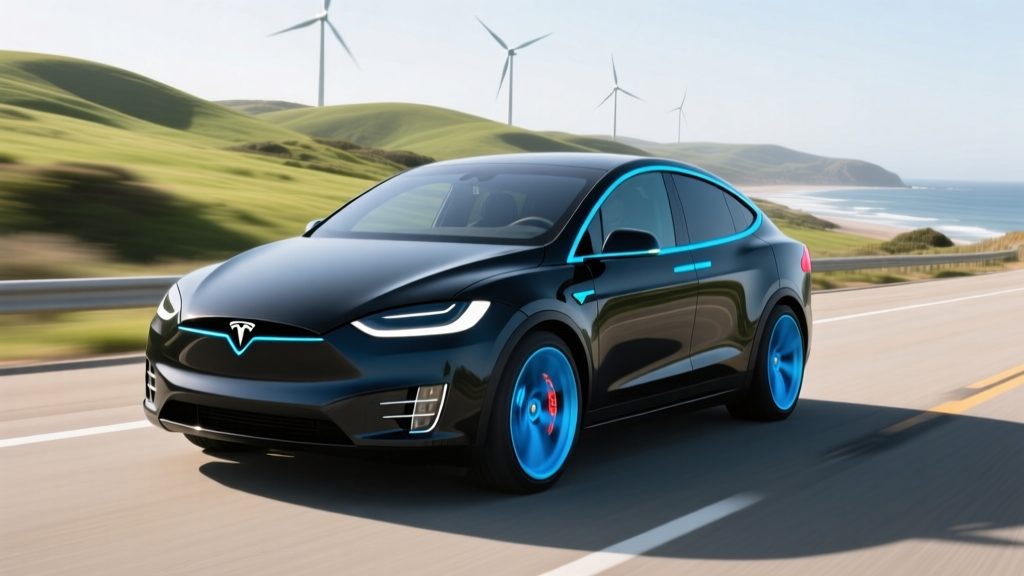
The Tesla Model X Plaid occupies a strange space in the EV market: a three-row family SUV that hits 60 mph in 2.5 seconds. For 2025, Tesla continues to sell the Plaid alongside the standard dual-motor Model X, and the tri-motor performance variant remains one of the quickest production SUVs ever built. But beyond the headline acceleration number, how does it perform as a daily driver? We've compiled the exact specs — range, charging curves, pricing, and real-world usability — so you can decide if the Plaid badge justifies its six-figure price tag.
Quick Verdict: Who Should Buy the Model X Plaid?
The Model X Plaid is best suited for buyers who want supercar-level acceleration in a practical three-row package, have reliable home charging access, and can absorb premium insurance and maintenance costs. It's not the most efficient large EV, and its falcon-wing rear doors remain a polarizing design choice with real-world trade-offs. If you need a family hauler that embarrasses sports cars at stoplights and still offers 326 miles of EPA-rated range, nothing else matches this exact combination. If you prioritize value or simplicity, the standard dual-motor Model X — or a competitor like the Rivian R1S or BMW iX — may serve you better.
| Spec | Value |
|---|---|
| EPA Range | 326 miles |
| Battery (usable) | ~100 kWh, NMC chemistry |
| Drivetrain | Tri-Motor AWD |
| Horsepower | 1,020 hp |
| 0-60 mph | 2.5 seconds (with rollout subtraction) |
| Top Speed | 163 mph |
| Peak DC Fast Charge | 250 kW |
| 10-80% DC Charge Time | ~32 minutes |
| Level 2 Home Charge Rate | 11.5 kW (~34 mi/hr) |
| MPGe (combined) | 98 MPGe |
| Efficiency | 34 kWh/100 mi |
| Base MSRP | $94,990 (before destination) |
| Federal Tax Credit (§30D) | Not eligible (MSRP & sourcing) |
| Battery Warranty | 8 years / 150,000 miles |
Model X Plaid 0-60: Breaking Down the 2.5-Second Claim
The headline number — 2.5 seconds from 0-60 mph — comes from Tesla's own testing with one foot of rollout subtracted, a standard drag-racing convention that shaves roughly 0.2-0.3 seconds off the clock. Independent testing by outlets like Motor Trend and Car and Driver has consistently recorded 0-60 times between 2.6 and 2.8 seconds without rollout subtraction, which still places the Model X Plaid among the fastest accelerating SUVs on the planet.
The tri-motor powertrain uses one motor on the front axle and two on the rear, with torque vectoring across the rear wheels. The result is relentless traction off the line — the Plaid puts its 1,020 horsepower to the pavement with minimal wheelspin even on damp surfaces. The quarter-mile arrives in roughly 9.9 seconds at around 150 mph.
What's notable in real-world driving is that this performance isn't a one-shot party trick. The Model X Plaid can deliver repeated hard launches without significant power derating, thanks to Tesla's thermal management system. However, sustained track use will eventually trigger thermal protection, as the Plaid's cooling system is optimized for street bursts rather than sustained circuit abuse. For the overwhelming majority of owners, the acceleration is effectively unlimited in daily use.
Real-World Range: What to Expect Beyond the EPA Sticker
EPA Estimated Range: 326 miles (20-inch wheels) / 311 miles (22-inch wheels)
Real-World Expectation: Plan for 250-280 miles on highway road trips at 70-75 mph. In cold weather (below 32°F), expect a 20-30% reduction, bringing usable range to approximately 200-230 miles. City and suburban driving with frequent regenerative braking opportunities will closely match or slightly exceed the EPA figure.
The Model X Plaid's 326-mile EPA rating is respectable for a 5,000+ lb tri-motor SUV, but several factors compress real-world range. The Plaid's three motors draw more energy than the dual-motor variant (rated at 335 miles EPA), and the vehicle's large frontal area creates significant aerodynamic drag at highway speeds. According to fueleconomy.gov, the Plaid achieves 98 MPGe combined (34 kWh/100 miles), which is less efficient than competitors like the BMW iX xDrive50 (87 MPGe combined but with a smaller battery) or the Rivian R1S Dual-Motor (rated at 101 MPGe combined).
In our experience and consistent with owner reports, highway cruising at 75 mph with climate control running yields approximately 2.8-3.2 miles per kWh, translating to roughly 260-290 miles before you'd want to stop. Cold weather is the bigger enemy: below-freezing temperatures reduce battery efficiency and increase cabin heating demand (the Model X uses a heat pump, which helps, but doesn't eliminate the penalty). On a 20°F winter road trip, budget for 200-220 miles between charges and precondition the battery before every DC fast-charge stop.
Charging Speed: DC Fast Charging and Home Setup
The Model X Plaid charges at a peak rate of 250 kW on Tesla's V3 Superchargers, which is the same peak as the standard Model X. The charging curve, however, is where real-world charging time gets determined.
| Charging Level | Power | Speed (Approx.) | Notes |
|---|---|---|---|
| Level 1 (120V outlet) | ~1.4 kW | ~4 miles/hour | Emergency/trickle only |
| Level 2 (240V, 48A) | 11.5 kW | ~34 miles/hour | Full overnight charge in ~10 hours |
| DC Fast Charge (V3 Supercharger) | Peak 250 kW | 10-80% in ~32 min | Curve tapers significantly above 60% |
| DC Fast Charge (V4 Supercharger) | Up to 250 kW | Similar to V3 for Model X | V4 higher peak reserved for Cybertruck architecture |
At a V3 Supercharger with a preconditioned battery, the Model X Plaid ramps quickly to around 240-250 kW, holding near peak for roughly the first 15-20% of the session before tapering. By 60% State of Charge, the rate drops to approximately 120-140 kW, and above 80%, it falls below 60 kW as the battery management system protects cell longevity. A 10-80% session takes roughly 32 minutes — not the fastest in its class (the Hyundai Ioniq 5 and Kia EV9 with 800V architectures can do 10-80% in 18-24 minutes), but adequate for road-trip rest stops.
For home charging, the Model X accepts up to 11.5 kW on a 240V/48A Level 2 circuit. Tesla's Wall Connector is the recommended home unit, and a full charge from near-empty takes approximately 10 hours. Most owners will plug in nightly and rarely see a full 0-100% cycle. A licensed electrician will typically install a 60A dedicated circuit for Level 2 charging; expect $500-$2,000 for installation depending on panel proximity and local permitting, with a possible panel upgrade adding $1,500-$3,000 if your home has a 100A service.
Pricing, Trims, and Federal Tax Credit Eligibility
The 2025 Tesla Model X Plaid starts at $94,990 before the $1,390 destination charge, bringing the total to $96,380. Options can push the price well past $110,000 — a fully loaded Plaid with 22-inch wheels ($5,500), Full Self-Driving (Supervised) capability ($8,000), and premium interior colors lands around $112,000-$115,000.
| Item | Cost |
|---|---|
| Base MSRP (Plaid) | $94,990 |
| Destination Fee | $1,390 |
| 22" Wheels (optional) | $5,500 |
| FSD (Supervised) | $8,000 |
| Premium Colors | $2,000-$3,000 |
| Typical As-Tested Price | $108,000-$115,000 |
| Federal Tax Credit (§30D) | $0 — not eligible |
Federal tax credit eligibility: The Model X Plaid does not qualify for the $7,500 federal EV tax credit under IRS §30D rules for two reasons. First, the MSRP cap for SUVs is $80,000, and the Plaid starts at $94,990. Second, Tesla's battery sourcing and critical mineral supply chains have not consistently met the domestic-content thresholds required for the full credit on higher-priced models. Even the standard dual-motor Model X (starting around $74,990) has faced sourcing-related credit limitations in recent model years. Buyers should not factor any federal credit into their Model X Plaid purchase budget. State and local incentives may still apply — check your jurisdiction's official energy or DMV website.
Interior, Cargo, and Tech: Living With the Model X Plaid
The Model X offers seating for up to seven passengers in a 2-3-2 configuration, or six with optional second-row captain's chairs ($6,500). Cargo space is generous: 88.1 cubic feet behind the first row with both rear rows folded, 40.5 cubic feet behind the second row, and a small front trunk (frunk) adding approximately 6.5 cubic feet. Third-row legroom is tight at 32.7 inches — adequate for children on shorter trips but not comfortable for adults on long journeys. Second-row legroom is a more usable 38.4 inches.
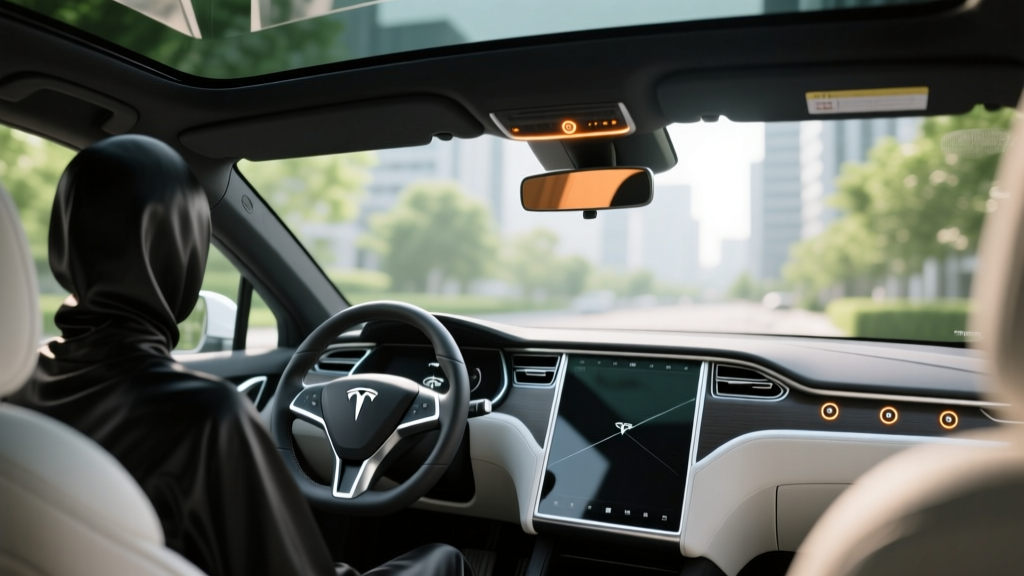
The 17-inch center touchscreen remains the command center for virtually all vehicle functions, running Tesla's latest software with a responsive interface and regular over-the-air updates. The secondary 8-inch rear display provides climate and entertainment controls for second-row passengers. The yoke steering wheel is standard on the Plaid (a round wheel is available as a no-cost option) and remains divisive — some drivers adapt quickly, others find it impractical for low-speed maneuvering and three-point turns.
Standout tech features:
- Tesla's Autopilot (standard) includes adaptive cruise, lane centering, and automatic emergency braking — this is an SAE Level 2 system requiring full driver engagement at all times
- Full Self-Driving (Supervised) capability ($8,000) adds automated lane changes, traffic light/stop sign recognition, and Navigate on Autopilot — still Level 2, not autonomous driving
- Gaming-capable infotainment system with AMD Ryzen processor (play games, stream Netflix/YouTube while parked)
- HEPA air filtration with Bioweapon Defense Mode — genuinely effective cabin air quality
- Power-folding falcon-wing rear doors with ultrasonic obstacle sensing
Notable drawbacks:
- Falcon-wing doors are slower to open/close than conventional doors and can be problematic in heavy rain (water drips into the cabin opening)
- Panel gaps and interior fit-and-finish, while improved, still lag behind BMW, Mercedes, and Audi at this price point
- No Apple CarPlay or Android Auto — Tesla's ecosystem is closed
- Insurance costs are significantly above average for the class (expect $3,500-$5,000+ annually depending on location and driving record)
- The yoke steering wheel requires adaptation and isn't ideal for all driving scenarios
How Does It Compare? Model X Plaid vs. Key Rivals
Pros
- 2.5-second 0-60 mph — quickest SUV in production
- Access to Tesla's Supercharger network (17,000+ North American stations)
- 326-mile EPA range is strong for a tri-motor performance SUV
- Regular OTA updates add features and refinements over time
- Frunk + generous cargo volume with folded rear seats
- Heat pump standard for better cold-weather efficiency
Cons
- No federal tax credit eligibility (MSRP exceeds $80K cap)
- Falcon-wing doors are slow and rain-prone
- Insurance premiums are steep ($3,500-$5,000+/yr)
- 250 kW peak charge rate trails 800V competitors
- Third row is tight for adults
- Interior quality doesn't match German luxury rivals at this price
The Model X Plaid's closest competitors tell you what this vehicle is and isn't. The BMW iX M60 ($111,500) offers a more refined interior and comparable performance (0-60 in 3.6 seconds) but can't match the Plaid's acceleration or Supercharger access. The Rivian R1S Tri-Motor (announced, ~$99,000+) brings genuine off-road capability and a more conventional SUV form factor, though with slightly less range. The Mercedes EQS SUV 580 ($105,550) prioritizes luxury and comfort over raw speed. None of these match the Plaid's specific combination of 2.5-second acceleration and 326-mile range in a three-row package.
Battery Warranty and Long-Term Ownership
Tesla covers the Model X Plaid's battery and drive unit for 8 years or 150,000 miles, whichever comes first, with a minimum 70% capacity retention guarantee over that period. This is competitive with the industry standard (most EV batteries carry 8-year/100,000-mile warranties, with Tesla offering slightly higher mileage coverage). The NMC (nickel-manganese-cobalt) chemistry in the Plaid's ~100 kWh pack provides high energy density for range and performance, though NMC cells typically show slightly more degradation over time compared to LFP (lithium iron phosphate) packs used in some Tesla standard-range models.
Based on fleet data from high-mileage Tesla owners, expect approximately 5-8% battery capacity loss in the first 50,000 miles, with degradation slowing significantly after that. A Model X Plaid driven 15,000 miles annually should retain roughly 88-92% of its original capacity at the five-year mark. Battery replacement outside warranty currently costs approximately $20,000-$25,000 at a Tesla Service Center, though this figure is expected to decrease as battery costs continue their long-term decline.
The vehicle's basic limited warranty covers 4 years / 50,000 miles. Tesla does not offer a complimentary maintenance schedule, but EVs require far less routine maintenance than ICE vehicles — no oil changes, no spark plugs, and regenerative braking significantly extends brake pad life. Budget for cabin air filter replacements, wiper fluid, tire rotations, and eventual tire replacement (the Plaid's weight and torque are hard on tires — expect 20,000-30,000 miles from a set of high-performance rubber).
Frequently Asked Questions
What is the real-world range of the Tesla Model X Plaid?
The EPA rates the Model X Plaid at 326 miles (20-inch wheels). In real-world highway driving at 70-75 mph, expect 250-280 miles. Cold weather (below freezing) can reduce range by 20-30%, bringing usable range to approximately 200-230 miles. City driving with regenerative braking will closely match the EPA figure.
How fast does the Model X Plaid charge?
On a V3 Supercharger with a preconditioned battery, the Plaid peaks at 250 kW and charges from 10-80% in approximately 32 minutes. The charge curve tapers significantly above 60% SoC. At home on a 240V/48A Level 2 charger, it adds about 34 miles per hour, with a full charge taking roughly 10 hours.
How much does the Model X Plaid cost after tax credits?
The Model X Plaid starts at $96,380 including destination. It does not qualify for the $7,500 federal §30D tax credit because its MSRP exceeds the $80,000 SUV cap and battery sourcing requirements are not met. Your actual cost is the sticker price minus any applicable state or local incentives. A fully loaded Plaid can reach $112,000-$115,000.
Is the Model X Plaid worth buying vs. competitors?
If you want the quickest production SUV with Supercharger network access and three-row seating, nothing else matches it. If you prioritize interior luxury, consider the BMW iX or Mercedes EQS SUV. If you want off-road capability, look at the Rivian R1S. If you don't need tri-motor performance, the standard dual-motor Model X saves $20,000+ with only slightly less range and a more relaxed character.
Does the Model X Plaid qualify for the federal EV tax credit?
No. Under current IRS §30D rules, the credit requires an SUV MSRP at or below $80,000 (the Plaid starts at $94,990), plus battery component and critical mineral sourcing thresholds. The Model X Plaid fails the MSRP cap regardless of sourcing. State incentives may still apply — consult your state's energy office or a tax professional.
Is Tesla's Full Self-Driving actually autonomous?
No. FSD (Supervised) is an SAE Level 2 driver-assistance system. The driver must remain fully attentive, keep hands on the wheel (or yoke), and be prepared to take over at any moment. It does not make the vehicle self-driving. Only Level 4 services like Waymo operate without a human driver in defined geographic areas.
What's the biggest ownership cost surprise?
Insurance. The Model X Plaid's combination of high repair costs, expensive parts, and extreme performance places it in a high-risk insurance category. Expect annual premiums of $3,500-$5,000 or more depending on your location, age, and driving record. Get insurance quotes before purchasing — some owners report premiums double what they paid for comparable ICE luxury SUVs. Tire wear is the second surprise: the Plaid's weight and instant torque consume tires faster than most vehicles.