Quick Verdict: A 2016 Icon Showing Its Age
The Tesla Model X P90D occupies a strange place in the used EV market in 2026. Originally launched for the 2016 model year, this dual-motor, all-wheel-drive SUV packed 532 horsepower, falcon-wing rear doors, and a 90 kWh NMC battery that earned a 250-mile EPA range estimate. A decade later, it remains one of the most recognizable electric SUVs on the road — but prospective buyers need to understand what a 10-year-old battery, outdated Supercharger hardware, and discontinued-trim realities mean for daily ownership.
If you're shopping for a used Model X P90D, this guide breaks down the real-world range you can expect from an aged pack, the charging speeds on both DC fast chargers and home Level 2 setups, total cost of ownership, and how it stacks up against newer used EVs in the same price bracket.
| Spec | Value |
|---|---|
| EPA Range (original) | 250 miles |
| Battery Capacity (usable) | ~85 kWh (90 kWh pack, NMC) |
| Drivetrain | Dual-Motor AWD |
| Horsepower | 532 hp (combined) |
| 0-60 mph | 3.2 sec (with Ludicrous Mode) |
| Peak DC Fast Charge | ~120 kW (Supercharger V2) |
| 10-80% DC Charge Time | ~45-50 minutes |
| Level 2 Home Charge Rate | ~11.5 kW (48A) / ~30 mi/hr |
| Efficiency | 89 MPGe combined / 38 kWh/100 mi |
| Cargo Volume (behind 2nd row) | 57.2 cu ft (5-seat config) |
| Seating | 5, 6, or 7 passengers |
| Battery Warranty (original) | 8 yr / 150,000 mi |
| Original MSRP (2016) | ~$115,000-$135,000 (as equipped) |
| Used Market Price (2026 est.) | $28,000-$42,000 |
Real-World Range: What the EPA Sticker Doesn't Tell You
Expected Real-World Range in 2026: 175-210 miles depending on battery health, driving style, and climate
The 250-mile EPA figure was measured on a brand-new 90 kWh NMC (nickel-manganese-cobalt) pack in 2016. According to fueleconomy.gov, the Model X 90D variant (the non-Performance twin) rated at 257 miles, while the P90D's sportier tuning and wider tire options dropped it slightly to 250 miles.
Here's the reality for a 2026 buyer: NMC batteries from this era typically show 12-20% capacity loss after 8-10 years and 80,000-120,000 miles. That degradation curve isn't linear — most loss happens in the first 2-3 years, then slows. But you're buying on the back end of that curve now.
Highway driving at 75 mph consistently yields 10-15% less range than the EPA combined figure, even on a healthy pack. Expect 180-195 miles from a well-maintained P90D on a flat highway run in moderate temperatures (60-75°F).
Cold weather hits the Model X hard. Tesla's early thermal management system lacks the heat pump found in the 2021+ refresh. In sub-30°F conditions, range loss of 25-35% is typical, driven by cabin resistive heating and battery warming demands. A 250-mile sticker becomes roughly 160-175 miles in a northern winter.
Battery State of Health (SoH) check: Before purchasing any used P90D, pull the battery health report through the Tesla service menu or a third-party OBD-II tool. Packs below 80% SoH should trigger a price reduction of $8,000-$15,000 to account for potential replacement — a full Model X battery replacement runs $14,000-$22,000 at a Tesla Service Center in 2026.
Charging Speeds: Supercharger V2 Limits and Home Setup
The P90D's charging architecture reflects 2016 hardware, and this is where used buyers need to calibrate expectations against newer EVs with 800V architectures and 250+ kW peak rates.
| Charging Level | Power | Speed | Notes |
|---|---|---|---|
| Level 1 (120V household) | ~1.4 kW | ~3-4 mi/hr | Emergency/trickle only; full charge in ~60+ hours |
| Level 2 (240V home, 48A) | ~11.5 kW | ~30 mi/hr | Full charge in ~8 hours; ideal daily charging |
| Level 2 (public, 40A) | ~9.6 kW | ~25 mi/hr | Common at destination chargers and older public stations |
| DC Fast (Supercharger V2) | ~120 kW peak | 10-80% in ~45-50 min | Peak rate not sustained; tapers significantly above 60% |
| DC Fast (Supercharger V3) | ~120 kW (car-limited) | 10-80% in ~45 min | V3 stalls cap the P90D at its onboard limit; no benefit over V2 |
| CCS Adapter (third-party DCFC) | ~100-120 kW | 10-80% in ~50 min | Tesla's CCS1 adapter works; speeds limited by car, not station |
The charge curve matters. The P90D peaks near 120 kW only between roughly 10-30% State of Charge (SoC). By 50%, it's already tapered to 70-80 kW. Above 80%, expect 30-40 kW as the battery management system protects the NMC cells. This means the last 20% takes almost as long as the first 50%.
Home charging recommendation: Install a Tesla Wall Connector (Gen 3, ~$450) on a 60-amp dedicated circuit. The P90D's onboard charger accepts up to 48 amps (11.5 kW), giving you roughly 30 miles of range per hour of charging. A full overnight charge from 20% to 90% takes about 6-7 hours. Budget $800-$1,500 for professional electrical installation depending on your panel capacity and run distance — confirm with a licensed electrician whether your 200-amp service panel has headroom.
Preconditioning is essential. Always navigate to a Supercharger using the car's built-in navigation. This triggers battery preconditioning, warming the pack to optimize charge acceptance. Show up cold and your peak rate may drop to 60-80 kW for the first several minutes, adding 10-15 minutes to your stop.
Performance and Driving Dynamics
The P90D's dual-motor AWD powertrain delivers 532 horsepower and a Ludicrous Mode 0-60 mph time of 3.2 seconds — numbers that still embarrass many performance SUVs in 2026, gas or electric. The instant torque delivery and low center of gravity (battery pack mounted under the floor) make it feel quicker than the numbers suggest in everyday driving.
However, the Model X's 5,271-pound curb weight is noticeable through corners. Body roll is well-controlled by the adaptive air suspension, but this is a straight-line performer that happens to have all-wheel-drive traction, not a sports car. The electromechanical steering is precise but numb — a common Tesla trait from this era.
Air suspension note: The P90D's Smart Air Suspension is a delight when it works, offering adjustable ride height for clearance and efficiency. But replacement air struts cost $1,500-$2,500 per corner, and 10-year-old units are reaching end-of-life. Budget for this or negotiate the purchase price accordingly.
Interior, Cargo, and Technology
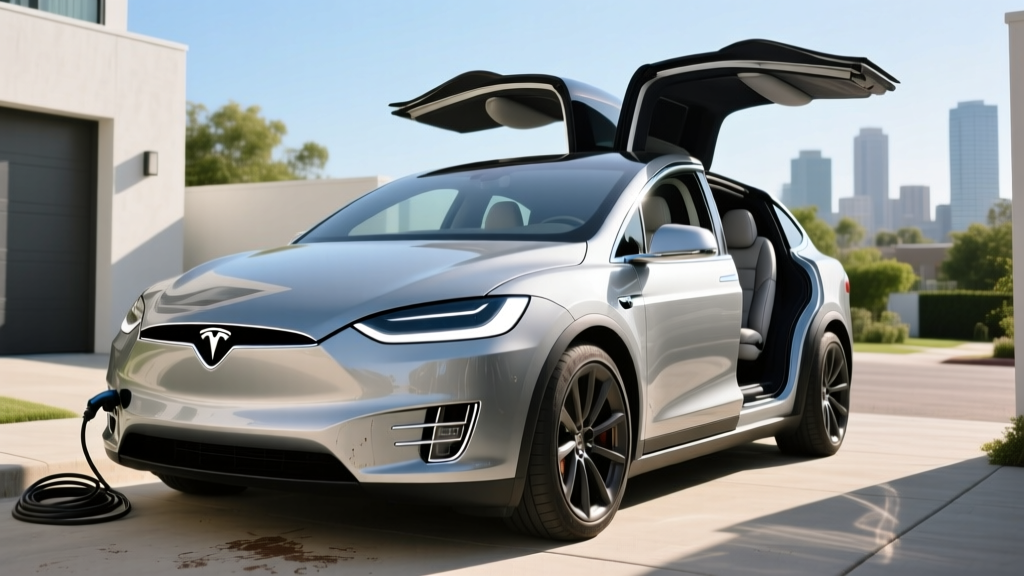
The Model X P90D's party trick remains its falcon-wing rear doors. They're dramatic, practical for loading child seats in tight parking spaces, and equipped with ultrasonic sensors to avoid overhead obstacles. They also developed a reputation for water leaks and sensor glitches in early production — check door seals and operation carefully on any used example.
Cargo capacity is generous: 57.2 cubic feet behind the second row in five-seat configuration, expanding to 88.1 cubic feet with both rear rows folded. The front trunk (frunk) adds 6.6 cubic feet — useful for charging cables or a small bag. In the seven-seat configuration, cargo space behind the third row shrinks to a tight 9.1 cubic feet.
Infotainment: The P90D originally shipped with a 17-inch touchscreen running Tesla's MCU1 (Media Control Unit). This older processor is noticeably sluggish by 2026 standards — slow map rendering, delayed app responses, and limited gaming capability. Tesla offered an MCU2 upgrade ($2,000-$2,500) that significantly improves responsiveness and enables features like the modern Netflix/YouTube streaming apps. Verify whether a used P90D has had this upgrade; it materially affects daily usability.
Driver assistance: The P90D supports Tesla Autopilot (SAE Level 2) with Traffic-Aware Cruise Control and Autosteer. Some examples have the Enhanced Autopilot or Full Self-Driving (Supervised) package. Important clarification: FSD Supervised remains a Level 2 driver-assistance system — the driver must remain fully engaged with hands on the wheel and eyes on the road at all times. It is not autonomous driving.
Used Pricing, Tax Credits, and Total Cost
The P90D was discontinued after the 2017 model year when Tesla replaced the 90 kWh pack with the 100D and P100D variants. You cannot buy one new. In the 2026 used market, expect to pay:
| Condition / Mileage | Price Range |
|---|---|
| Excellent, under 60k mi, MCU2 upgraded | $38,000-$42,000 |
| Good, 60k-100k mi | $30,000-$38,000 |
| Fair, 100k+ mi, no MCU2 upgrade | $28,000-$32,000 |
Federal Tax Credit for Used EVs (§25E)
The P90D may qualify for the IRS §25E Used Clean Vehicle Credit, which provides up to $4,000 or 30% of the sale price (whichever is lower) for qualifying used EVs. Key eligibility rules for 2026:
- Sale price cap: The vehicle must sell for $25,000 or less to qualify
- Buyer income limits: Modified AGI cannot exceed $75,000 (single), $112,500 (head of household), or $150,000 (joint)
- Vehicle age: Must be at least 2 model years old (P90D qualifies)
- Dealer sale: Must be purchased from a licensed dealer, not a private party
- First transfer: The credit applies only on the first qualified resale since August 16, 2022 — check the vehicle's transfer history
Given that most P90D examples sell above $25,000, the §25E credit is available primarily on higher-mileage or fair-condition units. Consult a tax professional to confirm your eligibility — rules are subject to change.
The §30D new vehicle credit does not apply to the P90D since it is no longer sold new. Do not confuse the two credits.
Battery Warranty and Long-Term Ownership Costs
Tesla's original battery and drive unit warranty for the P90D was 8 years / 150,000 miles (whichever came first), with a capacity retention threshold of 70%. By 2026, nearly every P90D has aged out of this warranty regardless of mileage. This means any battery failure or significant degradation is an out-of-pocket expense.
Ownership cost realities to budget for:
- Battery replacement: $14,000-$22,000 if the pack fails or degrades below acceptable levels
- Air suspension: $1,500-$2,500 per strut; all four may need service at this age
- MCU upgrade: $2,000-$2,500 if not already performed
- Falcon-wing door service: Actuator or sensor repairs run $800-$1,500 per door
- Tires: The P90D's weight and torque chew through tires; budget $1,200-$2,000 for a set of premium 20" or 22" rubber every 25,000-35,000 miles
- Insurance: Model X insurance premiums run 20-40% higher than comparable non-Tesla SUVs; get quotes before purchasing
On the savings side, electricity costs remain a fraction of gasoline. At the national average of $0.16/kWh and the P90D's 38 kWh/100 mi consumption, fuel cost runs roughly $0.06 per mile — about one-third the cost of a similarly sized gas SUV getting 18 mpg at $3.50/gallon.
Pros and Cons
- 532 hp and 3.2-sec 0-60 remain thrilling in 2026
- Supercharger network access (with NACS connector native)
- Falcon-wing doors are genuinely practical for families
- Generous cargo space in 5-seat mode (57.2 cu ft)
- Over-the-air updates still add occasional features
- Strong used-value depreciation already absorbed by first owner
- 120 kW peak DC charging is slow vs. 2026 competitors (250-350 kW)
- Battery warranty expired; replacement is $14k-$22k
- MCU1 infotainment is painfully slow without the paid upgrade
- No heat pump — severe cold-weather range loss (25-35%)
- Falcon-wing doors are expensive to repair and prone to early leaks
- Air suspension components reaching end-of-life
- Most examples exceed the $25,000 cap for the used-EV tax credit
Is the Used P90D Worth It vs. Competitors?
At $28,000-$42,000, the P90D competes with several newer, more efficient used EVs. Here's how it stacks up against three common cross-shops:
| Attribute | Tesla Model X P90D (2016) | Tesla Model Y LR (2021) | Ford Mustang Mach-E GT (2022) | Hyundai Ioniq 5 Limited (2022) |
|---|---|---|---|---|
| Used Price (2026) | $30k-$42k | $28k-$36k | $30k-$38k | $27k-$34k |
| EPA Range | 250 mi | 326 mi | 270 mi | 256 mi |
| Battery Warranty | Expired | Remaining (8yr/120k) | Remaining (8yr/100k) | Remaining (10yr/100k) |
| Peak DC Charge | ~120 kW | ~250 kW | ~150 kW | ~235 kW |
| 0-60 mph | 3.2 sec | 4.8 sec | 3.5 sec | 5.1 sec |
| Heat Pump | No | Yes | Yes (heat pump std.) | Yes |
| Seating | Up to 7 | 5 | 5 | 5 |
- You need 6-7 seat electric SUV capability and can't stretch to a newer Model X
- Performance (3.2-sec 0-60) is a top priority in a family hauler
- You value Supercharger network access and the falcon-wing door novelty
- You have a budget cushion for potential $10k-$20k in deferred maintenance
- Battery warranty peace of mind matters (Model Y, Mach-E, Ioniq 5 all likely still covered)
- You need fast DC charging for frequent road trips (P90D's 120 kW is limiting)
- You live in a cold climate and need a heat pump for winter range preservation
- You want modern infotainment without a costly MCU upgrade
Who the P90D Suits Best
The used Tesla Model X P90D is best suited for performance-oriented families who need three rows of seating, primarily drive in moderate climates, and have the financial flexibility to absorb out-of-warranty repair costs. It's a compelling second car for enthusiasts who want Tesla's Supercharger convenience and eye-popping acceleration without paying new-vehicle prices.
It's not ideal as a sole vehicle for high-mileage commuters in cold climates, budget-conscious buyers who can't absorb a $15,000 surprise battery bill, or road-trip-heavy families who need 250+ kW charging speeds to keep stops short.
Frequently Asked Questions
What is the real-world range of the Tesla Model X P90D in 2026?
With a 10-year-old NMC battery at typical 80-88% State of Health, expect 175-210 miles in mixed driving. Highway-only at 75 mph drops this to roughly 180-195 miles. In cold weather (below 30°F), plan for 160-175 miles. The original 250-mile EPA sticker assumed a new battery and mixed driving conditions.
How fast does the P90D charge at home and on DC fast chargers?
At home on a 240V Level 2 charger at 48 amps, the P90D charges at roughly 11.5 kW, adding about 30 miles of range per hour. A full charge from near-empty takes about 8 hours. On DC fast chargers (Tesla Supercharger V2 or V3), the car peaks at approximately 120 kW, charging from 10-80% in roughly 45-50 minutes. The car's older charge architecture limits it to these speeds regardless of station capability.
Does the Tesla Model X P90D qualify for any federal EV tax credit?
The §30D new-vehicle credit does not apply since the P90D is discontinued. The §25E used-EV credit may provide up to $4,000, but only if the sale price is $25,000 or less, the buyer's income falls under IRS thresholds ($75k single / $150k joint), and the vehicle is purchased from a licensed dealer. Most P90D examples sell above $25,000, limiting credit availability to higher-mileage units. Verify current rules at irs.gov and consult a tax professional.
Is the P90D's battery likely to need replacement?
Not necessarily, but it's the single biggest financial risk. NMC packs from this era typically retain 80-88% capacity at 100,000 miles. If the battery is above 80% SoH, it should provide years of service. Below 75%, range becomes noticeably compromised and replacement ($14,000-$22,000) may be needed within 1-3 years. Always check SoH before purchase.
Can the P90D use non-Tesla chargers?
Yes, with Tesla's CCS1 adapter (sold separately, ~$200-$250), the P90D can charge at Electrify America, EVgo, and other CCS-equipped public stations. However, the car's ~120 kW peak charge rate is the bottleneck — you won't benefit from 350 kW stations. The native Tesla NACS connector works at all Supercharger stalls without an adapter.
How does the P90D compare to the newer Model X Long Range?
The 2021+ Model X Long Range offers 348 miles of EPA range, a heat pump, 250 kW peak DC charging, Hardware 4.0 for better Autopilot performance, and the faster MCU (Ryzen-based). It's a generational leap in efficiency and charging speed, but used examples start around $55,000-$65,000 in 2026 — significantly more than the P90D.