The Tesla P90D Model X SUV in 2026: A Used-Market Flagship Reconsidered
The Tesla P90D Model X SUV occupies a unique space in the electric-vehicle landscape. Produced primarily for the 2016 and early 2017 model years, the P90D paired a 90 kWh battery pack with Tesla's dual-motor all-wheel-drive system and the headline-grabbing Ludicrous acceleration mode. It was the performance flagship of the original Model X lineup before being replaced by the P100D and, eventually, the current Plaid variant.
In 2026, the P90D exists exclusively on the used-EV market. That doesn't diminish its relevance — it reshapes it. With used prices ranging from roughly $28,000 to $42,000 depending on mileage, condition, and battery health, the P90D Model X represents one of the most affordable entry points into a long-range, three-row electric SUV with Supercharger access. But buying a used EV with a 90 kWh NMC battery that's approaching a decade old requires careful evaluation of battery degradation, charging infrastructure compatibility, and total cost of ownership.
This review covers everything a prospective used buyer needs to know: real-world range expectations, DC fast-charge performance on Tesla's current Supercharger network, home charging economics, and how the P90D stacks up against newer rivals you might cross-shop.
Spec Sheet: Tesla Model X P90D at a Glance
| Specification | Detail |
|---|---|
| Model Years | 2016 – early 2017 |
| Battery Capacity | 90 kWh (usable ~85 kWh), NMC chemistry |
| EPA Range (Original) | 250 miles |
| Drivetrain | Dual-motor AWD |
| Horsepower | ~532 hp (combined, Ludicrous mode) |
| 0–60 mph | 3.8 seconds (Ludicrous) / 4.8 seconds (Sport) |
| Top Speed | 155 mph |
| Max DC Fast Charge | ~120 kW peak (Supercharger V2) |
| Level 2 Charge Rate | ~17.2 kW (dual onboard chargers) or ~8.6 kW (single) |
| Efficiency (EPA) | 89 MPGe combined / 38 kWh/100 mi |
| Cargo Volume | 26.6 cu ft (behind 3rd row) / 88.1 cu ft (max) |
| Seating | 5, 6, or 7 passengers (config dependent) |
| Battery Warranty (Original) | 8 years / unlimited miles |
| Original MSRP (2016) | ~$115,000 – $135,000 (as equipped) |
| Used Market Price (2026) | ~$28,000 – $42,000 |
Source: EPA fueleconomy.gov, Tesla historical spec sheets.
Real-World Range: What 250 EPA Miles Actually Means in 2026
Real-World Expectation (New Battery): ~210–230 miles highway; ~230–250 miles mixed city
Real-World Expectation (Aged Battery, ~10–15% Degradation): ~180–210 miles mixed; ~165–190 miles highway
Cold-Weather Penalty (20°F / -7°C): Expect 25–35% reduction → ~130–175 miles effective range
The 90 kWh pack in the P90D was one of Tesla's largest at the time, but the Model X is a heavy vehicle — curb weight exceeds 5,000 lbs — and its aerodynamic profile, while improved over conventional SUVs, still can't match a sedan's efficiency. The EPA rated the P90D at 250 miles when new, and that figure was achievable under ideal conditions: moderate temperatures, mixed driving below 70 mph, and a healthy battery.
On a 75-mph highway run in 70°F weather with a fully healthy 90 kWh pack, owners consistently reported 210–230 miles of real range before hitting Tesla's reserve buffer. City driving with heavy regenerative-braking usage could push that closer to the 250-mile mark thanks to lower average speeds and frequent energy recapture.
The critical variable for a 2026 buyer is battery degradation. NMC (nickel-manganese-cobalt) chemistry in Tesla's 90 kWh packs has shown variable longevity. Tesla's own data and third-party fleet studies suggest average degradation of 10–15% over 8–10 years and 100,000–150,000 miles, though some packs have fared worse. A P90D with 12% degradation effectively delivers a ~220-mile EPA-equivalent range when new — and that drops further under highway or cold-weather loads.
Buyer action item: Before purchasing any used P90D, check the battery's State of Health (SoH) through Tesla's service menu or a third-party diagnostic tool like the Scan My Tesla app via an OBD-II dongle. A pack showing more than 15% degradation is a negotiation point — or a walk-away.
Charging Performance: Supercharger V2, V3, and Home Level 2
| Charging Level | Power / Rate | Estimated Speed | Notes |
|---|---|---|---|
| Level 1 (120V outlet) | ~1.4 kW | ~3–4 mi/hr | Emergency/trickle only |
| Level 2 (240V, single charger) | ~8.6 kW | ~24–26 mi/hr | Standard single onboard charger |
| Level 2 (240V, dual chargers) | ~17.2 kW | ~48–52 mi/hr | Optional dual onboard chargers (verify equipped) |
| DC Fast (Supercharger V2) | ~120 kW peak | 10–80% in ~40–45 min | Original hardware limit |
| DC Fast (Supercharger V3/V4) | ~120 kW peak (capped by car) | 10–80% in ~40–45 min | Car cannot accept V3's 250 kW |
The P90D's DC fast-charging capability is its most significant limitation by 2026 standards. The vehicle's onboard charge hardware maxes out at approximately 120 kW — which was competitive in 2016 but trails modern EVs that routinely accept 150–250+ kW. Plugging into a 250 kW Supercharger V3 stall won't damage the car, but the P90D will only draw what it can handle: roughly 120 kW at peak, tapering significantly above 60% State of Charge (SoC).
The charge curve matters. In practice, the P90D sustains near-peak rates from roughly 10% to 50% SoC, then progressively tapers. A 10–80% session typically takes 40–45 minutes at a V2 or V3 Supercharger. That's roughly 15–20 minutes slower than a current Tesla Model Y Long Range (which peaks at 250 kW and achieves 10–80% in ~25 minutes) on the same V3 stall.
For home charging, the P90D was available with either a single or dual onboard charger configuration. The dual-charger option (17.2 kW) is highly desirable — it can replenish the 90 kWh pack from 20–80% in roughly 3.5 hours on a properly wired 80-amp Level 2 circuit. Single-charger examples need about 7 hours for the same session. Verify which configuration a used P90D has before purchasing; it's not a user-upgradable option.
Connector note: The P90D uses Tesla's proprietary connector (now retroactively part of the NACS ecosystem). Tesla has opened its Supercharger network to non-Tesla EVs via the NACS standard, and the P90D retains full access to all Supercharger stations — a significant advantage over used non-Tesla EVs that may rely on less reliable CCS networks.
Performance: Ludicrous Mode Still Delivers
The P90D's performance credentials remain impressive even against 2026 competition. Dual electric motors — one driving each axle — produce a combined output of approximately 532 horsepower in Ludicrous mode, rocketing this 5,000+ lb SUV from 0 to 60 mph in 3.8 seconds. That's supercar territory from a family hauler.
Even in standard "Sport" mode (4.8 seconds to 60), the P90D outpaces most gasoline V8 SUVs from its era and many current competitors. The instant torque delivery characteristic of electric motors means real-world acceleration feels even more urgent than the numbers suggest, particularly in the 0–30 mph range that dominates urban driving.
The air suspension provides adjustable ride height and reasonable comfort, though it's a known maintenance item on older Model X vehicles — replacement air struts can cost $1,500–$2,500 per corner. The low center of gravity from the floor-mounted battery pack keeps body roll controlled for a vehicle of this size, and the AWD system provides confident traction in rain and light snow without the efficiency penalties of a mechanical AWD system.
Tax Credits, Pricing, and the Used-EV Incentive Landscape
| Item | Amount |
|---|---|
| Original MSRP (2016, typical build) | $115,000 – $135,000 |
| Used Market Price (2026 estimate) | $28,000 – $42,000 |
| Federal Used EV Credit (§25E) | Up to $4,000 (30% of sale price, max $4,000) |
| Effective Price After §25E Credit | ~$24,000 – $38,000 |
| Federal New EV Credit (§30D) | Not applicable — used vehicle |
The P90D is no longer eligible for the §30D new clean vehicle credit (up to $7,500) because it's a used vehicle. However, it may qualify for the §25E previously owned clean vehicle credit, which provides 30% of the sale price up to a maximum of $4,000. This credit has specific requirements:
- Sale price must be $25,000 or less: This is the critical constraint. Many P90D examples price above $25,000, which disqualifies them. Lower-mileage or well-maintained units often list for $32,000–$42,000, putting them above the §25E threshold.
- Buyer income caps apply: Modified adjusted gross income (MAGI) must not exceed $75,000 (single), $112,500 (head of household), or $150,000 (joint filing).
- Vehicle must be at least 2 model years old: The P90D (2016–2017) easily satisfies this.
- Must purchase from a licensed dealer: Private-party sales do not qualify for §25E.
- First-time transfer since August 16, 2022: The vehicle cannot have been previously sold as a qualifying used EV under §25E after that date. Verify the vehicle's transfer history.
Bottom line: If you find a P90D listed at or below $25,000 from a licensed dealer, the $4,000 credit (30% of $25,000 = $7,500, capped at $4,000) brings your effective cost to $21,000 — an exceptional value for a 250-mile-range AWD SUV. But qualifying examples at that price point are rare and often have higher mileage or battery degradation. Consult IRS guidance on §25E and a tax professional before relying on this credit.
Interior, Technology, and the Falcon-Wing Reality
The Model X interior blends minimalist design with genuine practicality. The 17-inch center touchscreen (upgraded from the original 17-inch unit in later service replacements) controls virtually all vehicle functions. Tesla's software continues to receive over-the-air updates even for 2016-era hardware, though the P90D's older MCU1 (Media Control Unit) is noticeably slower than current Tesla infotainment. Some P90D owners have paid for the MCU2 upgrade (~$1,500–$2,500 through Tesla service) to gain faster performance and modern app support — check whether this upgrade has been performed.
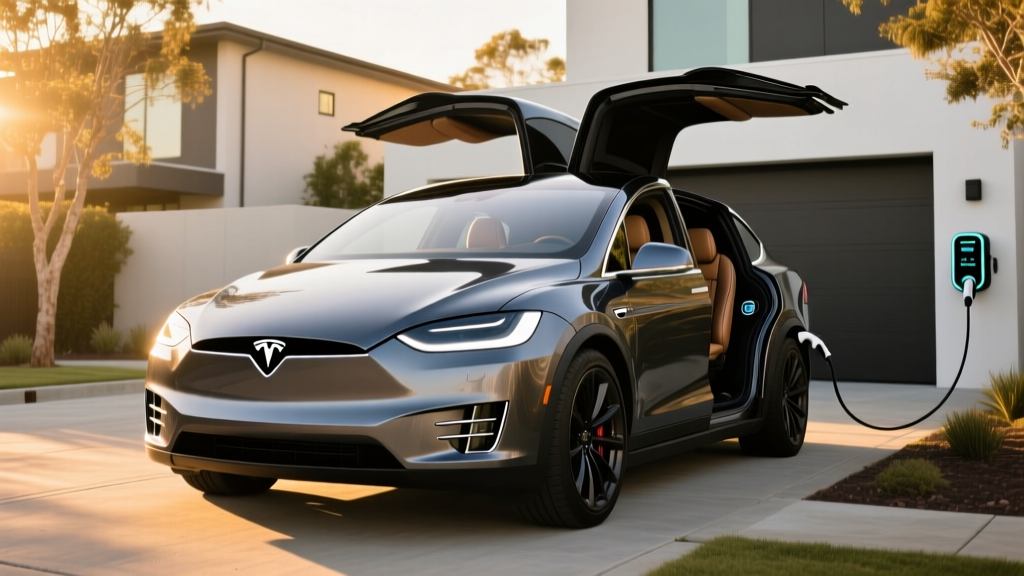
The signature Falcon Wing rear doors are the Model X's most polarizing feature. They provide excellent overhead clearance for loading children into car seats and offer dramatic visual appeal, but they're mechanically complex. The hydraulic hinges and sensors have been a maintenance pain point, and repairs can exceed $2,000 per door. In tight parking spaces, the doors' sensor-guided articulation actually works well — they adapt their opening arc to available space — but in heavy rain, water can drip into the cabin during the doors' upward sweep.
Cargo capacity is generous: 26.6 cubic feet behind the third row, expanding to 88.1 cubic feet with both rear rows folded. The front trunk (frunk) adds approximately 5.3 cubic feet of enclosed storage — useful for charging cables or groceries.
Driver assistance: P90D vehicles came with various hardware suites. Early 2016 models may have HW1 (Mobileye-based Autopilot), while later builds received HW2 (NVIDIA-based). Neither matches current HW4 capabilities, and Tesla's Full Self-Driving (Supervised) feature support on HW1/HW2 is limited. Remember: all Tesla driver-assist features remain SAE Level 2 — the driver must remain fully engaged with hands on the wheel and eyes on the road at all times.
Ownership Costs: What to Budget Beyond the Purchase Price
A used P90D's appeal hinges on value, but ownership costs extend well beyond the sticker. Here's what to budget:
- Insurance: Model X insurance premiums remain elevated. Expect $2,500–$4,000/year depending on your profile, location, and coverage. Get quotes before purchasing.
- Tires: The Model X wears through tires quickly due to its weight and torque. Budget $1,200–$2,000 for a set of four every 25,000–35,000 miles.
- Air suspension: If the original air struts haven't been replaced, budget $4,000–$8,000 for a full-corner refresh. Many 2016-era units are at or past their service life.
- Battery: The original 8-year/unlimited-mile battery warranty has expired for all 2016 P90D vehicles (and most 2017 models expired in 2025). A replacement 90 kWh pack, if needed, costs approximately $15,000–$22,000 through Tesla service or third-party rebuilders. This is the single largest financial risk of used EV ownership.
- Coolant and drive unit service: Tesla recommends periodic coolant flushes. Drive unit (motor) failures are uncommon but not unheard of — replacement runs $5,000–$8,000.
- Electricity cost: At the national average of ~$0.16/kWh and the P90D's 38 kWh/100mi efficiency, fuel cost is approximately $0.061/mile. Compare that to a gas SUV at 20 MPG and $3.50/gallon: $0.175/mile. Annual savings on 12,000 miles: roughly $1,370 in fuel.
How the P90D Stacks Up Against Used Alternatives
Why Buy the P90D Model X
- Supercharger network access — the most reliable DC fast-charging ecosystem in North America
- Ludicrous acceleration (3.8s 0–60) remains thrilling and practical
- Three-row seating with Falcon Wing convenience for car seats
- Continued OTA software updates from Tesla
- Strong cargo capacity (88.1 cu ft max) and usable frunk
- At $25,000 or below with §25E credit, exceptional value per mile of range
Why You Might Pass
- Battery warranty expired — replacement risk of $15,000–$22,000
- 120 kW DC fast-charge cap means slower road-trip stops vs. modern EVs
- Falcon Wing doors are a known maintenance liability
- MCU1 infotainment is slow without a costly MCU2 upgrade
- Air suspension replacement costs are significant
- §25E tax credit eligibility is constrained by the $25,000 sale-price cap
If you're cross-shopping the P90D against other used electric SUVs, the 2019–2021 Tesla Model Y Long Range offers a more modern platform, faster 250 kW charging, and lower maintenance risk — but starts around $30,000–$38,000 used and lacks a third row. The used Jaguar I-PACE (2019–2021) offers similar luxury and a 234-mile EPA range but charges at just 100 kW DC and lacks Supercharger access. The 2021+ Ford Mustang Mach-E Extended Range is a strong two-row alternative at ~$28,000–$35,000 used but doesn't match the Model X's cargo or passenger capacity.
For buyers specifically needing three rows and electric propulsion on a budget, the P90D Model X has very few direct competitors — which is simultaneously its greatest advantage and the reason buyers accept its maintenance risks.
Frequently Asked Questions
What is the real-world range of the Tesla P90D Model X?
With a healthy battery in moderate temperatures, expect 210–230 miles on the highway and up to 250 miles in mixed city driving. With typical 10–15% battery degradation at this vehicle's age, real range drops to approximately 180–210 miles mixed. In cold weather (below 30°F), plan for 130–175 miles effective range due to battery chemistry limitations and cabin heating demands.
How fast does the P90D charge at home and on the road?
On DC fast chargers (including Tesla Superchargers), the P90D peaks at approximately 120 kW, achieving a 10–80% charge in about 40–45 minutes. At home on a Level 2 charger, expect 24–26 miles of range per hour with a single onboard charger, or 48–52 miles per hour with the optional dual chargers — meaning a full overnight charge is easily achievable with a 48-amp or 80-amp home station.
Does the P90D Model X qualify for any federal EV tax credit?
The P90D does not qualify for the §30D new vehicle credit (up to $7,500) because it is a used vehicle. It may qualify for the §25E used clean vehicle credit (up to $4,000), but only if the dealer sale price is $25,000 or less, the buyer meets income caps, and the vehicle hasn't previously triggered a §25E credit since August 16, 2022. Consult IRS §25E guidance and a tax professional to confirm eligibility.
Is the P90D Model X worth buying vs. a newer Model Y or Mach-E?
It depends on your priorities. If you need three rows of seating, maximum cargo space, and Supercharger access on a tight budget, the P90D has few used alternatives. If you only need two rows, a newer Model Y or Mach-E offers faster charging, lower maintenance risk, and more modern hardware — but at a higher used price. The P90D is a calculated risk: exceptional capability at a low entry price, with meaningful repair-cost exposure.
What should I check before buying a used P90D?
Prioritize four inspections: (1) Battery State of Health via Tesla's service menu or OBD diagnostic — anything below 85% SoH is a negotiation lever. (2) Air suspension function — cycle through all ride heights and listen for compressor strain. (3) Falcon Wing door operation — test all sensors and hydraulic actuators for smooth, even movement. (4) Drive unit noise — listen for whining or grinding under acceleration. A pre-purchase inspection at a Tesla Service Center ($200–$400) is strongly recommended.
What's the battery replacement cost if the pack fails?
A 90 kWh replacement pack through Tesla Service typically costs $15,000–$22,000 including labor. Third-party EV battery rebuilders may offer refurbished packs for $10,000–$15,000. The original 8-year/unlimited-mile battery warranty has expired for all 2016 P90D vehicles and most 2017 examples. Factor this potential cost into your purchase budget — or negotiate the sale price accordingly.