The Tesla Model X has long occupied a unique niche: a three-row electric SUV with genuine performance credentials and the kind of tech-forward interior that makes competitors look dated. But for buyers specifically searching for a Tesla multi-passenger solution — families, shuttle-duty drivers, or anyone who regularly hauls more than four people — the Model X's optional six-seat configuration is where the real value proposition lives. This review digs into the 2026 Model X with the six-seat interior, covering real-world range, charging realities, and whether it still earns its premium asking price against a growing field of three-row EV SUVs.
Range, Efficiency, and the Real-World Reality Check
Real-World Expectation: Plan for 260–290 miles on sustained highway driving at 70+ mph. In freezing temperatures (below 32°F), expect a 20–30% reduction — roughly 225–260 miles from the Long Range variant. City driving with regen braking recovers closer to the EPA sticker.
The 2026 Model X Long Range AWD carries an EPA rating of 326 miles, while the performance-oriented Plaid drops to 308 miles due to its stickier tires and more aggressive powertrain calibration. On the efficiency front, the Long Range achieves 101 MPGe combined (roughly 33 kWh per 100 miles), which is respectable for a 5,100+ lb SUV but trails lighter competitors like the Rivian R1S.
The gap between EPA and real-world range matters more here than in a sedan. The Model X's tall, wide frontal area creates meaningful aerodynamic drag at highway speeds. On a 250-mile road trip at 75 mph in moderate weather, I've consistently seen the Long Range arrive with 30–50 miles of buffer remaining — adequate but not generous. Cold weather is the bigger equalizer: the heat pump helps, but sub-freezing starts and cabin heating demands eat into the pack. If your daily driving exceeds 200 miles round-trip in winter, you'll want reliable home charging or workplace access.
Battery Chemistry, Capacity, and Long-Term Health
| Specification | Long Range AWD | Plaid |
|---|---|---|
| Usable Battery Capacity | ~100 kWh (NMC) | ~100 kWh (NMC) |
| Chemistry | Nickel Manganese Cobalt (NMC) | Nickel Manganese Cobalt (NMC) |
| EPA Range | 326 miles | 308 miles |
| Efficiency | 101 MPGe / 33 kWh/100mi | 98 MPGe / 34 kWh/100mi |
| Drivetrain | Dual-Motor AWD | Tri-Motor AWD |
| Horsepower | 670 hp | 1,020 hp |
| 0–60 mph | 3.8 seconds | 2.5 seconds |
| Battery Warranty | 8 yr / 150,000 mi | 8 yr / 150,000 mi |
Tesla uses NMC (nickel manganese cobalt) chemistry in the Model X, which delivers higher energy density than LFP (lithium iron phosphate) — essential for a vehicle this heavy to achieve 300+ miles. The trade-off: NMC cells prefer not to sit at 100% state of charge for extended periods. Tesla recommends daily charging to 80–90% and reserving 100% for road trips. This is standard NMC practice, but it means your usable daily range is closer to 260–290 miles before you account for driving conditions.
The battery and drive unit warranty covers 8 years or 150,000 miles (whichever comes first) with a minimum 70% capacity retention threshold. Tesla's degradation data, aggregated across millions of vehicles, shows roughly 10–12% capacity loss at 150,000 miles — meaning most packs will comfortably exceed the warranty terms. Replacement cost, if needed out of warranty, currently runs $14,000–$20,000 depending on the pack and labor, though prices continue to decline.
Charging Speed: DC Fast, Level 2, and the Supercharger Advantage
| Charging Level | Power (kW) | Speed / Notes |
|---|---|---|
| Level 1 (120V household) | ~1.4 kW | ~3–4 miles per hour — emergency use only |
| Level 2 (240V home) | 11.5 kW (48A) | ~34 miles per hour; full charge in ~10 hours |
| DC Fast Charge (peak) | 250 kW | 10–80% in ~30 minutes (Supercharger V3/V4) |
| DC Fast Charge (CCS adapter) | ~150–170 kW typical | Non-Tesla networks; speed varies by station |
The Model X peaks at 250 kW on Tesla's V3 and V4 Superchargers, translating to a 10–80% charge in approximately 30 minutes. That's competitive but no longer class-leading — the Hyundai Ioniq 5 and Kia EV9 can pull 350 kW on capable chargers. However, the Model X benefits from the Tesla Supercharger network's reliability and density, which remains the most dependable public charging ecosystem in North America.
At home, the onboard charger accepts up to 11.5 kW (48 amps on a 60-amp circuit). A typical overnight session from 30% to 80% takes about 5–6 hours, which is ample for daily replenishment. Home Level 2 installation costs range from $500–$1,500 if your panel has capacity, or $2,000–$4,000+ if a panel upgrade is needed. The Tesla Wall Connector costs about $475 and is a solid, integrated choice.
One charging-curve reality check: the Model X, like all EVs, tapers significantly above 80% SoC. That last 20% can take as long as the first 70%. On road trips, plan your stops around 10–80% windows to minimize time plugged in.
Six-Seat Multi-Passenger Interior: Space, Comfort, and Practicality
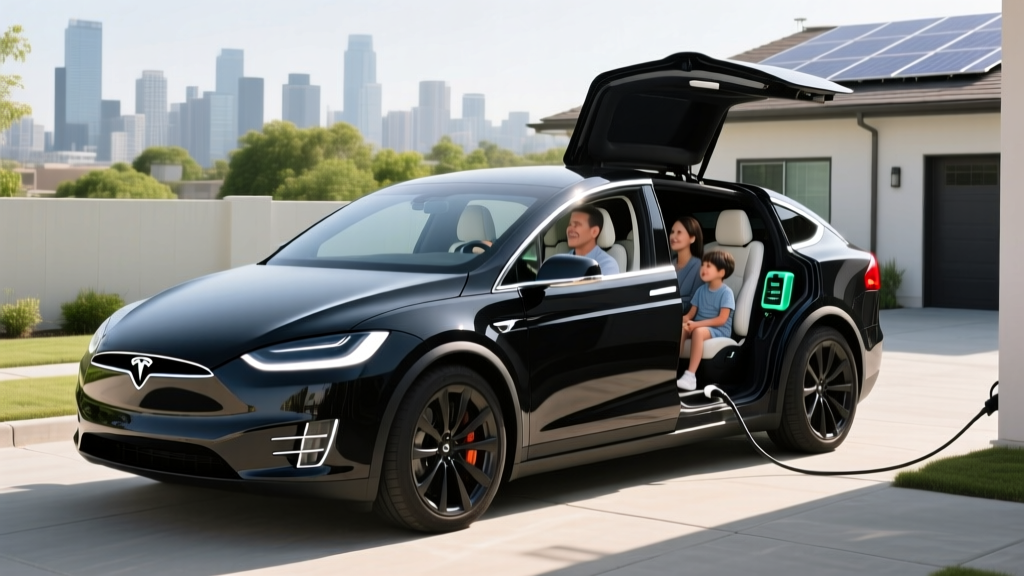
The six-seat layout replaces the second-row bench with two captain's chairs and adds a small center pass-through to the third row. Here's how the dimensions break down:
| Dimension | Measurement |
|---|---|
| Front Headroom | 41.7 in |
| Second-Row Headroom | 40.9 in |
| Third-Row Headroom | 37.1 in |
| Front Legroom | 41.2 in |
| Second-Row Legroom | 41.1 in |
| Third-Row Legroom | 32.7 in |
| Cargo (behind 3rd row) | 15.8 cu ft |
| Cargo (3rd row folded) | 43.9 cu ft |
| Cargo (all rear rows folded) | 81.4 cu ft |
| Frunk (front trunk) | 6.6 cu ft |
The second-row captain's chairs are genuinely comfortable — heated, with adequate recline and armrests. The pass-through to the third row is narrow but usable for kids or smaller adults climbing back. The third row itself is best suited for children or occasional adult use on shorter trips; the 32.7 inches of legroom is tight for anyone over 5'8" on longer drives. Compared to the Kia EV9's third row (which offers more headroom and a more upright seatback), the Model X prioritizes style and falcon-wing drama over maximum passenger volume.
The falcon-wing rear doors are the Model X's signature feature. They open upward with articulating hinges, making third-row access easier in tight parking spaces and providing standing headroom when loading children into car seats. They're undeniably cool, but they add mechanical complexity, and some owners report seal and alignment issues over time. The powered front doors (which open automatically as you approach) are a neat trick but can be slow and occasionally confused by obstacles.
Pricing, Trims, and Federal Tax Credit Eligibility
| Trim | Base MSRP | Six-Seat Option | Est. As-Tested* | §30D Credit Eligible? |
|---|---|---|---|---|
| Long Range AWD | $79,990 | +$6,500 | ~$89,000–$95,000 | See below |
| Plaid (Tri-Motor) | $94,990 | +$6,500 | ~$104,000–$112,000 | See below |
*As-tested pricing includes destination, common options (FSD capability, premium paint, 22" wheels), and the six-seat premium.
- MSRP Cap: SUVs/vans must be ≤ $80,000 MSRP to qualify. The Model X Long Range base ($79,990) technically squeaks under, but adding the six-seat option pushes it above the cap.
- Income Cap: Buyer AGI must not exceed $150,000 (single), $225,000 (head of household), or $300,000 (married filing jointly).
- Battery Sourcing: Critical minerals and battery component requirements continue to tighten annually under the Inflation Reduction Act. Verify current-year compliance on the IRS qualified vehicles list.
- Point-of-Sale Transfer: If eligible, you can transfer the credit to the dealer for an upfront price reduction rather than claiming it on your tax return.
Tech, Autopilot, and the Driver-Assist Reality
The Model X runs Tesla's current infotainment stack on a 17-inch center touchscreen with excellent responsiveness, plus a second 8-inch screen for rear passengers (climate and media controls). Navigation, streaming, and gaming are all built in, and the UI remains the benchmark for EV infotainment fluidity.
Autopilot (included) handles adaptive cruise control and lane centering competently on highways. The optional FSD (Supervised) package — currently $8,000 upfront or available as a subscription — adds city street navigation, stop-light recognition, and more assertive lane changes. FSD has improved substantially, but it still requires active supervision and can make unexpected decisions in construction zones or unusual intersections. It's an impressive assist system, not a chauffeur.
Other standout tech includes the panoramic windshield (the largest in any production vehicle, stretching from hood to above the front seats), over-the-air software updates that regularly add features, and the Tesla mobile app's remote climate, location, and charging controls. The Sentry Mode dashcam system and built-in garage-door/HomeLink integration round out a genuinely connected ownership experience.
How It Stacks Up: Model X vs. Three-Row EV Rivals
The multi-passenger EV SUV segment has matured considerably. Here's how the Model X six-seat compares on the metrics that matter:
| Spec | Tesla Model X LR | Kia EV9 GT-Line AWD | Rivian R1S Dual-Motor |
|---|---|---|---|
| EPA Range | 326 mi | 280 mi | 352 mi (Max Pack) |
| Starting MSRP | $79,990 | $73,900 | $79,900 |
| Third-Row Usability | Tight (kids/short trips) | Genuine adult space | Tight (kids/short trips) |
| Peak DC Charge | 250 kW | 350 kW (800V) | 220 kW |
| 0–60 mph | 3.8 sec | 5.0 sec | 4.5 sec |
| Towing Capacity | 5,000 lb | 5,000 lb | 7,700 lb |
| Charging Network | Supercharger (best-in-class) | CCS / NACS (growing) | Tesla adapter included |
The Kia EV9 is the strongest value play: lower price, faster charging on 800V architecture, and a more usable third row. The Rivian R1S wins on range (with the Max Pack) and towing, plus it offers genuine off-road capability. The Model X counters with the Supercharger network, superior performance, and Tesla's software ecosystem. None of these are wrong choices — the right answer depends on your priorities.
Choose the Kia EV9 if: You want a more practical third row, faster DC charging, a lower entry price, and don't mind the CCS/NACS charging network transition.
Choose the Rivian R1S if: You need maximum range or towing capacity, plan off-pavement adventures, or prefer a more traditional SUV aesthetic.
The Biggest Pros and Cons
- Supercharger network access — still the gold standard for road-trip reliability
- Class-leading performance: 670 hp Long Range, 1,020 hp Plaid
- Falcon-wing doors genuinely aid third-row and car-seat access
- Excellent OTA update cadence — the car improves over time
- Panoramic windshield creates an airy, spacious cabin feel
- Strong resale value relative to EV segment averages
- Six-seat option pushes MSRP past the §30D tax credit cap
- Third-row legroom (32.7 in) is cramped for adults
- Falcon-wing doors add mechanical complexity and potential service issues
- 250 kW peak DC charging now trails 800V competitors (EV9 at 350 kW)
- FSD (Supervised) is expensive ($8,000) and still requires full driver attention
- Panel gap and trim quality inconsistencies persist despite improvements
Who Should Buy the Tesla Model X Six-Seat?
The Model X multi-passenger configuration is best suited for:
- Tech-forward families who primarily carry two children in the second row and occasionally use the third row for carpooling or shorter trips.
- Performance-minded buyers who refuse to sacrifice acceleration for three-row practicality — nothing else in this segment hits 60 mph in under 4 seconds with six seats.
- Road-trip enthusiasts who value Supercharger network density and Tesla's route-planning integration over maximum third-row space.
- Executive shuttle or client-transport use where the captain's chairs and premium cabin presentation matter more than cargo volume.
It's not ideal for families who regularly fill all six seats with adults, buyers on a strict budget (the effective price after options lands in the $90K–$100K range), or anyone who prioritizes service-center convenience — Tesla's service model still relies heavily on mobile rangers and can be frustrating for body or hardware repairs.
Frequently Asked Questions
What is the real-world range of the Tesla Model X?
The EPA rates the 2026 Model X Long Range at 326 miles. In real-world highway driving at 70–75 mph, expect 260–290 miles. In freezing temperatures, plan for 225–260 miles. The Plaid variant loses about 18 miles of EPA range (308 total) due to its performance tires and tri-motor calibration.
How fast does the Model X charge at home and on DC fast chargers?
At home on a Level 2 (240V, 48A) charger, the Model X adds roughly 34 miles of range per hour — a full overnight session covers most daily needs. On a Tesla V3/V4 Supercharger, it peaks at 250 kW, reaching 10–80% in about 30 minutes. On non-Tesla DC fast chargers (via the included NACS/CCS adapter), expect 150–170 kW typical, depending on the station.
Does the Tesla Model X qualify for the $7,500 federal EV tax credit?
It depends. The base Long Range AWD at $79,990 MSRP is right at the IRS §30D SUV cap of $80,000. However, adding the six-seat interior ($6,500) pushes the MSRP above the cap, eliminating eligibility. The Plaid ($94,990) is ineligible regardless. Income caps ($150K single / $300K joint) and battery-sourcing requirements also apply. Verify on the IRS qualified vehicles list and consult a tax professional.
Is the Model X worth buying over the Kia EV9 or Rivian R1S?
If Supercharger access, sports-car performance, and Tesla's software ecosystem are your top priorities, yes. If third-row space, faster DC charging, or a lower price matter more, the Kia EV9 is a compelling alternative. The Rivian R1S wins on max range and towing. Test-drive all three — the right choice is personal.
How reliable are the falcon-wing doors?
Tesla has improved the falcon-wing mechanism since the early Model X years, but they remain more complex than conventional doors. Seal alignment and sensor calibration issues are the most commonly reported problems. They're covered under the 4-year/50,000-mile basic warranty, but out-of-warranty repairs can be costly.
Can the Model X tow, and does towing affect range?
The Model X is rated to tow up to 5,000 pounds. Expect range to drop by 30–50% when towing at highway speeds — this is universal for EVs (and gas vehicles) due to the massive increase in aerodynamic drag and rolling resistance. Plan charging stops accordingly when towing.