Search for an electric minivan and you'll quickly hit a wall: the segment barely exists in pure-BEV form. That's why a surprising number of family shoppers land on a different three-row hauler — the Tesla Model X. It's not a minivan, but with seating for up to seven, a flat floor, and a powertrain that eliminates gas-station stops, it occupies the same garage space in a buyer's decision tree. This review examines whether the 2026 Tesla Model X actually fills the EV minivan void, with exact range, charging, and pricing data to back it up.
Quick Verdict: The Closest Thing to an Electric Minivan
The Model X remains one of the few premium three-row electric SUVs with genuine adult-capable third-row seating and minivan-rivaling cargo volume. Its falcon-wing rear doors are more than theater — they genuinely ease child-seat loading in tight parking spots. But at a starting MSRP near $80,000 (before any incentives), it costs roughly double what a Chrysler Pacifica Hybrid does. Buyers prioritizing value over performance and tech will want to cross-shop the Kia EV9 and upcoming electric minivans before signing.
Range, Battery, and Real-World Efficiency
For 2026, the Model X Long Range carries an EPA-estimated 320 miles of range on its roughly 100 kWh (usable) NMC lithium-ion pack. Tesla does not publish exact chemistry breakdowns per model year, but the Long Range variants continue to use nickel-based NMC/NCA cells optimized for energy density, while the Plaid uses a similar high-output pack tuned for power delivery.
- EPA sticker: 320 miles
- Mixed highway (70-75 mph): ~265–285 miles
- Winter (below 32°F, highway): ~225–250 miles
- Plaid trim, aggressive driving: ~230–260 miles
The Model X's tall, wide body and available 22-inch wheels hurt highway efficiency versus lower-slung EVs. Expect a 12–18% range reduction on sustained interstate trips, and another 15–20% in freezing temperatures even with Tesla's heat pump and battery preconditioning.
Efficiency lands around 100 MPGe combined on the Long Range, translating to roughly 33–36 kWh per 100 miles depending on driving style. That's thirstier than a Model Y (which runs closer to 27 kWh/100 mi) but competitive with other heavy three-row EVs like the Rivian R1S.
Charging Speed: DC Fast, Level 2, and the NACS Advantage
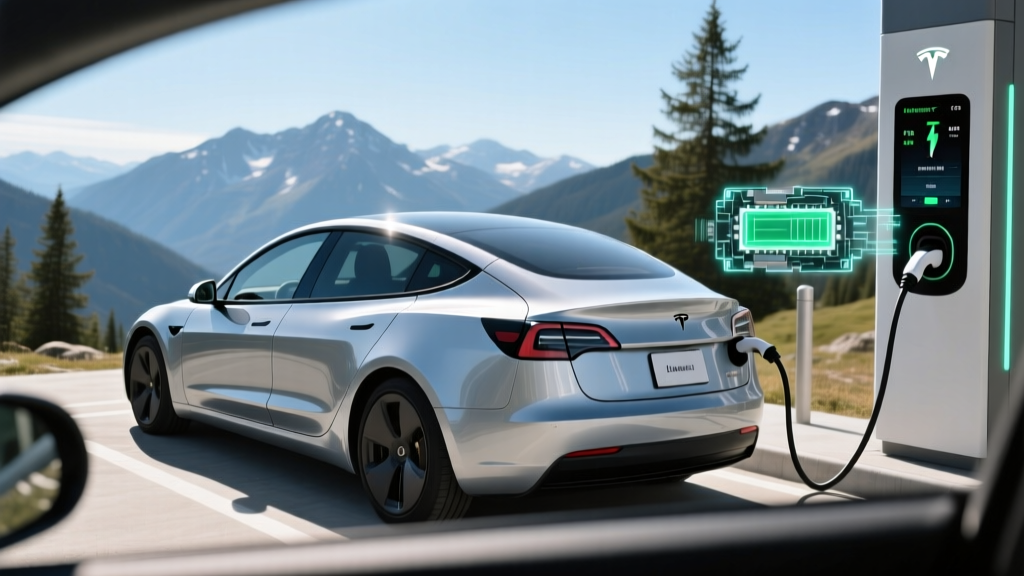
The 2026 Model X uses Tesla's native NACS connector, giving it first-party access to the entire Supercharger network — including V4 stalls now rolling out across major highway corridors. Peak DC fast-charge rate is rated at 250 kW on V3 and V4 Superchargers.
| Charging Level | Power / Rate | Practical Result |
|---|---|---|
| DC Fast (V3/V4 Supercharger) | Up to 250 kW peak | 10–80% in ~30 minutes; taper above 50% SoC |
| DC Fast (CCS adapter, Electrify America, etc.) | Up to ~150–175 kW typical | 10–80% in ~40–45 minutes |
| Level 2 (Tesla Wall Connector, 48A) | 11.5 kW | ~34 miles of range per hour; full charge in ~10 hours |
| Level 2 (generic J1772 via adapter) | Up to 11.5 kW | Same as Wall Connector at 48A |
| Level 1 (120V household) | ~1.4 kW | ~3–4 miles per hour — emergency use only |
The charging curve is the practical story: the Model X pulls its peak 250 kW only between roughly 10–30% State of Charge, then tapers through the mid-range and drops sharply above 80%. On a road trip, plan stops around the 10–80% window for the fastest turnarounds. Preconditioning the battery via the car's navigation-routed Supercharger prep is essential — arriving cold can halve your peak charge rate.
Performance, Drivetrain, and the Plaid Question
Every 2026 Model X comes standard with dual-motor all-wheel drive. The Long Range produces approximately 670 horsepower and hits 0–60 mph in 3.8 seconds — absurd acceleration for a 5,100-pound family vehicle. The Plaid variant adds a third rear motor for 1,020 horsepower and a 2.5-second 0–60 time, making it one of the quickest production SUVs on Earth.
| Specification | Long Range AWD | Plaid (Tri-Motor) |
|---|---|---|
| EPA Range | 320 miles | 311 miles |
| Battery (usable, est.) | ~100 kWh, NMC/NCA | ~100 kWh, NMC/NCA |
| Horsepower | 670 hp | 1,020 hp |
| 0–60 mph | 3.8 sec | 2.5 sec |
| Top Speed | 155 mph | 163 mph |
| Drivetrain | Dual-motor AWD | Tri-motor AWD |
| Towing Capacity | 5,000 lbs | 5,000 lbs |
For family duty, the Long Range is the rational pick. The Plaid's extra $20,000+ buys acceleration you'll use twice and a slightly stiffer ride you'll feel every day. Both variants include adaptive air suspension, which lowers at highway speed for efficiency and raises for rough driveways or light trail use.
Interior Space: Does It Actually Replace a Minivan?
The Model X offers three seating configurations: five-seat (two rows), six-seat (with second-row captain's chairs), and seven-seat (2-3-2 layout). Here's how the dimensions stack up against the minivan benchmark:
| Dimension | Model X (7-seat) | Chrysler Pacifica (minivan) |
|---|---|---|
| Cargo, behind 3rd row | 15.3 cu ft | 32.3 cu ft |
| Cargo, 3rd row folded | 57.0 cu ft | 87.5 cu ft |
| Cargo, max (all rear folded) | 82.0 cu ft | 140.5 cu ft |
| 3rd-row legroom | 32.7 in | 35.2 in |
| Front trunk (frunk) | 6.5 cu ft | None |
The numbers tell the story: the Model X is not a true minivan replacement for maximum-cargo families. Behind the third row, you get about half the Pacifica's cubic footage — enough for a few grocery bags or a compact stroller, but not the week-long road-trip luggage haul a minivan swallows. The third row fits children and shorter adults comfortably; six-footers will find it tight on long drives.
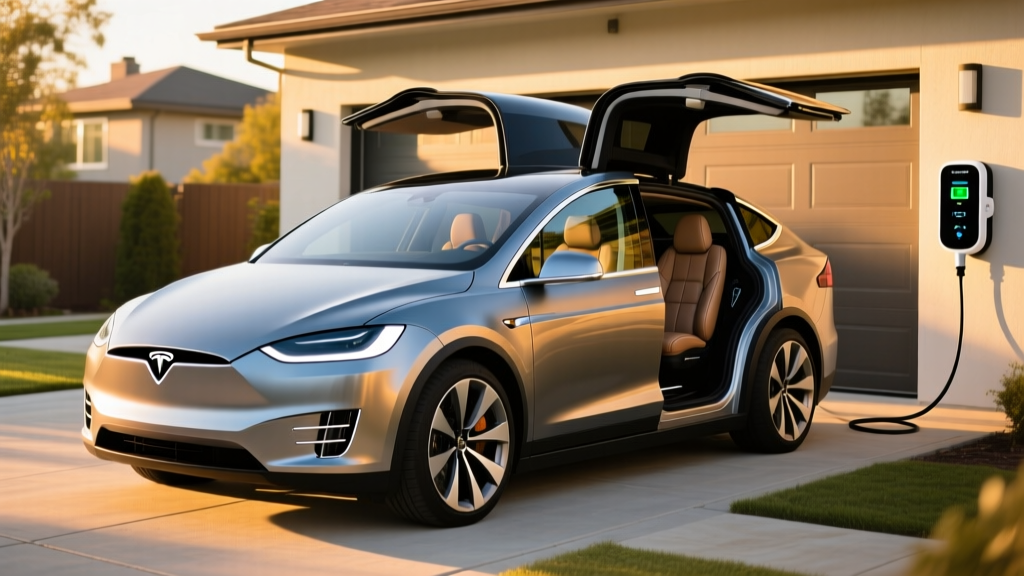
Where the Model X genuinely shines for families is the falcon-wing door system. The double-hinged doors open upward with minimal side clearance, making it dramatically easier to lean in and buckle toddlers into car seats compared to a traditional SUV door. The doors also have ultrasonic sensors to avoid hitting low garage ceilings or adjacent vehicles. It's a feature that looks gimmicky until you use it daily with kids.
Pricing, Tax Credits, and Total Cost
The 2026 Model X Long Range starts at an MSRP of approximately $79,990, with the Plaid at $94,990 (prices before destination fees). Adding the six- or seven-seat configuration, premium paint, 22-inch wheels, and Full Self-Driving capability can push a Long Range build past $95,000.
| Cost Factor | Long Range | Plaid |
|---|---|---|
| Base MSRP | $79,990 | $94,990 |
| Federal §30D Tax Credit | Up to $7,500* | Up to $7,500* |
| Adjusted Price (best case) | ~$72,490 | ~$87,490 |
*Federal tax credit eligibility is not automatic. Under current IRS §30D rules, the Model X must meet several criteria:
- MSRP cap: SUVs/vans must be at or below $80,000 MSRP. The Long Range base qualifies; the Plaid does not.
- Buyer income limits: Modified AGI must not exceed $300,000 (joint), $225,000 (head of household), or $150,000 (single).
- Battery sourcing: Critical minerals and battery components must meet escalating domestic/free-trade sourcing percentages that tighten each year. Verify current-year compliance on the IRS qualified vehicle list before purchase.
- Point-of-sale transfer: Eligible buyers can apply the credit as an immediate price reduction at the dealer rather than waiting for a tax refund.
Because battery-sourcing requirements shift and Tesla's supply chain compliance can change by production batch, always confirm the specific VIN's eligibility on fueleconomy.gov before finalizing a purchase order.
Warranty, Ownership Costs, and Reliability
Tesla covers the Model X with:
- Basic vehicle warranty: 4 years / 50,000 miles
- Battery and drive unit: 8 years / 150,000 miles (Long Range, AWD), with a minimum 70% capacity retention threshold
- Falcon-wing door mechanisms: Covered under the basic warranty; extended coverage available
Insurance premiums for the Model X tend to run 30–50% higher than comparable gas SUVs due to repair costs and performance classification. However, electricity costs offset fuel savings substantially: at $0.15/kWh national average, "fueling" a Model X costs roughly $5.00 per 100 miles versus $13–15 for a gas-powered large SUV at 20 MPG combined.
Driver Assistance: Autopilot and FSD Supervised
Every Model X includes Tesla's basic Autopilot (traffic-aware cruise control and lane centering). Full Self-Driving (Supervised) is an optional add-on that enables automatic lane changes, navigation-guided exits, and limited city-street steering assistance.
Tesla's Autopilot and FSD (Supervised) are SAE Level 2 driver-assistance systems, not self-driving. The driver must maintain full attention, keep hands available for steering input, and remain prepared to take over at any moment. Tesla's camera-based monitoring system tracks driver engagement, but this is not Level 3 or Level 4 autonomy.
- It does not navigate construction zones reliably
- It may struggle with faded lane markings, heavy rain, or direct sun glare
- It does not eliminate the driver's legal responsibility for the vehicle
- It is not approved for hands-off or eyes-off operation on public roads
Pros, Cons, and Who Should Buy It
- Supercharger network access via native NACS — the most reliable public charging ecosystem
- Falcon-wing doors genuinely ease child-seat loading
- 320-mile EPA range covers most family road trips with one short stop
- 670 hp Long Range with 5,000-lb towing capacity
- Over-the-air updates continuously add features
- Frunk adds secure front cargo space no minivan offers
- Third-row cargo space is half that of a Pacifica or Sienna
- Plaid trim exceeds the $80,000 MSRP cap for the federal tax credit
- Insurance premiums significantly higher than gas SUVs
- Falcon-wing door mechanisms have a history of service visits
- No CarPlay or Android Auto — Tesla's proprietary interface only
- Base price near $80K before options; well-equipped builds exceed $95K
- You want the Supercharger network for hassle-free family road trips
- Falcon-wing doors solve a real child-seat-loading pain point
- You need three rows but rarely fill the cargo area to the roof
- Performance and tech are higher priorities than maximum interior volume
- You need maximum cargo capacity behind the third row
- Budget is under $60,000
- You prefer Apple CarPlay / Android Auto integration
- You want a true minivan's sliding doors and low step-in height
Frequently Asked Questions
What is the real-world range of the Tesla Model X?
The EPA rates the 2026 Model X Long Range at 320 miles. In real-world highway driving at 70–75 mph, expect 265–285 miles. In freezing winter conditions, that can drop to 225–250 miles. The Plaid's higher power draw reduces real-world range to roughly 230–260 miles under similar conditions.
How fast does the Model X charge at home and on the road?
On a Tesla V3 or V4 Supercharger, the Model X peaks at 250 kW and charges from 10–80% in approximately 30 minutes. At home on a 48-amp Level 2 Tesla Wall Connector (11.5 kW), it adds about 34 miles of range per hour, fully recharging overnight in roughly 10 hours.
Does the Tesla Model X qualify for the federal EV tax credit?
The Long Range base MSRP of $79,990 falls under the $80,000 SUV cap for the §30D credit, making it potentially eligible for up to $7,500. The Plaid at $94,990 exceeds the cap and does not qualify. Eligibility also depends on buyer income limits and battery-sourcing compliance, which can change by production batch — verify on the IRS qualified vehicle list before ordering.
Is the Model X worth buying over the Kia EV9 or Rivian R1S?
The Model X wins on charging infrastructure (Supercharger network), raw performance, and tech features. The Kia EV9 costs $25,000–$35,000 less and offers more third-row cargo space. The Rivian R1S provides superior off-road capability and a more traditional SUV interior. Your priority — budget, cargo, charging, or performance — determines the right pick.
Can the Model X actually replace a minivan for a family of five or more?
For passenger seating, yes — the seven-seat configuration accommodates up to seven. For cargo flexibility, no: the Model X offers 15.3 cu ft behind the third row versus 32+ cu ft in a Pacifica or Sienna. Families that routinely haul large strollers, sports gear, or luggage for five will find the Model X's cargo area limiting compared to a dedicated minivan.
What are the biggest ownership costs beyond the purchase price?
Insurance is the largest variable cost, typically running 30–50% above comparable gas SUVs. Electricity costs are substantially lower than gasoline (roughly $5 per 100 miles vs. $13–15). Tire replacement costs are higher due to the vehicle's weight and performance tires, and out-of-warranty falcon-wing door service can be expensive.
Sources: EPA efficiency data via fueleconomy.gov; federal tax credit rules via IRS.gov §30D; Tesla Model X specifications via Tesla's official configurator and press materials.