Quick Verdict: The Largest Tesla Still Has Niche Appeal
If you've searched for the Tesla Model X length to see whether it fits your garage or your life, the answer is 199.1 inches bumper to bumper — roughly the same footprint as a BMW X5 or Mercedes GLE. But unlike those midsize SUVs, the Model X pairs three-row seating, falcon-wing rear doors, and up to 340 miles of EPA-estimated range in a package that starts near $80,000 before incentives. For 2026, Tesla continues to offer the Model X in Long Range and Plaid trims, retaining the 100 kWh battery architecture and NACS connector that grants access to the full Supercharger network.
This review covers the dimensions, real-world efficiency, charging behavior, pricing, and tax-credit reality of the 2026 Tesla Model X — the data points that matter when you're deciding between this and competitors like the Rivian R1S, BMW iX, or Kia EV9.
Dimensions, Cargo, and Passenger Space
Understanding the Tesla Model X length in context helps buyers plan for parking, garages, and third-row usability. Here's how the exterior and interior dimensions break down:
| Measurement | Value |
|---|---|
| Overall Length | 199.1 in (5,057 mm) |
| Wheelbase | 116.7 in (2,964 mm) |
| Width (mirrors folded) | 81.5 in (2,070 mm) |
| Height | 66.1 in (1,680 mm) |
| Cargo (behind 3rd row) | 13.7 cu ft |
| Cargo (2nd row folded) | 43.9 cu ft |
| Cargo (all rows folded + frunk) | 85.1 cu ft |
| Front Legroom | 41.2 in |
| 2nd-Row Legroom | 38.4 in |
| 3rd-Row Legroom | 32.7 in |
The 199.1-inch length places the Model X squarely in midsize SUV territory, though the 81.5-inch width (mirrors folded) can challenge narrow garages. Third-row legroom at 32.7 inches is best suited for children on longer trips; adults will find it tight beyond 20-minute rides. The front trunk (frunk) adds roughly 6.5 cu ft of enclosed storage — useful for charging cables or groceries you want separated from the main cabin.
Range, Battery, and Efficiency
The 2026 Model X Long Range carries a ~100 kWh battery pack (approximately 95 kWh usable) using NMC (nickel manganese cobalt) chemistry. Tesla does not offer LFP in the Model X lineup; the energy density required for this vehicle's mass and range target favors NMC's higher specific energy.
| Trim | EPA Range | Real-World Highway (70 mph) | Cold Weather (below 32°F) |
|---|---|---|---|
| Long Range (AWD) | 340 mi | ~280–300 mi | ~230–260 mi |
| Plaid (Tri-Motor AWD) | 320 mi | ~260–280 mi | ~215–245 mi |
Highway driving at sustained 70+ mph reduces range 12–18% vs. EPA combined. Cold weather with cabin heating can cut range 25–35%. Preconditioning the battery before departure mitigates some loss. Source: fueleconomy.gov.
Efficiency for the Long Range trim lands around 101 MPGe combined, translating to roughly 33–35 kWh per 100 miles driven. That's slightly less efficient than the Model Y (which benefits from lower mass and a smaller frontal area) but competitive with the Rivian R1S and BMW iX xDrive50. The Plaid's tri-motor setup and performance tuning drop efficiency to approximately 96 MPGe.
Charging: DC Fast, Level 2, and the Supercharger Advantage
The Model X uses Tesla's NACS connector natively, meaning full access to the Supercharger network — currently the most reliable DC fast-charging infrastructure in the U.S. Non-Tesla EVs gaining NACS access in 2025–2026 still may face software-handshake quirks at some V3 stalls; the Model X avoids that entirely.
| Charging Method | Max Power | Rate / Time |
|---|---|---|
| DC Fast Charge (V3 Supercharger) | 250 kW peak | 10–80% in ~30 min |
| DC Fast Charge (V4 Supercharger) | 250 kW (vehicle-limited) | 10–80% in ~28 min |
| Level 2 (Tesla Wall Connector, 48A) | 11.5 kW | ~30 mi/hr added |
| Level 2 (Public J1772 w/ adapter) | Up to 11.5 kW | ~30 mi/hr added |
| Level 1 (120V household) | ~1.4 kW | ~3–4 mi/hr added |
Charging curve reality: The Model X peaks near 250 kW only between roughly 10–30% State of Charge. From 30–60%, expect sustained rates of 150–180 kW. Above 80%, the rate tapers sharply to under 50 kW to protect the NMC cells — which is why Tesla's navigation system typically targets 80% at Superchargers unless you override it. On a road trip, plan stops around the 10–80% window; pushing to 100% at a DC stall adds 30+ minutes for only ~60 extra miles.
At home on a 48-amp Tesla Wall Connector (requires a 60-amp dedicated circuit), a full overnight charge from 20% to 90% takes roughly 7–8 hours. Installation costs for a Wall Connector setup typically range from $800 to $2,500 depending on panel proximity and whether your electrical panel needs an upgrade.
Performance and Drivetrain
| Spec | Long Range | Plaid |
|---|---|---|
| Drivetrain | Dual-Motor AWD | Tri-Motor AWD |
| Horsepower | 670 hp | 1,020 hp |
| 0–60 mph | 3.8 sec | 2.5 sec |
| Top Speed | 155 mph | 163 mph |
| Towing Capacity | 5,000 lbs | 5,000 lbs |
The Long Range's 3.8-second 0–60 time already outpaces most V8 SUVs on the market. The Plaid's 2.5-second sprint is supercar territory in a three-row family hauler — genuinely remarkable engineering, though the $15,000+ premium over Long Range is hard to justify unless you regularly attend drag strips. Both trims feature adaptive air suspension that adjusts ride height for efficiency at speed or ground clearance on rough roads.
Pricing, Trims, and Federal Tax Credit Eligibility
| Trim | Base MSRP | Typical As-Tested |
|---|---|---|
| Long Range | $79,990 | $85,000–$92,000 |
| Plaid | $94,990 | $100,000–$110,000 |
Both trims exceed the $80,000 MSRP cap for SUVs set by the IRS under §30D for new clean vehicle credits. This means the 2026 Tesla Model X does not qualify for the $7,500 federal EV tax credit on new purchases. Buyers should verify current rules at IRS.gov, as legislative changes could alter caps.
- ❌ MSRP must be ≤ $80,000 for SUVs — Model X Long Range starts at $79,990 (borderline; destination charge pushes it over)
- ❌ Plaid at $94,990 MSRP far exceeds the cap
- ⚠️ Buyer income caps apply: ≤ $300K joint / $225K head of household / $150K individual
- ⚠️ Battery critical-mineral and component sourcing requirements must be met
- ✅ Point-of-sale transfer is available — but only if the vehicle qualifies in the first place
Consult a tax professional for your specific situation. State incentives (California, Colorado, etc.) may still apply — check your local DMV or energy office.
Tech, Driver Assistance, and Standout Features
The Model X's 17-inch center touchscreen remains the primary interface for nearly all vehicle controls, navigation, and entertainment. The yoke steering wheel (standard on Plaid, optional on Long Range) takes adaptation but opens sightlines to the instrument cluster. Rear passengers get an 8-inch screen for climate and entertainment controls.
Autopilot and FSD (Supervised): Every Model X ships with basic Autopilot (traffic-aware cruise control + lane centering). Full Self-Driving (Supervised) is an $8,000 option or $99/month subscription that adds automatic lane changes, traffic-light recognition, and city-street navigation. Critically, FSD is SAE Level 2 — the driver must remain fully engaged, hands on the yoke/wheel, eyes on the road. It is not autonomous driving. Only Level 4 services like Waymo operate without driver supervision in geofenced areas.
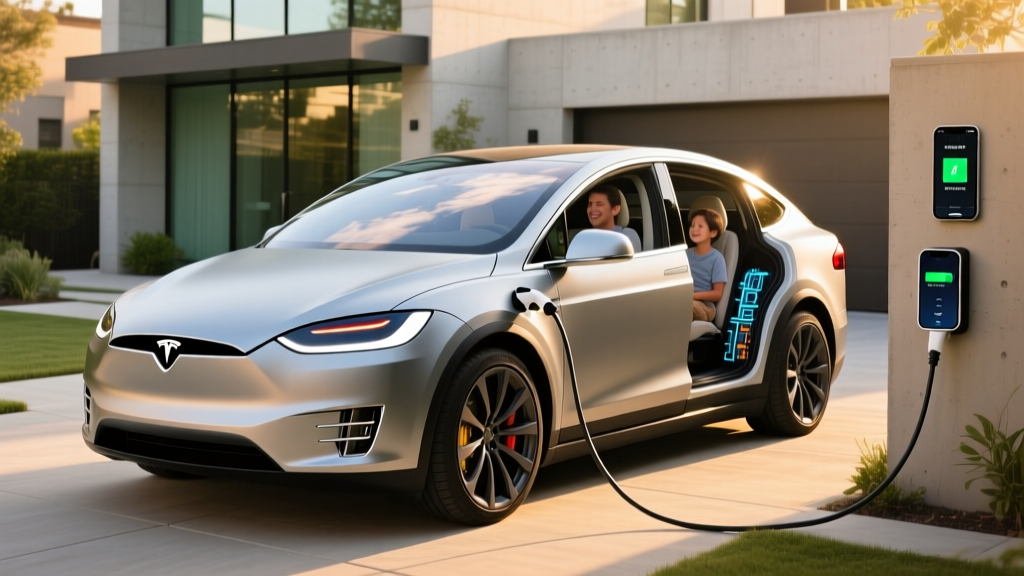
The falcon-wing rear doors remain the Model X's signature feature. They open vertically with articulated hinges, providing excellent access to second- and third-row seats in tight parking spaces. However, they add mechanical complexity and have historically been a source of warranty claims for seal and sensor issues.
- 340-mile EPA range (Long Range) is class-leading for three-row EVs
- Full Supercharger network access with native NACS
- 5,000-lb towing capacity covers most boat and utility trailers
- Falcon-wing doors ease child-seat installation and third-row access
- Tri-motor Plaid offers absurd performance for the segment
- OTA updates continuously add features post-purchase
- No federal tax credit due to MSRP cap
- Falcon-wing doors add repair risk and won't open in low-ceiling garages without clearance sensors working correctly
- Third-row legroom (32.7 in) is tight for adults
- Panel gaps and interior material quality lag behind BMW iX and Rivian R1S at this price point
- Yoke steering is polarizing and not universally preferred
- Insurance premiums run 20–35% higher than comparable ICE SUVs
Warranty and Long-Term Ownership
Tesla covers the Model X with the following warranty structure:
- Basic Vehicle: 4 years / 50,000 miles
- Battery & Drive Unit: 8 years / 150,000 miles (Long Range and Plaid), with a minimum 70% capacity retention guarantee over the warranty period
The 8-year/150,000-mile battery warranty is competitive with Rivian (8/175,000) and exceeds BMW's 8/80,000-mile coverage. NMC batteries in the Model X have demonstrated approximately 10–15% degradation over the first 100,000 miles based on fleet data, which is within the warranty threshold. Replacing a Model X battery pack out of warranty currently costs between $18,000 and $25,000 depending on configuration — a figure buyers should factor into long-term ownership projections.
Who the Model X Suits Best
- You need three rows + EV range for family road trips and already have home Level 2 charging
- Supercharger access is a priority for your travel patterns (rural West, cross-country routes)
- You tow a camper, boat, or utility trailer up to 5,000 lbs and want EV torque
- You want the fastest production SUV available (Plaid) and budget isn't the primary constraint
- You need genuine adult-sized third-row seating — check the Rivian R1S or Kia EV9
- Federal tax credit eligibility is essential to your purchase math — the BMW iX xDrive50 starts under the cap
- Interior luxury and material quality matter more than performance — the BMW iX and Mercedes EQS SUV deliver more refinement
- You live in an area with limited Supercharger density and need CCS compatibility with Electrify America or other networks
Frequently Asked Questions
What is the exact length of the Tesla Model X?
The 2026 Tesla Model X measures 199.1 inches (5,057 mm) from bumper to bumper. Its wheelbase is 116.7 inches, and its width with mirrors folded is 81.5 inches. For garage planning, allow at least 22 feet of depth to accommodate the vehicle plus walking space.
What is the real-world range of the Tesla Model X?
The EPA rates the Long Range at 340 miles and the Plaid at 320 miles. In real-world highway driving at 70 mph, expect 280–300 miles (Long Range) or 260–280 miles (Plaid). In cold weather below freezing with cabin heating active, range can drop to 230–260 miles. Preconditioning the battery and using seat heaters instead of cabin heat can recover 5–10% of lost range.
How fast does the Model X charge at home and on the road?
On a V3 or V4 Supercharger, the Model X peaks at 250 kW and charges from 10–80% in approximately 28–30 minutes. At home on a 48-amp Tesla Wall Connector (11.5 kW), it adds roughly 30 miles of range per hour, meaning a full overnight charge is easily achievable.
Does the 2026 Tesla Model X qualify for the federal EV tax credit?
Likely not. The §30D credit caps SUV MSRP at $80,000. The Long Range starts at $79,990 but destination and mandatory fees push it over. The Plaid at $94,990 is well above the cap. Always confirm current eligibility at IRS.gov and consult a tax professional.
Is the Tesla Model X worth buying vs. the Rivian R1S or BMW iX?
The Model X wins on Supercharger access, range (340 mi), and raw performance (Plaid). The Rivian R1S offers better off-road capability, a more usable third row, and a quad-motor option. The BMW iX delivers superior interior quality, qualifies for the federal tax credit in certain trims, and has more conventional styling. Your priority — charging network, interior luxury, or performance — should drive the decision.
How reliable are the falcon-wing doors?
Tesla has iterated on the door mechanism since the 2016 launch, and 2024+ models show fewer seal and sensor complaints. However, the articulated design involves more motors, sensors, and seals than a conventional door, which increases the probability of a warranty claim over 8+ years of ownership. The doors will not fully open in garages with low clearance — the ultrasonic sensors detect overhead obstacles and limit travel accordingly.