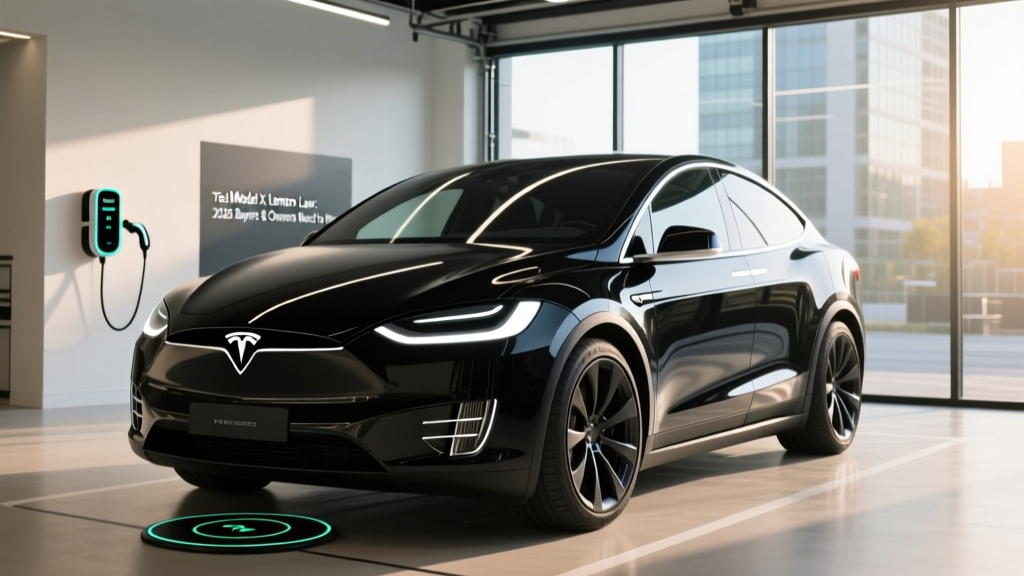
The Tesla Model X in 2026: Still the Family-Hauler Benchmark?
The Tesla Model X remains one of the few three-row electric SUVs that can genuinely seat six or seven adults, tow 5,000 pounds, and crack 300 miles of EPA range — all while delivering supercar-rivaling acceleration in Plaid trim. But its premium pricing and Tesla's historically uneven build quality have pushed a persistent question into EV forums and law offices alike: what happens when things go wrong, and how do lemon law protections apply to a $80,000+ electric vehicle?
This guide covers the 2026 Tesla Model X's core specs, real-world ownership data, and — critically — how state lemon laws interact with Tesla's warranty, arbitration process, and the realities of owning a complex, software-defined vehicle. Whether you're researching before buying or already documenting defects, you'll find the numbers and legal framework you need.
2026 Tesla Model X: Core Specifications
| Spec | Model X Long Range | Model X Plaid |
|---|---|---|
| EPA Range | 348 mi (20" wheels) / 320 mi (22") | 320 mi (20") / 295 mi (22") |
| Battery (usable) | ~95 kWh, NMC (nickel-manganese-cobalt) | ~95 kWh, NMC |
| Drivetrain | Dual Motor AWD | Tri-Motor AWD |
| Horsepower | 670 hp (combined) | 1,020 hp (combined) |
| 0-60 mph | 3.8 sec | 2.5 sec |
| Top Speed | 155 mph | 163 mph |
| Max DC Fast Charge | 250 kW (peak) | 250 kW (peak) |
| 10-80% DC Time | ~32 min | ~32 min |
| Level 2 Charge Rate | 11.5 kW (~34 mi/hr) | 11.5 kW (~34 mi/hr) |
| Efficiency | 100 MPGe / 34 kWh/100mi | 96 MPGe / 36 kWh/100mi |
| Cargo (behind 3rd row) | 15.8 cu ft | 15.8 cu ft |
| Cargo (all seats folded) | 85.1 cu ft | 85.1 cu ft |
| Seating | 5, 6, or 7 | 5 or 6 |
| Towing Capacity | 5,000 lb | 5,000 lb |
| Base MSRP | $79,990 | $94,990 |
| Federal §30D Credit | Not eligible (MSRP cap $80,000 for SUVs; base qualifies before dest. fee) | Not eligible (MSRP exceeds cap) |
| Battery Warranty | 8 yr / 150,000 mi | 8 yr / 150,000 mi |
| Basic Vehicle Warranty | 4 yr / 50,000 mi | 4 yr / 50,000 mi |
Sources: fueleconomy.gov, Tesla Model X Design Studio. Pricing reflects 2026 model year before destination and fees. The §30D MSRP cap for SUVs/vans/pickups is $80,000 — the Long Range base MSRP technically clears it, but destination charges and any options push it over. Consult a tax professional for your specific situation.
Real-World Range: What the EPA Sticker Doesn't Tell You
- EPA Combined: 348 miles
- Real-world highway (70-75 mph, 65°F): ~280-300 miles
- Real-world highway (30°F, heater on): ~230-260 miles
- City/stop-and-go with regen: ~310-340 miles
The Model X's large frontal area and ~5,100 lb curb weight penalize highway efficiency more than city driving, where regenerative braking recovers energy. Cold weather compounds this: battery preconditioning and cabin heating draw significant energy. Expect 25-35% range loss in sub-freezing highway conditions versus the EPA combined figure. Source: real-world testing data aggregated from EV communities and fueleconomy.gov.
For the Plaid trim, subtract roughly 10-15% from these figures due to higher rolling resistance and more aggressive powertrain tuning. On a 300-mile road trip in mild weather, the Long Range with 20-inch wheels is viable with one Supercharger stop; in winter or at sustained 80+ mph speeds, plan for two stops.
Charging: Speed, Infrastructure, and the NACS Advantage
The Model X charges exclusively via the NACS (North American Charging Standard) connector — Tesla's proprietary plug now adopted by nearly every major automaker. This gives the Model X seamless access to the Tesla Supercharger network, which remains the most reliable and geographically comprehensive DC fast-charging network in North America, with over 25,000 stalls in the U.S. alone.
| Charging Level | Power (kW) | Miles Added per Hour | Notes |
|---|---|---|---|
| Level 1 (120V household) | ~1.4 kW | ~3-4 mi/hr | Emergency/trickle only; ~95 hrs for 10-100% |
| Level 2 (240V, 48A Wall Connector) | 11.5 kW | ~34 mi/hr | Full charge in ~9 hrs; ideal for overnight |
| DC Fast (Supercharger V3/V4) | 250 kW peak | ~175 mi in 15 min | 10-80% in ~32 min; tapers sharply above 80% |
Charging curve reality check: The 250 kW peak rate is sustained only between roughly 10-30% State of Charge. By 50% SoC, the rate drops to ~150 kW, and above 80%, it falls below 50 kW as the battery management system protects cell longevity. The "32 minutes to 80%" figure is accurate; 10-100% takes closer to 60-65 minutes. This taper is physics-driven and applies to all NMC lithium-ion packs.
For home charging, Tesla's Gen 2 Wall Connector ($475) on a 60A circuit delivers the full 11.5 kW. Installation costs vary widely: expect $500-$2,000 for a straightforward install near the panel, but older homes may require a $1,500-$3,000 panel upgrade to support a dedicated 60A circuit. Always get a quote from a licensed electrician before purchasing.
Lemon Law Protections for Tesla Model X Owners
The search interest in "Tesla Model X lemon law" reflects a real pattern: complex vehicles with software-dependent systems, panel-fit inconsistencies, and occasional drivetrain issues have led some owners to pursue buyback or replacement claims under state lemon laws. Here's what the legal framework actually looks like.
How Lemon Law Applies to EVs
Every U.S. state has a lemon law, and they generally apply to the Model X the same way they apply to any new vehicle purchased or leased with a manufacturer's warranty. The core criteria in most states:
- Substantial defect: The issue must significantly impair the vehicle's use, value, or safety — not cosmetic-only complaints.
- Reasonable repair attempts: The manufacturer must be given a defined number of chances to fix the problem. Most states define this as 3-4 attempts for the same defect, or the vehicle being out of service for 30+ cumulative days.
- Warranty period: The defect must arise and be reported within the warranty period or a state-defined window (often the first 1-2 years or 18,000-24,000 miles, whichever comes first, though this varies significantly by state).
- Documentation: Every repair attempt must be documented through an authorized Tesla Service Center with a written repair order describing the complaint.
Common Model X Complaints That May Qualify
Based on NHTSA complaint databases and owner forums, recurring Model X issues that have triggered lemon law discussions include:
- Falcon-wing door malfunctions: Sensor failures, misalignment, and failure to open/close reliably — a safety concern if passengers are trapped.
- Drive unit failures: Loss of propulsion or "drive unit replaced" service visits within the first 30,000 miles.
- Touchscreen/infotainment blackouts: MCU (Media Control Unit) failures affecting climate controls, navigation, and rearview camera — all safety-relevant.
- Suspension and air-ride failures: Premature wear on air struts causing uneven ride height or "suspension fault" warnings.
- Wind noise and water intrusion: Seal failures around doors and the panoramic windshield.
Tesla's Arbitration Process and Its Limits
Tesla's purchase agreement includes a binding arbitration clause, which can complicate lemon law claims. However, most state lemon laws supersede private arbitration agreements for qualifying defects. Key points:
- You are not required to accept Tesla's internal resolution if it doesn't satisfy your state's lemon law requirements.
- Many states allow you to hire a lemon law attorney at no cost to you — the manufacturer pays legal fees if you prevail.
- Federal protections under the Magnuson-Moss Warranty Act supplement state laws for products over $15 with written warranties, covering the Model X fully.
Practical Steps If You Suspect a Lemon
- Document everything: Keep every repair order, take photos/videos of defects, save Tesla app service logs and communications.
- Use only authorized Tesla Service Centers for warranty repairs — third-party shops may void your claim.
- Track cumulative days out of service — many states count 30+ days (not necessarily consecutive) as automatic lemon qualification.
- Send a formal written notice to Tesla's legal department describing the defect and requesting a final repair attempt.
- Consult a lemon law attorney before accepting any settlement, buyback offer, or "goodwill" credit from Tesla.
Pricing, Tax Credits, and Total Cost Context
| Trim | Base MSRP | Typical As-Tested | §30D Federal Credit | Effective Price (with credit) |
|---|---|---|---|---|
| Long Range | $79,990 | $84,000-$88,000 (w/ options, dest.) | $0-$7,500 (base MSRP clears $80k SUV cap, but options/dest. may exceed) | ~$79,990-$88,000 |
| Plaid | $94,990 | $98,000-$105,000 | $0 (exceeds $80k MSRP cap) | $94,990-$105,000 |
The federal EV tax credit under IRS §30D has strict eligibility requirements that make the Model X a borderline case:
- MSRP cap: $80,000 for SUVs, vans, and pickups. The Long Range base MSRP of $79,990 technically clears this, but adding any options or the destination fee pushes the total over the cap.
- Buyer income cap: Modified AGI of $300,000 (joint), $225,000 (head of household), $150,000 (single).
- Battery sourcing: Critical minerals and battery components must meet escalating domestic-content thresholds — Tesla's supply chain has been adapting, but eligibility can change by production batch.
- Point-of-sale transfer: Since 2024, qualifying buyers can transfer the credit to the dealer for an immediate price reduction rather than waiting for tax filing.
In practice, most Model X buyers in 2026 will not qualify for the full $7,500 federal credit due to MSRP cap exceedance. State incentives (California's CVRP, Colorado's tax credit, etc.) may still apply — check your state's energy office for current programs.
How the Model X Stacks Up Against Competitors
The three-row electric SUV segment has grown, giving buyers genuine alternatives. Here's how the Model X compares on the metrics that matter:
| Metric | Tesla Model X LR | Rivian R1S (Dual Max) | Kia EV9 GT-Line AWD | Cadillac Escalade IQ |
|---|---|---|---|---|
| EPA Range | 348 mi | ~410 mi (Max Pack) | 270 mi | ~300 mi (est.) |
| Base MSRP | $79,990 | $84,900 | $73,900 | $129,990 |
| 0-60 mph | 3.8 sec | 4.5 sec | 4.9 sec | ~3.8 sec (est.) |
| Max DC Charge | 250 kW | 220 kW | 236 kW | 350 kW (est.) |
| 3rd-Row Legroom | 32.7 in | 30.4 in | 32.0 in | ~36 in (est.) |
| Towing | 5,000 lb | 7,700 lb | 5,000 lb | 7,500 lb (est.) |
- You prioritize Supercharger network access and Tesla's software ecosystem
- You want the fastest acceleration in the segment (Plaid trim)
- Falcon-wing doors and the panoramic windshield appeal to you
- You value OTA updates that add features over time
- Rivian R1S — you need maximum range (410 mi Max Pack), better off-road capability, or higher towing (7,700 lb)
- Kia EV9 — you want a lower entry price (~$59,900 base) and are willing to accept shorter range
- Cadillac Escalade IQ — you need maximum third-row space and luxury at a significantly higher price point
Tech, Interior, and the Ownership Experience
The Model X's interior is defined by its 17-inch center touchscreen (landscape orientation, running Tesla's proprietary OS), a 12.3-inch driver instrument cluster, and an available 8-inch rear-seat entertainment screen. The yoke steering wheel is standard (a conventional round wheel is available as a no-cost option). Build quality has improved meaningfully since the 2022 refresh, but panel-gap variability and occasional interior rattles still surface in owner reports — relevant context if you're building a lemon law case around fit-and-finish defects.
Autopilot and FSD (Supervised): Tesla's driver-assistance suite includes Autopilot (standard, with traffic-aware cruise and autosteer) and Full Self-Driving (Supervised) as a $8,000 add-on or $99/month subscription. FSD remains SAE Level 2 — it requires constant driver supervision and does not make the vehicle autonomous. Tesla's FSD v13 (current as of early 2026) handles highway and some city driving impressively but still disengages unpredictably in construction zones, unmapped areas, and adverse weather. Never treat it as a substitute for attentive driving.
Other standout features: HEPA air filtration with Bioweapon Defense Mode, a 22-speaker audio system, ventilated front seats, power-folding second- and third-row seats, and a front trunk (frunk) adding 6.6 cu ft of cargo space.
Pros, Cons, and Final Verdict
- Best-in-class acceleration (Plaid: 2.5 sec 0-60)
- Supercharger network access — still the gold standard for road-trip charging
- Genuine three-row seating with usable cargo space (85.1 cu ft max)
- Over-the-air updates continuously improve the vehicle
- Strong battery warranty: 8 yr / 150,000 mi with 70% minimum capacity retention
- 5,000-lb towing capacity is practical for boat/trailer duty
- Falcon-wing doors add complexity and are a frequent repair-order item
- Real-world range falls 15-25% below EPA in highway/cold conditions
- Federal tax credit eligibility is uncertain due to MSRP cap
- Service center wait times can be weeks to months in high-population areas
- Insurance premiums run 20-40% above comparable ICE SUVs
- Build-quality variability may require multiple service visits early in ownership
Verdict: The 2026 Tesla Model X is a genuinely capable family EV with no direct equal in acceleration-per-dollar and Supercharger convenience. But its complexity — especially the falcon-wing doors and tri-motor Plaid powertrain — means more potential failure points than simpler EVs. If you're buying, document every service interaction from day one. If you're already experiencing repeated defects, your state's lemon law likely applies, and you should consult a qualified attorney rather than relying solely on Tesla's internal resolution process.
Frequently Asked Questions
What is the real-world range of the 2026 Tesla Model X?
The EPA rates the Long Range at 348 miles (20" wheels) and the Plaid at 320 miles. In real-world highway driving at 70-75 mph in mild weather, expect 280-300 miles for the Long Range. In cold weather (below 32°F), that drops to 230-260 miles due to battery heating demands and reduced regenerative braking efficiency.
How fast does the Model X charge at home and on the road?
At home on a Level 2 Tesla Wall Connector (11.5 kW), the Model X adds roughly 34 miles of range per hour, achieving a full charge in about 9 hours. On DC fast charging (Tesla Supercharger V3/V4), it peaks at 250 kW and charges from 10-80% in approximately 32 minutes. Expect ~175 miles of range added in the first 15 minutes of a fast-charge session.
Does the 2026 Tesla Model X qualify for the federal EV tax credit?
It depends. The IRS §30D credit caps SUV MSRP at $80,000. The Long Range base MSRP of $79,990 technically clears this, but destination charges and any factory options push the total above the cap, disqualifying most configurations. The Plaid ($94,990 base) does not qualify. Additionally, buyer income limits ($300k joint / $150k single) and battery-sourcing requirements apply. Consult a tax professional and check IRS.gov for the latest rules.
Is the Tesla Model X worth buying over the Rivian R1S or Kia EV9?
The Model X wins on acceleration, Supercharger network access, and software features. The Rivian R1S offers more range (up to 410 mi with Max Pack), superior off-road capability, and higher towing (7,700 lb). The Kia EV9 is significantly cheaper ($59,900-$73,900) but has shorter range (~270 mi AWD). Your choice depends on whether Supercharger convenience and Tesla's ecosystem outweigh the R1S's versatility or the EV9's affordability.
What are the biggest pros and cons of the Model X?
Top pros: supercar-level acceleration (Plaid), Supercharger access, usable three-row seating, strong OTA update cadence, and an 8-year/150,000-mile battery warranty. Top cons: falcon-wing door reliability, real-world range shortfall vs. EPA, uncertain tax credit eligibility, long service-center wait times, and elevated insurance costs.
How do I know if my Model X qualifies as a lemon?
Generally, if your vehicle has a substantial defect covered by warranty that the manufacturer has failed to repair after 3-4 attempts (varies by state), or if the vehicle has been out of service for 30+ cumulative days, you may qualify under your state's lemon law. Document every repair order, keep all communications, and consult a lemon law attorney — most work on contingency with fees paid by the manufacturer if you prevail.
What is the Model X battery warranty and replacement cost?
Tesla covers the battery and drive units for 8 years or 150,000 miles, whichever comes first, with a minimum 70% capacity retention guarantee. If the battery degrades below 70% within this window, Tesla replaces it at no cost. Out-of-warranty replacement costs are estimated at $12,000-$20,000 depending on pack configuration and labor, though prices have been declining as battery costs fall industry-wide.