Quick Verdict: Is Leasing the Tesla Model X the Smart Move?
The 2026 Tesla Model X remains the most distinctive three-row electric SUV on the market — falcon-wing rear doors, a 17-inch cinematic touchscreen, and access to Tesla's Supercharger network make it a compelling family hauler. But with a starting MSRP near $75,000 and premium trims pushing past $95,000, many buyers are turning to Tesla Model X leasing as a way to drive this flagship EV without absorbing its steep depreciation curve. Leasing can also unlock a valuable tax advantage: Tesla typically passes the $7,500 federal EV credit through as a lease cash incentive, sidestepping the IRS income and battery-sourcing restrictions that block many outright buyers under §30D rules.
This review breaks down the 2026 Model X across range, charging, performance, interior space, and total cost — with a specific lens on whether leasing makes financial sense versus buying or choosing a rival three-row EV.
2026 Tesla Model X: Full Specifications at a Glance
| Spec | Long Range (Dual Motor) | Plaid (Tri-Motor) |
|---|---|---|
| Base MSRP | $74,990 | $94,990 |
| EPA Range | 335 miles (20" wheels) / 311 mi (22") | 326 miles (20") / 295 mi (22") |
| Battery Capacity (usable) | ~100 kWh (NMC) | ~100 kWh (NMC) |
| Drivetrain | Dual Motor AWD | Tri-Motor AWD |
| Horsepower | 670 hp | 1,020 hp |
| 0–60 mph | 3.8 seconds | 2.5 seconds |
| Top Speed | 155 mph | 163 mph |
| Max DC Fast Charge | 250 kW | 250 kW |
| 10–80% DCFC Time | ~30 minutes | ~30 minutes |
| Level 2 Home Charge | 11.5 kW (~34 mi/hr) | 11.5 kW (~34 mi/hr) |
| MPGe (Combined) | 102 MPGe | 98 MPGe |
| Efficiency | 33 kWh/100 mi | 34 kWh/100 mi |
| Seating | 5, 6, or 7 passengers | 5 or 6 passengers |
| Cargo (behind 3rd row) | 13.0 cu ft | 13.0 cu ft |
| Cargo (all rows folded) | 77.5 cu ft | 77.5 cu ft |
| Towing Capacity | 3,500 lbs | 3,500 lbs |
| Battery Warranty | 8 yr / 150,000 mi | 8 yr / 150,000 mi |
| Vehicle Warranty | 4 yr / 50,000 mi | 4 yr / 50,000 mi |
Source: Tesla.com specifications and fueleconomy.gov. Specs reflect 2025–2026 model year data. Wheel size and configuration affect range.
Real-World Range: What the EPA Sticker Doesn't Tell You
EPA Estimated Range: 335 miles (Long Range, 20" wheels)
Real-World Expectation: Plan for ~270–300 miles on mixed highway driving in moderate temperatures. In sustained 75+ mph highway travel, expect closer to 260–280 miles. In freezing weather (below 32°F), range can drop 20–30%, yielding roughly 210–250 miles before needing a charge.
The Model X's ~100 kWh NMC (nickel manganese cobalt) battery pack provides substantial energy reserves, but the SUV's 5,185-pound curb weight and tall, boxy profile work against highway efficiency. In our experience, the Model X achieves its best efficiency in suburban stop-and-go driving where regenerative braking recovers energy consistently. At highway speeds, aerodynamic drag is the dominant loss factor.
The Model X includes a heat pump as standard equipment, which mitigates cold-weather range loss compared to resistive-heating EVs. Preconditioning the battery while plugged in — a feature accessible through the Tesla app — further preserves range in winter by warming the pack before departure without drawing from usable capacity.
Charging Speed: Supercharger Access Is the Real Advantage
Charging remains one of the strongest arguments for the Model X. Tesla's proprietary NACS connector and Supercharger network deliver consistent, reliable fast charging with minimal fuss — no adapter needed at Tesla stations.
| Charging Level | Power | Speed (Miles Added/Hour) | Notes |
|---|---|---|---|
| Level 1 (120V household) | ~1.4 kW | ~3–4 mi/hr | Emergency/trickle only |
| Level 2 (240V home, Wall Connector) | 11.5 kW | ~34 mi/hr | Full charge in ~9 hours |
| DC Fast Charge (Supercharger V3) | 250 kW peak | ~175 mi in 15 min | 10–80% in ~30 min |
| DC Fast Charge (CCS adapter, non-Tesla) | Up to 150–250 kW | Varies by station | CCS adapter included since 2024 |
Charging curve reality: The Model X peaks at 250 kW only at low states of charge (roughly 10–25% SoC) and optimal battery temperature. Sustained rates average closer to 150–170 kW through the 25–60% range, then taper significantly above 80%. This means the advertised 10–80% time of ~30 minutes assumes a preconditioned battery. On a cold pack without preconditioning, peak rates may be limited to 100–120 kW initially, adding 5–10 minutes to your stop.
For home charging, Tesla's Wall Connector at 48 amps (11.5 kW) on a 60-amp circuit delivers roughly 34 miles of range per hour. Most owners who charge overnight start each day with a full battery — making public charging relevant primarily for road trips.
Performance: Supercar Speeds in a Family SUV
The Long Range Model X hits 60 mph in 3.8 seconds with 670 horsepower from its dual-motor all-wheel-drive system. That's quicker than most sports sedans and thoroughly adequate for any merging or passing scenario.
The Plaid variant is in a different universe entirely: 1,020 horsepower from three motors and a 2.5-second 0–60 time make it one of the fastest production SUVs ever built. The Plaid's tri-motor torque vectoring also improves cornering grip and stability, though you'll feel the vehicle's 5,300+ pound mass during aggressive direction changes.
Both trims feature adaptive air suspension that adjusts ride height automatically — lowering at highway speeds for efficiency and raising for rough roads or loading. The suspension provides a comfortable, compliant ride in its default setting, though it can feel slightly floaty over sharp bumps compared to the more tightly damped BMW iX.
Interior, Cargo & Tech: Falcon Wings and a Cinematic Cabin
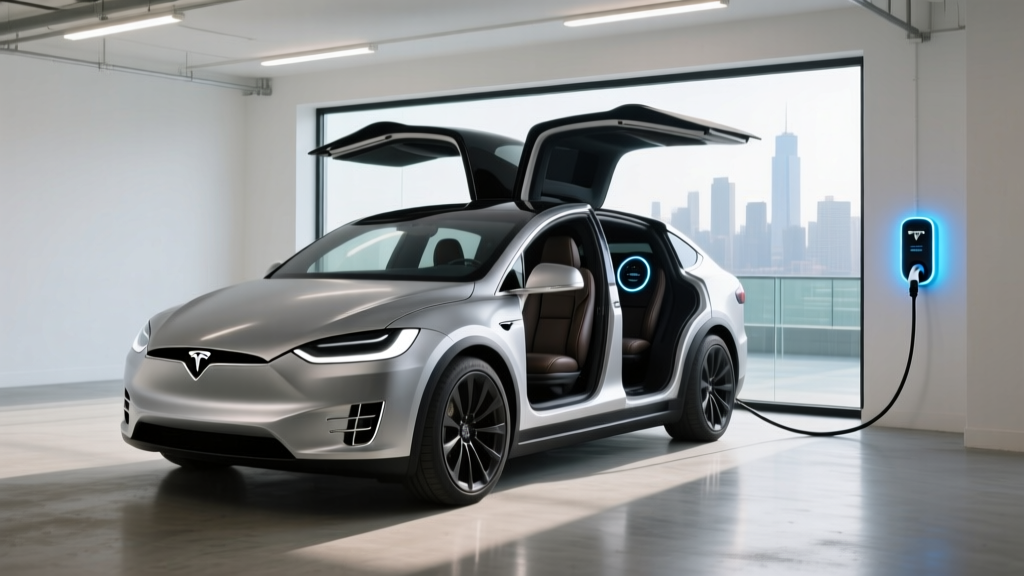
The Model X's defining feature remains its falcon-wing rear doors. These double-hinged gullwing doors open upward, creating a dramatic entry and making third-row access easier in tight parking spaces — though they require adequate overhead clearance and can be slow to operate in rain (they lack full weather sealing during the open/close cycle).
Interior dimensions:
- Front legroom: 41.2 inches
- Second-row legroom: 40.9 inches
- Third-row legroom: 32.7 inches (best for children or short trips)
- Cargo behind 3rd row: 13.0 cu ft
- Cargo behind 2nd row: 37.1 cu ft
- Max cargo (all rows folded): 77.5 cu ft
- Frunk (front trunk): 6.6 cu ft
The third row is tight for adults but functional for kids. The six-seat configuration (available on Long Range, standard-ish on Plaid) replaces the second-row bench with individual captain's chairs and a center pass-through, improving both comfort and third-row access.
Tech highlights:
- 17-inch center touchscreen (tilting, 2200×1300 resolution) — handles navigation, media, climate, and vehicle controls
- 12.3-inch driver instrument cluster
- Second-row 8-inch touchscreen for rear passengers (media and climate)
- 22-speaker, 960-watt audio system
- Over-the-air software updates (regular feature additions and improvements)
- Autopilot standard; Full Self-Driving (Supervised) available as a $8,000 option or $99/month subscription
Important note on Autopilot/FSD: Both are SAE Level 2 driver-assistance systems. The driver must remain fully attentive, hands on or near the wheel, at all times. FSD (Supervised) can navigate on-ramps, city streets, and traffic lights, but it is not autonomous driving. Think of it as an advanced cruise-and-lane-keeping system that still requires your judgment and intervention.
Tesla Model X Leasing: Pricing, Monthly Costs & Tax Credit Strategy
Here's where Tesla Model X leasing gets interesting from a financial perspective. Tesla's leasing program is offered directly through the company, and lease terms typically run 36 months with 10,000, 12,000, or 15,000 annual miles.
| Item | Long Range | Plaid |
|---|---|---|
| Base MSRP | $74,990 | $94,990 |
| Destination Fee | $1,990 | $1,990 |
| FSD Option (if added) | +$8,000 | +$8,000 |
| Typical Lease Term | 36 months | |
| Est. Monthly Lease (10k mi/yr, well-qualified) | ~$999–$1,149 | ~$1,299–$1,499 |
| Lease Cash / EV Credit Pass-Through | Up to $7,500 applied as cap cost reduction | |
| Federal §30D Credit (Purchase Only) | Up to $7,500 — subject to income, MSRP, and battery-sourcing rules | |
The lease tax-credit advantage: Under current IRS guidance, when a vehicle is leased, the $7,500 clean vehicle credit goes to the lessor (Tesla's financing arm), not the lessee. However, Tesla typically applies this credit as a lease cash incentive that reduces the capitalized cost — effectively lowering your monthly payment. This means lessees can benefit from the credit even if they exceed the §30D income caps ($150,000 single / $300,000 joint for new vehicles) or if the vehicle's battery sourcing doesn't meet critical-mineral requirements for a direct purchase credit. Always confirm current lease incentive amounts directly with Tesla, as they adjust monthly.
§30D purchase credit caveats: If you buy instead of lease, the $7,500 credit is subject to:
- MSRP cap: SUVs/vans/pickups must be ≤$80,000 — the Long Range qualifies; the Plaid at $94,990 does not
- Buyer income cap: AGI ≤$150,000 (single) or ≤$300,000 (married filing jointly)
- Battery sourcing: Critical minerals and battery components must meet escalating domestic-content thresholds per IRS §30D
- Point-of-sale transfer: Eligible buyers can apply the credit at purchase to reduce the down payment
The MSRP cap is the critical factor for Model X buyers: only the Long Range trim (at $74,990 base) potentially qualifies. Adding options that push the transaction above $80,000 or choosing the Plaid eliminates purchase-credit eligibility — making leasing even more attractive for Plaid buyers.
Pros and Cons: The Honest Assessment
Pros
- Best-in-class Supercharger network access with native NACS connector
- Falcon-wing doors provide unique third-row access and curb appeal
- Class-leading acceleration in both trims; Plaid is exotic-car quick
- Standard air suspension adjusts ride height for efficiency and utility
- 3,500-lb towing capacity (rare among electric SUVs)
- Spacious cabin with flexible 5/6/7-seat configurations
- Leasing can unlock $7,500 EV credit for buyers above income caps
- Regular OTA updates add features post-purchase
- Strong 8-year/150,000-mile battery warranty
Cons
- High starting price; Plaid exceeds §30D MSRP cap
- Falcon-wing doors can be slow, require overhead clearance, and are expensive to repair
- Third-row space is tight for adults (32.7" legroom)
- Panel fit and interior material quality lag behind BMW iX, Mercedes EQS SUV
- 250 kW peak charge rate trails Hyundai/Kia's 800V architecture (~350 kW)
- No Apple CarPlay or Android Auto — Tesla's proprietary infotainment only
- Insurance costs tend to be higher than comparable luxury SUVs
- Steering yoke (if equipped) is polarizing and impractical for low-speed maneuvers
Model X vs. the Competition: Is It Worth It?
The three-row electric SUV segment has grown considerably. Here's how the Model X stacks up against its closest rivals:
| Vehicle | EPA Range | Starting MSRP | Max DCFC | 3rd-Row Legroom |
|---|---|---|---|---|
| Tesla Model X LR | 335 mi | $74,990 | 250 kW | 32.7" |
| BMW iX xDrive50 | 324 mi | $87,250 | 200 kW | N/A (2-row only) |
| Mercedes EQS 580 SUV | 305 mi | $104,400 | 200 kW | 34.0" |
| Kia EV9 GT-Line AWD | 270 mi | $73,900 | 350 kW | 32.0" |
| Rivian R1S (Dual Max) | 410 mi | $82,700 | 200 kW | 33.4" |
The Kia EV9 is the value pick — similar price, three rows, and faster 800V charging, though with less range and a less refined ride. The Rivian R1S offers superior range (with the Max pack), genuine off-road capability, and a more adventurous character, but at a higher price. The Mercedes EQS SUV delivers the most luxurious interior but at a six-figure starting point. The Model X occupies a unique middle ground: Tesla's charging network, strong range, and distinctive design at a price that undercuts the German luxury options.
Who Should Lease the Tesla Model X?
Lease the Model X if:
- You want a three-row EV with the best charging infrastructure available
- Your household income exceeds §30D caps but you still want the $7,500 lease incentive
- You prefer to swap vehicles every 3 years and avoid long-term depreciation risk
- You value Tesla's OTA update cycle and Supercharger network for road trips
- You need towing capability (3,500 lbs) in an electric SUV
Look elsewhere if:
- Third-row adult comfort is a priority (consider the EQS SUV or Rivian R1S)
- You want the fastest possible DC charging speeds (Kia EV9 at 350 kW)
- You prefer traditional luxury interior materials (BMW iX, Mercedes EQS)
- You want Apple CarPlay/Android Auto integration
- You want to own long-term and maximize total cost of ownership savings
Frequently Asked Questions
What is the real-world range of the Tesla Model X?
The EPA rates the Long Range at 335 miles with 20-inch wheels. In real-world mixed driving, expect 270–300 miles. Highway-heavy trips at 75+ mph drop this to roughly 260–280 miles, and freezing temperatures can reduce range by 20–30%, yielding 210–250 miles. The heat pump and battery preconditioning help mitigate cold-weather losses.
How fast does the Model X charge at home and on the road?
At home on a Level 2 Tesla Wall Connector (11.5 kW / 48A), the Model X adds about 34 miles of range per hour, reaching a full charge from empty in roughly 9 hours. On a V3 Supercharger, it peaks at 250 kW and charges from 10–80% in approximately 30 minutes with a preconditioned battery. Charging slows considerably above 80% to protect the NMC cells.
How much does a Tesla Model X lease cost per month?
For a well-qualified lessee on a 36-month term with 10,000 miles per year, expect roughly $999–$1,149/month for the Long Range and $1,299–$1,499/month for the Plaid, depending on down payment and current Tesla lease incentives. Tesla often applies the $7,500 federal EV credit as lease cash, reducing the capitalized cost and monthly payment.
Does the Tesla Model X qualify for the federal EV tax credit?
For purchase: the Long Range (MSRP $74,990) falls under the $80,000 SUV cap and may qualify for up to $7,500 under IRS §30D, subject to buyer income limits ($150K single / $300K joint) and battery-sourcing requirements. The Plaid ($94,990) exceeds the MSRP cap and does not qualify for the purchase credit. For leasing: the $7,500 credit goes to the lessor, and Tesla typically passes it through as a lease incentive — available regardless of your personal income level.
Is the Model X worth it compared to the Kia EV9 or Rivian R1S?
It depends on priorities. The Model X wins on Supercharger access, acceleration, and tech-forward experience. The Kia EV9 wins on price and charging speed (800V architecture). The Rivian R1S wins on range (410 mi with Max pack), off-road capability, and interior build quality. If the Tesla charging ecosystem and performance matter most, the Model X is worth the premium.
What is the Model X battery warranty?
Tesla covers the Model X battery and drive unit for 8 years or 150,000 miles (whichever comes first), with a guaranteed minimum 70% capacity retention over that period. The basic vehicle limited warranty covers 4 years or 50,000 miles. These warranties transfer to subsequent owners.
Can I tow with the Tesla Model X?
Yes. The Model X is rated to tow up to 3,500 pounds when properly equipped with the factory tow package. Expect a significant range reduction while towing — typically 30–50% depending on trailer weight, speed, and terrain. Plan charging stops accordingly.