2026 Tesla Model X: Quick Lease Verdict
Leasing a Tesla Model X in 2026 makes sense for buyers who want three-row electric utility with access to the Supercharger network, but the math requires scrutiny. With a base MSRP hovering around $79,990 for the Long Range variant and $94,990 for the Plaid, monthly payments typically land between $1,100 and $1,600 depending on term length, mileage allowance, and down payment. Unlike purchasing, leasing generally means you forfeit the federal §30D tax credit — Tesla (or the leasing bank) claims it and may or may not pass savings through as a capitalized-cost reduction.
The Model X remains one of very few premium electric SUVs offering genuine three-row seating, a frunk, and a usable tow rating. But competitors like the Rivian R1S and BMW iX have narrowed the gap in interior quality and ride refinement. Below, we lay out every number you need before signing.
Range, Efficiency & Real-World Expectations
| Metric | Long Range (Dual-Motor AWD) | Plaid (Tri-Motor AWD) |
|---|---|---|
| EPA Range | 340 miles | 320 miles |
| Battery (usable) | ~100 kWh, NMC | ~100 kWh, NMC |
| MPGe (combined) | 102 MPGe | 98 MPGe |
| Efficiency | ~33 kWh/100 mi | ~34 kWh/100 mi |
| Drivetrain | Dual-Motor AWD | Tri-Motor AWD |
| 0-60 mph | 3.8 sec | 2.5 sec |
| Horsepower | 670 hp | 1,020 hp |
The NMC (nickel-manganese-cobalt) chemistry in the Model X prioritizes energy density over cycle life compared to LFP packs in the base Model 3 and Model Y. For a lease term of 24–36 months, degradation is a non-issue — you'll return the vehicle well before any meaningful capacity loss appears.
Charging Speed: DC Fast, Level 2 & Home Setup
| Charging Level | Rate | Time / Miles Added |
|---|---|---|
| DC Fast Charge (peak) | 250 kW (CCS via Supercharger or NACS native) | 10–80% in ~30 min |
| DC Fast Charge (sustained avg.) | ~170 kW avg. 10–80% | ~200 mi added in 15 min |
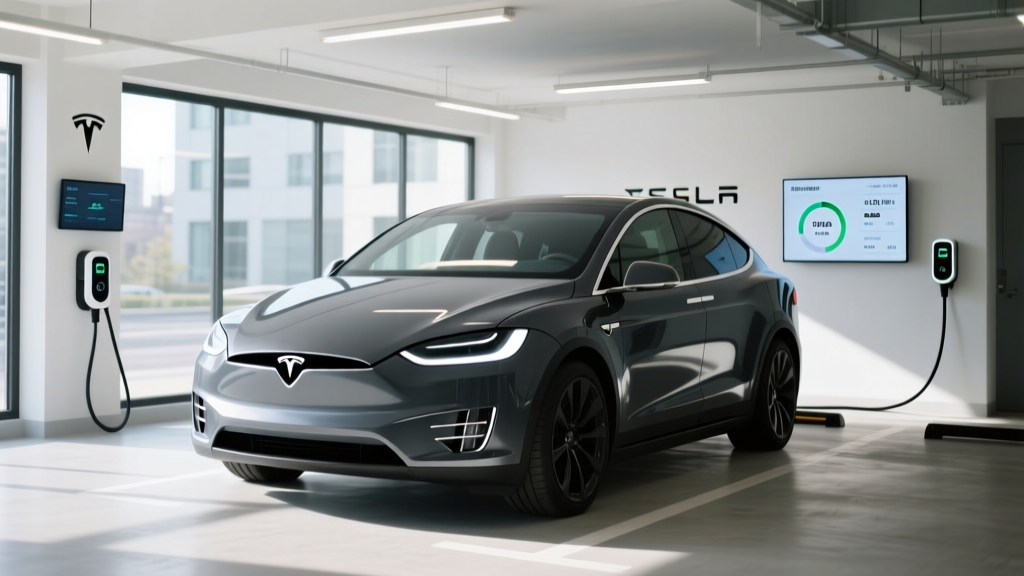
| Level 2 (Tesla Wall Connector, 48A) | 11.5 kW | ~34 mi/hr, full charge ~9 hrs |
| Level 2 (generic J1772 w/ adapter) | Up to 11.5 kW | Same as above |
| Level 1 (120V household) | ~1.4 kW | ~3–4 mi/hr |
Tesla's V3 and V4 Superchargers deliver the 250 kW peak, but only between roughly 10% and 35% state of charge. Above 50%, the charge curve tapers steeply — 80–100% can take as long as 10–80%. On road trips, plan stops around 15–20% remaining and charge to 70–80% for the fastest average speed.
For home charging, a NEMA 14-50 outlet on a 50-amp circuit delivers about 40 amps (9.6 kW) to the vehicle — adequate for overnight replenishment. The Tesla Wall Connector on a 60-amp circuit pushes 48 amps (11.5 kW), adding roughly 34 miles per hour of charging. Expect $500–$1,500 for a licensed electrician to install a 240V outlet, or $1,200–$2,800 for a hardwired Wall Connector, depending on panel proximity and whether your electrical panel needs upgrading.
Pricing, Lease Economics & Tax Credit Impact
| Trim | Base MSRP (2026) | Typical Lease (36 mo / 10K mi) | §30D Credit Impact |
|---|---|---|---|
| Long Range AWD | $79,990 | $1,150–$1,350/mo | Credit goes to lessor; may reduce cap cost |
| Plaid AWD | $94,990 | $1,400–$1,650/mo | Credit goes to lessor; may reduce cap cost |
Federal Tax Credit (§30D) Rules for Leases: Under IRS IRS §30D guidelines, the $7,500 credit for new clean vehicles applies to the buyer/lessor — not the lessee directly. In a Tesla lease, the financing entity (typically Tesla Finance or a partner bank) claims the credit. Some lessors pass the full or partial amount as a capitalized-cost reduction, lowering your monthly payment; others do not. Always ask for the "lease trade-in" or "cap cost reduction" line item on the deal sheet.
- MSRP cap: SUVs/vans must be ≤ $80,000 — the Long Range qualifies; the Plaid does not.
- Income cap: AGI ≤ $150K single / $300K joint filers (if credit were passed through).
- Battery sourcing: Critical-mineral and battery-component requirements phase in annually; confirm current-year compliance on the IRS eligible-vehicle list.
- Point-of-sale transfer: Available for purchases; in a lease, the lessor controls this.
Destination fees, paint upgrades ($2,000 for multi-coat), 22" wheels ($4,500), and Enhanced Autopilot ($6,000) or Full Self-Driving Supervised ($8,000) push as-tested prices well above base. A Long Range with FSD and premium wheels can land near $98,000 — exceeding the §30D SUV cap and eliminating credit eligibility even on purchase.
Interior Space, Cargo & Family Practicality
The Model X offers two seating configurations: a six-seat layout (2+2+2) with second-row captain's chairs, or an optional seven-seat (2+3+2) arrangement. The six-seat version provides superior third-row access via the walk-through between second-row seats.
| Dimension | Specification |
|---|---|
| Cargo (behind 3rd row) | ~37.1 cu ft |
| Cargo (3rd row folded) | ~72.3 cu ft |
| Cargo (all rows folded) | ~85.1 cu ft |
| Front trunk (frunk) | ~6.7 cu ft |
| Front legroom | 41.2 in |
| 2nd-row legroom | 38.4 in |
| 3rd-row legroom | 32.7 in |
| Max towing capacity | 5,000 lbs |
The third row suits children or short trips for adults. For regular six- or seven-passenger duty, the Rivian R1S and Kia EV9 offer more third-row headroom. The Model X's falcon-wing rear doors provide dramatic curb appeal and easier child-seat access in tight parking spaces, but their complexity has historically driven higher repair costs out of warranty.
Technology, Driver Assistance & Notable Drawbacks
The 17-inch center touchscreen runs Tesla's latest software suite, including gaming (up to 10 teraflops GPU), theater-mode streaming, and over-the-air updates that add features post-delivery. The secondary 8-inch rear touchscreen controls climate and entertainment for second-row passengers.
Notable drawbacks:
- No Apple CarPlay or Android Auto — Tesla's proprietary infotainment only.
- Yoke steering wheel (optional) requires adaptation; not ideal for low-speed maneuvering.
- Ride quality on 22" wheels is firm; 20" wheels improve comfort noticeably.
- Falcon-wing door sensors occasionally misread obstacles in tight garages.
- Panel-gap consistency still lags German competitors at this price point.
Model X vs. Key Competitors: Is It Worth the Lease?
| Metric | Tesla Model X LR | Rivian R1S (Dual-Motor) | BMW iX xDrive50 | Kia EV9 GT-Line AWD |
|---|---|---|---|---|
| Base MSRP | $79,990 | $79,900 | $87,250 | $73,900 |
| EPA Range | 340 mi | 321 mi | 324 mi | 280 mi |
| 3rd Row | Yes (tight) | Yes (moderate) | No | Yes (roomy) |
| DC Fast Charge (peak) | 250 kW | 200+ kW | 195 kW | 236 kW |
| Tow Rating | 5,000 lbs | 7,700 lbs | 3,500 lbs | 5,000 lbs |
| §30D Eligible (SUV cap) | Yes (LR only) | Yes | No | Yes |
Choose the Rivian R1S if: You need serious towing capability (7,700 lbs), better off-road clearance, and a more conventional interior layout.
Choose the Kia EV9 if: You want the most third-row space and lowest entry price, and can accept ~280 miles of range.
Skip the Model X if: You need Apple CarPlay, prefer traditional luxury build quality, or want a third row adults can actually use daily.
Warranty Coverage
Tesla's warranty structure is competitive within the premium EV segment:
- New Vehicle Limited Warranty: 4 years / 50,000 miles
- Battery & Drive Unit: 8 years / 150,000 miles (Long Range & Plaid), with a minimum 70% capacity retention guarantee over the warranty period
- Roadside Assistance: 4 years / 50,000 miles
For a 36-month lease, you'll remain fully within the bumper-to-bumper and battery warranty. The 70% retention threshold is generous — Tesla's official warranty documentation covers replacement if degradation exceeds 30% within the term, which real-world fleet data shows is extremely rare before 150,000 miles.
Pros & Cons at a Glance
- Class-leading 340-mile EPA range (Long Range)
- Access to 250 kW Supercharger network (18,000+ stalls in North America)
- Genuine 5,000-lb towing with integrated trailer mode
- Frunk + rear cargo flexibility
- Continuous OTA improvements
- Plaid variant: 2.5-sec 0-60, supercar-SUV performance
- Third row tight for adults on longer drives
- No Apple CarPlay / Android Auto
- Falcon-wing doors add complexity and potential repair cost
- Plaid trim exceeds §30D MSRP cap ($80K SUV limit)
- Panel gaps and interior finish lag BMW/Mercedes at this price
- Lease forfeits direct tax-credit claim to lessor
Frequently Asked Questions
What is the real-world range of the Tesla Model X?
EPA rates the Long Range at 340 miles and the Plaid at 320 miles. In mixed real-world driving, expect 290–310 miles (Long Range) and 260–280 miles (Plaid). Sustained highway driving at 75+ mph drops range by 15–20%; sub-freezing temperatures can cut it by 25–35% due to battery preconditioning and cabin heating demands.
How fast does the Model X charge at home and on the road?
On a V3/V4 Supercharger, it peaks at 250 kW and reaches 10–80% in approximately 30 minutes, though sustained average is closer to 170 kW due to charge-curve taper above 50% SoC. At home on a 48-amp Level 2 Wall Connector (11.5 kW), a full charge takes roughly 9 hours, adding about 34 miles per hour of plug-in time.
Does the Model X qualify for the $7,500 federal EV tax credit?
The Long Range (MSRP ≤ $80,000) can qualify under §30D, but only if the buyer's AGI is within limits ($150K single / $300K joint), battery sourcing requirements are met, and the vehicle is purchased — not leased. In a lease, the lessor claims the credit and may or may not pass savings to you. The Plaid (MSRP $94,990) exceeds the $80,000 SUV cap and is ineligible regardless of purchase or lease.
Is leasing the Model X better than buying?
Leasing lowers monthly outlay and shields you from long-term depreciation and battery-replacement risk. However, you surrender the §30D credit (unless the lessor passes it through), face mileage penalties (typically $0.20–$0.25/mile over the limit), and cannot customize the vehicle. If you drive under 10,000 miles/year and want a new vehicle every three years, leasing works. High-mileage drivers or those wanting equity should purchase.
What are the biggest drawbacks of the Model X?
The cramped third row, absence of Apple CarPlay, falcon-wing door reliability concerns, and panel-gap inconsistency are the most cited complaints. The Plaid's ineligibility for the federal tax credit also stings. For pure family hauling, the Kia EV9 or Rivian R1S offer more practical third rows.
Who is the Model X best suited for?
The Model X fits tech-forward families who primarily use two rows but occasionally need a third, value the Supercharger network for road trips, and want towing capability for a small boat or camper. It's less ideal for large families needing daily three-row use or buyers who prioritize traditional luxury craftsmanship over software-centric innovation.