Quick Verdict: Is Leasing the Tesla Model X the Smart Move in 2026?
The 2026 Tesla Model X remains the benchmark for three-row electric SUVs that can genuinely seat six adults, tow 5,000 pounds, and still hit 60 mph in under four seconds. For buyers weighing whether to purchase outright or explore Tesla Model X lease deals, the math has shifted meaningfully in 2026. Tesla's lease pricing, combined with the fact that lessees can capture the §30D federal tax credit as a capitalized-cost reduction (via point-of-sale transfer), makes the monthly payment equation more attractive than it was even a year ago.
But the Model X isn't for everyone. It's a premium, tech-forward vehicle with a polarizing yoke option, falcon-wing doors that are impressive but occasionally impractical in tight garages, and a price that starts north of $77,000. This review breaks down every spec, real-world driving observation, and financial detail you need to evaluate current Tesla Model X lease deals — and decide whether this EV fits your driveway.
Range, Efficiency & Real-World Expectations
EPA Range (2026 Model X Plaid): 320 miles
Real-World Highway (70-80 mph, moderate climate): ~270-290 miles
Cold-Weather Estimate (20°F, highway): ~220-250 miles
Efficiency: 102 MPGe combined / 33 kWh per 100 miles (Long Range AWD)
The 2026 Model X Long Range AWD carries an EPA-estimated 329 miles of range on its ~100 kWh (usable) battery pack. The Plaid variant, with its tri-motor setup and higher performance tuning, drops slightly to 320 miles EPA. These are strong numbers for a vehicle this large, but as with any EV, the real-world story is more nuanced.
On highway road trips at sustained 75-80 mph speeds in 60-80°F weather, expect to extract roughly 270-290 miles before needing to stop. That's a 12-18% reduction from the EPA sticker — typical for large, aerodynamically challenged SUVs at highway speed. In freezing temperatures (20°F or below), battery chemistry limitations and cabin-heating demands can push range loss to 25-35%, leaving you with approximately 220-250 miles of usable range on a full charge. Tesla's heat pump system helps mitigate this compared to older resistance-heater EVs, but physics is physics.
City driving with frequent regenerative braking opportunities actually gets you closer to — and sometimes slightly above — the EPA number, since regen recaptures energy that internal-combustion vehicles waste as brake heat. For daily commuters covering 40-60 miles round trip, range is a non-issue; you'll charge at home nightly and rarely think about it.
Charging Speed: DC Fast, Level 2 & Home Setup
Charging speed is where the Model X's 800V-capable architecture shows its teeth — but only if you have access to the right infrastructure. Here's the full breakdown:
| Charging Level | Power (kW) | Speed / Time | Notes |
|---|---|---|---|
| Level 1 (120V household) | ~1.4 kW | ~3-4 miles per hour | Emergency/trickle only; ~80+ hrs for full charge |
| Level 2 (240V, 48A Wall Connector) | 11.5 kW | ~34 miles per hour; full charge in ~9.5 hrs | Recommended home setup; requires 60A circuit |
| Level 2 (240V, 32A mobile connector) | 7.7 kW | ~23 miles per hour; full charge in ~13 hrs | Included mobile connector; NEMA 14-50 outlet |
| DC Fast Charge (V3 Supercharger) | Peak 250 kW | 10-80% in ~28 minutes | Taper begins ~60% SoC; 80-100% adds ~25 more min |
| DC Fast Charge (V4 Supercharger) | Peak 250 kW | 10-80% in ~28 minutes | Newer V4 stalls with CCS/NACS; same peak for Model X |
| Third-Party DC (Electrify America, etc.) | Up to 150-250 kW | 10-80% in ~30-40 minutes (varies) | Requires NACS-to-CCS adapter (included with 2026 models) |
The 2026 Model X uses the NACS (North American Charging Standard) connector natively, meaning direct compatibility with the entire Tesla Supercharger network — over 6,000 V3 and V4 stalls across North America. For third-party networks like Electrify America or EVgo that use CCS1 connectors, Tesla includes a NACS-to-CCS adapter, though charging speeds on non-Tesla hardware can be slightly lower due to handshake protocol variations.
A critical real-world note: the 250 kW peak rate is exactly that — a peak. The charge curve tapers meaningfully above 60% state of charge (SoC). In practice, you'll see 250 kW from roughly 10-35% SoC, dropping to ~150 kW by 50%, ~90 kW by 70%, and ~50 kW by 85%. This is why the 10-80% time of ~28 minutes is the more useful metric than peak kW alone. Preconditioning the battery (which the car does automatically when you navigate to a Supercharger) is essential to hitting these numbers — without it, cold-soaked batteries may peak at under 100 kW.
For home charging, Tesla's Wall Connector at 48 amps on a 240V/60A circuit delivers 11.5 kW, adding roughly 34 miles of range per hour. A full overnight charge from 10% takes about 9.5 hours — perfectly suited for off-peak utility rates. Installation of a 60A circuit typically runs $500-$1,500 depending on panel proximity, though older homes may need a panel upgrade ($1,500-$3,000 additional). Consult a licensed electrician for your specific situation.
Performance & Drivetrain: Long Range vs. Plaid
The 2026 Model X offers two powertrain configurations, and the gap between them is substantial:
| Spec | Long Range AWD | Plaid |
|---|---|---|
| Drivetrain | Dual-Motor AWD | Tri-Motor AWD |
| Horsepower | 670 hp | 1,020 hp |
| 0-60 mph | 3.8 seconds | 2.5 seconds |
| Top Speed | 155 mph | 163 mph |
| EPA Range | 329 miles | 320 miles |
| Battery | ~100 kWh usable (NMC) | ~100 kWh usable (NMC) |
| Towing Capacity | 5,000 lbs | 5,000 lbs |
The Long Range AWD's 3.8-second 0-60 time is already faster than most sports sedans, delivered with the instant torque that only electric drivetrains provide. The dual-motor setup provides confident all-weather traction, with torque vectoring between front and rear axles.
The Plaid's tri-motor configuration (one front, two rear) produces a staggering 1,020 hp and a 2.5-second 0-60 — making it one of the quickest production SUVs ever built. The Plaid also includes track-tuned suspension, carbon-sleeved rotors, and a dedicated track mode. But for most buyers, the Long Range is the rational choice: it's $15,000+ cheaper, offers 9 more miles of EPA range, and is still absurdly quick.
Both trims feature adaptive air suspension that adjusts ride height based on speed and terrain, providing up to 7 inches of ground clearance adjustment. This is useful for speed bumps, steep driveways, and light off-road situations.
Interior Space, Cargo & Passenger Comfort
The Model X is available in five-seat, six-seat, and seven-seat configurations. The six-seat layout with second-row captain's chairs is the most popular and arguably the most practical, offering a walk-through to the third row.
| Dimension | Measurement |
|---|---|
| Cargo Volume (behind 3rd row) | ~15 cu ft (with frunk: ~18 cu ft total) |
| Cargo Volume (3rd row folded) | ~42 cu ft |
| Cargo Volume (all rear rows folded) | ~75 cu ft |
| Front Legroom | 41.2 inches |
| 2nd-Row Legroom | 38.4 inches |
| 3rd-Row Legroom | 32.7 inches |
| Front Headroom | 40.7 inches |
| Frunk (Front Trunk) | ~3.0 cu ft |
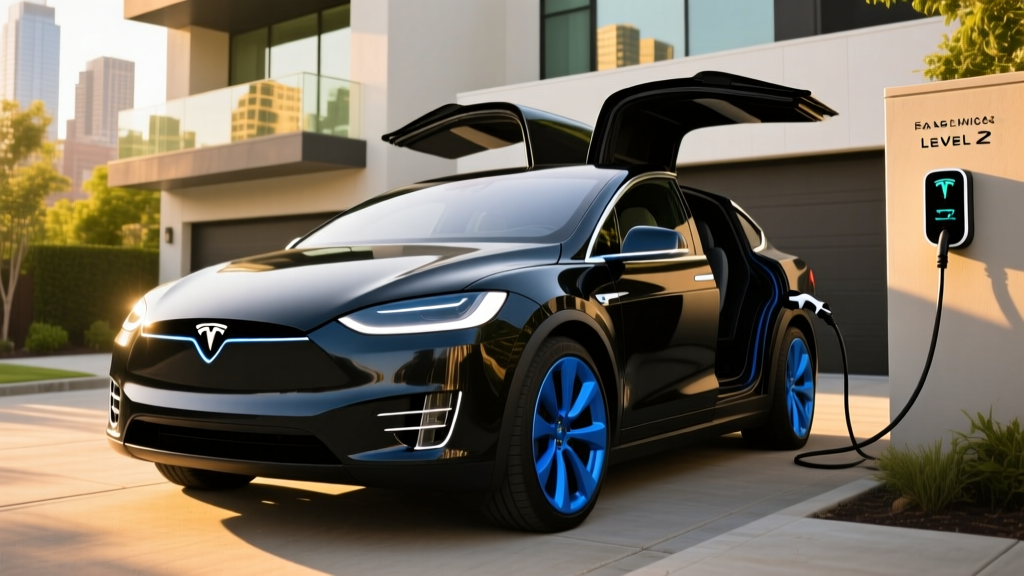
The falcon-wing rear doors are the Model X's most recognizable feature. They open vertically, hinging upward from the roof, which makes loading car seats and accessing the second and third rows significantly easier in tight parking spaces — you can stand fully upright while loading. However, they require more overhead clearance than conventional doors (about 12 inches above the roofline), which can be an issue in low-ceiling garages. The doors use ultrasonic sensors to detect obstacles and adjust their opening arc, but the system isn't flawless.
The panoramic windshield extends deep into the roof, creating an airy cabin feel. The 17-inch center touchscreen is the command center for virtually all vehicle functions — there are almost no physical buttons. The second row gets its own 8-inch touchscreen for climate and media controls. Build quality on the 2026 refresh has improved notably over earlier Model X generations, with tighter panel gaps and better interior material quality.
2026 Tesla Model X Lease Deals: Pricing & Tax Credits
Understanding the pricing landscape is essential before evaluating any Tesla Model X lease deal. Here's where the 2026 model year stands:
| Trim | Base MSRP | Typical As-Tested | §30D Credit Eligible? | Est. Effective Price w/ Credit |
|---|---|---|---|---|
| Long Range AWD | $77,990 | $82,000-$95,000 | No (over MSRP cap) | N/A |
| Plaid | $92,990 | $97,000-$115,000 | No (over MSRP cap) | N/A |
Important tax credit clarification: Under current IRS §30D rules, the federal new clean vehicle credit of up to $7,500 has an MSRP cap of $80,000 for SUVs, vans, and pickup trucks. The 2026 Model X Long Range AWD starts at $77,990, which is under the cap — but adding virtually any options (paint upgrades beyond free white, FSD, premium wheels, enhanced autopilot) pushes the MSRP above $80,000, disqualifying it. The Plaid, at $92,990 base, is ineligible regardless. Additionally, buyers must meet income caps ($300,000 joint / $150,000 individual) and the vehicle must satisfy battery-component and critical-mineral sourcing requirements. Always verify current-year eligibility on IRS.gov or with a tax professional.
How leasing changes the equation: When you lease a Model X, the leasing entity (typically Tesla Finance) is the legal purchaser. Under §30D, the credit can be applied as a capitalized-cost reduction at the point of sale, effectively lowering the lease's capitalized cost and thus the monthly payment. Even if the vehicle's MSRP exceeds the cap for a direct purchase, the lease structure may allow the credit to flow through as a "lease cash" incentive from Tesla — though this depends entirely on Tesla's current promotional programs and is not guaranteed. Always ask the dealer or Tesla advisor for the exact money factor, residual value, cap cost, and any applied incentives in writing.
Typical 2026 Model X lease terms run 24-36 months with 10,000-15,000 miles per year. Expect monthly payments in the $1,100-$1,600 range depending on trim, term, mileage allowance, and down payment. A $5,000-$8,000 cap cost reduction is common. Tesla's lease calculator on their website provides real-time estimates, and third-party lease-comparison tools can help benchmark offers.
Warranty, Safety & Driver-Assistance Technology
Tesla's warranty coverage for the 2026 Model X is competitive within the premium EV segment:
- Basic Vehicle Warranty: 4 years / 50,000 miles
- Battery & Drive Unit Warranty: 8 years / 150,000 miles (Long Range AWD)
- Battery & Drive Unit Warranty: 8 years / 120,000 miles (Plaid)
- Battery Capacity Retention Guarantee: Minimum 70% capacity over the warranty period
The battery pack uses NMC (nickel manganese cobalt) chemistry, which offers higher energy density than LFP (lithium iron phosphate) — important for a vehicle this size — but with a slightly faster long-term degradation curve. Tesla's 70% retention threshold at 8 years/150,000 miles is the industry-standard floor; real-world data from high-mileage Model X owners suggests most packs retain 85-92% capacity at 100,000 miles when charged primarily on Level 2 and not repeatedly DC-fast-charged to 100%.
On the safety front, the Model X has earned a 5-star overall rating from NHTSA and top scores from IIHS in multiple crash-test categories. The vehicle's low center of gravity (battery pack mounted under the floor) contributes to exceptional rollover resistance.
The 2026 Model X comes standard with Tesla's Basic Autopilot (adaptive cruise control, lane centering, automatic emergency braking, blind-spot monitoring). The Enhanced Autopilot package ($6,000) adds automatic lane changes, autosteer on city streets, and Smart Summon. Full Self-Driving (Supervised) at $8,000 or $99/month adds traffic light/stop sign recognition and more advanced city-street navigation — but remains a driver-supervised system that can make errors and requires constant vigilance.
Standout tech features include the 17-inch cinematic touchscreen, 22-speaker audio system, HEPA air filtration (with a "Bioweapon Defense Mode" that pressurizes the cabin), over-the-air software updates that add features remotely, and Tesla's app ecosystem for remote preconditioning, charging management, and vehicle location.
Pros, Cons & Who the Model X Is Really For
- Best-in-class Supercharger network access (NACS native, 6,000+ stalls)
- Genuine three-row seating for 6-7 adults with falcon-wing access
- 329-mile EPA range (Long Range) is excellent for a large SUV
- 5,000-lb towing capacity — viable for boats, campers, horse trailers
- Over-the-air updates continuously improve the vehicle post-purchase
- Plaid performance (2.5s 0-60) is unmatched in the SUV segment
- Heat pump + preconditioning = efficient cold-weather operation
- MSRP exceeds §30D tax credit cap on most configurations
- Falcon-wing doors need overhead clearance; sensor glitches reported
- No physical buttons — all controls via touchscreen can distract
- Yoke steering wheel (optional) is divisive and not ideal for low-speed maneuvers
- Insurance premiums run 20-40% higher than comparable ICE SUVs
- Third-row legroom (32.7 in) is tight for adults on long trips
- Panel gaps and service-center wait times remain common complaints
- You need three rows and genuine SUV cargo space but refuse to compromise on EV range and performance
- You road-trip frequently and want the reliability of the Supercharger network
- You tow a trailer (boat, camper) and need 5,000-lb capacity with electric efficiency
- You value continuous software improvements and OTA feature additions
- You prefer a more traditional luxury interior with physical controls
- You need a more compact footprint for urban parking (iX)
- Off-road capability is a priority (Rivian R1S with quad-motor)
- Third-row adult comfort on long trips is non-negotiable (EQS SUV)
Frequently Asked Questions
What is the real-world range of the 2026 Tesla Model X?
The EPA rates the Long Range AWD at 329 miles and the Plaid at 320 miles. In real-world highway driving at 75-80 mph in moderate temperatures, expect 270-290 miles. In cold weather (20°F), plan for 220-250 miles. City driving with regenerative braking often achieves close to the EPA figure.
How fast does the Model X charge at home and on the road?
At home on a Level 2 Tesla Wall Connector (48A/240V), the Model X charges at 11.5 kW, adding about 34 miles per hour — a full charge takes roughly 9.5 hours. On a V3 Supercharger, it peaks at 250 kW DC and charges from 10-80% in approximately 28 minutes, though the rate tapers significantly above 60% SoC.
Does the 2026 Tesla Model X qualify for the federal EV tax credit?
It depends on configuration and buyer income. The Long Range AWD base MSRP of $77,990 is under the $80,000 SUV cap, but adding options typically pushes it over, making it ineligible. The Plaid at $92,990 is always over the cap. Buyers must also meet income limits ($300,000 joint / $150,000 individual) and the vehicle must meet battery-sourcing requirements. When leasing, the credit may pass through as a cap-cost reduction — verify with Tesla directly. Always check current rules at IRS.gov.
Is leasing the Model X better than buying in 2026?
Leasing can lower your monthly outlay and may allow the §30D credit to flow through as a cap-cost reduction even on configurations that wouldn't qualify for a direct purchase. However, leases come with mileage limits (typically 10K-15K/year), and you don't build equity. If you drive high miles, plan to keep the vehicle 5+ years, or want to modify it, purchasing may be better despite higher monthly costs. Run both scenarios through Tesla's calculator with your specific term and mileage.
Is the Model X worth it versus the Rivian R1S or BMW iX?
The Model X wins on Supercharger network access, towing capacity (5,000 lbs vs. the iX's ~3,500 lbs), and raw performance in Plaid trim. The Rivian R1S offers superior off-road capability, a more rugged design, and competitive range. The BMW iX provides a more refined luxury interior and a smaller footprint but only two rows. Your priority — tech/network (Tesla), off-road (Rivian), or luxury (BMW) — should drive the decision.
What are the biggest drawbacks of the Model X?
The most cited issues are the touchscreen-only interface (no physical buttons for climate or volume), falcon-wing door clearance requirements, higher-than-average insurance costs, occasional panel-gap inconsistencies, and service center wait times in some metro areas. The MSRP also exceeds the federal tax credit cap on most real-world configurations.