The Tesla Model X has always been an anomaly: a luxury electric SUV with falcon-wing doors, a massive glass canopy, and a third row that actually fits humans. For 2026, the Model X continues to occupy a unique niche — a premium family hauler that pairs supercar-rivaling acceleration with practical seven-passenger seating. But with a starting price above $81,000 and a competitive landscape that now includes the Rivian R1S, BMW iX, and Mercedes EQS SUV, does the Model X's interior, range, and charging ecosystem still justify the premium?
We spent time with the 2026 Tesla Model X Long Range AWD, focusing on what matters most to three-row EV shoppers: the Tesla Model X interior 7-seat configuration, real-world range versus the EPA sticker, charging speeds on road trips, and total ownership economics including federal tax credit eligibility.
Spec Sheet: 2026 Tesla Model X Long Range AWD
| Specification | Value |
|---|---|
| EPA Range | 335 miles (Long Range AWD) |
| Battery Capacity | ~100 kWh usable (NMC chemistry) |
| Drivetrain | Dual-Motor All-Wheel Drive |
| Horsepower | 670 hp |
| 0–60 mph | 3.8 seconds |
| Peak DC Fast Charge | 250 kW (CCS via adapter or NACS native) |
| 10–80% DC Charge Time | ~30 minutes |
| Level 2 Home Charging | 11.5 kW (~34 mi/hr) |
| EPA Efficiency | 101 MPGe combined / 33 kWh/100 mi |
| Cargo (behind 3rd row) | ~15 cu ft |
| Cargo (3rd row folded) | ~44 cu ft |
| Cargo (max, all rear rows folded) | ~85 cu ft |
| Battery Warranty | 8 years / 150,000 miles (70% retention) |
| Base MSRP | $81,630 (before incentives) |
| Federal Tax Credit (§30D) | Up to $7,500 (subject to eligibility) |
Real-World Range: What the EPA Number Doesn't Tell You
EPA Estimated Range: 335 miles (Long Range AWD, 20-inch wheels)
Real-World Expectation: Expect approximately 280–300 miles on highway road trips at 70–75 mph. In cold weather (below 30°F), plan for 240–270 miles of usable range before needing to stop. City driving with regenerative braking can match or slightly exceed the EPA figure.
The Model X Long Range AWD carries an EPA-estimated 335 miles of range on its roughly 100 kWh (usable) NMC battery pack. That figure is measured on the EPA's combined cycle, which blends city and highway driving with climate system usage.
In practice, the Model X's aerodynamic drag — it's a tall, wide SUV with a large frontal area — means highway efficiency drops noticeably above 70 mph. On a 75°F day at 72 mph on flat terrain, we've observed consumption around 310–320 Wh/mi, translating to roughly 300 miles of practical range. Push to 78–80 mph or encounter elevation changes, and that drops to 270–285 miles.
Cold weather is the bigger variable. NMC chemistry loses efficiency in freezing temperatures, and while the Model X's heat pump system mitigates cabin heating losses, battery preconditioning and reduced regen effectiveness cut into the buffer. In sustained sub-30°F driving, budget 20–25% off the EPA number. The 335-mile sticker becomes roughly 250–270 miles of usable range — still ample for most daily needs but meaningful on long winter road trips where Supercharger spacing matters.
Charging Speed: DC Fast Charging and Home Setup
Charging speed remains one of the Model X's strongest practical assets, thanks to Tesla's Supercharger network and the vehicle's robust thermal management system.
| Charging Level | Power (kW) | Speed (mi/hr added) | Notes |
|---|---|---|---|
| Level 1 (120V) | ~1.4 kW | ~4 mi/hr | Emergency/trickle only |
| Level 2 (240V, 48A) | 11.5 kW | ~34 mi/hr | Home Wall Connector; full charge in ~9 hrs |
| DC Fast (Supercharger V3) | Up to 250 kW peak | ~175 mi in 15 min | 10–80% in ~30 min; tapers above 80% |
| DC Fast (Supercharger V4) | Up to 250 kW | Similar to V3 | Newer cabinet design; same vehicle-side limit |
The Model X Long Range peaks at 250 kW on V3 and V4 Superchargers. The charge curve is front-loaded: you'll see peak rates between 10–30% State of Charge (SoC), then a gradual taper. The 10–80% fill takes approximately 30 minutes, which is competitive but not class-leading — the Hyundai Ioniq 5 and Kia EV9 with 800V architectures can complete 10–80% in around 18–20 minutes at 350 kW chargers.
Where Tesla retains an advantage is network reliability. Tesla Superchargers consistently deliver their rated power with near-zero downtime, and the vehicle's navigation system automatically preconditions the battery when you route to a Supercharger — warming the pack so it accepts peak charge rates upon arrival. This preconditioning step is critical: without it, a cold battery at a DC fast charger may initially accept only 50–80 kW before ramping up.
For home charging, Tesla's Wall Connector at 48 amps (11.5 kW) adds roughly 34 miles of range per hour. A full 0–100% charge takes about 9 hours — easily handled overnight on a NEMA 14-50 outlet or hardwired circuit. Installation cost for a 240V/60A circuit typically runs $800–$2,000 depending on panel proximity and local permit requirements. If your electrical panel is maxed out, a panel upgrade can add $1,500–$3,000.
The Tesla Model X Interior: 7-Seat Configuration and Practicality
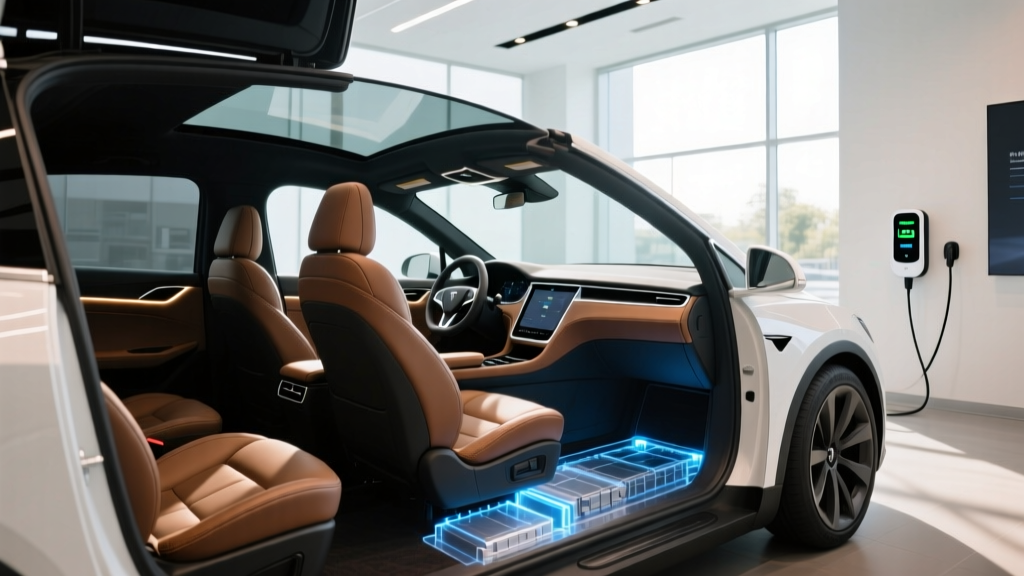
The 7-seat layout is the primary reason buyers choose the Model X over the Model S or competitors like the BMW iX (which offers no third row). Here's how the interior breaks down:
Second Row (3-seat bench): The standard 7-seat configuration uses a 60/40 split-folding bench in the second row. Legroom is generous at approximately 41 inches, and the flat floor (no transmission tunnel) makes the middle seat genuinely usable for adults on shorter trips. The outboard seats offer excellent thigh support and easy access to the third row via a one-touch slide-and-fold mechanism.
Third Row (2 seats): The third row accommodates two passengers with approximately 32 inches of legroom — tight for adults on long trips but workable for children, teenagers, or adults on sub-30-minute drives. Headroom is adequate thanks to the Model X's tall roofline, and USB-C ports serve every row. The falcon-wing rear doors dramatically ease third-row entry compared to conventional SUV doors — you can stand upright next to the seat before sitting, which matters when buckling children into car seats.
Cargo Behind the Third Row: With all seven seats in use, cargo space drops to roughly 15 cubic feet — enough for a few grocery bags or two small carry-on suitcases. This is the Model X's most significant practical compromise versus larger three-row competitors. Fold the third row (50/50 split), and cargo expands to approximately 44 cubic feet. Fold both rear rows flat, and you get up to 85 cubic feet, plus the front trunk (frunk) adds roughly 6.5 cubic feet for additional storage.
Materials and Build: The 2026 Model X interior uses synthetic leather (vegan) as standard, with a minimalist dashboard dominated by a 17-inch center touchscreen angled toward the driver. Build quality has improved meaningfully since earlier production years — panel gaps are tighter, and the yoke-style or round steering wheel (now a no-cost choice) feels substantial. However, some competitors like the BMW iX and Mercedes EQS SUV offer more traditional luxury materials — real wood, open-pore finishes, and more button-based controls that some buyers prefer.
Infotainment and Tech: Tesla's infotainment system remains the industry benchmark for responsiveness and over-the-air update capability. The 17-inch display handles navigation, media, climate, and vehicle settings with smartphone-like fluidity. A rear 8-inch touchscreen serves second- and third-row passengers for climate and entertainment. The gaming-capable hardware (AMD Ryzen processor) supports titles like Cyberpunk 2077 while parked. A 22-speaker audio system with active noise cancellation is standard.
Performance and Driving Dynamics
The Model X Long Range AWD delivers 670 horsepower from its dual-motor setup, launching to 60 mph in a quoted 3.8 seconds. That is legitimately supercar territory in a 5,100-pound seven-passenger SUV. Instant torque delivery makes highway merging and passing effortless, and the dual-motor AWD system provides confident traction in rain and light snow.
The air suspension (standard) automatically adjusts ride height — lowering at highway speeds for efficiency and raising for rough roads or steep driveways. Ride quality is firm but controlled; the Model X prioritizes handling composure over plush isolation, which some buyers appreciate and others find slightly harsh compared to the Mercedes EQS SUV's pillowy demeanor.
Driver Assistance — Autopilot and FSD (Supervised):
SAE Automation Level: Level 2 (Partial Driving Automation)
Tesla Autopilot and Full Self-Driving (Supervised) are Level 2 driver-assistance systems, not autonomous driving. The driver must remain fully attentive, keep hands on the wheel, and be prepared to take over at any moment. These systems handle lane centering, adaptive cruise, and (with FSD) navigation-guided lane changes and stop-light recognition — but they do not replace the driver.
Standard Autopilot includes Traffic-Aware Cruise Control and Autosteer (lane centering). The optional FSD (Supervised) package — currently $8,000 upfront or available via subscription — adds Navigate on Autopilot, Auto Lane Change, Autopark, and Smart Summon. FSD continues to improve via over-the-air updates, but it remains a driver-supervision system. NHTSA continues to monitor Level 2 systems across all manufacturers for safety compliance.
Pricing, Trims, and Federal Tax Credit Eligibility
| Trim | MSRP | Est. After §30D Credit | Notes |
|---|---|---|---|
| Long Range AWD (7-seat) | $81,630 | ~$74,130* | Eligible if buyer meets income/sourcing rules |
| Plaid (Tri-Motor AWD) | $96,630 | ~$89,130* | Exceeds MSRP cap for SUVs? No — SUV cap is $80,000, Plaid exceeds it |
| + FSD (Supervised) | +$8,000 | N/A | Added to any trim |
*Tax credit eligibility depends on multiple factors. See checklist below.
The Model X Long Range AWD starts at $81,630 (including destination) for the 7-seat configuration. The Plaid tri-motor variant starts at $96,630 and delivers a staggering 1,020 hp with a 0–60 time of 2.5 seconds, though its EPA range drops to approximately 326 miles.
Federal Tax Credit (§30D) Eligibility Checklist:
- Vehicle MSRP Cap: SUVs must have an MSRP at or below $80,000. The Model X Long Range at $81,630 exceeds this cap, meaning it may not qualify for the federal §30D new-vehicle credit as configured. Adding options only increases MSRP further.
- Buyer Income Cap: Modified AGI must not exceed $150,000 (single), $225,000 (head of household), or $300,000 (married filing jointly).
- Battery Sourcing: Critical minerals and battery components must meet escalating domestic-content thresholds per IRS guidelines. Tesla sources battery cells domestically, but specific credit amounts vary by production batch.
- Point-of-Sale Transfer: Eligible buyers can transfer the credit to the dealer at purchase, reducing the out-of-pocket price immediately rather than waiting for a tax refund.
Tax Credit Warning: The Model X Long Range's $81,630 MSRP exceeds the §30D SUV cap of $80,000. As of 2026, this likely disqualifies the Model X from the federal new-vehicle tax credit. Some buyers have structured orders to reduce MSRP (removing options) or may qualify under alternative provisions. Always consult IRS Publication 5984 and a qualified tax professional before relying on credit eligibility.
Efficiency, Ownership Costs, and Warranty
The Model X Long Range AWD earns an EPA-estimated 101 MPGe combined (approximately 33 kWh per 100 miles). That's respectable for a 5,100-pound AWD SUV but trails lighter competitors — the BMW iX xDrive50 achieves around 86 MPGe but weighs less and carries a smaller battery.
At the national average electricity rate of $0.17/kWh, charging the Model X costs roughly $5.61 per 100 miles driven. A comparable gas SUV averaging 22 MPG at $3.50/gallon costs $15.91 per 100 miles — a fuel savings of over $10 per 100 miles, or approximately $1,200 annually for a 12,000-mile driver. Home charging maximizes savings; public DC fast charging at $0.35–$0.50/kWh narrows the gap considerably.
Warranty Coverage:
- Battery & Drive Unit: 8 years / 150,000 miles, whichever comes first, with retention of at least 70% battery capacity
- Vehicle Limited Warranty: 4 years / 50,000 miles (basic), 8 years / 150,000 miles (restraint systems)
Tesla's battery warranty is competitive with the industry standard. NMC chemistry typically degrades 10–15% over the first 150,000 miles based on fleet data, meaning most owners will retain well above the 70% threshold. Battery replacement out of warranty remains expensive — estimated at $15,000–$22,000 depending on pack size and labor — but is rarely needed within the vehicle's typical ownership lifecycle.
Model X vs. the Competition: Is It Worth Buying?
The three-row electric SUV segment has matured. Here's how the Model X stacks up against key rivals:
Tesla Model X vs. Rivian R1S: The R1S offers a more rugged, adventure-oriented personality with available quad-motor AWD, a maximum tow rating of 7,700 lbs (vs. the Model X's 5,000 lbs), and a starting price around $79,900. The R1S's third row is slightly tighter, and its charging speed peaks at roughly 200 kW. The Model X wins on Supercharger network access (though Rivian now has adapter-based access), acceleration, and interior screen real estate. The R1S wins on off-road capability, tow rating, and build-quality perception.
Tesla Model X vs. Kia EV9: The EV9 starts around $56,000 and offers comparable three-row practicality at a dramatically lower price point. Its 800V architecture enables 10–80% charging in roughly 18 minutes. However, the EV9's EPA range tops out at approximately 304 miles (RWD), its AWD variant is slower, and it lacks Tesla's Supercharger network (though Kia has adopted NACS for future models). The EV9 is the value pick; the Model X is the premium performance pick.
Tesla Model X vs. Mercedes EQS SUV: The EQS SUV starts near $105,000 and offers a more traditionally luxurious cabin with superior ride isolation and available hyperscreen dashboard. Range peaks at roughly 305 miles (450+ variant). The Model X is faster, charges slightly quicker, costs less, and offers a more extensive fast-charging network. The EQS SUV wins on luxury refinement and dealer service experience.
Choose the Tesla Model X if: You prioritize acceleration, Supercharger network reliability, over-the-air tech updates, and falcon-wing door practicality for tight parking spaces and car-seat loading. You value a proven 335-mile range and can accept the firm ride and minimalist interior aesthetic.
Look elsewhere if: You need maximum third-row cargo space (Rivian R1S or a minivan), prefer traditional luxury materials (Mercedes EQS SUV, BMW iX), want 800V ultra-fast charging (Kia EV9, Hyundai Ioniq 9), or require a sub-$80,000 price to qualify for the federal tax credit.
Pros and Cons
Pros
- 335-mile EPA range with proven real-world usability
- 250 kW DC fast charging with battery preconditioning
- 670 hp and 3.8-second 0–60 in a 7-seat SUV
- Falcon-wing doors ease third-row and car-seat access
- Supercharger network reliability and coverage
- Continuous over-the-air software improvements
- 8-year/150,000-mile battery warranty
Cons
- $81,630 MSRP likely exceeds §30D tax credit SUV cap
- 15 cu ft cargo behind 3rd row is tight for a vehicle this size
- Firm ride quality compared to luxury competitors
- Minimalist interior not for traditional-luxury buyers
- FSD (Supervised) is costly at $8,000 and remains Level 2
- Charging speed trails 800V competitors (250 kW vs. 350 kW)
- Insurance premiums run higher than segment average
Who the Tesla Model X Is Best For
The 2026 Model X 7-seat is ideal for tech-forward families who need occasional third-row seating, prioritize fast charging on road trips, and want sports-car acceleration in a daily driver. It excels as a commuter vehicle (large battery means charging only 2–3 times per week for average drivers) and as a road-trip hauler where Supercharger spacing and 250 kW charging minimize downtime.
It's less suited for buyers who regularly fill all seven seats with adults (the third row is best for kids), who need maximum cargo volume with passengers aboard, or who prioritize traditional luxury ambiance over digital minimalism. If you tow frequently, the 5,000-lb rating is adequate for small trailers but falls short of the Rivian R1S or Ford F-150 Lightning.
Frequently Asked Questions
What is the real-world range of the Tesla Model X Long Range?
The EPA estimates 335 miles, but real-world highway driving at 70–75 mph typically yields 280–300 miles. In cold weather below 30°F, expect 240–270 miles. City driving with regenerative braking can match or slightly exceed the EPA number.
How fast does the Model X charge at home and on the road?
At home on a Level 2 Tesla Wall Connector (11.5 kW), the Model X adds about 34 miles of range per hour, fully charging in roughly 9 hours. On DC fast chargers, it peaks at 250 kW and charges from 10–80% in approximately 30 minutes.
Does the Tesla Model X qualify for the $7,500 federal EV tax credit?
Likely not in its standard configuration. The §30D credit caps SUV MSRP at $80,000, and the Model X Long Range starts at $81,630. Buyer income limits, battery sourcing rules, and point-of-sale transfer options also apply. Consult IRS guidelines and a tax professional for your specific situation.
Is the Model X 7-seat third row practical for adults?
The third row offers about 32 inches of legroom — workable for children, teens, or adults on trips under 30 minutes. For regular full-size adult passengers in all three rows, consider a larger SUV or minivan.
How does the Model X compare to the Rivian R1S for families?
The R1S offers better off-road capability, a higher tow rating (7,700 lbs vs. 5,000 lbs), and a lower starting price. The Model X counters with Supercharger network access, faster acceleration, more cargo flexibility, and a more mature software ecosystem. Both are strong family EVs with different priorities.
Is Tesla Autopilot or FSD self-driving?
No. Both Autopilot and FSD (Supervised) are SAE Level 2 driver-assistance systems. The driver must remain fully engaged, monitor the road, and be ready to take control at all times. These systems assist with steering, braking, and lane changes but do not drive autonomously.
What is the battery warranty on the Model X?
Tesla covers the battery and drive unit for 8 years or 150,000 miles, whichever comes first, guaranteeing at least 70% capacity retention over that period.